From Listing-Photo Spirals to Decide-and-Honor: The Childhood Home

Finding Clarity in the 11:38 p.m. Listing Refresh
You saw the listing photos drop in the family group chat and instantly zoomed in on tiny details (the hallway, the kitchen, the porch) like your body thinks the right angle could restore safety.
Jordan (name changed for privacy) said it almost like a confession, settling into the chair across from me with their phone face-down on their knee, as if it might buzz again at any second.
They live in Toronto, the kind of condo where the city is always present but never quite intimate—the fridge hum never stops, the street noise comes in softened and metallic, like it’s being played through a wall. Jordan described Wednesday night at 11:38 PM: condo lights off, only the blue phone glow. Pinch-zoom on the kitchen doorway until the photo pixelates. Then a hard switch—Notes app draft, a careful paragraph to the family, reread, delete. HouseSigma tab open “just to be rational.” Then back to the photo carousel like it might make the feeling settle.
“I know it’s just a house,” Jordan said. “But my body doesn’t believe that.”
What I heard underneath the words wasn’t indecision. It was grief trying to find somewhere to land—and getting redirected into competence. The grief sat in Jordan’s throat like a tight, warm knot that wouldn’t swallow. And every time they pictured strangers stepping into those rooms, their stomach dropped like an elevator that starts moving before you’re ready.
“You want to move forward with the life you’ve built now,” I said, keeping my voice steady, “and you’re terrified that letting the childhood home go will sever your belonging—like it would erase what mattered.”
Jordan’s eyes went shiny for a second. Not tears exactly. More like a screen that’s been on too long.
“Yeah,” they whispered. “And everyone’s so… efficient about it. Like: date, price, agent. And I’m over here acting like the listing is… personal.”
I nodded. “Let’s make this personal in a way that actually helps. Not dramatic. Not numb. Just honest.”
I leaned forward a little, as if we were lowering our voices in a café. “Our goal today isn’t to force a yes or no. It’s to find the past story that’s holding the pen on your yes/no—so you can choose from who you are now, while still honoring what that house carried. That’s the journey to clarity.”

Choosing the Compass: The Decision Cross Tarot Spread
I asked Jordan to take one slow breath—not as a ritual for luck, but as a clean transition. “Just to tell your nervous system: we’re here now.” Then I shuffled the deck the way I used to on transoceanic voyages, when a traveler would sit across from me under warm ship lights, halfway between ports, needing a map more than a prediction.
“Today we’ll use a five-card spread called the Decision Cross,” I said. “It’s designed for a yes/no choice—but it doesn’t pretend a human heart is binary.”
For you reading this: I choose the Decision Cross when the surface question is a practical fork (“sell or keep,” “yes or no”), but the real stuckness is emotional and subconscious. This spread holds both paths side-by-side and surfaces the hidden driver underneath. It’s a structure for finding clarity without forcing an answer.
Here’s the map we’re using: the first card shows the present emotional knot—what the listing is doing to your body and your habits right now. The second card shows the “Yes” path—what saying yes asks you to release beyond logistics. The third card shows the “No” path—what saying no protects, and what it costs. The fourth card reveals the past story steering the decision underneath your logic. And the fifth card is integration: guidance that restores self-trust so the decision stops feeling like a moral verdict.
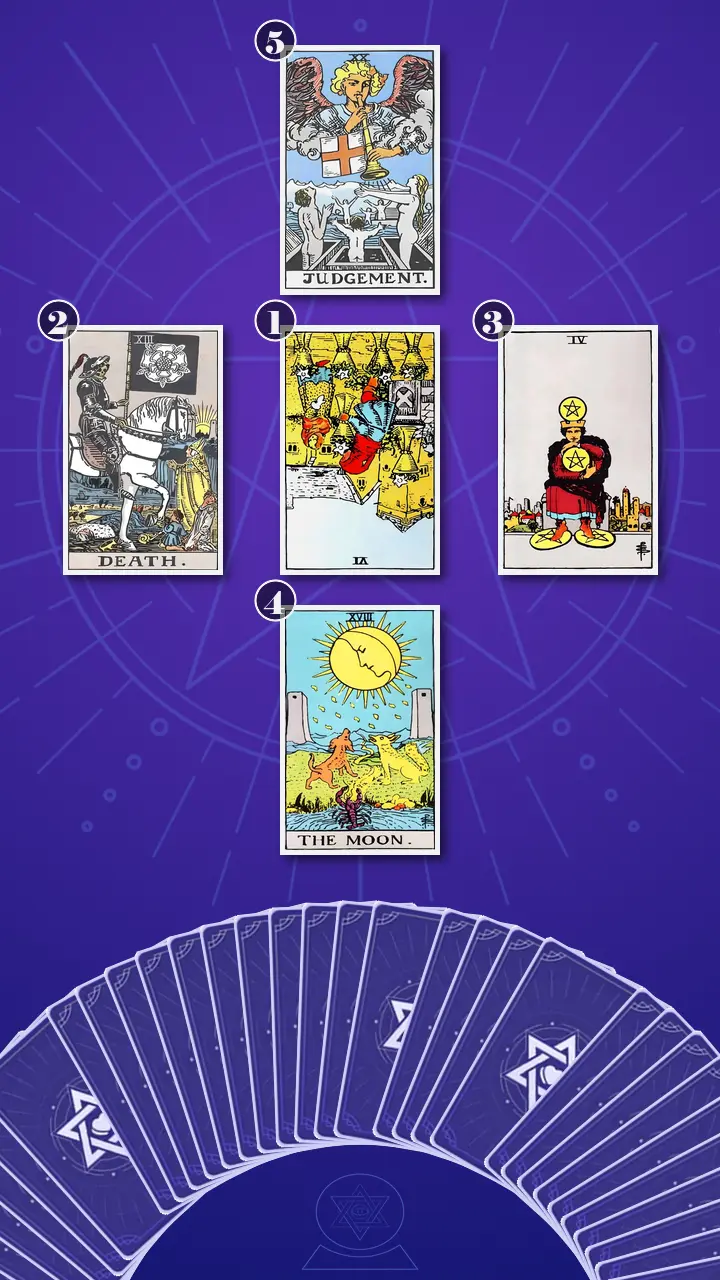
Reading the Map: Card Meanings in Context
Position 1 — The present emotional knot: the stuck loop
“Now we turn over,” I said, “the card representing the present emotional knot: how the listing is landing in your body and behavior right now.”
Six of Cups, reversed.
The image is childhood, memory, a walled garden—sweetness, safety. Reversed, that sweetness can turn into a grip. Not because nostalgia is wrong, but because it starts acting like a lock instead of a bridge.
And immediately, the card matched Jordan’s scene with almost embarrassing precision: you’re on your couch after work, condo lights off, phone warm in your hand. You keep reopening the listing and zooming in on the hallway and kitchen like you’re trying to retrieve a specific version of yourself. Then you snap into competent mode, open a spreadsheet, and tell yourself you’ll decide once you have enough proof.
I let the specifics land. “Thumb hovering over the photo carousel. Double-tap zoom on the hallway scuff mark. Then—like a panic button—you switch to a spreadsheet tab. And the inner monologue goes: If I can just find the right fact, I won’t have to feel the lump in my throat.”
Jordan gave a quiet laugh that didn’t reach their face. “That’s… too accurate. Honestly, kind of brutal.”
“I know,” I said softly. “And I’m not saying it to shame you. I’m saying it so you can stop thinking you’re ‘being weird’ and start seeing the pattern.”
I watched their shoulders, how they sat slightly forward—as if bracing. “This reversed Six of Cups is grief trying to use memory as safety. The energy here is blocked: tenderness is present, but it’s stuck in a loop. The loop protects you from naming what the house symbolizes out loud. And the cost is that your decision becomes a referendum on your past instead of a choice in your present.”
I added one line I’ve learned can defuse the self-mockery without letting the loop run the show: “You’re not being irrational—you’re being loyal to a feeling you don’t want to lose.”
Jordan exhaled, a little embarrassed, but relieved. Their fingers stopped fidgeting with the edge of their phone case.
Position 2 — The “Yes” path: what release would really mean
“Now we turn over the card representing the ‘Yes’ path: what saying yes is really asking you to release or allow, beyond logistics.”
Death, upright.
I could feel Jordan tense before I even spoke, because the word lands hard for most people. So I anchored it in the imagery: the river, the rising sun between two towers. This is transition with a horizon—not punishment.
“In your real life,” I said, “this looks like choosing a clean ending instead of dragging it out through delay. It’s the moment you stop trying to keep the chapter open by rereading messages and refreshing the listing, and you let it close on purpose—so your current life in Toronto has room to feel more like home.”
Death upright is a balance of honesty and movement: it doesn’t demand you feel happy. It asks you to stop treating the ending as betrayal and start treating it as a transition you can mark with intention.
Jordan stared at the card and then at their hands. Their jaw unclenched slightly, like they were testing what it would feel like to let the breath go all the way out.
Position 3 — The “No” path: what you’re protecting (and what it costs)
“Now we turn over the card representing the ‘No’ path: what saying no is really protecting, and what it may cost to hold on.”
Four of Pentacles, upright.
This card is posture. A coin held to the chest, feet planted on two more coins, crown fixed tight. Security achieved through tightening.
“Saying no can be wise stewardship,” I said, “but this card asks a sharper question: are you protecting a value—or building a security system around a fear?”
In modern life terms: saying no looks like tightening around the house as a symbol of safety—keeping it (or fighting the listing) so you don’t have to feel the vulnerability of change. The relief is immediate—no ending yet. But the cost is emotional tightness, and a life organized around not losing, rather than around what you’re building now.
The Four of Pentacles energy is excess Earth: too much holding, too much control. It can stabilize you in the short term, but it also limits movement. You can’t carry new things when your hands are full of gripping.
Jordan lifted their shoulders without realizing, then lowered them. “That’s the thing,” they said. “When I picture saying no, my body relaxes. Like: okay, we can breathe. But when I picture it a year from now… it feels like I’m still waiting.”
“Exactly,” I said. “Your body is giving you data. Immediate relief versus long-term constriction.”
Position 4 — The past story steering the decision: what’s driving the fear underneath
“Now we turn over the card representing the past story steering the decision: the hidden belief, fear, or inherited meaning tied to ‘home’.”
The Moon, upright.
Something in the room got quieter, as if the city outside lowered its volume for a second. The Moon does that—it turns the lights down on purpose so you notice what your mind has been filling in.
I described it the way it lives in Jordan’s world: “This is 1:12 AM blue phone light. The hum of a condo fridge. The TTC streetcar hiss outside. The feeling that you’re awake in a world that’s asleep—and your brain is trying to solve grief the way you’d try to solve sleep by scrolling.”
The Moon’s energy isn’t wrong—it’s ambiguous. It’s low light mode on your nervous system: everything looks real, but depth perception is off. The dog and the wolf are both reacting—comfort and panic, domesticated memory and wild fear—at the same time.
“Here’s the pivot,” I told Jordan, and I watched their eyes because this is where people often feel the floor move under them: “What if part of this is a concrete loss, and part of it is symbolic?”
I asked the two questions out loud, slowly: “What am I losing? And—what old fear is being reactivated?”
Jordan went still. A three-step reaction rippled through them: first, a tiny freeze—breath held, fingers hovering like they were about to swipe a screen. Then their gaze unfocused, as if replaying an old scene in their mind. Then, quietly, their shoulders dropped.
“It’s not… just the house,” they said. “It’s… the idea that if it can be gone, then I’m… untethered.”
“Yes,” I replied. “And this is the line I want you to take seriously: A house can be gone without your belonging being gone. The Moon shows why certainty feels necessary—because your nervous system is reacting to what the house symbolizes, not just what the decision practically requires.”
When Judgement Sounded Like a Push Notification from Your Actual Self
Position 5 — Integration and guidance: the reframe that restores self-trust
I held the deck for a beat. “We’re turning over the integrating card now,” I said. “This is the one that doesn’t pick a side—yes or no. It shows how to choose without turning the choice into a verdict on your worth.”
“Now we turn over the card representing integration and guidance: the reframe that restores self-trust so you can decide without treating it as a moral verdict.”
Judgement, upright.
Judgement is the trumpet. The call. Not a panic siren—a clear signal. And in Jordan’s world, it felt less like an angel in the sky and more like a notification that’s not loud, just unmistakably yours.
Setup. I watched Jordan’s face as I named what I already knew they’d lived: “If you’ve ever opened the listing at night, zoomed in on the kitchen like you could retrieve a feeling, then switched to your Notes app to draft the perfect family text—only to delete it—you already know this isn’t really about real estate.” Their mouth tightened, like they were holding back a defense: But I should be able to be normal about this.
Delivery.
Not a loyalty test to the past—answer the trumpet of your present self and let the old story rise into a new form.
I let silence do its job for a second.
Reinforcement. Jordan’s reaction came in layers. First, their throat worked like they were trying to swallow around that old knot. Their eyes widened a fraction—surprised, like they’d been caught doing something they didn’t realize they were doing. Then their gaze dropped to the card, and their hands—hands that had been braced, clenched around control—opened on their lap.
“But if I stop treating it like a loyalty test,” they said, and there was a flash of anger under the fear, “doesn’t that mean I’ve been making it harder than it had to be? Like… I did this to myself?”
I nodded, not flinching away from the honesty. “That reaction makes sense. And no—this isn’t you being ‘dramatic’ or ‘irrational.’ This is you doing what you learned would keep you safe: trying to make the decision emotionally risk-free. It’s protective.”
I leaned in a little, gentler now. “Judgement isn’t a scolding card. It’s an awakening card. It says: you get to be the author, not the defendant.”
This is where I brought in my Choice X-Ray—my way of helping someone see hidden costs and benefits in multiple dimensions without turning it into another spreadsheet. “When you treat the decision as a verdict,” I said, “both options become traps. ‘Yes’ becomes betrayal. ‘No’ becomes failure to move on. But when I X-ray the choice through Judgement, I see a third option appear: Decide—and honor. That’s the third option.”
Jordan’s face softened in a way that looked like relief and grief sharing space. Their shoulders sank—an actual physical release. And then came the new vulnerability: the slight dizziness of having a clearer path. They blinked a few times, as if the room had gotten brighter.
“Now,” I asked them, keeping it practical, “with this new lens, think back to last week. Was there a moment—maybe when the group chat pinged, or when you were doomscrolling the listing—when this could have changed how you felt?”
Jordan breathed out, slow. “Tuesday. TTC Line 1. Message pops up: ‘Agent says we need an answer.’ I went straight to the comps. Like… if I could win the argument, I wouldn’t have to admit I was sad.”
“That’s it,” I said. “This card marks a step in your emotional transformation: from grief-tight, nostalgia-fueled overanalysis and letting-go guilt… toward calm self-authorship. Not certainty. Authorship.”
Decide—and Honor: Actionable Advice for Your Next Steps
I gathered the thread of all five cards the way I used to chart a route between ports: not romanticizing the sea, not ignoring it either. “Here’s the story your spread told,” I said.
“The Six of Cups reversed shows the present: nostalgia has become a control loop—refresh, zoom, draft, delete—because your inner child is trying to keep a feeling safe. Death shows what ‘yes’ really is: a deliberate ending that makes space for your current life. Four of Pentacles shows what ‘no’ protects: immediate safety through holding tight, with a long-term cost of living inside a security system. The Moon names the hidden engine: you’re not only reacting to a sale, you’re reacting to an old fear that if the place disappears, your belonging disappears too. And Judgement integrates it: this choice isn’t a loyalty trial. It’s a present-day decision you can make while actively honoring what the house meant.”
“The cognitive blind spot,” I continued, “is thinking you need the perfect reason—one flawless argument that makes everyone understand—before you’re allowed to choose. Trying to make the decision risk-free is what keeps it frozen.”
Then I gave Jordan what I always aim to give: not a commandment, but a few small experiments—practical, low-stakes, and real enough to break the loop. I framed them using my cruise-brain strategy, the Port Decision Model: “You don’t live in the port,” I told them. “You dock, you unload what needs unloading, you take on what you need, and you leave on purpose. This decision needs a docking plan—not endless circling offshore.”
- Memory-Keeper Before Logistics (7 minutes)Before you read another message or open HouseSigma, do one tiny “memory-keeper” action: scan 10 old photos of the house into a single album titled What I’m keeping—or record a 2-minute voice note where you walk through your favorite room from memory (no editing, no sharing).Expect the protective voice to say “this is cringe.” Keep it tiny: one page max, two minutes max. If you start spiraling, stop early—this is giving grief a container, not forcing catharsis.
- Concrete vs Symbolic Loss Split (Moon clarity tool)On one page, make two short lists: Concrete losses vs Symbolic losses. Put at least 3 items under each. Then circle one symbolic loss and write one sentence: “When else have I felt this?”If your throat tightens, put both feet on the floor and pause. You’re collecting data, not proving anything.
- “Trumpet vs Group Chat” Note + 60-word messageSet a timer for 7 minutes. Split a page into two columns: Left—“What I need everyone to understand.” Right—“What I need to be true for me.” Bullet points only. Then draft a 3-sentence family message (under 60 words): (1) what you’re feeling, (2) what you need, (3) your timeline.Treat this as a communication design problem, not a moral performance. You don’t need the perfect speech; you need a clear, bounded one. If you fear debate, set a time limit: “I can talk for 15 minutes now and revisit Sunday.”
To keep it grounded, I offered one more piece of structure—my Reality Testing strategy—because the mind that spirals also needs something it can trust in the next 48 hours. “Pick one thing to test,” I said. “Not decide forever—test.”
“For the next two days, any time you catch yourself refreshing the listing, ask: Am I searching for information—or for emotional safety? If it’s safety, do the smallest version of one action above. Then stop.”
Jordan nodded slowly, like they were finally holding a tool that didn’t require them to become a different person first.

A Week Later: Ownership, Not Certainty
A week after our session, Jordan texted me a screenshot. Not of the listing—of a Notes app draft they’d actually sent.
It was 53 words. Three sentences. Clear. Bounded. Human.
“I told them I’m not ready to talk numbers tonight,” Jordan wrote, “but I can talk meaning for ten minutes. And I made the album. It’s literally called What I’m keeping. I didn’t think that would help, but it did.”
The bittersweet part was in the quiet after: Jordan admitted they celebrated by sitting alone in a coffee shop for an hour, watching snow turn to slush on the sidewalk—relieved, and still a little hollow. They slept a full night, but woke up once with the thought, What if I’m wrong? Then, for the first time, they didn’t reach for the listing. They just put a hand on their chest and breathed.
That’s what a real Journey to Clarity looks like in the nervous system: not a thunderclap of certainty, but a clean, chosen next step—authored by the present self.
And if there’s one thing I want you to carry from Jordan’s spread, it’s this: when a childhood home is on the market, it can feel like your belonging is on the market too—so you freeze at the door, throat tight, trying to find one flawless reason that proves you’re loyal and still allowed to move forward.
If you didn’t need the past to approve you, what’s the smallest honest step your present self would want to take this week—just to feel a little more inside your own life?