Stuck at the Delete Button, Building Self-Trust With Memory Curation

Pressing “Delete” Didn’t Feel Like Storage—It Felt Like Erasing Proof
If you’re a late-20s NYC tech/UX person who can ship features at work but can’t hit “Delete” on old photos without spiraling into timestamp-checking… yeah, this is that kind of stuck.
Jordan (name changed for privacy) appeared on my screen in a soft rectangle of Sunday-night light. Behind her, a shoebox apartment did that familiar New York thing—radiator ticking like it had opinions, streetlight bleeding through blinds in thin, impatient stripes. She sat on the edge of her bed with her phone warm in her palm, and even through Zoom I could see the posture: shoulders slightly forward, throat held tight, like she was bracing for impact from a button that should have been harmless.
“It’s just photos,” she said, and then her mouth twitched. “So why does it feel like a breakup?”
She told me the loop: Sunday Scaries, a quick camera-roll cleanup, the iCloud storage pop-up glaring at the top like an overdue bill. She taps an old album. Her chest goes heavy. She zooms into faces like the answer is hidden in someone’s smile. She re-reads dates like they’re evidence. She opens the same three photos again. Her thumb hovers over the trash icon—and stops.
The longing in her voice wasn’t dramatic. It was quieter than that. It felt like trying to breathe through a scarf pulled a little too tight: a heavy chest, a tight throat, and that suspended half-second before you press “Delete,” as if the air itself might change if you commit.
“You want a lighter, clearer present,” I said gently, “and you’re scared the past only counts if you keep the receipts.”
She exhaled through her nose—short, almost a laugh. “That’s… yeah. That’s so accurate it’s kind of rude.”
“We can work with rude accuracy,” I told her. “Let’s try to turn it into clarity. Not a lecture, not a purge—just a map.”

Choosing the Compass: The Four-Layer Insight Ladder Tarot Spread
I asked Jordan to put both feet on the floor and take one slow breath—not as a mystical ritual, but as a clean transition: from reacting to her phone to observing what her mind and body do around it. While she did that, I shuffled my worn Rider-Waite-Smith deck the way I used to on long sea days, when passengers would come to me between ports carrying questions that looked practical on the surface but were really about identity.
“Today,” I said, “we’ll use a spread I call the Four-Layer Insight Ladder · Context Edition. It’s a six-card tarot spread for decision paralysis and closure—perfect when the problem is ‘why can’t I let go?’ and the surface issue (storage) is hiding a deeper fear (meaning, worth, endings).”
For you reading this: this is one of the most grounded ways to show how tarot works in real life. We start with the observable stuck moment, climb into what’s emotionally protected, name the shadow-level block, then move toward a healthier reframe, the inner support available, and a realistic next step you can actually do within a week.
“Card 1,” I told Jordan, “will name the exact freeze-frame where you get stuck. Card 3 is the shadow—the fear that keeps the loop alive. And Card 6 is the integration: a practical next step, not a personality makeover.”
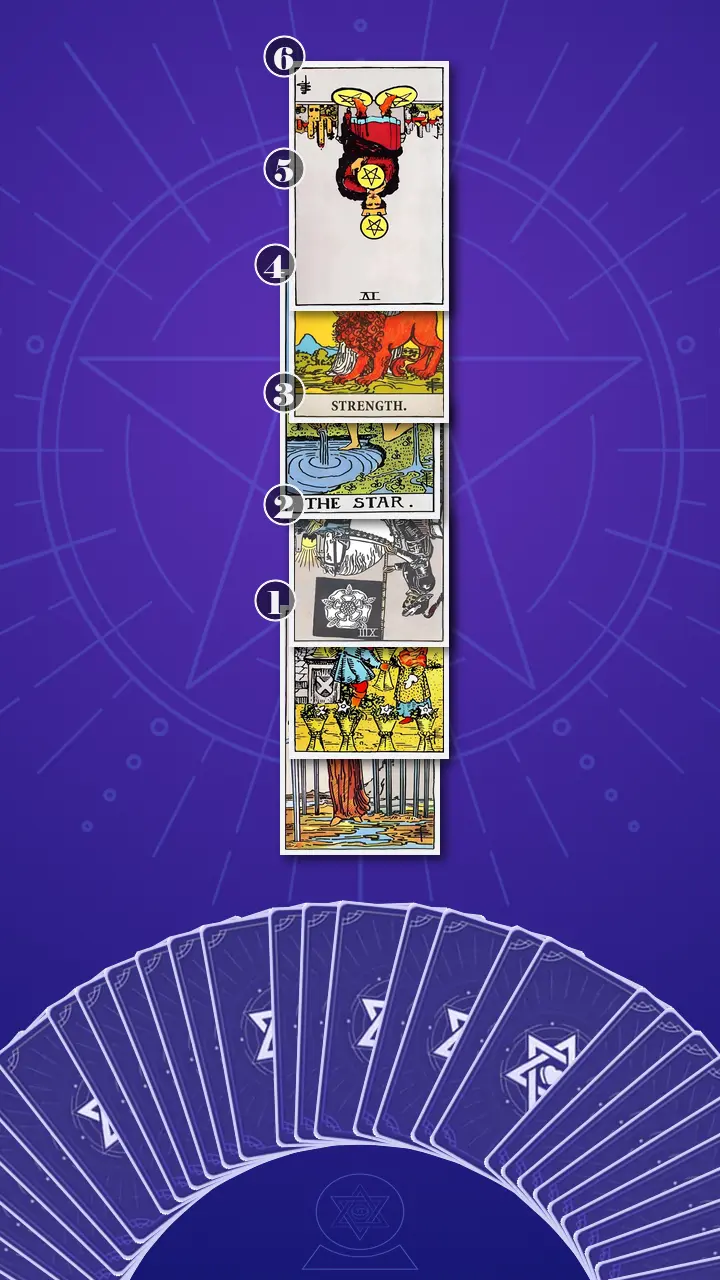
Reading the Map: From Camera-Roll Chaos to Meaning
Position 1: The Current Stuck Moment
“Now flipped,” I said, “is the card representing the current stuck moment: the concrete decision paralysis behavior around deleting photos.”
The Eight of Swords, upright.
I angled the card toward the camera. A blindfolded figure, loosely bound, surrounded by swords like a narrow fence.
“This,” I said, “is you on your bed Sunday night with the blue glow of your phone, iCloud warning at the top. You open Photos to ‘finally clean it up,’ but every photo becomes a test you could fail. You hover over Delete, then back out to re-check the date, the location tag, the thread it came from—like you’re trying to guarantee Future You won’t regret it.”
I watched Jordan’s eyes narrow, not in disagreement—more like recognition with a wince.
“Energetically, Eight of Swords is blockage,” I continued. “Not because you’re incapable, but because the rule set is too strict. It’s like you wrote a product spec so intense that nothing passes QA. The trap isn’t the photo; it’s the rule that says you need 100% certainty to make a 1% decision.”
Jordan let out that small bitter laugh again. “I literally A/B test my own memories.”
“Exactly,” I said. “And the binding isn’t iron. Your thumb is free. The rule is what’s tight.”
Position 2: What You’re Trying to Preserve
“Now flipped,” I said, “is the card representing what you’re trying to preserve or protect through keeping the photos—the emotional benefit of holding on.”
The Six of Cups, upright.
Even before I spoke, Jordan’s face softened in a way I’ve learned to trust—like the body recognizing itself in a story.
“This is the past offering a feeling,” I said, “not issuing a command. You find one candid photo—an old kitchen hang, a friend’s birthday, a summer rooftop—and you instantly feel younger-you’s relief: I belong. And then deleting doesn’t feel like managing files; it feels like betraying the version of you who needed those moments.”
I kept my voice steady. “A photo can be a touchstone without being a tether.”
Jordan’s fingers, off-screen, made a small movement—like she was rubbing her thumb against her index finger, the way people do when they’re trying not to cry or trying not to show they’re trying not to cry.
“If I delete it,” she said quietly, “I’m scared I’ll rewrite the story and blame myself.”
“That makes sense,” I told her. “And it’s why a purely ‘organizing’ solution never sticks. We’re not dealing with clutter. We’re dealing with tenderness.”
When the River Refused to Flow: Death Reversed and the Endings We Bargain With
I slowed down before the next card. On my side of the screen, the late-afternoon Venetian light hit the table at an angle that made the deck’s edges look like small waves. On Jordan’s side, a siren passed and faded—New York’s reminder that time keeps moving whether we approve or not.
“Now flipped,” I said, “is the card representing the deeper fear that keeps the cycle alive.”
Death, reversed.
Jordan’s breath caught. Not theatrically—more like a tiny freeze, the way your lungs pause when your phone unlocks to a photo you weren’t expecting.
“Let me translate this into your exact micro-scene,” I said. “There’s a set of photos you revisit like a receipt folder: a relationship that ended, a friendship shift, an old identity you’re not living anymore. You tell yourself you’re ‘not ready’ to delete anything because what if you forget how it felt—or worse, what if forgetting means it didn’t matter.”
Then I used the rhythm of the loop itself, because Death reversed thrives in repetition.
“You check the date. You check the face. You check the thread. You check the feeling. You check the backup. You check again.”
Jordan looked down and away from the camera, like she’d just been shown a screenshot of her own habit.
“This is the energy of stalled closure,” I said. “In tarot, Death isn’t punishment. It’s a life-cycle completing. Reversed, the river won’t flow. So your mind keeps reopening the case file to make sure the verdict is still valid.”
She lifted her head fast, a flash of resistance. “But if I finish it—if I delete—doesn’t that mean I was wrong? Like… I wasted time? Or I chose badly?”
That was the unexpected reaction I wait for in good readings: the moment the defense shows its true job.
“No,” I said, firm but kind. “Finishing isn’t erasing. It’s completing. And completion is not an admission of stupidity—it’s an admission of reality.”
I leaned into my Energy State Diagnosis the way I would on a ship when someone couldn’t sleep because their nervous system was leaking energy from three directions at once.
“Let’s locate the leak in 3D,” I said. “Environment: Apple ‘Memories’ and storage warnings ambush you at night, when your willpower is lowest. Relationships: an ex or old friend pops up on Instagram, and you reopen albums to ‘confirm what was real.’ Self: the belief underneath it all—‘If the evidence disappears, I won’t count.’ When those three line up, no folder system will save you. You’ll bargain.”
Jordan went still in a three-step chain I could almost time: first a physical freeze (her shoulders rose and held), then cognitive seep-in (her eyes unfocused like she was replaying a specific night), then the emotional release (a long exhale that finally dropped her shoulders).
Now I shifted into the aha moment.
Setup: “You know that moment when you’re trying to clear storage before a trip, you tap a photo, zoom in like the answer is hidden in the pixels, and suddenly it’s 1:12 a.m. and you haven’t deleted anything—only re-lived it.”
Delivery:
Stop bargaining with the ending; let the old chapter finish its cycle, so the river can carry you toward what’s next.
Silence landed between us—clean, almost weightless. Jordan blinked hard once, and I saw her throat work like she was swallowing a truth that had been stuck there for months.
Reinforcement: “Set a 10-minute timer. Open one emotionally loaded album. Pick exactly ONE photo you’re not ready to delete and do this instead: add it to a new album called ‘Kept on Purpose,’ then write one sentence in Notes: ‘What this proves is ____.’ Stop when the timer ends—even if you want to keep going. If your chest tightens or you feel yourself bargaining, close the app and take three slow breaths; you can come back later. The point is to practice a bounded, safe release—not to win a purge.”
Jordan’s face did something subtle but enormous: her eyebrows lifted like she’d been trying to solve a problem with only one tool, and someone finally handed her a second one. Her hands—still off-screen—seemed to unclench; her shoulders sank a fraction. Then came the new vulnerability, the dizzy edge of clarity.
“So… I’m allowed to keep one,” she said, voice thin but steadier. “But on purpose. Not because I panicked.”
“Yes,” I said. “This isn’t about deleting to prove you’re over it. It’s about finishing a chapter gently.”
I held her gaze through the screen. “Now, with this new frame—finishing versus erasing—think back to last week. Was there a moment when you hovered over Delete, and this would have let you feel different?”
She nodded slowly. “Tuesday. I got an ‘On This Day’ notification. I took a screenshot of the screenshot. I felt insane.”
“Not insane,” I corrected softly. “Protective. And tired.”
In that moment, the shift was visible: from proof-driven digital nostalgia hoarding toward a curated, self-trusting relationship with memory. Not complete yet. But started.
Position 4: The New Perspective—What Becomes Possible
“Now flipped,” I said, “is the card representing the healthier reframe and what becomes possible when release is allowed.”
The Star, upright.
“This is the medicine,” I told her. “Imagine opening your Photos app and feeling calm—not braced. You see a curated set of memories that supports you: the photos that still feel like nourishment, not quicksand. You’re not pretending nothing happened; you’re choosing what stays in your daily orbit.”
“Energetically,” I said, “The Star is balance. Two steady pours. Not a dramatic purge. A gentle, continuous flow.”
As a Jungian psychologist, I see The Star as the psyche’s instinct toward healing after transformation: the part of you that wants negative space, like good design. Less noise. More meaning.
Position 5: The Support You Can Rely On
“Now flipped,” I said, “is the card representing the internal resource you can rely on to do this gently and consistently.”
Strength, upright.
“This is my favorite card for this question,” I said, and Jordan’s shoulders dropped as if her body already knew why.
“Your culture—tech, productivity, New York—will tell you to handle this with discipline. Strength says: use gentle reps. Soft jaw. Unclenched hand. Three breaths. One calm choice. And then: stop on purpose.”
I watched Jordan mimic the cue without thinking—jaw loosening, hand relaxing. It’s a tiny thing, but I’ve trained enough people at sea (and in life) to know: small nervous-system shifts are the doorway.
“We’re not doing a purge,” I said. “We’re doing a practice. Small reps build trust. Purges build panic.”
Position 6: The Next Step Within a Week
“Now flipped,” I said, “is the card representing a realistic next step you can take within a week to begin letting go.”
Four of Pentacles, reversed.
“This card is the clench,” I said. “Your camera roll has become an emotional emergency fund: keeping everything ‘just in case’ you need to prove something later—to yourself or someone else.”
“Reversed,” I continued, “the energy is release—but bounded. Not chaos. Not ‘delete everything and never feel again.’ A controlled opening of the hand.”
I added the warning, because the reversal carries it. “The overcorrection risk here is deleting emotionally intense photos to prove you’re ‘over it.’ That backfires. It creates regret and makes you trust yourself less.”
Jordan nodded once—sharp, like she’d nearly done exactly that.
“You don’t need a perfect system—you need a safe boundary,” I said.
The One Boundary That Changes Everything (Without a Purge)
I braided the whole ladder into one story for her, because meaning lands better as narrative than as scattered advice.
“Here’s what your spread says,” I summarized. “Your mind (Eight of Swords) turns deletion into a verdict. Your heart (Six of Cups) is protecting tenderness and belonging. Your shadow (Death reversed) fears that completion equals loss of identity—so you keep reopening the case file for proof. But there’s another route: The Star says curation creates space and hope, and Strength says you can do this with calm reps. Four of Pentacles reversed turns that into earth-level action: a bounded release that teaches your nervous system it’s safe.”
“The cognitive blind spot,” I added, “is believing the only options are keep everything or erase the past. That’s Eight of Swords logic. The transformation direction is this: shift from treating photos as proof you must keep to treating them as a curated relationship you can shape—keeping what supports you and releasing what keeps you stuck.”
I offered her a Venice metaphor because it’s how my own mind makes complex systems simple. “In Venice, if you try to control the canals like they’re static containers, you get stagnation. You regulate flow. You let water move. Your archive needs canal wisdom: guided current, not a locked vault.”
Then I gave Jordan the smallest possible next steps—UX-friendly, testable, and kind.
- Single-Category Delete (20 minutes)Set a 20-minute timer. Delete only one neutral category: duplicates or blurry shots or screenshots. No emotionally loaded albums today.Stop when the timer ends even if you’re on a roll—stopping on purpose is what teaches safety.
- “Kept on Purpose” Album (12-photo cap)Create an album called Kept on Purpose. Move up to 12 photos into it—only ones you’re choosing for meaning, not panic-keeping.If your throat tightens, add one photo and write a single Notes line: “What this proves is ____.” Then close Photos.
- End the Session Like a Ritual (30 seconds)When the timer ends, put your phone face down and do one tiny grounding action: wash one mug, refill your water, or open a window.This is an instant adjustment technique you can do on a coffee break—your nervous system learns “we finished safely.”
“And one modern-life adaptation,” I added, because this is where digital detox can be real instead of performative: “Turn off Apple Photos ‘Memories’ notifications for one week while you practice. You’re not banning your past. You’re removing surprise triggers so you can choose when you engage.”
Jordan looked at her phone like it was less of a judge and more of a tool. “That actually feels… doable,” she said. “Like I can run an experiment instead of passing a test.”
“Exactly,” I said. “That’s the Four-Layer Insight Ladder tarot spread doing its job: turning ‘I’m broken’ into ‘I have a pattern, and I can work with it.’”

A Week Later: The Quiet Proof
Six days later, Jordan messaged me: “Did the 20-minute duplicates thing. Deleted 214. Didn’t die. Also made ‘Kept on Purpose’ and put 9 photos in it. I cried for like… two minutes, then it passed. Slept better.”
The bittersweet part was there, too, because it always is: she wrote, “I still opened an old album once after seeing someone’s Instagram Story. But I stopped. I actually stopped.”
That’s what I call a real journey to clarity: not a spotless ending, but a new relationship with the moment you used to freeze in.
When you hover over “Delete” with a heavy chest, it’s rarely about storage—it’s the fear that if the evidence disappears, the part of you who lived it won’t count anymore.
If you treated your camera roll like a relationship you’re allowed to shape—what’s one tiny boundary you’d want to try this week so your present has a little more room to breathe?