The 10-Minute Two-Cup Mix That Turned Storage Guilt into Self-Trust

Finding Clarity in the 8:47 p.m. Box Hallway
You booked a storage unit and immediately realized you’re basically paying rent on a past version of yourself—identity-in-transition clutter in 10x10 form.
Jordan (name changed for privacy) said it like a confession, but their laugh landed with that dry edge people get when something is true and they’re tired of arguing with it. They were 28, Toronto-rent-tired, and moving apartments with the kind of schedule that turns “life admin” into a second job.
They described Tuesday at 8:47 p.m. in their one-bedroom: boxes lined along the living room wall like a temporary hallway. The fluorescent kitchen light buzzed. Packing tape squealed every time it pulled free. Their phone felt warm in their palm from scrolling. They’d sort for twenty minutes, shoulders creeping up toward their ears, chest heavy—then open Instagram “for a break,” save a minimalist fresh start reel, and watch the Sharpie cap roll under the couch like the universe was making a joke.
“I can’t tell if I’m being responsible,” they said, “or if I’m just… avoiding. If I get rid of it, it’s gone forever. It’s not stuff, it’s evidence.”
I’d heard versions of that sentence from students, colleagues, and young professionals across half a dozen cities. The objects change—hoodies, lanyards, work notebooks—but the pressure is the same: wanting a clean new chapter, fearing that letting go will erase proof of who you were.
Jordan’s ambivalence wasn’t abstract. It sat in their body like a weight vest they couldn’t remove: heavy chest, tired shoulders, the sense of carrying something even while standing still.
“We’re not going to moralize your sentimentality,” I told them. “And we’re not going to demand a dramatic purge. Let’s try something simpler: we’ll map what this choice is really protecting, and what it’s quietly costing. This is a Journey to Clarity—practical, not performative.”

Choosing the Compass: The Decision Cross Tarot Spread
I asked Jordan to take one slow breath in through the nose and out through the mouth—just enough to shift from “doing” into “noticing.” While they held the question in mind—Storage unit booked—keep my old life in boxes or start fresh?—I shuffled, not as a mystical act, but as a focusing mechanism. Like clearing a desk before you can actually work.
“Today, we’ll use a spread called the Decision Cross,” I said.
For anyone wondering how tarot works in moments like this: I’m not using the cards to predict whether you’ll regret donating a hoodie. I’m using them as a structured way to surface the psychology under the logistics—because this is a true choice point with two strategies (store vs. release) and a hidden driver that makes the decision feel bigger than decluttering. The Decision Cross is the smallest classic structure that still gives us the full arc: present tension → both paths → the belief under the floorboards → integration guidance that produces actionable advice and next steps.
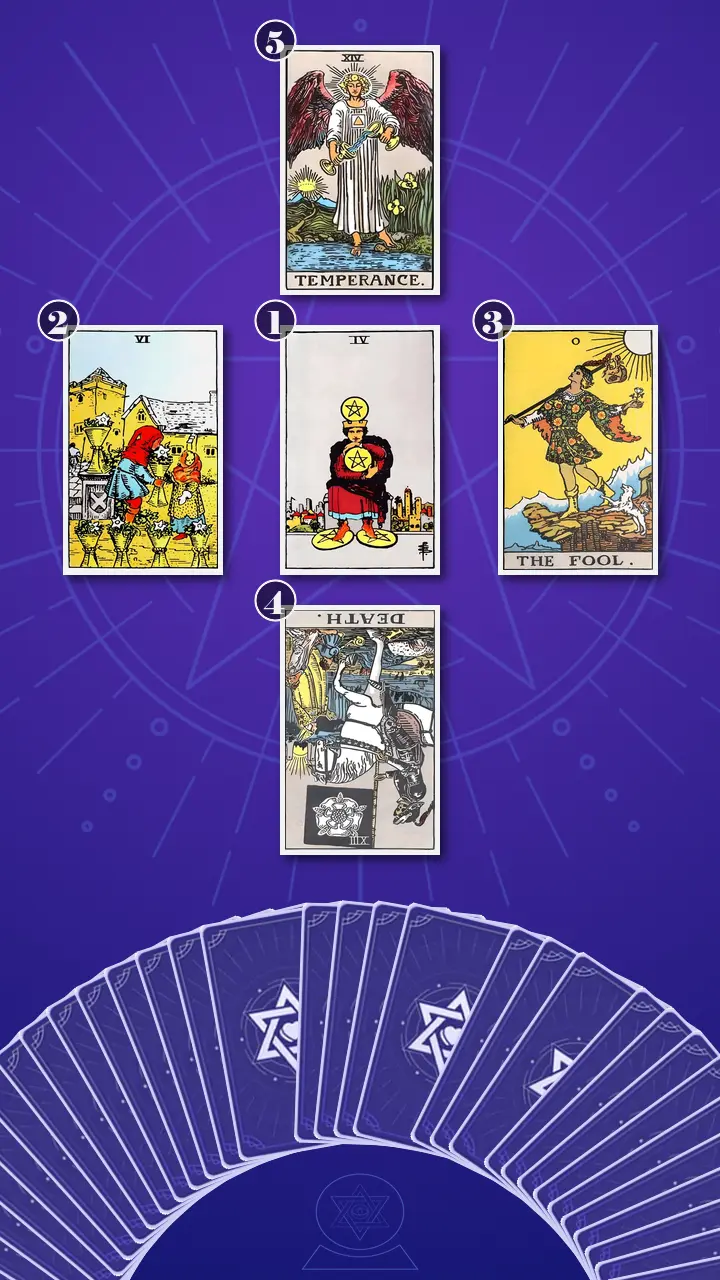
In this spread, the center card names what the boxes represent right now. The left card shows the inner pattern if you choose storage as your strategy. The right card shows what changes if you choose a fresh start. The card below reveals what’s secretly pulling the strings. The card above offers the healthiest integration—so you’re not forced into hoarding vs. purging.
Reading the Map: The First Turns of a Two-Path Decision
Position 1: What the Boxes Represent Right Now
“Now flipping over, we have the card representing the current stuck point: what the boxes/storage represent emotionally and behaviorally right now.”
Four of Pentacles, upright.
I pointed to the figure clutching the pentacle to their chest. “This is stuff as emotional armor. In modern life, it looks like this: you’re in a small Toronto apartment where space is expensive, yet you’re still taping up box after box because keeping everything feels like control. You label things ‘MAYBE’ not because you’re unsure of the item’s usefulness, but because deciding feels like a referendum on who you are.”
“A storage unit can be a safety deposit box for identity,” I added. “If nothing leaves, nothing can prove you chose wrong.”
Energetically, Four of Pentacles is an excess of containment—security becoming rigidity. It buys you short-term relief, but it also locks your life in a holding pattern.
Jordan gave a small, bitter laugh—then went still. A three-beat reaction I’ve learned to respect: (1) their breath paused mid-inhale, (2) their gaze unfocused as if replaying every half-labeled box, (3) their shoulders dropped an inch with a quiet exhale that said, Okay. So I’m not lazy. I’m scared.
“You’re not storing stuff—you’re storing a version of you,” I said gently. “And we can treat that version with dignity without renting it a permanent apartment.”
Position 2: If You Keep the Old Life in Boxes (Storage as Strategy)
“Now flipping over, we have the card representing Path A: what happens internally if you keep the old life in boxes.”
Six of Cups, upright.
“This is the tender reason it’s hard,” I said. “Keeping the boxes feels warm at first. You open one ‘just to check,’ find something from an earlier era, and suddenly you feel safer staying connected to who you were. It’s comfort on demand—like stepping into an old timeline whenever life feels uncertain.”
I watched Jordan’s mouth soften, the way it does when memory arrives before words. “Nostalgia is sweet,” I said, “but it still takes up rent.”
Six of Cups is an excess of emotional return visits: not wrong, not shameful—just powerful. The tradeoff is that the transition never fully lands. You keep revisiting the past every time you touch a box.
Jordan nodded once, eyes down, thumb rubbing the edge of their water bottle label like it was a worry stone.
Position 3: If You Start Fresh (Releasing or Radically Curating)
“Now flipping over, we have the card representing Path B: what happens internally if you start fresh.”
The Fool, upright.
“This isn’t carelessness,” I said, tapping the small knapsack in the image. “This is carry-on rules. Starting fresh looks like picking one category and letting it go without a perfect forecast—treating the decision like a trial, not a forever sentence.”
I framed it the way my younger clients tend to understand instantly: “A fresh start here is like a free trial, not signing a lifetime contract. Donating one category is like shipping one small PR, not rewriting your whole codebase.”
The Fool is a balance of curiosity and risk. It loosens stagnation by asking a modern, merciful question: What if you’re allowed to learn what you miss, instead of predicting it perfectly?
Jordan’s posture changed—barely, but unmistakably. Their jaw unclenched, and for a moment their face held something like curiosity instead of negotiation.
When Temperance Poured Between Two Cups
Position 4: The Hidden Driver Under the Decision
Before I turned the next card, I felt the room settle. Even over the quiet city hum outside, there’s a particular kind of silence that shows up when we’re about to name the real thing.
“Now flipping over, we have the card representing the hidden driver: the underlying fear or belief that makes this decision feel so loaded.”
Death, reversed.
“Underneath the storage decision,” I said, “is resistance to making an ending official. The move happens, but the ending doesn’t. The storage unit becomes a paid pause button—monthly billing for not choosing—so you never have to feel the finality of ‘that era is over,’ even as the autopay notification quietly proves the transition is still running your life.”
Death reversed is a blockage of completion. Not failure—just an unfinished ending, like a browser tab that’s been open for months, draining battery even when you don’t look at it.
Jordan swallowed, then looked up at me with a flash of irritation that surprised even them. “But if I make it official,” they said, “doesn’t that mean I messed up? Like… I chose wrong back then?”
I kept my voice steady. “No. Endings aren’t verdicts. They’re acknowledgments. In archaeology, we don’t call a layer ‘wrong’ because a city rebuilt on top of it. We call it a stratum—evidence of survival, adaptation, and time.”
Position 5 (Key Card): Integration Guidance for Clarity
“Now flipping over, we have the card representing integration guidance: the healthiest next step that honors both memory and forward movement.”
Temperance, upright.
I’ve spent years studying crossroads—literal ones in ancient road systems, and metaphorical ones in civilizations deciding what to preserve and what to redesign. This is where my Historical Case Matching clicks in: thriving cultures don’t drag every brick of the old city into the new one, and they don’t burn their archives to prove they’re modern. They curate. They restore what still carries value, archive what matters, and let the rest return to the soil.
Temperance is that curator. The angel pours water between two cups: slow, measured, repeatable. One foot on land, one in water: grounded and emotional at the same time.
Here’s the moment Jordan had been bracing for without realizing it. You know that moment after work when the boxes are lined up, you sort for 20 minutes, then you blink and you’re saving “fresh start” reels while the Sharpie cap sits open on the floor?
Not “keep everything so nothing ends,” and not “trash it all to prove you’ve moved on”—Temperance says blend, measure, and let your next chapter decide what stays.
The words landed and Jordan went through a whole sequence: (1) their fingers froze mid-fidget, hovering above the bottle cap; (2) their eyes glassed for a second, like they were watching themselves in that 8:47 p.m. hallway; (3) a breath left their chest in a shaky, relieved exhale, and their shoulders lowered as if someone had finally taken a backpack off them. Then a new vulnerability flickered in—because clarity can feel like standing on clean ground after months of mud: steadier, but also exposed.
I leaned in just slightly. “Do a 10-minute ‘Two-Cup Mix’ right now: pick one box (or one drawer). Set a timer for 10 minutes. Make two quick piles: (1) ‘Next-Chapter Useful’—things you can realistically use in the next 90 days; (2) ‘Memory Anchor’—items you’d keep even if you moved again tomorrow. Everything else stays untouched for now. If your chest tightens or you start bargaining—‘but what if…’—pause for three slow breaths. You can stop at any time and it still counts. If a box is too much, do 10 items only.”
After a beat, I asked, “Now—using this new lens—think back over last week. Was there a moment when the boxes felt like a test you had to pass? How would it have felt to make it a method instead?”
Jordan blinked hard, then nodded. “It would’ve felt… like I’m allowed to be in progress.”
That was the bridge: from braced, guilt-tinged indecision toward relieved spaciousness and quiet self-trust. Not because the past vanished—because the rules changed.
The One-Page Curation Plan: Actionable Advice for the Next 48 Hours
I tied the spread together for Jordan in plain language: Four of Pentacles showed the present—control as a stand-in for safety. Six of Cups revealed the emotional payoff of storage—portable home, comfort on demand. The Fool offered the alternative—movement through small experiments instead of perfect prediction. Death reversed named the real weight—an ending kept unofficial, draining attention like a background app. Temperance resolved the false binary: a paced, values-based curation where your space aligns with what you’re building now, not what you’re afraid to lose.
“Your cognitive blind spot,” I said, “is thinking this has to be one clean, irreversible decision—something that proves you’re ‘doing adulthood right.’ That’s why you keep refining categories like a Notion ‘Declutter Plan v4’ and still feel stuck. The transformation direction is smaller and kinder: from all-or-nothing purging vs. hoarding to timed, values-based curation.”
Jordan frowned. “Okay, but I can’t even find ten minutes. After work I’m cooked. And the boxes… they just stare at me.”
“That’s real,” I said. “So we use what I call Time Stratigraphy: separate what’s a tired-night impulse from what’s lasting value. We’re not excavating your whole life at once. We’re brushing one square foot.”
- Box Cap BoundaryWrite a number—1 to 3 boxes total—for how much physical space your ‘old life’ gets this month. Put it on a sticky note on your wall or as your phone lock screen. Anything beyond the cap must be released, digitized, or swapped in (something new comes in only if something old exits).If your brain argues, treat that as the signal you’re protecting identity, not managing stuff. Go smaller: choose “1 box for now.”
- Two-Container System (No Third Category This Week)Set up only two containers: a box labeled Memory Anchors and a box labeled Next-90-Days Useful. For 10 minutes tonight, sort just one drawer or ten items into one of those two boxes. Everything else stays untouched—no “maybe” pile allowed this week.Do it sitting down with music and a drink. When you feel the bargaining start, take three breaths and stop on purpose. Stopping safely teaches self-trust.
- Same-Day Donation ExitIf you decide to donate anything, put it in a bag and get it out of the apartment the same day—building donation bin, drop-off, or a friend’s trunk. Don’t let it become another “temporary pile” in your hallway.Make it absurdly easy: tie the bag shut and place it by the door before you go to bed, like you’re setting out gym clothes.
“The method is the maturity—not the dramatic purge,” I reminded them. “And Temperance tarot meaning for decluttering and balance is exactly that: proportions, not punishment.”

A Week Later: Ownership, Not Certainty
A week later, Jordan sent me a photo: two boxes on a bare patch of floor. One read MEMORY ANCHORS. The other: NEXT 90 DAYS. No towering ‘MAYBE’ stacks in the background.
“I did ten items only,” their message said. “Then I stopped. And nothing bad happened. I still woke up the next morning thinking, ‘What if I’m doing this wrong?’—but I also laughed a little, because now I have a rule, not a spiral.”
That’s what finding clarity often looks like in real life: not a dramatic moment, but a quiet proof. A clean transition where your memories are honored, but not in control—where money, space, and attention begin to align with what you’re building now.
When you’re staring at a taped-up box with a Sharpie in your hand, it can feel like you’re not deciding about stuff—you’re deciding whether you’re allowed to outgrow the person those things once proved you were.
If you didn’t have to prove you’ve “moved on” or “kept it all,” what’s one small, kind boundary you’d try this week—so your past is honored, but your next chapter gets room to breathe?