That Hoodie on the Chair—And the One Sentence That Breaks the Loop

Finding Clarity in the Hoodie-on-the-Chair Loop
If your London flat is so small that one hoodie can hijack the whole vibe, and you keep telling yourself you’ll deal with it “next week,” this is for you.
Taylor (name changed for privacy) joined my session from a compact flat in London where the furniture did double duty and nothing could really be “out of sight.” They angled their laptop just enough that I could see the infamous chair behind them—half reading nook, half dumping ground. And there it was: a hoodie slumped over the back like it had tenancy rights.
“It’s just a hoodie,” Taylor said, then huffed out a short laugh that didn’t sound amused. “But it’s also not just a hoodie.”
I watched them rub the cuff with two fingers, absent-minded, like checking a pulse. The overhead light in their room had that slightly harsh white tone—clean, but not cosy. Somewhere offscreen, a radiator clicked and settled. Their phone buzzed once, the small, sharp sound of a notification in a too-quiet room.
“I keep drafting the text,” they admitted. “Like, literally: ‘Hey, I found your hoodie…’ and then I delete it. I can write it, I just can’t hit send.”
They paused, swallowing like there was a knot stuck halfway down. “If I drop it off, it’s like I’m confirming the breakup for the hundredth time. And if I don’t, my apartment is starting to feel like a waiting room.”
The feeling in the room wasn’t dramatic heartbreak. It was more like living with a browser tab you never read—open, quietly draining your attention, making your nervous system do admin every time you walk past the chair. Taylor’s ambivalence had a physical shape: a tight throat when they imagined reaching out, a heavy chest when their eyes landed on the hoodie, and that restless, late-night energy that makes scrolling feel like a sedative that doesn’t work.
“I’m not here to push you into a grand gesture,” I told them. “We’re here to find clarity—something you can actually do. Let’s make a map for the choice: closure in a calmer home, without forcing you to pretend you don’t feel anything.”

Choosing the Compass: The Decision Cross Tarot Spread
I asked Taylor to take one slow breath in, then out, not as a ritual for the universe, but as a hard reset for the mind—the way you might close a dozen tabs before trying to work. I shuffled while they held the question clearly: “My ex’s hoodie on my chair—do I drop it off, or am I just delaying closure?”
“We’ll use something called the Decision Cross,” I said, laying out the space on my desk. “It’s built for moments like this—when the surface question is practical, but the emotional undercurrent is what keeps the decision stuck.”
For anyone reading along who’s ever googled how tarot works and felt sceptical: this spread isn’t about predicting your ex’s mood. It’s about clarifying what each option costs you, what it protects, and what boundary makes the whole thing feel clean rather than messy.
In this cross, the centre card names the current stuck point—what’s happening in real life, not in theory. The left and right cards put your two options in direct dialogue: return it versus delay. The top card gives decision guidance—the principle that keeps you from making a choice based on hope or guilt. The bottom card reveals the hidden driver, the fear underneath the “logistics.” And the final card is the practical next step: one grounded move in the next 24–72 hours.
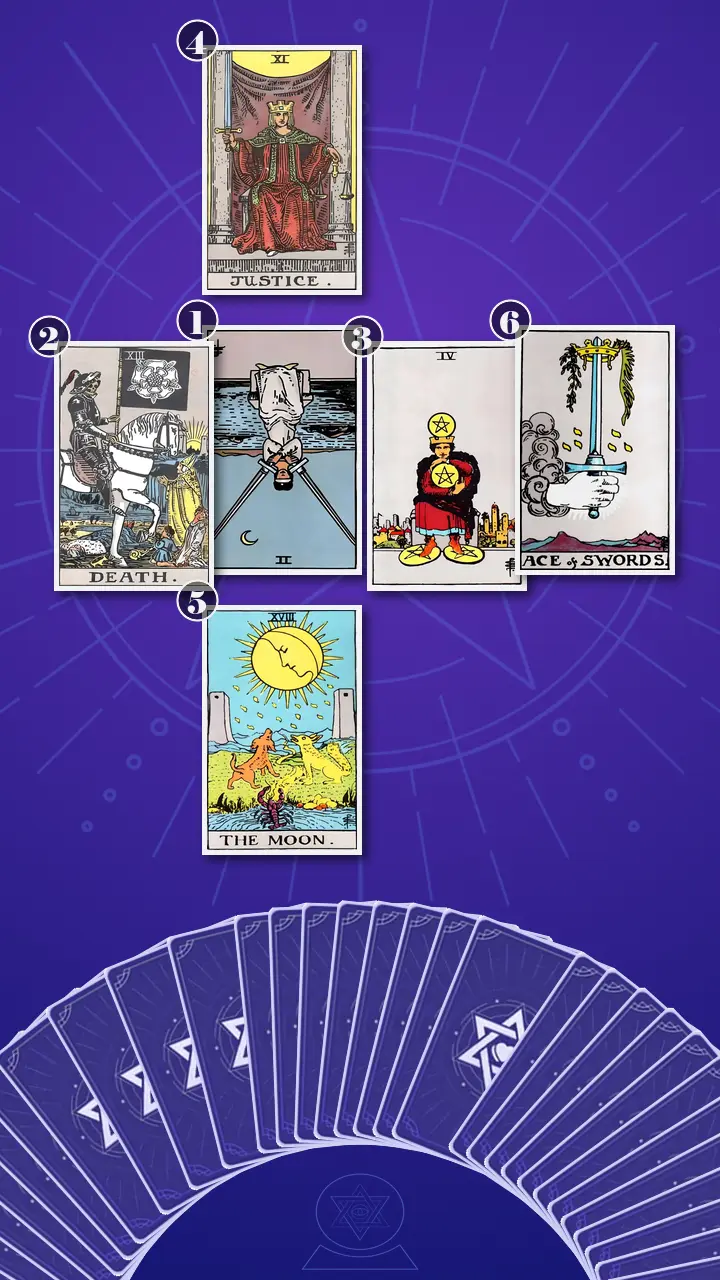
Reading the Map: Breakup Limbo, Option A, Option B
Position 1: The current stuck point — Two of Swords (reversed)
“Now flipped over,” I said, “is the card representing the current stuck point: how the hoodie is functioning as a daily trigger and why closure is being delayed in practice.”
Two of Swords, reversed.
“This is uncannily literal,” I told Taylor. “It’s 9 PM, you’re doing a tiny tidy-up in your flat, and the hoodie on the chair becomes the whole emotional weather system. You open the message thread, draft something neutral, then delete it because you can’t choose a tone that won’t accidentally sound like either ‘I miss you’ or ‘I’m cold.’ Keeping it unsent feels safer than choosing, but your brain stays loud anyway.”
In upright form, this card is a stalemate held in place—like someone standing still with a blindfold and crossed swords, trying not to tip into feeling. Reversed, the energy leaks. It becomes blockage that spills into mental noise: indecision that no longer even feels protective, just exhausting.
Taylor let out a sharp exhale, then—unexpectedly—laughed again, a quick ugh laugh, bitter at the edges. “That’s… honestly cruel,” they said, half smiling. “Like you’ve seen my WhatsApp drafts.”
“It’s not cruelty,” I said gently. “It’s precision. This is decision paralysis. And it’s not a character flaw—it’s a safety strategy that’s stopped working.”
Position 2: Option A (return it) — Death (upright)
“Now flipped over is the card representing Option A: drop it off / return it—what this choice activates emotionally and what kind of closure it supports.”
Death, upright.
Taylor’s eyes widened a fraction, the way people do when a card’s name lands too loudly.
“In tarot, Death is almost never about literal death,” I said. “It’s about an ending that’s chosen—deliberate, clean enough to change the landscape.”
And the modern translation here was plain: “You decide returning the hoodie is not a conversation, it’s a completion. You bag it, pick a neutral handoff (drop at reception, quick doorstep exchange, or mutual friend), and treat it like closing a ticket: respectful, final enough, no extra emotional subtext required.”
This isn’t a dramatic cliff-edge. It’s a door. The white rose and the rising sun in this card are the whole point: an ending that isn’t punishment. An ending that makes your nervous system stop scanning your own living room for unfinished business.
Taylor nodded, but their mouth tightened, like they were holding back a flinch. The discomfort was real—and so was the relief they could almost taste.
Position 3: Option B (delay) — Four of Pentacles (upright)
“Now flipped over is the card representing Option B: keep it / delay—what this choice protects, and what it costs over time.”
Four of Pentacles, upright.
“This card is the body holding on,” I said. “Clutching something to the chest like it’s oxygen.”
And the scenario was, again, painfully contemporary: “You tell yourself you’re keeping the hoodie because it’s practical (they’ll want it eventually), but it’s also a small, physical guarantee against feeling alone. The chair becomes a checkpoint: every time you pass it, you re-open the breakup in your head—then feel annoyed at yourself for still caring.”
This is excess Earth energy: stability turning into gripping. Security turning into a cramped kind of control. It protects you from a sharp moment of finality… but it costs you spaciousness. Breath. Ownership of your own flat.
Taylor did the exact thing the card depicts without noticing: their shoulders lifted slightly, their chest went tight. Then they caught themselves and let out a small, defeated laugh. “It’s like… I’m holding my breath,” they said. “And calling it being ‘practical.’”
“Exactly,” I replied. “And the longer you hold your breath, the more urgent the whole thing feels—until even a neutral text starts to feel like standing on a stage.”
When Justice Set the Policy for Peace
Position 4 (Key): Decision guidance — Justice (upright)
I turned over the next card and felt the room go quiet in that particular way it does when the right framework arrives—the kind of quiet I’ve heard in excavation trenches when a shape in the soil finally resolves into an artefact, unmistakable.
“Now flipped over is the card representing Decision guidance: the boundary, value, or principle that makes the choice feel clean rather than messy.”
Justice, upright.
Justice is one of those cards people think is moral. I read it as structural. In archaeology, a civilisation doesn’t rise or fall because of one emotional moment; it rises or falls because of policies—repeatable rules that determine what happens next. Justice is that kind of energy: self-respect, accountability, calm clarity in communication.
I leaned in slightly. “This is where we stop asking, ‘How do I make this feel less weird?’ and start asking, ‘What is fair and uncomplicated—if hope and guilt aren’t allowed to vote?’”
In my own work, I use something I call Historical Case Matching: comparing a personal crossroads to the kind of decision point we see in whole societies. And what I see here is a familiar pattern. When a city keeps an old gate half-open “just in case,” it doesn’t preserve peace—it preserves vulnerability. Trade stalls. Rumours grow. Everyone keeps watch. That’s the hoodie on the chair: a half-open gate that forces vigilance.
Taylor’s eyes flicked toward the chair behind them, then back to me.
We were right at the hinge of the reading—the place where a person usually says, I’m waiting until I feel ready—and then realises readiness is not the currency that buys relief.
Setup (the stuck thought): Taylor had been treating closure like a mood that might arrive on a calmer day—maybe after a better night’s sleep, maybe when work was less intense, maybe when their chest didn’t tighten at the idea of being seen as “still caring.” The problem was that the hoodie guaranteed the mood would never come. The flat kept re-opening the file.
Delivery (the sentence that changes the frame):
Stop waiting for the blindfold to feel comfortable; choose the clean boundary that the scales can live with, and let the sword make one honest cut.
I let the words sit. No extra explaining. Just air.
Reinforcement (the body catches up): Taylor’s breath stopped for a beat—like their lungs had paused to listen. Their hands, which had been clasped tightly just below the frame, loosened. Their gaze went unfocused for a second, as if they were replaying every time they’d drafted that message and then locked their phone face-down like it was hot. Then their eyes got wet—not a breakdown, more like a pressure valve releasing.
“But if I do that,” they said, and there was a flash of anger under the words, “doesn’t it mean I was… wrong? Like I’ve been dragging this out for no reason?”
“No,” I replied, steady. “It means you’ve been protecting belonging the only way you could—by keeping a door ajar without having to ask anyone to stay. That strategy makes sense. It just doesn’t give you peace.”
Taylor swallowed again, but the knot looked smaller. Their shoulders sank a fraction, as if gravity was finally allowed back in. They took one fuller breath, then another—still a little shaky, but real.
“Now,” I asked them, “with this new lens—fair boundary, one honest cut—can you think of one moment last week when you touched the hoodie, opened WhatsApp, and froze? What would have felt different if you’d treated that moment like admin you can complete, rather than a referendum on your worth?”
Taylor stared at the chair, then gave a slow nod. “Tuesday,” they said. “I literally picked it up and… put it back. Like I was waiting for it to tell me what to do.”
“That’s the shift,” I said. “From breakup limbo and decision paralysis… toward self-respect, calmer closure, and steadier boundaries. Not because you feel nothing. Because you choose a policy you can live with.”
Position 5: Hidden influence — The Moon (upright)
“Now flipped over is the card representing the hidden influence: the underlying fear or projection that is keeping the loop open.”
The Moon, upright.
I didn’t need to ask Taylor whether they were a night-time overthinker; their whole question lived in the late hours. The Moon is the card of uncertainty, projection, and the mind trying to manufacture certainty out of vibes.
“Late at night,” I said, “the hoodie becomes a talisman against uncertainty. You mentally rehearse every possible drop-off scene—awkward, cold, tender, humiliating—until the task feels too emotionally charged to touch. The silence gets interpreted as meaning, and meaning becomes paralysis.”
I made it concrete, because that’s where The Moon loses its power: “It’s 2:13 AM. Streetlight glow through the blinds. The radiator clicks. Your phone is warm in your hand. And your brain writes three different endings like it’s doomscrolling your own imagination.”
This is muddled Water energy: not wrong, not irrational—just unverified. It turns “they might reply neutrally” into “if they don’t care, it proves I didn’t belong.”
Taylor looked down, a little embarrassed, and nodded. “I argue with imaginary versions of them,” they admitted. “Like… full debates.”
“The Moon loves a blank space,” I said. “It fills it with stories. Our job is not to banish emotion. It’s to stop treating guesses like verdicts.”
Position 6: Integration and next step — Ace of Swords (upright)
“Now flipped over is the card representing integration and next step: one specific, grounded action that restores clarity and moves you toward closure without needing to predict the emotional outcome.”
Ace of Swords, upright.
“This is Air done properly,” I said. “Not spinning. Not tone-auditing. Just one clean line.”
The modern scenario was almost a script: “You write one clean, specific message and send it without performing your feelings: a day option, a time window, a simple handoff. You let the outcome be what it is—because the point is to stop negotiating with limbo and reclaim your space.”
This is balanced clarity: not brutal, not icy. Simply direct enough to end the daily activation loop.
Taylor’s hand drifted toward their phone, then stopped—like their body was testing whether it could approach the “send” button without flinching. “One sentence,” they murmured. “Not a manifesto.”
“Exactly,” I said. “One sentence. One plan. One clean cut.”
From Insight to Action: The One Clean Cut Plan
I pulled the whole story together for Taylor, the way I’d stitch together layers at a dig site. “Here’s what the spread shows,” I said. “Two of Swords reversed is the loop: indecision disguised as ‘being practical.’ The Moon is the engine underneath: your mind filling silence with stories, especially at night. Four of Pentacles is the coping strategy: holding the hoodie like an emotional security deposit against loneliness. Death offers a respectful chapter-end. Justice gives the rule: fair boundary, no secret clauses for hope or guilt. And Ace of Swords gives the method: one clear sentence, executed without drama.”
“Your cognitive blind spot,” I added, “is thinking you need to feel ready before you act. But what these cards are saying is the opposite: action creates the conditions for relief. Closure isn’t a mood. It’s a boundary.”
As an archaeologist, one of my favourite tools is time stratigraphy—separating layers that look similar on the surface but belong to different eras. In your life, it’s the same: the impulse to keep the hoodie visible (a short-term comfort layer) is not the same as the value you’re actually trying to preserve (long-term belonging and self-respect). When you separate those layers, the next step becomes obvious.
So I offered Taylor a plan using my Voyage Log Technique: like ancient navigators, you don’t wait for the ocean to stop moving. You choose a bearing, log one deliberate action, and let the weather be weather.
- The 10-Minute “One Clean Cut” ResetSet a 10-minute timer. Put the hoodie in a tote bag or paper bag and place it by the door. Draft ONE neutral message: “Hey—found your hoodie. I can drop it off this week; Tue or Thu evening work?”One reread only. If you feel the urge to write a long message, label it “overcorrection” and return to the one-sentence rule.
- Pick the Low-Drama Handoff Before You SendDecide your method now: reception drop-off, mutual friend, or a quick doorstep handoff. Choose the option that protects your energy and doesn’t invite extra emotional negotiation.Send at a neutral time (lunchtime), not at 1 AM. If you’re worried about instant replies, mute the chat for 60 minutes after sending.
- The 20-Minute Post-Send BufferAfter you send, put your phone in another room for 20 minutes. Do one grounding task: wash a mug, shower, change your bedsheets—something that tells your body “we’re safe.”You’re not avoiding their reaction; you’re refusing to refresh your screen like it’s a verdict on your worth.
“If sending today still feels too spiky,” I told Taylor, “your boundary can be completing the prep—bagged, message drafted, method chosen. That alone breaks the loop of ‘temporary spot, permanent limbo.’”

A Week Later: Quiet Proof in a Reclaimed Chair
Six days later, Taylor messaged me. Not an essay—just a screenshot and one line: “Sent it at lunch. Muted the chat. Didn’t die.”
The screenshot was the cleanest possible text—one sentence, two day options, no emotional subtext. Under it, Taylor had typed: “Also… I put a book on the chair. Like it’s mine again.”
It wasn’t a fairy-tale ending. They added, almost as an afterthought: “I slept through the night, but I still woke up and thought, ‘What if I did the wrong thing?’ for like ten seconds. Then it passed.”
That’s the real Journey to Clarity: not certainty, but ownership. A calmer nervous system. A boundary you can repeat.
When you want your home to feel calm again but you’re scared that returning one hoodie will prove you don’t belong anywhere, you can end up living with a ‘temporary’ object that keeps making the breakup feel present.
If you let closure be one fair, quiet boundary—rather than a dramatic emotional moment—what would your smallest ‘clean action’ look like this week?