From post-grad fog to grounded momentum: letting the student label end
The 8:47 p.m. Queen West Spiral
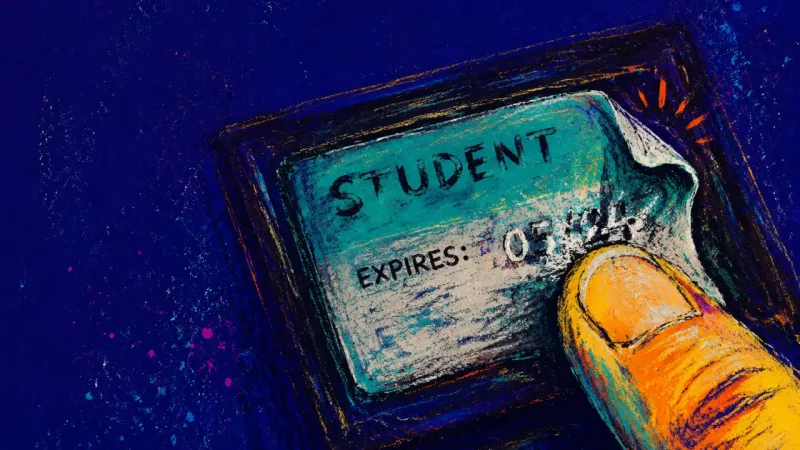
You still have your expired student ID in your wallet because it feels like a safety net, even though you haven’t been on campus in months.
Alex (name changed for privacy) said it like a confession and a joke at the same time, sliding into the chair across from me in a crowded Queen West café. She wasn’t dressed like someone in crisis—just jeans, a winter coat half-zipped, hair pulled back—but her body told the truth her face was trying to edit. Shoulders slightly up. Throat held. A kind of careful breathing, like she was bracing before a difficult introduction.
Outside the window, late-winter Toronto looked like it had been sketched in graphite: grey sidewalk, grey sky, grey impatience. Inside, the espresso machine hissed like a small animal. The music overhead was one notch too loud. Alex’s coffee had gone cold and she kept turning the cup by the lid, as if rotation might generate a plan.
When she flipped open her wallet to pay for something—pure habit—the expired student ID flashed in the plastic sleeve. The gesture was small, but the reaction was immediate: her chest tightened and her jaw set, the way people do a half-second before they’re asked, “So what do you do?”
“It’s stupid,” she said, eyes flicking to her laptop and then away. “But I keep… acting like being a student is my default label. Like I’m not allowed to start until I’m sure.”
I watched her cursor bounce between tabs—job boards, a half-edited résumé, a grad program page—like a nervous metronome. The laptop fan was already warming up from the effort of her “research.”
This wasn’t laziness. This was identity limbo after graduation: wanting to move on from the student chapter vs fearing that without the student identity you’ll lose your place, purpose, and confidence. Uncertainty, not in the abstract, but as a physical sensation—tight in the chest and throat, as if the next step required an introduction she didn’t have words for.
“I get it,” I told her. “And I’m not here to yank the student chapter out of your hands. I want us to translate what that expired ID is really doing for you—so we can find clarity without forcing certainty. Let’s make a map through the fog.”

Choosing the Ladder: How Tarot Works for Identity Transitions
I’ve spent most of my life around artifacts that look ordinary until you remember what they once meant—an old seal, a broken key, a stamped bit of clay. An expired student ID is not so different. It’s small, everyday, and yet it carries an entire system of belonging.
I asked Alex to take one slow breath in through the nose and out through the mouth, not as theatre, but as a transition: from spiraling into observing. While she exhaled, I shuffled—steady, quiet motions that give the mind something to land on.
“Today,” I said, “I’m going to use a spread I call the Four-Layer Insight Ladder · Context Edition.”
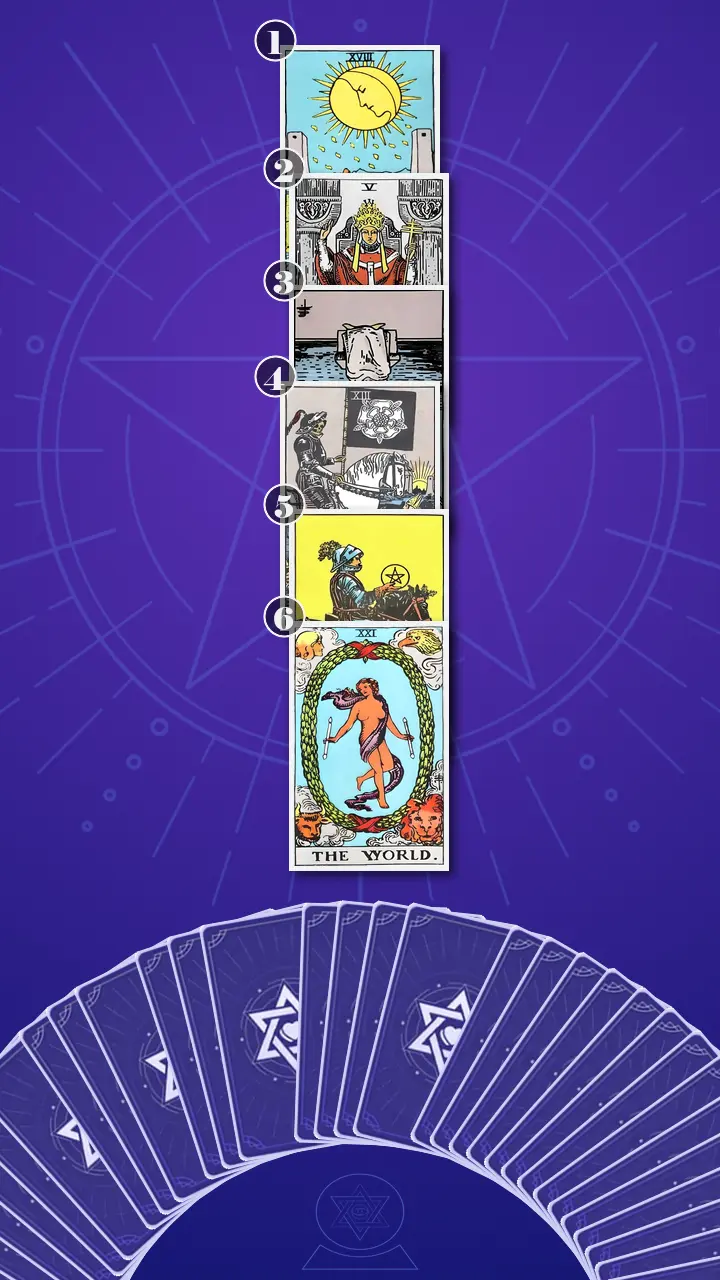
If you’ve ever wondered how tarot works when the problem isn’t a yes/no outcome, this is the kind of structure I rely on. An expired student ID is a liminal-symbol problem: the external object points to an internal identity shift more than a concrete prediction. This ladder uses six cards to translate the symbol into a coherent inner narrative—present limbo behavior (1) → what has expired (2) → the fear-mechanism that repeats the loop (3) → the bridge reframe (4) → a repeatable next rung (5) → integration (6). It keeps us focused on recognition and agency, not fate.
“We’ll read straight down,” I added, laying out the space between us as if it were a staircase. “The first card is your present snapshot—what this looks like on a normal day. The third is the mechanism—the belief that keeps you freezing. The fourth is the turning point. That’s usually where the light comes in.”
Fog vs Freeze at a Career Crossroads
Position 1: Present snapshot — The Moon (upright)
“Now turned over,” I said, “is the card that represents your Present snapshot: how the ‘expired ID’ shows up as a current behavior pattern and emotional tone.”
The card was The Moon, upright.
“This is going to sound painfully specific,” I told her, “because your life has already given us the perfect translation.” I tapped the card lightly, then looked up. “It’s 8:03 AM on the TTC and you’re scrolling job posts with one hand while your other thumb keeps flicking back to a grad program page. Nothing feels solid. You’re not lacking options—you’re in that foggy in-between where you can’t see the whole route yet, so your brain keeps demanding a full map before you take a step.”
Alex let out a short laugh—sharp at the edge, like it surprised her. “That’s… kind of brutal,” she said. “Like, yes. Exactly.”
In tarot terms, The Moon is not a verdict. It’s weather. The energy here isn’t “wrong”; it’s ambiguity—a workable fog. Fog is fine if you’re moving carefully. It becomes miserable when you treat it as evidence you’re not allowed to drive.
“Clarity doesn’t come before the first step. It comes because of it,” I said, letting the sentence settle between us like a handrail. “The Moon is basically saying: you only ever get the next fifty meters. If you insist on seeing the entire highway, you’ll keep standing still.”
I watched her mouth tighten, then soften. She nodded, but not enthusiastically—more like someone who’s been found out.
Position 2: What has expired — The Hierophant (upright)
“Now turned over,” I said, “is the card that represents What has expired: the past identity or structure you’re still using as a reference point.”
The Hierophant, upright.
“Your student ID isn’t just plastic—it’s a permission slip,” I said. “Even after graduation, you keep the logins, discounts, and ‘student’ framing because it tells you the rules of the game. Without it, you feel like you lose the script, the milestones, and the built-in belonging that made you feel legitimate.”
That got her quiet. Not defensive—more like her attention dropped into her body. Her fingers found the edge of the wallet again, the same way some people touch a necklace when they need reassurance.
The Hierophant energy is structure and approved identity. In balance, it’s mentorship, education, and a healthy tradition. In excess, it becomes borrowed authority: “I’m real when an institution says I’m real.”
My mind flashed—briefly, uninvited—to an excavation in Turkey years ago. We’d found a doorway where the threshold stone was worn down by thousands of feet. People kept walking the same entrance long after the city had changed, because the body remembers where it once belonged. The Hierophant is that worn threshold.
“Which rulebook are you still using?” I asked. “Not because it’s true—but because it’s familiar.”
Alex swallowed. “I don’t miss school,” she said, voice lower. “I miss the structure.”
Position 3: The mechanism — Two of Swords (reversed)
“Now turned over,” I said, “is the card that represents The mechanism: the core belief/fear that keeps you in limbo and repeats the loop.”
Two of Swords, reversed.
“Here’s the freeze,” I said. “You keep two—or six—futures alive in your head: ‘Maybe I’ll apply, maybe I’ll go back to school, maybe I’ll pivot.’ You draft messages you never send. You make pros/cons lists that breed more pros/cons lists. The truth is: committing to anything feels like risking being wrong—and being wrong feels like it would expose you as not actually good enough.”
I saw her do the exact thing the card depicts. Her arms didn’t literally cross, but her posture did: ribcage tucked in, shoulders up, breath held—self-protection disguised as neutrality.
“This is the kind of loop that sounds professional inside your head,” I went on, deliberately borrowing the voice I’ve heard from a hundred brilliant students. “I’m just being strategic. But your body is telling on you: tight jaw, held breath, hovering over ‘send.’ Then you delete the DM draft, reopen Notes titled ‘Plans,’ and if it gets too loud in your head, you scroll until you’re numb.”
She stared at the card and exhaled through her nose—one long, involuntary release. The kind of exhale that says, Oh. So that’s what I’m doing.
“You’re not lazy—you’re in identity limbo, and your brain is calling it ‘planning,’” I said gently. “The reversed Two of Swords is a protective strategy that’s started to fail. And that’s good news.”
“Good news?” Alex repeated, skeptical but listening.
“Because it means the old armor isn’t sustainable,” I replied. “Fog is survivable—you can move slowly. Freeze is what hurts.”
When Death Spoke: The Clean Ending You’ve Been Avoiding
Position 4: The bridge — Death (upright)
I let the café noise blur for a moment—steam, spoons, someone laughing too loudly—until it all felt far away. “We’ve reached the bridge,” I said. “This is the most transformative reframe: the turning point that turns the ending into forward movement.”
Death, upright.
Alex’s first reaction wasn’t spiritual dread. It was irritation—almost anger. “I hate that card,” she said immediately. Then she caught herself. “Not like… literally. I just—God. Does this mean I messed up? Like, I should’ve had it figured out by now?”
For about three seconds I watched a full reaction chain move through her:
First, a physiological freeze—her shoulders rose and her breathing stalled, as if the word ending had hooked itself under her ribs.
Second, cognitive penetration—her eyes went slightly unfocused, like she was replaying the last six months: the job boards, the grad school tabs, the ID in the wallet, the feeling of “almost.”
Third, emotion trying to find language—her mouth opened, closed, and then she shook her head once, small and tired.
I kept my voice plain. “Death in tarot is the card people Google as ‘what tarot card means endings and identity change in real life’—and it’s rarely about catastrophe. It’s about clean endings. A chapter closing on purpose.”
“But it still feels like failure,” she said.
“That’s the pivot,” I answered. “Let’s put it in modern language.”
This is the moment you stop trying to extend the student era and name it as complete. Not with drama—with honesty. You let the expired badge be expired. You stop treating the ending like a personal failure and start treating it like an intentional shedding, so your energy can move from maintaining an old identity to building a new one.
And then I slowed down. I’ve learned—through teaching, through digs, through watching people face thresholds—that certain sentences need space to land.
Stop treating the ending as failure, start treating it as an intentional shedding—Death asks you to put down the expired badge so your hands are free to build the next chapter.
There was a pause. Not awkward. Ritual. The kind you hear in old stone rooms after a bell stops ringing.
Alex’s face changed in layers. First her brow loosened, as if she’d been clenching a thought for months. Then her eyes went glossy—not a dramatic cry, but that specific, startled wetness of relief when something finally makes sense. Her shoulders, which had been up near her ears, dropped a fraction. She pulled the wallet out again and, without quite looking at it, slid the expired student ID halfway out of its sleeve. Her fingers hovered, then she set the wallet on the table—flat, open—like placing down a burden to talk about it honestly.
“So it’s not… that I failed,” she said, voice unsteady. “It’s that I’m keeping the old label alive because it feels safer than being new.”
“Exactly,” I said. “Your next chapter isn’t blocked by lack of potential. It’s blocked by keeping the old label on life support.”
This is where my own lens—the one I’ve built across decades of history—kicked in. In archaeology we talk about stratigraphy: layers of life. When a layer ends, it doesn’t become meaningless. It becomes foundation. But you can’t build on a layer you’re still trying to live inside.
“Death is a mythic archetype,” I said, bringing in the tool I use when people need a metaphor bigger than their anxiety. “In so many legends, the hero doesn’t ‘win’ by staying who they were. They win by surrendering an old name at the threshold. Not because the old self was wrong—but because it’s complete. The rising sun on this card matters. The light comes after the letting-go.”
I leaned in slightly. “Now, with this new frame, I want you to do something specific. Think back to last week. Was there a moment—hovering over ‘submit,’ rewriting a DM, checking a student portal—when this insight would’ve changed how you felt?”
Alex’s gaze flicked to the side as she searched her memory. “Thursday night,” she said. “I was updating my bank info and my old .edu email was still on there. My fingers literally froze. I told myself it didn’t matter, but it did.” She laughed once, softer. “It felt like changing it would make it real.”
“That’s the doorway,” I said. “And you’ve just named it.”
What I saw, right then, was not an instant transformation. It was the first inch of it: the shift from numb uncertainty and borrowed legitimacy toward grounded momentum—a self-authored belonging beginning to take shape.
The Knight’s Calendar Invite, and the World Beyond the Campus Gates
Position 5: The next rung — Knight of Pentacles (upright)
“Now turned over,” I said, “is the card that represents The next rung: a practical, repeatable step that builds evidence of competence and self-trust.”
Knight of Pentacles, upright.
“Instead of waiting for one decisive ‘career moment,’ you build a week that proves you can show up,” I told her. “Two applications, one outreach message, one hour on a portfolio. Not glamorous—repeatable. Your confidence grows from evidence, not from hype or perfect certainty.”
This card’s energy is Earth in balance: steady, consistent, almost boring on purpose. If The Moon is driving in fog, the Knight of Pentacles is the simple discipline of staying in your lane for the next fifty meters.
“You’ve been trying to buy certainty with more thinking,” I said. “This knight builds confidence the way you build credit: small deposits, repeatedly.”
Alex gave a tiny nod, and for the first time her hands stopped fidgeting. They just rested on the table. It was subtle, but I’ve learned to trust subtle shifts—they’re usually the honest ones.
“Make it reversible. Make it visible. Make it small enough to repeat,” I added, because she needed a rule she could execute when her mind inevitably tried to renegotiate.
Position 6: Integration — The World (upright)
“Now turned over,” I said, “is the card that represents Integration: what it looks like to carry the past with you without living inside it.”
The World, upright.
“This is the end-state your nervous system is craving,” I said, keeping it grounded. “Not a perfect job title. Not a perfectly curated identity. An integrated sense that the student chapter is complete—and you’re allowed to be a beginner in the next chapter without apologizing for it.”
In modern terms: you can say, “I’m not a student anymore,” without panic because you’re already living your next identity in small, real ways. Your past becomes foundation—skills, discipline, friendships—without needing to be your shelter.
“You don’t need a new badge to belong—you need a life you’re actually living,” I said.
Alex looked down at the spread as if it were a mirror she didn’t entirely trust yet. “So I don’t have to pick the perfect path,” she said slowly. “I have to stop maintaining the old one, and then… build evidence.”
“That’s the key shift,” I replied. “From ‘I need the right identity before I act’ to ‘I build my next identity through small actions that I can repeat.’”
The One-Page Badge Drop Ritual (Actionable Advice for Feeling Stuck After Graduation)
I gathered the story of the cards into one thread for her—because insight without integration just becomes another tab open in the mind.
“Here’s what the ladder shows,” I said. “You’re in Moon-fog—uncertainty that’s normal at a career crossroads. But you’re measuring that fog using an old Hierophant ruler: institutional legitimacy, syllabi, being ‘on track.’ When that ruler no longer fits, you protect yourself with the reversed Two of Swords—analysis paralysis, neutrality, drafting without sending. Death doesn’t punish you; it clarifies the real task: let the student label end cleanly. Then the Knight of Pentacles builds your next identity through cadence. The World arrives when your past is a foundation, not a shelter.”
“Your cognitive blind spot,” I added, “is thinking you’ll feel legitimate before you take real-world steps. But legitimacy—confidence, belonging—shows up as an after-effect of evidence.”
Then I gave her something she could actually do. Not a reinvention. A practice.
Because of my own training, I like to borrow a tool from ancient sites: we don’t write wishes in the air; we carve them into something we can revisit. I call it Inscription Affirmations—not magical thinking, but a deliberately crafted line you can return to when your brain starts demanding a syllabus for adulthood.
- 10-Minute “Badge Drop” Admin PassSet a timer for 10 minutes. Pick ONE place your student identity still lives (old .edu email on a bank account, a student discount account, an outdated LinkedIn headline) and update just that one thing—today.If emotion spikes—panic, sadness, weird emptiness—pause with one hand on your chest and take one slow exhale. That feeling is the attachment point, not a stop sign. You’re allowed to stop after one change.
- The 20-Minute Reversible Move (“Submit Before You Research”)Before you open any new tabs, start a 20-minute timer and do ONE reversible action: submit one application, send one DM for an informational chat, or book one coffee chat.Use this low-stakes script: “Hey—quick question. I’m exploring roles in ___. If you’re open, could I ask you 2–3 questions on a 15-min call sometime this week?” Your goal is data, not perfection.
- Inscription Affirmation (Pinned Note)Open your Notes app and write one sentence: “The student chapter is complete. I’m allowed to be a beginner in my next chapter.” Pin it. Read it once before any ‘career spiral’ session this week.Treat it like a carved line on stone: not inspirational fluff—an anchor you return to when your mind starts negotiating for more certainty.
Alex immediately found the snag—the real-world friction point. “But I genuinely don’t have time,” she said. “I’m working this in-between job, and when I get home I’m wiped. Even the 20 minutes feels…”
I nodded. “Good. That’s honest. So we do what archaeologists do when a wall looks too big: we start with one small square and we keep it consistent.”
“Make the 20 minutes a ‘same place, same time’ appointment twice this week,” I said. “Same café, same playlist. Let your nervous system learn the ritual of showing up. If 20 is too much on a low-energy day, do the five-minute version—but still make it visible.”

A Week Later: Ownership, Not Certainty
A week later, I got a message from Alex. Not a paragraph—just a screenshot and one line.
The screenshot was an updated account profile: her email changed from the old .edu address to her current one. Under it, she’d typed: “Badge dropped. I felt weirdly sad for ten minutes. Then I sent one DM anyway.”
I could picture it: she’d done the brave, unglamorous thing—probably alone at a kitchen table, no applause, just the quiet click of an update button. Clear, but still tender. She wasn’t “fully confident.” She was in motion.
That’s what this Journey to Clarity looked like in real life: not a sudden new identity, but the first evidence that she could author her own structure—one clean ending, one small action, repeated.
When the student chapter ends, it can feel like standing at a doorway with an expired pass in your hand—chest tight, throat braced—wondering if the fact that it won’t scan means you don’t belong anywhere yet.
If you didn’t need a new label to be ‘ready,’ what’s one small, repeatable action you’d be curious to try this week—just to give yourself one fresh piece of evidence?