From Storage-Bar Overwhelm to Steadier Agency: Small-Batch Deleting

The Photo You Couldn’t Take
She came in because her phone wouldn’t let her remember her life.
Taylor (name changed for privacy) slid into the corner table of my café in Toronto with the kind of careful, contained energy I’ve learned to recognize: shoulders slightly raised like a winter coat she couldn’t take off indoors, jaw set like she’d been biting down on a thought all day.
“It’s so stupid,” she said, already apologizing. “But I tried to take a video yesterday—like, a real moment—and my phone just… blocked me. Storage almost full. Right when I actually wanted to keep something.”
Outside, the street was damp and grey. Inside, the espresso machine hissed and settled in its familiar rhythm, and the air smelled like toasted hazelnut and warm milk. Taylor’s phone sat on the table between us like a tiny glowing judge. She tapped into Settings and tilted the screen toward me: the storage bar was red, the kind of red that makes your throat tighten even before you think a full sentence.
“I always do the same thing,” she admitted. “I hit ‘Not Now.’ And then I screenshot something anyway. Like I’m… trying to prove I’m responsible.”
The contradiction was right there, clean and painful: wanting a clear, usable phone and computer… while being scared that deleting anything means losing something important, or proving you’ll regret it later.
When Taylor described it, I could almost feel it in my own body—like trying to sort a drawer full of tangled cords while someone keeps tossing new chargers in. Her overwhelm wasn’t an idea. It was a tight clamp in the jaw, the shoulders creeping up, and that restless urge to do anything except make one more keep/delete decision.
“You’re not messy because you’re lazy,” I told her, keeping my voice steady and normal. “You’re messy because you’ve been using saving as a way to feel safe.”
She let out a small, disbelieving laugh—half humor, half pain. “Okay, wow. That was… accurate. Kind of rude, but accurate.”
I nodded. “Let’s make a map of this. Not a moral verdict. A map. Today is a journey to clarity—so your phone can stop silently grading your worth.”

Choosing the Compass: The Energy Diagnostic Map Spread
I asked Taylor to take one slow breath and hold the question in plain language: When I see “Storage almost full,” what loop am I really running? I shuffled the deck the way I tamp espresso grounds—unhurried, practical, no theatrics. Not because the cards need drama, but because the mind does. A small ritual tells your nervous system: we’re switching modes.
“We’ll use my Energy Diagnostic Map (7) · Context Edition,” I said, laying the cards in a circular layout with one card in the center like a jammed hub.
For readers: I choose this spread when the issue isn’t a single decision—it’s a repeatable pattern. A “Storage almost full” alert looks like a tech problem, but it often behaves like a psychological loop: clutter → spend → avoid → repeat. This seven-card map is the smallest structure that separates the symptom from the inner tension, the external pressure, the core blockage, the resource, the transformation point, and the next grounded step—so you can go from “what I’m doing” to “why it persists” to “what breaks it.”
“Card one will show the visible behavior,” I told Taylor. “Card four in the center names the engine that keeps the loop alive. And card six—our key transformation—will tell us what has to change so deletion stops feeling like a high-stakes gamble.”
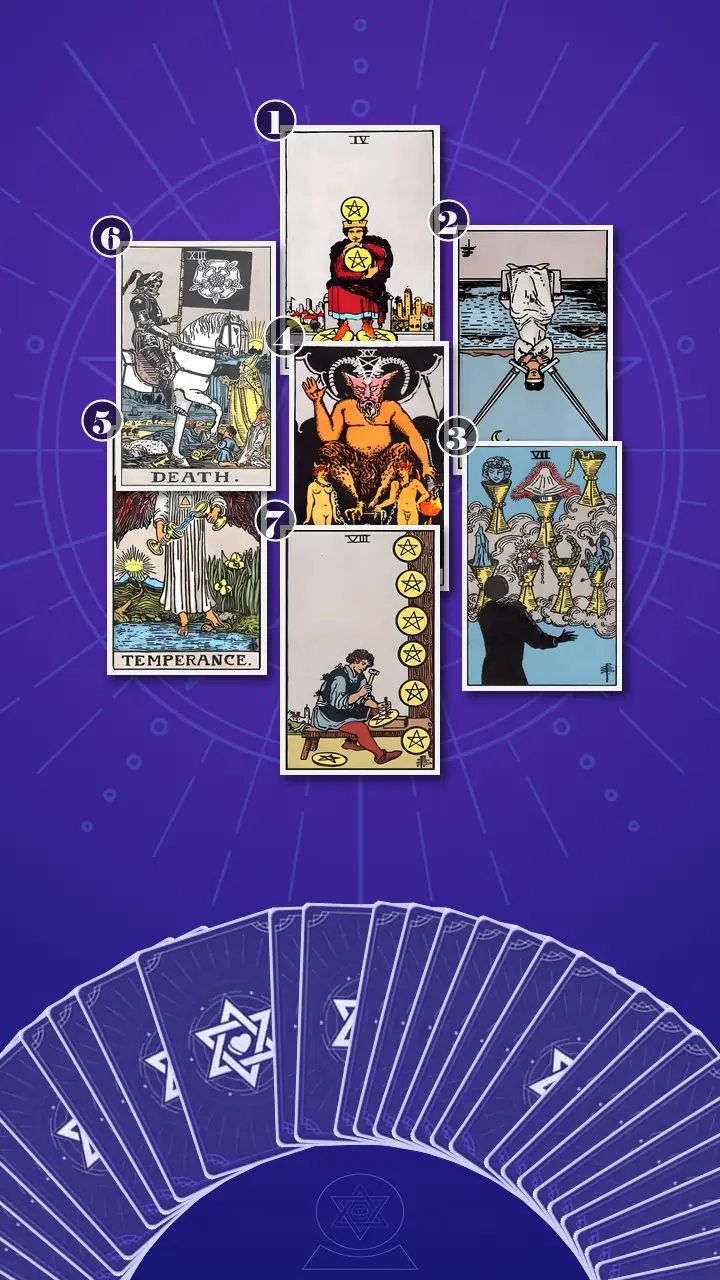
Reading the Map: When Digital Clutter Becomes a Self-Trust Problem
Position 1: The Most Visible Symptom—What You Do on Autopilot
“Now we turn over the card representing the most visible symptom-behavior of the ‘storage almost full’ loop—what you’re doing day-to-day,” I said.
Four of Pentacles, upright.
I didn’t even need to reach for an abstract meaning. The card practically narrated Taylor’s week: It’s 9:18 PM in your Toronto apartment, you’re on the couch, your phone warm in your hand. You see ‘Storage almost full.’ You still take one more screenshot—an event flyer, a skincare rec, a restaurant menu—because saving feels like being responsible.
“This is control-through-keeping,” I said. “It’s not greed. It’s grip. It’s the part of you that thinks, ‘If I hold tighter, nothing will slip.’”
In energy terms, Four of Pentacles is excess and contraction—too much holding, not enough flow. When that energy runs your phone, you end up protecting information the way you’d protect cash in your pocket… even when it keeps you from moving freely.
Taylor’s thumb rubbed the edge of her phone case. She didn’t look up. That was recognition, not resistance.
Position 2: The Inner Tug-of-War—Where the Decisions Jam
“Now we open the card representing the internal tug-of-war and decision fatigue that makes you stall,” I said.
Two of Swords, reversed.
“This,” I told her, “is the near-duplicate spiral.”
I described it exactly as it shows up in modern life: You open Photos to delete ‘just a few.’ You hit five versions of the same sunset, three screenshots of the same address, a selfie where the only difference is a fraction of a smile. Your jaw locks. You zoom in, compare, second-guess—and then you swipe out of the app and open Instagram, because at least scrolling doesn’t ask you to choose.
Two of Swords reversed is blocked Air energy—thinking that can’t land. Not because you’re incapable, but because you’re trying to make every tiny decision carry the weight of a life philosophy.
Taylor barked one short laugh and shook her head. “Why is this so accurate? I literally do that. Like, I can feel my body freeze and I just… escape.”
“Because ‘not choosing’ is still a choice,” I said gently. “It keeps the system exactly where it is.”
Position 3: External Pressure—The Infinite Inputs Feeding the Flood
“Now we turn over the card representing the modern environment triggers that intensify saving and postponing,” I said.
Seven of Cups, upright.
Seven of Cups is the algorithm in card form: too many shiny options, all floating in the cloud, all asking to be saved.
“Commuting, half-work, half-life-admin,” I said, tapping the card lightly. “You save a Reel about morning routines, bookmark a budget meals thread, screenshot a workout plan, open three tabs on how to organize your camera roll… and it all feels ‘potentially important.’”
In energy terms, this is inflated Water—a flood of possibility with no container. It’s not just screenshot hoarding. It’s FOMO dressed up as productivity.
Taylor’s eyes flicked up at me for the first time. “And work doesn’t help. Slack is like… if I don’t respond instantly, I feel behind. So I save everything.”
“Exactly,” I said. “Your environment is training you to treat every input like it’s urgent.”
Position 4: The Jammed Hub—The Engine of the Loop
“Now we open the card representing the deeper attachment driving the clutter-spend-avoid loop,” I said, and I turned over the center card.
The Devil, upright.
“Buying storage is relief,” I said, letting the line land. “Deleting is closure. They’re not the same thing.”
I watched Taylor’s shoulders tighten, then drop a millimeter as if her body recognized itself before her mind did.
“This card isn’t calling you weak,” I continued. “It’s naming a compulsion loop. When the red bar appears, the discomfort spikes. So you look for the fastest way to stop feeling it.”
I leaned into the micro-scene the card always brings me: You’re staring at iCloud storage tiers. You hover over ‘Upgrade.’ For a second, you exhale—because if you pay, you don’t have to decide. The shame softens for a day. Then it comes back, with a bigger bill attached.
Taylor’s reaction came in three beats: her breath paused; her gaze drifted past me like she was replaying the exact checkout screen; then she nodded once, slow and unwilling, the way you nod when you finally admit a chain exists.
“Yeah,” she said quietly. “That’s the chain.”
“And notice something important,” I added, pointing at the imagery. “The chains in this card are loose. They feel mandatory, but they aren’t. The real lock is the story: ‘I have to keep everything, or I’ll prove I’m careless.’”
Position 5: What Helps—The Middle Path That Doesn’t Trigger Rebound
“Now we open the card representing the stabilizing resource to regulate extremes,” I said.
Temperance, upright.
The café felt quieter for a moment, like the room agreed to stop pushing. The steam wand clicked off. Somewhere behind the counter, a spoon tapped porcelain—gentle, unhurried.
“If you wait for the perfect system, your storage will fill up faster than your motivation,” I told Taylor. “Temperance is the antidote to the all-night reset fantasy.”
And the modern translation was almost boring—on purpose: Set a 15-minute timer. Pick one category: screenshots. Delete only screenshots older than 30 days. No sorting. No re-reading. When the timer ends, stop on purpose.
Temperance is balance and regulation—not intensity. This is “interval training” for your attention: short sets, clear boundary, no burnout heroics.
Taylor exhaled like she’d been holding her breath since Sunday. “I could actually try that,” she said, surprised by her own voice.
When Death Cleared the Storage So the Present Could Fit
Position 6 (Key Transformation): The Clean Ending That Breaks the Spell
“We’re turning over the card representing the turning point that breaks the loop by redefining deletion as a clean ending rather than a loss,” I said, and I let my hand hover for a beat longer than usual.
The air shifted. Even the espresso machine seemed to hold its breath with us.
Death, upright.
People get dramatic about this card, but I’ve always found it practical. In my café, we close every night with a small clearing ritual—wipe down surfaces, purge old grounds, empty the knock box. Not because we’re punishing the day, but because tomorrow’s espresso can’t be brewed on yesterday’s leftovers.
This is where my Grounds Divination lens clicks into place: in Venetian cafés, you can read patterns in the sediment, but only after the cup is emptied. The shapes don’t appear in a full cup. The message requires space. Your digital life works the same way—meaning becomes readable after you clear the old residue.
Still, I watched Taylor brace, because the fear here is never “losing files.” It’s losing the illusion of control.
Setup (the moment right before the breakthrough): Taylor was back at the red storage bar in her mind—jaw tight, thumb hovering over ‘Not Now’—with that familiar urge to do literally anything except decide. She’d been treating every delete like a pass/fail test of judgment.
Delivery (the sentence that cuts through):
Stop searching for a perfect keep/delete verdict; choose one clean ending and let the old files ride out—Death clears the storage so the present can actually fit.
I let the words sit between us like the first sip of espresso: bitter, honest, oddly relieving.
Reinforcement (the body catches up to the truth): Taylor froze—actual stillness. Her eyes widened a fraction, then softened, like something in her finally unclenched. Her shoulders dropped, then she noticed they’d been up around her ears and let them drop again. One hand had been gripping her phone; her fingers loosened, slow, careful, as if she didn’t trust the release yet. She swallowed once. Her voice came out thinner than before, not dramatic—real. “Oh. That’s why this feels so hard.” She blinked fast, the way you blink when you’re trying not to make a thing into a thing. “It’s not storage. It’s… trust.”
I nodded. “Deletion isn’t punishment—it’s you trusting Future You to cope without receipts.”
Then I asked her the question that turns insight into lived memory: “Now, with this new perspective—can you think back over the last week. Was there a moment when you tapped ‘Not Now’ and went scrolling… and this idea could’ve made you feel different?”
Taylor stared at the tabletop, then gave a small, almost embarrassed smile. “Sunday. I hovered over the iCloud upgrade like it was a life raft.”
“That’s the moment,” I said. “This card is telling you the real risk isn’t deleting the wrong thing. The real risk is never letting anything end.”
In terms of her journey, this was the first step from overwhelm-and-self-critique toward calm agency: not a perfect purge, but a new identity-level permission—I’m allowed to choose endings.
Position 7: The Repeatable Rhythm—From Clutching to Crafting
“Now we open the card representing the realistic, repeatable action rhythm you can try this week,” I said.
Eight of Pentacles, upright.
“This is craftsmanship,” I told her. “Not a personality overhaul.”
The modern life version is beautifully unsexy: Every Thursday after dinner, you do a 20-minute digital maintenance session. Clear Downloads, delete duplicates, empty Recently Deleted. Track it with a single checkmark. It’s boring on purpose—and that’s why it works.
Eight of Pentacles is steady Earth energy: one pentacle at a time. Skill beats motivation when you’re building a sustainable system.
Taylor sat a little straighter. “Okay,” she said, and I could hear the difference. Not hype. Not shame. Just a plan forming. “I know what I’m doing this Thursday.”
From Insight to Action: A Small-Batch Delete Rule That Actually Sticks
When I stitched the spread together, the story was almost painfully coherent: Taylor’s surface habit (Four of Pentacles) is a tight grip—saving to feel prepared. That grip creates a mental bottleneck (Two of Swords reversed), and her environment keeps pouring in new “maybe important” inputs (Seven of Cups). At the center, the engine isn’t laziness—it’s The Devil: using saving and spending (hello, iCloud upgrade dopamine) as emotional regulation to avoid the discomfort of choosing. The way out isn’t a dramatic purge. It’s Temperance’s steady pacing and Death’s clean endings—then Eight of Pentacles turns it into maintenance instead of crisis.
The cognitive blind spot was simple: Taylor had been treating deletion like a courtroom verdict—prove you’re competent, prove you won’t regret it—instead of treating it like normal closure. The transformation direction was equally simple: shift from “keep everything just in case” to “curate with a simple rule and practice letting go in small batches.”
“Here’s what I want you to do,” I said, switching into my clearest coach voice. “Not forever. Just this week.”
- The 15-Minute Screenshot SweepOnce this week, set a 15-minute timer. Delete only screenshots older than 30 days—no sorting, no re-reading, no debating. When the timer ends, stop.Expect “But what if I need it?” That’s your cue to lower stakes, not negotiate. One rule + one timer keeps decision fatigue contained.
- One Clean Ending (Death’s Door Close)Pick one album/folder named “To Sort”. Choose a clean ending: delete it outright, or move only 10 truly needed items into one folder called “Actually Important,” then delete the rest.Before you delete, say: “This is me choosing space.” If it turns into self-punishment, stop immediately and return later—closure, not penance.
- A Weekly Maintenance Slot (Eight of Pentacles Mode)Schedule a 20-minute weekly Digital Maintenance block (pick a day/time you can keep). Each week is one category only: Downloads, duplicates, screenshots, or voice notes.No “while I’m here” expansions. Miss a week? Don’t do a marathon—just return to the next 20 minutes.
Before Taylor left, I offered one of my café-based tools as a little extra support: Aroma Anchoring. “Choose one scent you already associate with calm—coffee, vanilla, even your hand cream,” I said. “Every time you start your 15-minute timer, smell it on purpose for one breath. Your brain learns: this is safe, this is contained, this ends.”

A Week Later: The Quiet Proof
Five days later, Taylor DM’d me a screenshot—ironically, yes, a screenshot—of her calendar with a small block labeled “Digital Maintenance.” Under it, one line: “Deleted screenshots older than 30 days. Didn’t die.”
Her follow-up message was even better: “I took a video on the TTC today and it just… worked. I felt weirdly emotional about it. Like my phone stopped fighting me.”
I pictured her in a coffee shop after work, alone at a small table, phone charging, shoulders lower than usual. Not euphoric—just lighter. The old guilt still hovering at the edges, but quieter, like background noise turned down a notch.
This is what a journey to clarity looks like in real life: not a perfect system, but a clean ending chosen on purpose—and a small practice that keeps the present from getting crushed under “just in case.”
When your storage bar goes red, it can feel like you’re not just deleting files—you’re trying to prove you won’t regret being the kind of person who lets something go.
If you let yourself treat deletion like a clean ending—not a verdict—what’s one tiny category you’d be willing to close this week, just to see how it feels?