Non-Compete Ends Friday: From Draft-Loop Panic to a Pilot I’d Defend

Finding Clarity in the 11:42 p.m. Two-Tab Ritual
If your non-compete ends Friday and you’ve got a launch email in drafts—but you keep reopening the agreement like the PDF will magically tell you what to do (classic decision paralysis), I already know the posture your body has been taking around your laptop.
Jordan (name changed for privacy) showed up on my screen from a Brooklyn apartment kitchen table at 11:42 p.m. Cold takeout sat to one side like it had given up on being comforting. The radiator hissed in that steady, irritated way NYC radiators do. Blue laptop light reflected off the dark window, turning their face into a faint mirror.
On the left: a draft launch email—ConvertKit open, subject line blinking like a tiny metronome daring them to commit. On the right: a PDF of the old employment agreement with yellow highlights and comments in the margins. Their phone vibrated with a calendar reminder that simply read: NON-COMPETE ENDS FRIDAY.
Jordan’s jaw was set so tight I could almost hear it. Their shoulders crept upward in slow motion. Their hands kept doing that restless, wired thing—touching the trackpad, tapping a pen, hovering over “Save draft” like it was a life raft.
“I’m not scared of the work,” they said. “I’m scared of the first public step. I want to hit publish the second my non-compete ends… and then I freeze and rewrite everything until it barely exists. I don’t need permission. But I do need a rule I trust.”
Anticipatory pressure has a particular texture. In Jordan, it looked like a body bracing for impact in a room where nothing is actually moving—like trying to run a sprint while someone’s hand is pressing down on your shoulders.
I let that land without trying to cheerlead it away. “Okay,” I said gently. “We’re not going to force certainty where it doesn’t exist. We’re going to find clarity you can actually use—something you can explain, repeat, and trust. Let’s draw you a map through this Friday fog.”

Choosing the Compass: The Decision Cross Tarot Spread
I’m Laila Hoshino. By day, I guide people through a Tokyo planetarium—ten years of watching faces tilt up when the dome goes dark and the stars appear. By night, I read tarot with the same respect for rhythm and orbit. Dates matter, but they don’t decide anything on their own. They’re just coordinates.
Before we touched the deck, I offered Jordan one small thing I use with anxious, high-functioning brains that try to think their way into safety: my pre-meeting 3-minute cosmic breathing. Three minutes. That’s it. Inhale like you’re pulling in air from the edge of the atmosphere. Exhale like you’re letting gravity take what you don’t need. It’s not mystical; it’s a nervous-system handoff.
Then I shuffled slowly and said, “For your question—my non-compete ends Friday… do I launch my idea or wait?—I’m going to use a spread called the Decision Cross.”
For readers who are curious about how tarot works in a situation like this: the Decision Cross is perfect when you’re stuck between two paths (launch now vs wait) and the real issue is not prediction, but structure. It gives just enough framework to compare options, reveal the deciding principle you’ve been missing, and turn insight into actionable advice.
Here’s what I told Jordan to expect: “The center card will show the current pressure point—what your paralysis looks like in real life. Left will be Path A: if you take a public step right away. Right will be Path B: if you pause. Above will be the deciding principle—the rule that governs both. Below will be the grounded next step you can take in the next 7–14 days.”
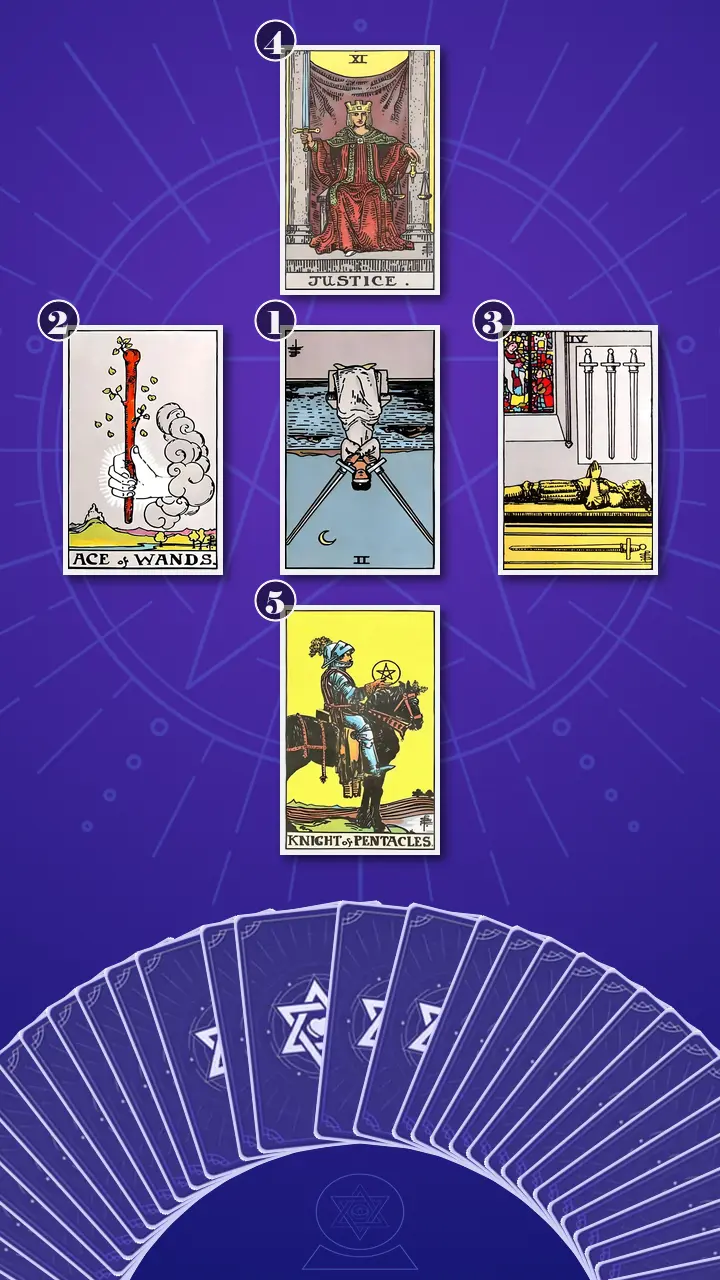
When Justice Drew a Clean Line: Launch Now vs Wait When Your Non-Compete Ends Friday
Position 1 — The current pressure point
“Now turning over,” I said, “is the card that represents the current pressure point: the specific way decision paralysis is showing up as you approach the non-compete end date.”
Two of Swords, reversed.
It was almost too on-the-nose. In my mind, it split the screen exactly the way Jordan had been living it: left side, Gmail/ConvertKit with the subject line blinking; right side, a highlighted PDF with clauses that looked like they could judge you if you stared long enough.
“This,” I told them, “is the two-tab ritual. Draft on the left. Agreement on the right. You rewrite one sentence—‘what I’m building’—into something so vague it stops being a real offer, and you call it ‘being careful.’ Your body tells the truth: tight jaw, tense shoulders, restless hands. That’s the alarm system. The blindfold energy.”
In reversed position, the Two of Swords isn’t a calm stalemate. It’s a stalemate that’s becoming impossible to maintain. The block is cracking, but not elegantly—more like pressure building behind a door you’ve been holding shut.
“You’re not avoiding the work,” I said, keeping my voice steady. “You’re avoiding the exposure of being clear.”
Jordan let out a small laugh that sounded like it had teeth. “That’s… brutal. Accurate. But brutal.” Their fingers tightened around their mug, then loosened. A quiet nod followed—like part of them wanted to reopen the draft immediately just to prove they weren’t stuck.
“Let’s name the two fears out loud,” I said. “Not solve them. Just name them.”
“Visibility risk,” Jordan said, fast. Then, after a beat: “Lost momentum.”
Position 2 — Path A (Launch now)
“Now turning over,” I said, “is the card that represents Path A: what energy becomes available if you take a public first step immediately after Friday.”
Ace of Wands, upright.
“This is the spark,” I said. “Not the whole bonfire. In modern terms, it’s not ‘launch day.’ It’s a first commit.”
I described what it looked like in Jordan’s world, because that’s where tarot becomes practical: Friday morning, a barebones waitlist page—no dramatic positioning, no over-explaining. A title. One honest sentence about the problem. A button. Cursor blinking. Phone warm in your hand as you hover over Publish.
“The Ace says: momentum is available the moment the restriction lifts,” I said, “but the best use of it is a simple, focused first move—not an engineered debut that tries to pre-defend every hypothetical.”
Energy-wise, this is Fire in balance: clean initiation. But if it gets hijacked by adrenaline and FOMO, it becomes spectacle. That’s the risk—posting to prove you’re not behind because LinkedIn hit you with another ‘I’m excited to announce…’ jump scare.
Jordan’s face softened for a second. Not relaxed—more like remembering they actually want this. “I could do a small version,” they said, surprised by their own sentence.
“Yes,” I said. “And here’s the permission frame—not permission from anyone else. Permission from your own rules: I’m allowed to begin before I can explain everything.”
Position 3 — Path B (Wait)
“Now turning over,” I said, “is the card that represents Path B: what this pause is actually for if you choose to hold back a little longer.”
Four of Swords, upright.
This card doesn’t say “hide.” It says “recover and structure.” It’s the difference between a strategic pause and an indefinite postponement that slowly turns into shame.
“If you wait,” I said, “this card wants it to be a container. A one-week quiet build sprint. Phone on Do Not Disturb. Close social apps. Three internal milestones. End date on the calendar so it doesn’t turn into fog.”
I could practically see the scene: Jordan making a checklist labeled “7-day quiet build,” the way some people make a Notion board called Launch Plan v4—but this time with fewer tabs and more boundaries. The discomfort would still be there—wired-but-stuck—but now it would have purpose.
Jordan’s shoulders dropped a fraction. Relief, but without the guilt. “So waiting isn’t automatically… failing,” they said.
“Not if it’s purposeful,” I answered. “Rest doesn’t cancel momentum. It prevents you from burning it up in one anxious post.”
Position 4 — The deciding principle (Key Card)
When I reached for the fourth card, I slowed down on purpose. The room didn’t change, but the tone did—the way it does in a planetarium when the last city light fades and everyone realizes the next thing they see might rearrange them.
“Now turning over,” I said, “is the card that represents the deciding principle: the non-negotiable standard that makes either option workable.”
Justice, upright.
Justice is scales and sword: measure first, then speak with precision. It’s boundaries that hold steady when your emotions surge. It’s also the adult part of you that can say, “Here is what I’m doing. Here is what I’m not doing. Here is how I can show the difference.”
And this is where my research brain always kicks in. In orbital mechanics, you don’t brute-force your way out of uncertainty—you use structure. You calculate what you can, define constraints, and then you fly inside them.
I leaned into my Dark Matter Detection lens—my way of finding the overlooked factor that’s shaping everything. “There’s something missing here,” I told Jordan, “and it’s not courage. It’s not even information. It’s a rule you trust—your own internal audit. Right now you’re outsourcing that trust to Reddit edge cases and highlighted clauses.”
Setup. It was Thursday night in NYC, and Jordan was flipping between a draft launch email and an old employment agreement like the right tab would finally hand them certainty. Their brain had turned Friday into a one-shot gate: one wrong step and momentum, money, reputation—gone.
Delivery.
Not “I have to choose perfectly on Friday,” but “I can weigh what’s true and act with a clear blade”—let the scales and sword of Justice turn urgency into a defensible first move.
I let it sit in the air for a breath, the way you let a star name hang after you point to it.
Reinforcement. Jordan’s body answered before their mouth did—three distinct beats. First: a freeze, like their breath paused mid-inhale and their fingers stopped fidgeting above the trackpad. Second: their gaze went slightly unfocused, as if their mind replayed the week—every time they’d made the copy “safer” until it barely existed. Third: a long exhale that loosened something around their mouth; the jaw unclenched, not from relief that everything was guaranteed, but from the feeling of having a handle.
“But…” Jordan said, and there it was—the flash of resistance. Their eyebrows pulled together. “If I need boundaries and receipts and wording rules… doesn’t that mean I’ve been doing it wrong? Like I was naive?”
I shook my head. “No. It means you were trying to protect yourself with the only tool you had available: vagueness. Justice doesn’t shame you for that. It upgrades your protection system from ‘disappear’ to ‘be clearly bounded.’”
I gave them the exercise in the most unglamorous, usable form. “Set a 10-minute timer. Open a Notes doc. Title it: Rules of Engagement. Then bullet point these four lines:
(1) What I am launching in the next 14 days.
(2) What I am explicitly not launching.
(3) What language I will and won’t use publicly.
(4) What proof I can keep—timestamps, drafts, notes, early prototypes.
If your jaw clenches or your thoughts race, switch to shorter bullets. This isn’t a performance. And if you find yourself drifting into legal interpretation, stop and mark it as: ask a lawyer / don’t assume.”
Then I asked the question that turns a pretty insight into lived change: “Now, with this new lens—Justice as your deciding standard—think back to last week. Was there a moment you almost hit publish, or almost told a friend what you were building, and you felt that bracing in your shoulders? If you’d had a written scope and one calm sentence, how would that moment have felt different?”
Jordan swallowed. “I would’ve sent the DM,” they said quietly. “Not the big post. Just… the DM.”
“That,” I said, “is the shift from deadline-driven launch paralysis and visibility fear to grounded confidence. Not because the world becomes safer overnight—because you become more explainable to yourself.”
And I added the line I wanted them to borrow on Friday when the calendar tried to bully them: “Friday doesn’t decide for you. Your boundaries do.”
Position 5 — Actionable next step
“Now turning over,” I said, “is the card that represents the smallest grounded move you can take in the next 7–14 days that reduces regret and builds momentum.”
Knight of Pentacles, upright.
“This is the Builder,” I said. “Low-drama progress. A repeatable cadence.”
In real life, it looked like a two-week pilot—not a huge Product Hunt blast, not a loud ‘new founder identity’ reveal. A contained rollout: private beta, small cohort, or a quiet consulting offer with a clear deliverable. One metric. Tracked daily. Evidence over hype.
Jordan nodded slowly, like their nervous system was finally willing to stay in the room. “I don’t need hype,” they said, almost to themselves. “I need evidence.”
“Exactly,” I replied. “A pilot is a launch with a seatbelt.”
The Boundary-First Pilot: Actionable Next Steps You Can Defend
I pulled the whole spread together the way I’d explain a constellation to a group: not as five random stars, but as one shape you can actually navigate by.
“Here’s the story,” I said. “You’re at a career crossroads where one hard date has started to feel like a starting gun. The Two of Swords reversed shows the pressure point: you’ve been protecting yourself by keeping everything in drafts and toggling between protection and momentum. The Ace of Wands says your idea has real ignition available on Friday—but it needs to be small and honest, not performative. The Four of Swords says waiting can be wise, but only if it’s structured and time-bound. Justice is the missing piece: you don’t need more scrolling; you need clean boundaries you can explain. And the Knight of Pentacles is your way forward: a contained experiment with a steady rhythm.”
“Your cognitive blind spot,” I added, “is believing the opposite of ‘risky’ is ‘invisible.’ It’s not. The opposite of risky is clearly bounded.”
“And your transformation direction is this,” I said, making sure it sounded like a plan, not a prophecy: “Shift from a binary ‘launch vs wait’ mindset to a defined, compliant pilot—small first release, clear boundaries, documentation, and scope.”
Then I gave Jordan concrete next steps—small enough to start, clear enough to defend.
- Write your 10-minute “Rules of Engagement” docTonight or tomorrow morning, open Notes/Google Doc and bullet: (1) what you will launch in the next 14 days, (2) what you will not launch, (3) the exact calm sentence you’ll use publicly, (4) language you will/won’t use (no hype, no vague dodge-phrases).If you feel your jaw clench, switch to shorter bullets. If you start doing DIY legal interpretation, stop and label it “ask a lawyer / don’t assume.”
- Create a “Receipts” folder to build self-trustMake a Drive/Dropbox folder called “Receipts — Independent Work.” Add dated drafts, early notes, prototypes, research logs, and a simple timeline of what you built and when.Keep it boring. Think “changelog,” not “courtroom.” The goal is nervous-system safety through evidence, not drama.
- Run a 14-day boundary-first pilot (not a big launch)Choose a limited audience (10–20 people). Send a DM-only invite with one sober line: “I’m exploring this problem—want to talk?” Track one metric for two weeks (e.g., 8 conversations booked or 25 waitlist sign-ups). Add three 45-minute build blocks on your calendar each week to ship one tangible artifact.If anxiety spikes, shrink the audience before you shrink the idea. Make it small enough to ship, clear enough to defend.
To help Jordan decide which version of visibility fit their body—not their ego—I used my “constellation alignment” shortcut: we quickly sketched two tiny constellations on paper. One labeled DM-only pilot. One labeled public waitlist. Under each: three pros, three cons, one boundary. Not to find perfection—just to see which option made their shoulders drop by even 10%.

A Week Later: The Quiet Proof of Grounded Confidence
Six days later, I got a message from Jordan. Not a victory lap. Not a screenshot of a viral post. Just a photo of a Notes doc titled “Rules of Engagement,” three headings visible: Scope, Messaging, Receipts. Under it: “Sent 12 DMs. Booked 3 calls.”
They added, “I slept a full night. Woke up and my first thought was still, ‘What if I’m wrong?’ But it didn’t spiral. I just… checked the scope line and sent the next message.”
That’s what a real Journey to Clarity looks like most of the time: not fireworks—just the moment the calendar stops being a verdict and becomes a coordinate. Not a perfect emotional state—just a clean boundary and one contained experiment that proves you can move.
When a hard date is coming, it can feel like you’re holding your idea in one hand and your future safety in the other—jaw tight, tabs open, trying to word-smith your way into a guarantee that doesn’t exist.
If you didn’t have to “launch perfectly” on Friday—only take one small, explainable step inside boundaries you trust—what would that first step look like for you this week?