From Numb Frustration to Beta Momentum: Ending Prep-Mode Loops

The Notion Dashboard That Kept Buffering
You’re a late-20s city professional with a stable job on paper, but you’ve been living in “prep mode” for months—rewriting the plan, refreshing the tabs, waiting for clarity that never fully arrives.
That’s the sentence Jordan said made them finally book a session with me—half laughing, half wincing, like they’d been caught doing something they didn’t even know had a name.
When they showed up on my screen (Toronto condo lighting, the slightly-blue glow of a laptop camera), I could see the story in their body before they said a word: shoulders lifted like a winter coat they couldn’t take off, jaw set like they were bracing for impact. Behind them, a tiny kitchen table; in front of them, the modern altar of a stuck life—laptop open, tabs hiding in plain sight.
“It’s 8:57,” Jordan said, glancing at the corner of the screen like it was a deadline. “This is literally the time I always do it. I sit down to apply for one UX role, and somehow… I’m rearranging a Notion ‘Life Reset’ dashboard again.”
I listened for the unspoken part, the thing that makes the whole loop snap into focus. It arrived in the next breath.
“I want a clean reset,” they said, voice low. “But I don’t want the first step to become evidence I chose wrong.”
That kind of frustration isn’t a dramatic panic. It’s more like trying to run through waist-high slush—every movement technically possible, but it costs twice as much, and you can feel yourself getting colder with every attempt. Jordan’s frustration had a numb undercurrent: flat all day, then a late-night spike of pressure to “fix everything,” like their nervous system only remembered it had needs after 10 p.m.
“Okay,” I said gently. “Let’s not try to fix your whole life tonight. Let’s do something more useful: let’s make the loading screen visible. Then we’ll figure out the first tiny input that actually moves the bar.”
I leaned in a little, the way I do on-air when a caller is right on the edge of saying the real thing.
“Before we pull cards—what’s the next irreversible-ish click you keep circling? Is it send? book? apply?”

Choosing the Compass: The Celtic Cross · Context Edition
I asked Jordan to put one hand on their jaw for a second. Not as a mystical gesture—just a check-in. “Notice if you’re clenching. That’s data.” They exhaled and their shoulders dropped about a millimeter, like a system recalibrating.
Then I shuffled slowly, the way I’ve learned to do after a decade of hosting a radio show about sound and the nervous system. The shuffle is a transition: from spiraling inside your head to focusing on one question you can actually work with.
“Today we’ll use a spread called the Celtic Cross · Context Edition,” I told them, and I said it clearly enough that anyone listening—anyone Googling how tarot works when you’re feeling stuck—could follow. “It’s based on the classic Celtic Cross, but I adapt the last position. Instead of predicting a fixed ‘outcome,’ we use it as integration: what your reset needs first to become sustainable.”
This spread works for a full-body ‘loading screen’ state because it gives us structure: what’s happening day-to-day, what crosses you, what’s underneath it, what you’ve been carrying, what story you’re operating under, and what energy becomes available the moment you do one real thing. Then it climbs—like steps—toward a grounded next priority.
“We’ll pay extra attention to three spots,” I said. “The present stuck point, the primary blocker, and the integration card—the part that turns insight into next steps.”
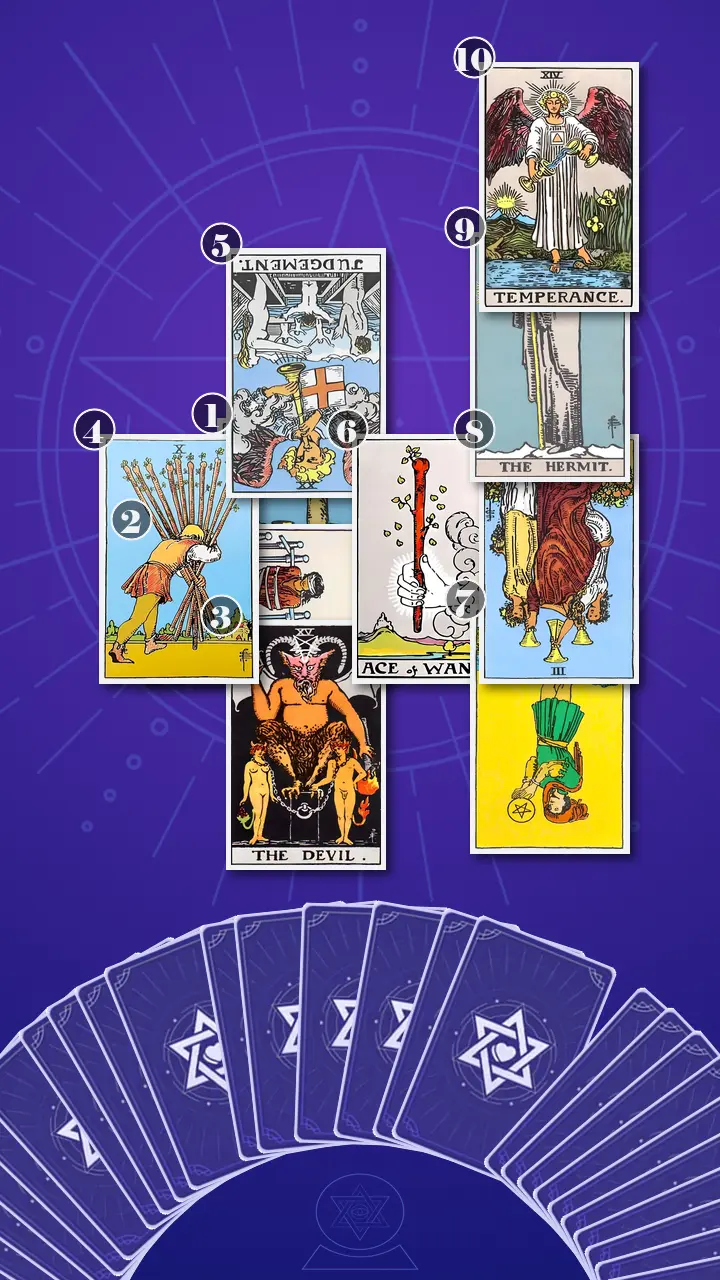
Reading the Map: Card Meanings in Context
Position 1 — Present stuck point: what day-to-day ‘loading screen’ looks like
“Now flipped over,” I said, “is the card representing your present stuck point—the lived ‘loading screen’ feeling and what’s happening day-to-day.”
Four of Cups, upright.
The image is almost painfully familiar: someone sitting under a tree, arms crossed, staring at three cups while a fourth is offered from a cloud—an invitation they’re not taking.
“This is you at the kitchen table,” I said, nodding toward their laptop. “Not because you don’t want change. Because what’s being offered doesn’t match the imagined ‘perfect reset.’ So your system goes: not enough. And it shuts the door.”
I used the modern translation I’ve watched play out in a thousand lives: “It’s like keeping a dozen tabs open for a better option while ignoring the one actionable email, application, or calendar slot that would actually start movement.”
Energy-wise, the Four of Cups is stagnation through disengagement—not a lack of intelligence, not laziness. More like emotional buffering.
Jordan let out a quick, bitter laugh.
“That’s… so accurate it’s kind of rude,” they said. “Like—yes. I’m sitting here waiting to feel something, and I’m also mad at myself for not feeling it.”
“That reaction makes sense,” I said. “The Four of Cups doesn’t shame you. It just tells the truth: when life doesn’t offer the movie-scene reset, you miss the small offer that would actually start the next chapter.”
Position 2 — Primary blocker: what most directly prevents the reset from starting
“Now flipped over is the card representing your primary blocker—the thought pattern or rule that stops you right before the click.”
Eight of Swords, upright.
The blindfold. The loose bindings. The swords forming a cage that isn’t even fully closed.
“This is the mental version of being stuck on the TTC at Bloor-Yonge,” I said, letting the scene land the way it does in Toronto—crowded, loud, and somehow still lonely in your own head. “You’re standing near the door on Line 1. The train hums. Your phone is warm in your hand. You open the same saved job post again. And the rule shows up like a pop-up you can’t close.”
I spoke it out loud so it stopped being fog: “I can’t start until I’m 100% sure.”
Then I did what I call an inner-monologue rewrite—because the Eight of Swords dissolves when the rule becomes visible.
“Notice what’s literally verifiable,” I continued. “In your body: tight jaw, breath held high in your chest. On your screen: the unsent draft, the open tab, the cursor that never clicks. This is a blockage—an Air overload. Thoughts doing too much, not enough permission.”
Jordan didn’t nod right away. They went still—eyes unfocusing for a second, like they were replaying a week of commutes in their head.
“I hate that you’re right,” they said quietly. “Because I always call it ‘being responsible.’ But it’s… a rule.”
“Exactly,” I said. “And rules can be renegotiated. Facts can’t.”
Position 3 — Root mechanism: the deeper attachment or fear keeping the loop running
“Now flipped over is the card representing the root mechanism—the deeper attachment or fear that keeps restarting the loop even when you ‘know better.’”
The Devil, upright.
I always slow down here, because The Devil isn’t about being a bad person. It’s about a system that’s running you.
“This is the ‘control-as-safety’ part of you,” I said. “And it has a very modern face. It looks like an algorithm that rewards looking productive over being in contact with reality.”
I described the loop the way Jordan had already lived it:
“LinkedIn scroll → comparison sting → your chest drops → you feel behind → then you open Notion and ‘optimize’ for an hour, because optimization feels like control.”
Jordan swallowed. Their hand drifted to their neck without them noticing.
“And here’s the hardest, most relieving part,” I added, keeping my voice warm. “The chains in this card are loose. Which means the bond is partly consented to. Not because you chose it consciously—but because it once protected you.”
I watched their expression shift: stomach-drop recognition, then a softer exhale.
“At work,” they said, “people think I’m… the capable one. I’m good at explaining risks. I can be calm in meetings. But if I’m a beginner in public—if I apply and it’s not perfect—then what am I?”
“There it is,” I said. “If the first step feels like a verdict on your worth, you’ll keep living in the waiting room.”
The Devil’s energy is a blockage through attachment: attachment to control, to image, to not being seen trying.
Position 4 — Recent past load: what you’ve been carrying that led to shutdown
“Now flipped over is the card representing your recent past load—what you’ve been carrying that set the stage for this numbness.”
Ten of Wands, upright.
I pointed to the figure bent under the bundle, vision blocked by what they’re hauling.
“This isn’t you being broken,” I said. “This is you being over-responsible for too long. Carrying work, carrying self-improvement, carrying social expectations, carrying ‘I should be grateful, I should be advancing, I should be optimizing.’”
Energy-wise, Ten of Wands is excess. Too much effort treated as the only valid currency.
“When you’ve been carrying that much,” I said, “Four of Cups makes sense. Shutdown is a nervous system strategy.”
Jordan’s shoulders lifted again for a second, then dropped. Like their body was admitting how heavy it had been.
Position 5 — Conscious narrative: the rule you think must be true before you can reset
“Now flipped over is the card representing your conscious narrative—what you think you need before you’re allowed to start.”
Judgement, reversed.
“Judgement upright is the call,” I said. “The moment you hear ‘it’s time’—and you answer.”
“Reversed,” I continued, “it looks like waiting for a perfect sign, a perfect plan, a perfect version of you. Like: once I feel confident, then I’ll do it.”
In the reversal, the energy is blocked awakening—not because you don’t want to change, but because starting before you feel ready feels like stepping into a spotlight.
Jordan gave a tiny nod that wasn’t quite agreement—more like surrender.
“What would it mean about you,” I asked, “if you started before you felt ready?”
They looked away from the camera. “That I’m… not as competent as people think.”
“Or,” I offered, “that you’re human, and you’re allowed to learn in motion.”
Position 6 — Available next energy: what becomes possible when you take one small first step
“Now flipped over is the card representing the available next energy—what shows up the moment you take one small step, not a guaranteed outcome.”
Ace of Wands, upright.
“Here’s the spark,” I said, and even through a screen I felt the shift: Fire arriving in an Air-and-Water loop.
“This is that one-click moment,” I told them, and I made it cinematic on purpose because the Ace of Wands is simple and physical. “Cursor hovering over Submit. Finger hesitating. Screen brightness too bright in the dark kitchen. The tiny click sound that feels louder than it should.”
“And then—micro-yes.”
The energy here is available ignition. Not a life sentence. A test run.
“Stop waiting for 100% certainty,” I said, using one of my favorite phrases because it cuts through perfectionism without shaming it. “Ship the 10% test.”
Jordan’s throat bobbed as they swallowed, and I saw the smallest lift at the corner of their mouth—like something inside them believed me for two seconds.
Position 7 — Self-positioning: how you show up in the reset process
“Now flipped over is the card representing your stance—how you currently show up in the reset process, especially beginner energy and follow-through.”
Page of Pentacles, reversed.
“This is the student mindset getting jammed,” I said. “When reversed, the Page treats practice like a final exam.”
I pointed to the coin the Page studies. “You’re staring at the ‘right way’ so hard that you never do the first rep.”
Modern translation: “This is watching tutorials and reading threads for hours, then feeling too intimidated to open the software and try the simplest version yourself.”
The energy is deficiency in grounded follow-through—not because you can’t, but because the stakes are inflated.
Jordan let out a breath that sounded like the first honest one of the day. “I literally have a folder called ‘Portfolio Tips’ with… I don’t even want to tell you how many bookmarks.”
“You don’t have to tell me,” I said. “I believe you.”
Position 8 — External inputs: social media, friends, work culture shaping your pace
“Now flipped over is the card representing external inputs—the environment that shapes your sense of pace and worth.”
Three of Cups, reversed.
“Community turned out of tune,” I said. “This is comparison fatigue. Highlight reels. The pressure to perform your reset like it’s a glow-up montage.”
I didn’t need to invent it. Jordan had already told me the scene: TTC screech, LinkedIn scroll, someone else’s ‘thrilled to announce…’ and that instant, private stomach drop.
Energy-wise, Three of Cups reversed is imbalance: connection becomes performance. Support becomes a scoreboard.
“The danger,” I added, “is you’ll either overcompensate—make a huge plan to catch up—or you’ll withdraw completely and lose the people who would actually help you feel human.”
Jordan pressed their lips together, then nodded once. The kind of nod that means: called out, but safely.
Position 9 — Hope-fear tension: what you secretly want, and what you fear it will cost
“Now flipped over is the card representing your hopes and fears.”
The Hermit, upright.
“You want quiet,” I said. “Not empty quiet—intentional quiet. The kind where you can hear yourself think without a podcast, without a productivity video playing like a moral obligation in the background.”
The Hermit’s lantern is a small light, not a full map. “You hope stepping back will bring clarity,” I continued, “and you fear stepping back means falling behind.”
The energy here is balance through inner guidance—but only if it’s structured. Otherwise, it turns into isolation-as-safety.
Jordan’s eyes softened. “I miss… not being so loud in my head.”
“That’s a very real need,” I said. “And it’s part of the reset. Not a reward you earn after.”
When Temperance Poured Between Two Cups
Position 10 — Integration and first priority: what your reset needs first
I let my hands rest on the deck for a beat. The room—even through a video call—felt quieter, like a studio right before the mic goes live.
“We’re turning over the most important card in this reading,” I said. “Not a prediction. An instruction.”
“Now flipped over is the card representing integration and first priority: what your life reset needs first to become sustainable.”
Temperance, upright.
The angel pours water between two cups. One foot on land, one in water. A path leading to a rising sun. No drama—just steady alchemy.
Setup (the trap you’ve been living in): It’s 10:46 PM, you’re on the couch with your laptop open, Notion dashboard glowing like a tiny control room—your jaw is clenched, your shoulders feel heavy, and you’re still telling yourself you’re “getting ready” to start. You’re waiting for the bar to hit 100% certainty before you’re allowed to move.
Delivery (the sentence that changes the physics):
Stop treating the reset like a single dramatic rebirth and start mixing small, repeatable ingredients like Temperance pouring water between two cups.
I paused long enough for it to echo.
Reinforcement (what I watched happen in their body): Jordan’s breath stopped first—like their system froze on the exact frame where they usually panic and open another tab. Then their eyes went slightly glassy, gaze drifting off-camera, as if they were seeing every Sunday night they’d tried to “start over” by perfecting a template. Finally, their shoulders dropped in a slow cascade, and their mouth opened on a soft, surprised exhale—relief, and also a tiny grief that they’d made it so high-stakes for so long.
“So it’s not… a full factory reset,” they said, voice a little shaky. “It’s… like syncing?”
“Yes,” I said, and this is where my own life’s work slid in naturally—the part of me that’s spent years studying how sound regulates stress, how rhythm builds safety. “Temperance is stable sync. In audio terms, it’s not a single perfect track. It’s a playlist you can actually finish.”
“I call it a Breath Soundtrack,” I added, bringing in my signature skill the way I would on my radio show. “Because when people are stuck in analysis paralysis, their breath gets choppy. Their body thinks the first click is danger. We don’t argue with that—we give it a rhythm.”
I counted it out softly. “Inhale for four. Exhale for six. Not to ‘calm down’ as a performance—just to tell your nervous system: we’re safe enough to try one small thing.”
Then I gave them the core line I wanted them to carry into real life: “A reset doesn’t start with certainty—it starts with a rhythm you can actually repeat.”
I leaned forward. “Now—use this new lens and rewind. Last week, was there a moment where this would have changed how you felt? A moment you were about to click send, book, apply… and you didn’t?”
Jordan blinked fast, then nodded. “Tuesday. 9:18. I had the intake form open for a therapist. I filled it out. Then I stared at the last button and thought, ‘If I do this, it means I’m officially not okay.’ So I… watched an Ali Abdaal video and reorganized my calendar.”
“That’s perfect data,” I said. “Not a failure. Data.”
And I named the transformation out loud so it stayed anchored: “This is you moving from numb frustration and self-judgment toward grounded momentum—by shifting from ‘I need certainty’ to ‘I can run a small experiment and learn.’ That’s self-trust in its earliest, most real form.”
From Insight to Action: The Two-Cup Mix for Finding Clarity
I pulled the whole story together for them, like I was producing a segment: a clean narrative arc, no mysticism required.
“Here’s what the spread is saying,” I summarized. “You’re in Four of Cups—emotionally disengaged because the current options don’t look like the perfect reset. Eight of Swords crosses you—an invisible rule that says you can’t start until you’re sure. Underneath, The Devil is running the algorithm: your worth gets tied to outcomes and looking competent, so beginning feels like a public verdict. Ten of Wands explains why you’re numb—you’ve carried too much too long. Judgement reversed keeps you waiting for the ‘right’ you to arrive. Ace of Wands says momentum returns the moment you take one real click. But Page of Pentacles reversed warns you’ll over-prepare unless we build structure. Three of Cups reversed says social inputs distort your pace. The Hermit says you need less noise. And Temperance says the reset begins with a repeatable rhythm: one action + one recovery, daily.”
“Your cognitive blind spot,” I added carefully, “is that you’ve been treating planning as proof of responsibility. Planning isn’t the problem—planning as protection is. It protects you from being seen trying.”
“The direction,” I said, “is not a dramatic overhaul. It’s beta mode. Small steps, quick feedback, gentle adjustments. That’s how you get out of ‘prep mode’ and into lived momentum.”
The Beta-Mode Reset (with sound as your stabilizer)
I offered Jordan actions that were intentionally unglamorous—because unglamorous is sustainable.
- The 10-Minute Two-Cup MixSet a 10-minute timer. Do one energizing micro-action (send one message, submit one low-stakes form, book one time slot, or write 5 messy lines in the doc). Immediately after, do one grounding micro-recovery (drink water at the window + 5 slow breaths, or a 7-minute walk around the block with no podcast). End by writing one sentence: “What did I learn from contact with reality?”If perfectionism spikes, scale it down to 2 minutes + 2 minutes. This is not a productivity test—it’s reality contact.
- One Irreversible-Ish ClickChoose one tiny step that makes it real (submit one application, book one therapy consult, or send one outreach). Do it once—today or within 48 hours—then stop. No “ten more,” no redesigning the plan afterward.Expect your brain to call it “too small to matter.” That’s the point: small keeps your worth out of the blast radius.
- My BGM Prescription (3-track container)Before you start the Two-Cup Mix, play a short, repeatable sound cue: (1) 60–70 BPM instrumental for 2 minutes while you set the timer, (2) a higher-energy track around 110–130 BPM during the micro-action, (3) low, steady brown noise or rain audio for the recovery block. Same three cues for a week so your body recognizes the routine.Make it repeatable on a bad day—that’s the whole point. If silence feels edgy, use low-input sound instead of forcing full quiet.
Jordan raised an eyebrow. “You’re prescribing… a playlist?”
“I’m prescribing a container,” I said. “Temperance isn’t just philosophy. It’s nervous system engineering. And sound is the easiest way to make a rhythm feel real.”
I also gave them my fast intervention for nights when the spiral hijacks sleep—my White Noise First Aid. “If you’re stuck at 1 a.m. refreshing tabs,” I told them, “put on low, steady noise at a comfortable volume, face down your phone, and do ten rounds of 4-in/6-out breathing. Not to ‘fix’ yourself—just to interrupt the loop long enough to choose one next step tomorrow.”

A Week Later: The Quiet Proof
Eight days later, Jordan messaged me at 7:23 AM. Not a paragraph. Not an essay. One line: “Booked the consult. Did the 10-minute Two-Cup Mix after. Didn’t ‘restart my life’ when it felt awkward.”
They added, a minute later: “Also I slept. Like, actually slept. Woke up and my first thought was ‘what if I chose wrong?’—but I didn’t spiral. I just… got up.”
That’s the kind of clarity tarot is good for when it’s done ethically: not telling you who you’ll become, but showing you the pattern you’re inside of—and the smallest lever that changes the system.
When you crave a clean reset but your jaw stays clenched at the thought of one visible first step, it’s usually because you’re not just choosing an action—you’re afraid you’re choosing a verdict on your worth.
If you let your reset be “beta” for one week, what’s the smallest real-world step you’d be willing to try—just to get information, not to prove anything?