The Bio Field Stayed Blank—Until Three Facts and One Human Line

The 11:47 p.m. LinkedIn Voice Spiral
You can write copy for brands in your sleep, but the second you have to write a 3-sentence work bio about yourself, you go full LinkedIn voice panic.
Jordan (name changed for privacy) said it like they were confessing to a crime, not describing a totally normal human reaction to workplace visibility. They sat across from me on a video call, Toronto evening light still faintly blue behind them, hoodie half-zipped like they’d been meaning to sleep but got pulled back into the doc again.
They described the scene with the precision of someone who has lived it too many times: 11:47 p.m. on a Wednesday in their condo bedroom. The laptop fan humming like a tiny engine that wouldn’t shut off. The LED desk lamp making the keyboard look harsher than it deserved. Their phone warm from constant scrolling. Three tabs open—Google Doc, LinkedIn profiles, Thesaurus.com—while their hands hovered between backspace and refresh, jaw clenched, shoulders creeping toward their ears.
“HR needs it by end of day tomorrow,” they said. “And I keep… toggling. If I sound confident, I feel fake. If I sound honest, I feel small.”
I could almost feel it in my own body: that tight chest and jaw, the restless fingers trying to delete the risk of being seen. Like trying to walk into a new room wearing a suit that technically fits the dress code but feels itchy and wrong.
“If writing your bio makes your skin crawl,” I told them, “that’s not a personality flaw—it’s visibility hitting your nervous system. Let’s not treat this like a branding problem. Let’s treat it like a clarity problem. We’ll map what’s really happening, and then we’ll get you to a draft you can actually submit.”

Choosing the Compass: the Celtic Cross · Context Edition
I asked Jordan to take one slow breath—not as a ritual for luck, but as a hard reset for attention. Then I shuffled while they held the question in mind: Do I hype myself up, or face why this feels so wrong?
“I’m going to use a spread called the Celtic Cross · Context Edition,” I said. “It works well when a situation has layers: a visible deadline, an internal identity conflict, and an environment—like LinkedIn—that turns everything into comparison.”
To you, reading along, here’s why this spread fits: it separates the on-screen loop (what you’re doing at midnight) from the deeper driver (what you’re afraid it might prove), then shows both the social pressure around it and the most practical next move for the next seven days. It’s less ‘prediction,’ more ‘diagnostic map.’
“We’ll start with the center,” I added, “because that’s the present loop. The crossing card will name what pressure is distorting the whole task. Then we’ll go beneath it to the root fear. And at the top of the spread, we’ll look for integration—what changes if you practice the lesson instead of chasing a perfect sentence.”
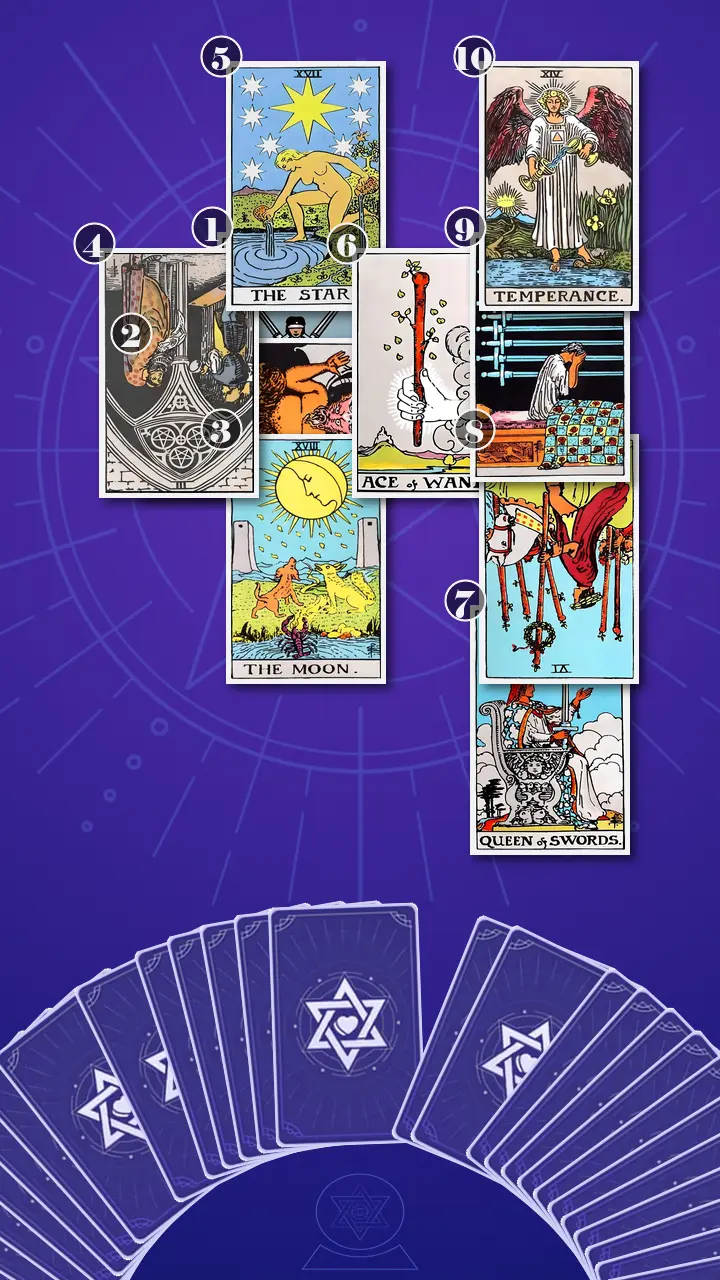
Reading the Map: Card Meanings in Context
Position 1 (Present Loop): Two of Swords, upright
“Now flipped over is the card that shows the current bio-writing loop—the exact on-screen moment you can’t move past.”
Two of Swords, upright.
“This is you staring at the company bio form like it’s a personality test you can fail,” I said. “You keep toggling between two ‘acceptable’ tones—polished corporate LinkedIn voice versus honest human voice—then freeze, because choosing one feels like locking in a version of yourself for the whole office to quietly judge.”
In the Two of Swords, the energy isn’t lack of intelligence. It’s blockage—a self-protective pause. The blindfold says, I can’t know how this will land. The crossed swords over the heart say, So I won’t commit. And the cost is exactly what Jordan described: nothing moves, but the pressure builds.
Jordan let out a small laugh—sharp, almost embarrassed—then looked down at their hands. “That’s… brutal,” they said. “But yeah. That’s exactly it.”
Position 2 (What Crosses You): The Devil, upright
“Now flipped over is the card that names the main psychological pressure distorting your self-description—what makes the bio feel ‘wrong.’”
The Devil, upright.
“This is where the bio stops being a practical intro and turns into a high-stakes audition,” I said. “You write one power line—‘results-driven,’ ‘spearheaded,’ ‘award-winning’—and you immediately feel trapped. Like you just signed a contract to perform that persona every day on Slack, in meetings, and on client calls.”
The Devil’s energy is excess: too much weight placed on approval, status, and being un-criticizable. And the detail I always come back to is the loose chain. The pressure is real, but the bondage is partly maintained by an internal rule like: If I don’t sound exceptional, I won’t belong.
I watched Jordan’s throat move as they swallowed. Their shoulders rose a fraction, like bracing for impact.
“This is the line your nervous system is running at midnight,” I said, keeping my voice gentle: “If they can’t criticize the wording, they can’t criticize me. But that turns every verb choice into a safety purchase. And safety is expensive.”
Jordan nodded once, tight. “I’m writing like it’s… a performance review I haven’t earned yet.”
“Exactly,” I said. “And here’s the reframe we’ll keep using: A bio is not a verdict. It’s an orientation tool. It’s not a trial. It’s directions.”
Position 3 (Foundation): The Moon, upright
“Now flipped over is the card that reveals the underlying fear and belief driving the discomfort around self-promotion.”
The Moon, upright.
“You’re trying to describe your place in a new job before you’ve fully felt the job,” I said. “So your brain fills in the blanks: imagined judgment, vague ‘they’ll regret hiring me’ stories, mind-reading about what coworkers ‘really’ think—because the path isn’t visible yet and you want certainty now.”
The Moon is deficiency of clarity, not deficiency of capability. In onboarding, you’re in low visibility. Like navigating a new city with low-signal GPS—your brain starts inventing turns, then panics about missing them.
I asked Jordan to do something very un-mystical: “Open a note and split it down the middle. Left side: Facts I know. Right side: Stories I’m predicting.”
They blinked, then their gaze went slightly unfocused—like they were replaying the last week of Slack messages in their head. “Oh,” they said quietly. “I’m trying to write an identity I haven’t fully lived yet.”
“Yes,” I said. “That’s not failure. That’s a threshold.”
Position 4 (Recent Past): Three of Pentacles, reversed
“Now flipped over is the card that shows the recent experiences with evaluation or belonging that shaped your self-trust.”
Three of Pentacles, reversed.
“Old mixed feedback is still in the room with you while you write,” I said. “You can name the work you did, but you don’t trust how it gets evaluated—so you try to package it perfectly, like you’re pre-defending yourself against a rubric nobody actually stated.”
Reversed, this card reads as blockage in confidence-through-craft: the work was real, but the recognition and standards were inconsistent enough that you learned to over-control presentation. That’s why your hands reach for adjectives and ‘high-status’ verbs. You’re trying to make the outcome undeniable.
Jordan’s mouth tightened. “My last manager would say things like, ‘Great initiative,’ and then… nothing. No specifics. No growth plan. Just vibes.”
“That would make anyone distrust their own internal scorecard,” I said. “So you outsource it to the wording. But wording can’t give you belonging. Evidence can give you steadiness.”
Position 5 (Conscious Goal): The Star, upright
“Now flipped over is the card that clarifies what you actually want the bio to accomplish—beyond meeting the deadline.”
The Star, upright.
“What you actually want isn’t attention—it’s relief,” I said. “A bio that feels clean to read, where nothing is inflated and you don’t have to brace for someone calling you out. You want to be credible in a way that still feels like your real speaking voice.”
The Star is balance—a steady, honest pour. Not flashy. Not defensive. It’s your system saying: Please let me be real.
I saw Jordan’s shoulders drop a millimeter, like their body recognized that goal as permission. “Yes,” they said. “Relief. That’s the word.”
Position 6 (Next 7 Days Writing Move): Ace of Wands, upright
“Now flipped over is the card that points to the most helpful writing move in the next seven days—something that breaks the loop without forcing a fake persona.”
Ace of Wands, upright.
“This is a clean restart,” I said. “You stop trying to craft the perfect headline and you just draft. Timer on, 15 minutes, write it like you’re introducing yourself to a new teammate on day one—simple, direct, slightly imperfect, but alive. Momentum breaks the spell.”
The Ace’s energy is excess of life in the best way: a spark strong enough to cut through analysis paralysis. It doesn’t ask you to solve identity forever; it asks you to start.
Jordan exhaled, surprised. “I can do fifteen minutes,” they said, like it was the first doable thing anyone had offered all week.
Position 7 (Self / Your Best Stance): Queen of Swords, upright
“Now flipped over is the card that describes your internal stance—the voice you can access when you stop negotiating with the inner critic.”
Queen of Swords, upright.
“You access a sharper, calmer voice: fewer adjectives, more facts, and no begging to be liked,” I said. “You write one sentence that names your lane and one sentence that proves impact, and you stop negotiating with imaginary critics about whether you sound ‘impressive enough.’”
Queen of Swords energy is balance through precision. It’s not cold. It’s clean. I often demonstrate it with a line pair:
“Buzzword version: ‘Results-driven marketer spearheading innovative go-to-market strategies.’”
“Queen version: ‘I lead lifecycle and paid campaigns across email and search, and I’ve improved conversion rates by X% by testing and iterating weekly.’”
I watched Jordan’s face change as the second version landed in their nervous system. Their jaw unclenched slightly.
“Clarity reads as confidence—buzzwords read as fear,” I said.
Jordan nodded, immediate. “The second one feels… like I can breathe.”
Position 8 (Environment): Six of Wands, reversed
“Now flipped over is the card that shows the social and workplace context shaping this pressure.”
Six of Wands, reversed.
“Your environment is a visibility scoreboard,” I said. “Job updates, promotion posts, coworker intros, the subtle pressure to seem ‘thriving.’ Even if nobody is actually judging your bio that hard, your feed teaches your nervous system that being seen equals being ranked.”
Reversed, the energy is blockage in recognition: applause feels conditional, so you try to control perception. That’s why you keep checking other people’s ‘About’ sections like they’re the answer key.
Jordan grimaced. “Toronto grind culture is… loud.”
“It is,” I agreed. “So we’re going to write for one real audience, not for the crowd.”
Position 9 (Hopes & Fears): Nine of Swords, upright
“Now flipped over is the card that surfaces what you secretly hope the bio will secure—and what you fear it might expose.”
Nine of Swords, upright.
“The bio leaks into bedtime,” I said. “You wake up remembering one phrase, re-run it like a courtroom cross-examination, and imagine every possible misread. Part of you hopes the ‘perfect’ bio will finally let you sleep—like flawless wording could guarantee safety.”
This is excess mental pressure. Not because the bio is big, but because your brain is treating it like an emergency alarm. And when a paragraph becomes responsible for proving your worth, of course your body reacts like there’s a spotlight with no script.
Jordan’s eyes flicked away from the screen. “I literally woke up at 2 a.m. last night and almost opened the doc,” they admitted.
“Then let’s lower the stakes again,” I said. “A bio is not a verdict. It’s an orientation tool. It should not be stealing your sleep.”
When Temperance Wrote a Livable Voice (and the Room Went Quiet)
Position 10 (Integration / Direction): Temperance, upright
I took a breath before turning the last card. “This is the integration position,” I said. “Not a fixed prediction. It’s what becomes likely if you practice what the spread is teaching.”
Temperance, upright.
“This is you writing a bio you can live inside,” I said. “Real achievements plus a human tone, blended. Confident without being loud. Specific without being defensive. It reads like someone competent who isn’t trying to win a debate—just telling the truth clearly.”
Temperance is balance through alchemy—mixing two cups that used to feel like enemies: hype and honesty. And for someone in marketing, it’s familiar: proof points plus voice. Except the ‘brand’ is you, and it has to be livable on a random Tuesday.
Here’s where my old life on Wall Street flashed in—quick and sharp. I used to watch smart people torture themselves trying to pick the “perfect” deal, as if certainty existed. The professionals weren’t the ones who sounded most confident. They were the ones who could say: Here are the facts. Here are the risks. Here is the plan.
“Jordan,” I said, “I want to run my Risk-Reward Matrix on your bio voice—three-scenario forecasting, like we’d do for a valuation.”
“Scenario A: Full hype persona. It might feel powerful for two minutes, but the cost is you feel trapped—like you have to perform it daily.”
“Scenario B: Full disappearing act. Safer emotionally tonight, but it under-prices your work and keeps you anxious that you’re unseen.”
“Scenario C: Temperance. Earned facts plus one human sentence. Highest probability of sustainable confidence, because it’s checkable. You can stand behind it without bracing.”
Jordan’s eyes went still. The kind of stillness that isn’t zoning out—it’s something landing.
And then I slowed down, because this was the hinge of the whole reading.
Setup: It’s 11:47 p.m. You’re in bed with your laptop glowing, LinkedIn open in one tab, your bio doc in another, and your hand keeps doing that restless backspace-hover like you’re trying to delete the risk of being seen. You’re trapped between “sound impressive” and “say nothing.”
Stop trying to sound like a perfect headline and start mixing honest facts with calm confidence—Temperance writes your bio by blending what’s true with what’s earned.
I let the sentence sit there. No extra explanation. Just air.
Jordan’s reaction came in a chain I’ve learned to respect: first, a brief physiological freeze—breath held, fingers stopped moving entirely, like their body was checking if this was safe. Second, their eyes softened and unfocused for a second, as if replaying the last week of drafts and deletions through a new lens. Third, the release: a long exhale that sounded like their chest finally had room.
“But…” they started, and there was a flash of irritation—real, protective. “If it’s that simple, does that mean I’ve been doing it wrong? Like I made this whole thing up?”
I didn’t rush to soothe it. “It doesn’t mean you made it up,” I said. “It means your nervous system chose a strategy that tried to keep you safe: performance. It worked short-term—momentary control. It just isn’t working anymore.”
“Your bio doesn’t need a ‘winning voice,’” I added. “It needs a livable one: calm confidence built from specific, checkable truths.”
Then I gave them the reinforcement as an actual practice, not a vibe. “Here’s a 10-minute ‘Temperance Blend’ micro-practice. Stop anytime if you feel yourself spiraling:
1) Set a 10-minute timer.
2) Write 3 bullet facts only (no adjectives): role + domain, one measurable win, one collaboration/skill proof.
3) Add exactly ONE human values sentence (how you like to work / what you care about).
4) Read it out loud once. If your jaw tightens, don’t rewrite everything—only swap one verb for a simpler one.
Boundary reminder: this is a draft, not a verdict. If you feel flooded, close the doc and come back later; you’re allowed to work in short passes.
I leaned in slightly. “Now, with this new frame—earned facts plus calm confidence—can you think back to last week? Was there a moment where you could’ve written one checkable truth instead of chasing the perfect tone?”
Jordan nodded, slow. “Yesterday,” they said. “I deleted the only line that was actually true. The one with the metric. Because it felt… too plain.”
“That’s the shift,” I said. “This isn’t just about a bio. It’s about moving from dread-driven self-editing and comparison anxiety to steadier self-respect through specific, livable self-expression.”
From Insight to Action: The One-Page Decision Ledger for Your Bio
I summarized what the spread had told us in plain language: the Two of Swords showed the freeze—your on-screen stalemate. The Devil showed why it tightens—approval as a chain, making the bio feel like a test. The Moon showed the root—low-visibility onboarding fog, where your mind projects judgment. The Star showed what you actually want—relief through honesty. The Ace of Wands and Queen of Swords showed how you get there—draft first, then edit for clarity. And Temperance closed it: integration, not extremes.
“Here’s your cognitive blind spot,” I said. “You’ve been treating polish like proof. Like if the tone is bulletproof, you’ll be safe. But that’s the same loop keeping you stuck. Your transformation direction is the opposite: stop performing an impressive persona and start stating measurable truths in plain language—then let your work speak.”
Jordan gave me a look that was half laugh, half exhausted honesty. “But I genuinely don’t have time,” they said. “My calendar is wall-to-wall onboarding. I can’t do some two-hour writing exercise.”
“Good,” I said, and I meant it. “We’re not doing two hours. We’re doing boardroom rules: short, timed, decision-based.”
I used my Pre-commitment ritual—a trading-floor focus technique I still use when something triggers perfectionism. “Before you write,” I told them, “you commit to the container.”
- The 10-Minute Temperance Blend DraftTonight or tomorrow morning, set a 10-minute timer. Write 3 bullet facts only (role + domain, 1 measurable win, 1 collaboration/skill proof). Then add exactly ONE human values sentence. Paste it into the bio field as a draft.If you feel the urge to rewrite everything, only swap one verb for a simpler one. Drafts are allowed to be plain.
- The One-Audience BioPick ONE real audience—your immediate team or one client type. Write the bio as if it’s for that person, not “everyone on LinkedIn.” Literally title the doc: “Bio for My Team.”Before you start, close LinkedIn. If you “need inspiration,” you get one example only—then you write from memory.
- The Clarity-Only Final PassDo one last edit pass with one rule: remove one buzzword and add one concrete proof point (number, scope, or outcome). Then submit.Say out loud: “Stop editing for safety. Edit for truth you can stand behind tomorrow.” If your jaw tightens, you’re editing for safety.

A Week Later: Ownership, Not Perfect Certainty
Six days later, I got a message from Jordan while I was making coffee. “Submitted,” it read. “60-ish words. Two metrics. One human line. Didn’t check LinkedIn first. Felt weird. Then… I slept.”
I pictured it: not fireworks, not a grand reinvention. Just a quiet win—closing the tab, writing the facts, letting one sentence stand. Clear, specific, grounded. A bio that wasn’t a costume.
That’s the journey to clarity I trust most: not the kind that erases uncertainty, but the kind that gives you something sturdy to stand on—reality, stated plainly, with a human voice you can live inside.
When you’re trying to sound confident but you’re terrified confidence will expose you, even a simple bio can feel like standing under a spotlight with no script.
If you let your bio be a blend—one measurable truth plus one human sentence—what’s the smallest line you’d be willing to let stand today?