From Promotion-Proof Panic to Calm Follow-Through: A 30-Day Evidence Plan

The 9:41 p.m. Tab-Switch Spiral
“You’re a 20-something PM in Toronto with a training budget deadline,” I told Taylor (name changed for privacy), “and you’re stuck in that career-crossroads energy—three cert tabs open, one stretch-project doc open, and still no submission because you’re trying to pick the one move that won’t get side-eyed in promo calibration.”
On my screen, their condo living room looked like every Sunday Scaries vignette I’ve ever read in a group chat: role-leveling PDF snapped to the left, three certification pages stacked like guilty secrets, and a half-written one-pager titled something like Stretch Project Proposal v4. The streetcar hum leaked through their window in a steady metallic sigh. Their phone—still warm from LinkedIn scrolling—sat face-down like a dare. The blue light from the laptop made their skin look sharper, harsher, like the room had been overexposed.
They rolled one shoulder, then the other, as if trying to peel tension off their collarbones. “My training budget is due,” they said, voice tight in that way people get when they’ve been negotiating with themselves for days. “It’s either a certificate or a stretch project. And I… can’t choose.”
I watched their fingers hover over the trackpad, jittery, ready to flip back to research like it was a life raft. The pressure wasn’t abstract; it lived in the body—shoulders climbing toward ears, that fluttery, restless stomach that won’t let you fully exhale until the decision feels ‘solved.’
“So the question isn’t just money,” I said gently. “It’s: what counts as proof for promotion here. You want an undeniable case… and you’re scared that picking the wrong signal will make you look out of sync with what leadership values.”
They nodded once, sharp. “Exactly. Everyone else seems to have a clean story. Credential plus impact. Why can’t I pick one thing and commit?”
Pressure like this always reminds me of an overworked laptop: twelve browser tabs open, fan screaming, screen bright with ‘productivity’—but nothing actually gets submitted. “Let’s not treat this like a referendum on your worth,” I said. “Let’s treat it like what it is: a decision under a deadline. We’ll build a map through the fog—finding clarity, not perfection.”

Choosing the Compass: The Decision Cross Spread
I invited Taylor to take one slow breath—not as a mystical ritual, just a psychological gear shift. “Pick one sentence that describes the dilemma,” I said, and while they held it in mind, I shuffled. The point, the way tarot works in real life, is focus: we give your brain a structured mirror, so the chaos becomes legible enough to act on.
“For this,” I explained, “I’m using a Decision Cross—a tarot spread for choosing between two options at work when time pressure makes everything feel higher-stakes than it needs to.”
To you, reading along: the Decision Cross is small on purpose. Six cards is the minimum structure that still covers the real mechanics of a binary choice: the current overload, each path’s core energy, what makes each option succeed or fail in practice, and a final integration card that turns insight into next steps. Visually it’s like weighing two options—then setting the scale on a stable table.
“Card 1 will show the concrete shape of your decision pressure,” I told Taylor. “Cards 2 and 3 will lay out the certificate path versus the stretch-project path. Cards 4 and 5 will reveal what makes each path effective—or what quietly sabotages it. And the last card is the verdict: not a fate, a process you can defend.”
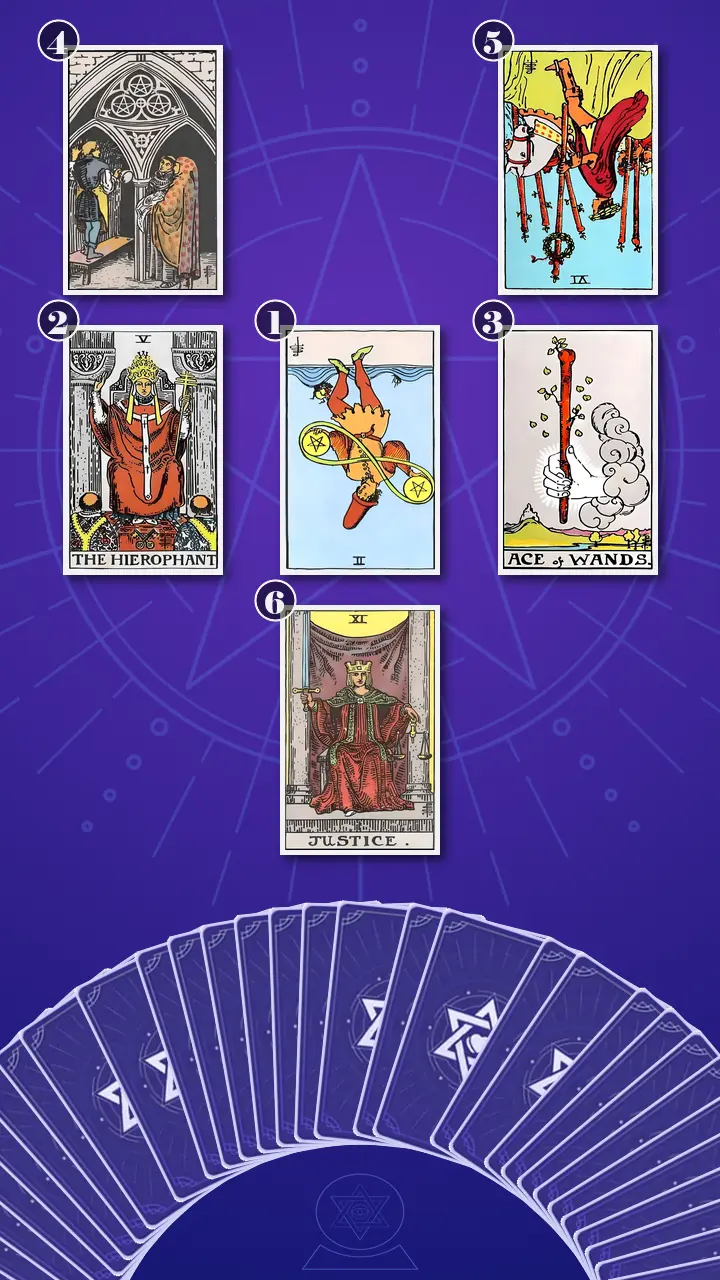
Reading the Map: Two Carts, Two Doors
Position 1: The current decision pressure — Two of Pentacles (reversed)
“Now flipped over,” I said, “is the card that represents the current decision pressure and the concrete way choice paralysis shows up around the training budget deadline.”
Two of Pentacles, reversed.
It landed like an x-ray of their browser history. “It’s 10 PM and you’re juggling like it’s a second job,” I said, echoing exactly what this card looks like in modern life: role ladder PDF, promo examples, three certificate pages, a stretch-project doc—plus a draft budget request you keep rewriting. “You tell yourself you’re being responsible, but the real pattern is rhythm loss. You’re maintaining options instead of making a move.”
I named the energy dynamic plainly: reversed Two of Pentacles is blockage. Not ‘you’re bad at choosing’—more like your mental bandwidth is getting taxed by constant switching costs. “Keeping both options open feels safer,” I said, “but it’s draining you. Busy-looking isn’t evidence-building.”
I let the split-screen run, because it’s what I could already see behind Taylor’s eyes:
Tab-switching voice: “If I just research 20 more minutes, I’ll know.”
Visibility-avoidance voice: “If I share this now, they’ll see the messy middle.”
LinkedIn scroll. Promo rubric PDF. Draft email stuck in Outbox. That meeting where you said nothing because it wasn’t ‘perfect’ yet.
Taylor gave a short laugh that had no joy in it. “That’s… brutal,” they said. Then they inhaled, held it—freeze—eyes going slightly unfocused like a memory was replaying—then the breath left their chest in a sharp exhale. “Wow. Yeah. I literally rewrote the same ‘impact’ bullet five times tonight.”
“It’s not brutal,” I said, warm but firm. “It’s a pattern you can interrupt. This card is telling us the pressure isn’t solved by finding the perfect option. It’s solved by reducing moving pieces and choosing a criterion.”
Position 2: Option A (certificate) — The Hierophant (upright)
“Now flipped over,” I said, “is the card that represents Option A: investing the budget in a certificate and what kind of proof it represents in this promotion context.”
The Hierophant, upright.
“This is the certificate path looking like buying legibility,” I said. “A recognized badge or framework that translates your skill into a language your org already respects. In a company where the rubric reads clear but the examples feel inconsistent, The Hierophant can feel like a permission slip.”
The energy here is balance—structure can soothe the chaos. But I added the necessary edge, because I’ve watched enough smart people hide in ‘approved learning’ when what they need is a visible output. “The Hierophant can also tempt you into outsourcing your confidence to an institution,” I said. “Like, ‘If I look official, I’ll feel safe.’”
Taylor’s mouth tightened, not disagreement—recognition. Their eyes dropped to the bottom of my screen, where the budget request was probably waiting like an unopened text.
Position 4: What makes Option A effective — Three of Pentacles (upright)
“Now flipped over,” I said, “is the card that represents what would make the certificate path effective—how the certificate must be applied or demonstrated to matter for promotion.”
Three of Pentacles, upright.
“This is the antidote to ‘I took a course, trust me,’” I said. “Three of Pentacles is skill made visible through artifacts and collaboration. It’s a shared blueprint—something reviewable, reusable, and validated by other people.”
I kept it concrete, because “card meanings in context” only matter when they touch your calendar. “If you choose the certificate,” I told them, “it works best when it turns into a tangible artifact your team can use: a stakeholder workshop, a decision template, a short playbook, a new process. A certificate that never becomes an artifact is just expensive reassurance.”
Taylor’s shoulders lowered a fraction, like their body liked the idea of proof that wasn’t just vibes. “So it’s not ‘credential vs project,’” they murmured. “It’s ‘credential plus artifact.’”
“Exactly,” I said. “The artifact is what makes the learning promotable.”
Position 3: Option B (stretch project) — Ace of Wands (upright)
“Now flipped over,” I said, “is the card that represents Option B: investing the budget—or equivalent effort—into a stretch project and what kind of promotion evidence it can generate.”
Ace of Wands, upright.
The air in Taylor’s room seemed to sharpen, like the laptop fan got quieter for a second. “This is you claiming a lane,” I said, “a one-page proposal with a clear why, one metric it moves, and a definition of done within 60–90 days. It’s the spark that turns promotion into something you can build in public: ownership, influence, momentum—rather than something you have to prove on paper first.”
I gave them the micro-scene, because this card’s magic is tactile: “That moment when the one-pager finally has a title, an owner—you—and a definition of done. It’s a different dopamine than research. It’s momentum dopamine. It’s the feeling of hitting ‘Send’ on a short project pitch and your brain finally stops bargaining.”
Taylor’s eyes flicked up. “I can picture it,” they said, almost surprised. “There’s a cross-team metric we’ve been punting on. I could own a v1 dashboard + decision process.”
“That’s the Ace,” I said. “Specific. Nameable in one sentence.”
Position 5: What trips up Option B — Six of Wands (reversed)
“Now flipped over,” I said, “is the card that represents what could trip up the stretch-project path—especially visibility, narrative, and recognition.”
Six of Wands, reversed.
“Here’s the hidden risk,” I said. “Not the work—the credit pathway. You might execute something meaningful, but if you don’t shape the narrative—short updates, impact notes, stakeholder alignment—it stays invisible. Then you feel resentful: you did the hard part, but the promotion story never gets witnessed.”
I said it the way I’d say it to a friend in the hallway after a team sync: “A stretch project without a visibility plan is just private effort.”
Taylor winced, and I could tell their brain jumped to a specific moment: a win that lived in their head but never made it into the rooms that count. Their hand slid to their mug, grip tightening, then loosening. “I hate that this is true,” they said. “I always wait until it’s polished.”
“Polish is not the same as proof,” I replied. “And the messy middle is where leadership is actually watching: how you handle uncertainty, influence without authority, and communication.”
When Justice Spoke: The Rubric Became a Case File
When I reached for the final card, I slowed down. The room on both sides of the screen felt quieter, like we’d stepped out of the Sunday-night hum and into something more deliberate.
“Now flipped over,” I said, “is the card that represents integration and next step—how to decide in a way that reduces regret and builds a promotion-aligned evidence plan.”
Justice, upright.
Justice is one of my favorite cards to pull for career decisions because it doesn’t flatter you and it doesn’t panic with you. It’s the tarot Justice meaning for decision-making at work: criteria, accountability, clean communication. “This is the end of vibes-based career decisions,” I said. “It’s you choosing like you’d defend it in a rubric review.”
Setup. I could feel Taylor’s old loop rising—Sunday night, role-leveling doc open, three cert tabs, stretch one-pager—rewriting the same ‘impact’ bullet like one perfect sentence could make the risk disappear. They were trying to buy certainty with wording, because the fear underneath was: If I pick wrong, it proves I don’t understand how promotions work.
Delivery.
Not “I’ll be promotable once I look official,” but “I’ll be promotable when I choose with clear criteria”—let the scales weigh what counts and let the sword commit.
I let the line sit between us.
Reinforcement. Taylor’s reaction came in layers—the way truth does when it lands in the body before it lands in the mind. First: a brief stillness, like their breath got caught halfway in. Second: their eyes softened and unfocused, as if they were scrolling through recent weeks—check-ins, quiet wins, the unsent message drafts—watching themselves from the outside. Third: their shoulders dropped, slow and heavy, and they exhaled like they’d been holding air hostage.
Then the pushback arrived—real, human, necessary. Their eyebrows pulled together. “But if I commit to one thing,” they said, a flash of irritation in it, “and it’s wrong… doesn’t that mean I was wrong? Like I misread the whole game?”
I nodded. “That’s the exact moment Justice is for,” I said. “Justice doesn’t promise you’ll never revise. It promises you can make a fair, defendable call with the information you have—and then create exhibits. The ‘wrong’ choice isn’t ‘not promotable.’ The wrong choice is choosing nothing and calling it ‘being thorough.’”
My mind flashed—because I’m an artist, and because my brain thinks in frames—back to laying out a Mondrian grid on canvas: a few strong lines, clean blocks of color, no extra decoration. When you’re overwhelmed, more detail doesn’t help; structure helps.
“Here’s my Mondrian Grid Method,” I said, bringing my signature skill in like it belonged there—because it did. “We take the chaos and we make a grid: two promotion signals across the top, and 30 days down the side. Every choice you make has to paint inside those boxes. If it doesn’t create proof for a signal in a real timeframe, it’s just noise.”
I watched Taylor’s face change—not into certainty, but into something steadier: self-trust beginning to form because the decision was no longer an IQ test. It was an evidence plan.
“Now,” I asked, “with this perspective—criteria first, exhibits second—think back to last week. Was there a moment when you could’ve put one clean piece of evidence on the table instead of polishing in private?”
Taylor swallowed. “Wednesday,” they said quietly. “I had a cross-team win. I decided it wasn’t ‘big enough’ to mention, so I asked for feedback instead. I left the call with… vibes. No criteria.”
“That’s the shift,” I said. “From promotion-proof panic and tab-switching indecision to rubric-anchored self-trust and calm follow-through. Not overnight. But beginning now.”
The One-Page Evidence Plan (and a Two-Minute Closing Statement)
I pulled the whole spread together for them, like cutting a trailer from raw footage.
“Here’s the story,” I said. “Two of Pentacles reversed is you juggling ‘credential’ and ‘visibility’ like you’re holding two shopping carts at a career crossroads—refusing to move until you can guarantee neither cart is a mistake. The Hierophant says the certificate can help if your org respects institutional signals—but Three of Pentacles insists it only counts when you turn learning into an artifact other people can reference. Ace of Wands says a stretch project can generate real leadership evidence fast—but Six of Wands reversed warns that without a visibility plan, your impact stays private. And Justice? Justice says: stop hunting for the one perfect signal. Ask for the rubric, then build exhibits.”
“Your cognitive blind spot,” I added softly, “is thinking the decision has to protect you from judgment. That’s why you keep rewriting the email like a legal brief. The transformation direction is simpler: choose based on explicit criteria, commit cleanly, and let real outputs—not hypotheticals—teach you what works.”
Then I gave Taylor the next steps—small, specific, doable. Not a new Notion system. A plan you could start even with tight shoulders and a fluttery stomach.
- Two-Criteria Filter (30 minutes)Block one 30-minute window this week. On a single page titled “My Evidence Plan,” write: “In the next promo cycle, the top 2 signals I’m optimizing for are: ___ and ___.”If you feel tempted to add a third criterion, treat it like a tab-switching urge. Two is enough for this cycle; you can revise next cycle.
- One-Question Manager Check (5 minutes)Send one Slack/Teams message to your manager: “For my next-level case in the next 60–90 days, which matters more: (A) a recognized framework/credential, or (B) owning a cross-team deliverable with measurable impact?”Ask one question, not five. If the reply is vague, ask for one example promo case that showed the signal.
- Your “Closing Statement” (2 minutes)Using my Oscars Speech Training strategy, draft a two-minute self-pitch you can say in a check-in: one sentence on the signal, one sentence on the exhibit, one sentence on what you need. Paste the one-sentence choice into your budget request: “I’m choosing ___ because it produces ___ by ___ (date).”If your chest tightens, write it in Notes first and come back later. Clarity sticks better than urgency.
“And if you choose the stretch project,” I added, “we neutralize Six of Wands reversed with a boring, scheduled visibility plan: one weekly wins-in-progress note. Three bullets. No hype.”

A Week Later: The Quiet Proof
Six days later, I got a message from Taylor. Not a novel—just a screenshot: a sent Slack to their manager with the one clean question, and underneath it, their one-sentence decision. They’d also scheduled a 20-minute stakeholder pre-align for the stretch project with a crisp definition of done.
They added one line: “I slept through the night. I still woke up thinking, ‘What if I picked wrong?’—but this time I didn’t open another tab. I opened the doc.”
That’s the kind of evidence I trust: not grand transformation, but a nervous system loosening its grip because the next step is real. A Journey to Clarity rarely looks like lightning. More often, it looks like scales set down on a steady table—and a sword used to cut one clean path through the noise.
When a promotion decision starts feeling like an IQ test you have to pass in public, your shoulders tense, your stomach flips, and you keep hunting for the one “right” move—because choosing wrong feels like it would prove you don’t belong at the next level.
If you didn’t need the choice to be perfect—only defendable—what’s the smallest piece of evidence you’d want on the table 30 days from now?