From Outfit-Copy Panic to Self-Trust: Reclaiming Your Vibe Without Competing

The 11:43 PM Spiral in a Bedroom Lit by Instagram
“If you’ve ever said ‘I know it’s just clothes, but it doesn’t feel like just clothes,’ and then stayed up doing comparison-checking like it’s your second job—welcome to the identity anxiety spiral.”
I said it the way I always do—half invitation, half truth serum—because I could already see it in Taylor’s face. Taylor (name changed for privacy) sat across from me with her hoodie sleeves pulled over her hands, like she was trying to make herself smaller without admitting she was doing it.
She described the exact slice of time that had been looping in her head: 11:43 PM on a Wednesday in her small NYC bedroom. Streetlight stripes across the wall. The radiator clicking like it had opinions. She was in a robe, phone warm in her palm, Instagram brightness turned down. She saw her friend’s Story—the same silhouette she’d planned for Friday—and her body reacted before her brain could argue. Stomach drop. Chest tight. A sudden, restless urge to fix it.
“I know it’s petty,” she said, voice flat like she’d already tried to scold herself out of it. “But my thumb just… starts. I’m tapping between her post, my camera roll, and shopping tabs like I’m building a case.”
It wasn’t “just clothes.” Not the way she was carrying it. It felt like her style was a receipt for her identity—proof she was real, original, worth noticing. And the moment someone else wore a similar look, that proof felt flimsy, like paper in rain.
Her insecurity wasn’t an abstract thought; it was a physical compression—like she was trying to breathe through a too-tight sports bra. And beneath the embarrassment sat irritation and a sharp little jealousy she hated admitting.
“Okay,” I told her, gentle and direct. “We’re not here to judge you for caring. We’re here to understand why this hits so hard—and to find clarity, so your style can go back to being yours instead of a battlefield.”

Choosing a Map for a Very Modern Problem
I invited Taylor to put her phone face-down for a moment and take one slow breath—not as a ritual for luck, but as a clean transition. A way to get out of the feed and into her own body. While she did, I shuffled, listening for the tone beneath her story: the parts she said out loud, and the parts she didn’t.
“Today,” I said, “I want to use a spread I built for exactly this kind of situation: the Four-Layer Insight Ladder · Context Edition.”
For anyone reading along: this isn’t a predictive spread. It’s a structure for the mechanism—especially when you’re asking, ‘Why do I spiral when someone copies my style?’ The Ladder works because it separates what’s happening on the surface (the spiral) from what triggered it (the story your mind attaches), then drops down into the root belief, the protective strategy, and finally the turning point and next steps. It’s the minimum number of positions you need to move from “why this hits” to “what do I do differently” without getting lost in endless analysis.
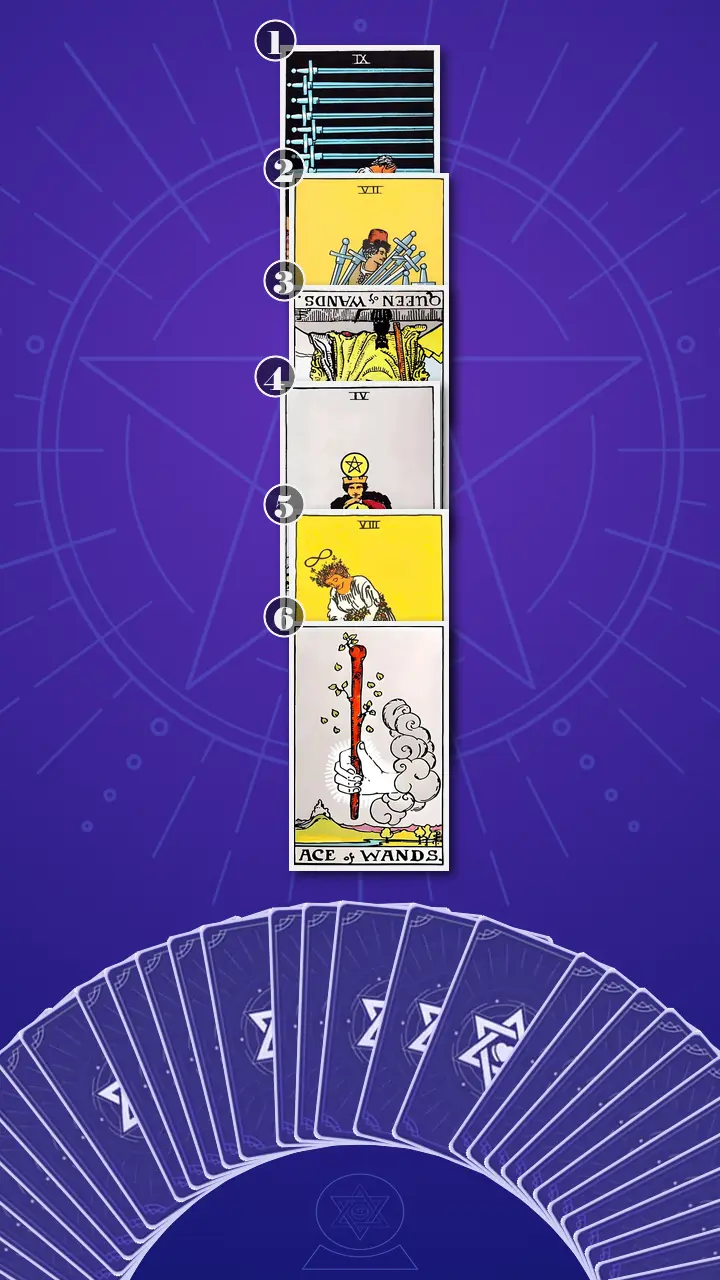
“We’ll read it like stairs,” I told Taylor. “Card 1 is the presenting symptom. Card 3 is the root fear. Card 5 is the medicine—the key transformation. And Card 6 is one grounded thing you can actually do this week.”
She nodded, but I saw the tell: her shoulders were still up by her ears, like her nervous system didn’t fully believe relief was allowed yet.
Reading the Evidence: When Thoughts Turn into a Courtroom
Position 1 — The presenting symptom: the spiral you can’t stop
“Now I’m turning over the card that represents the presenting symptom—the specific mental and behavioral spiral after the outfit copying,” I said.
Nine of Swords, upright.
I didn’t have to dramatize it. This card always looks like a person waking up into their own mind like it’s an emergency alarm.
“It’s 1:00 AM in your NYC apartment and you’re wide awake, phone glow in a dark room, replaying one outfit photo like it’s a courtroom exhibit,” I said, using the scene the card was already holding. “You toggle between her Story, your camera roll, and old pics to prove you had the vibe first—then you open a shopping cart to ‘fix’ the feeling. Your body is tense, your chest tight, and your inner voice is harsh: ‘If I can be copied, I’m not special.’”
This is Air energy in overload—thoughts stacked like evidence, not insight. Not clarity. Accusations. The mind trying to regain safety by building an airtight argument.
Taylor let out a small laugh that didn’t reach her eyes. “That’s… too accurate,” she said, and then, quieter: “It’s kind of mean.”
“It’s not mean,” I replied. “It’s precise. And precision is how we stop confusing the symptom for the truth.”
I watched her fingers worry the edge of her sleeve—restless, like her body wanted to keep moving so the feeling wouldn’t catch up.
Position 2 — The trigger story: what the situation is made to mean
“Now I’m turning over the card that represents the trigger story—what this situation is ‘made to mean,’ and why it hooks you,” I said.
Seven of Swords, upright.
“You see the similar outfit and instantly slip into detective mode,” I told her. “You zoom in on details, check the timestamp, reread her caption, and scroll back to see if this is a pattern. It’s less about the actual clothes and more about the feeling of something personal being used without consent—like your taste was treated as public property while you’re left guessing what the move was.”
Seven of Swords isn’t always a villain. Sometimes it’s simply the sensation of ‘something here isn’t being said out loud’—and your mind tries to create certainty with surveillance.
I leaned in a little. “Let me ask you the Ladder question for this spot: what clues have you been collecting—caption tone, timing, tags, repeated brands—and what boundary need might be hiding underneath that detective work?”
Her eyes flicked down and left, the way they do when someone is replaying receipts. “I keep thinking… was it intentional?” she admitted. “And then I feel stupid for thinking that.”
“A boundary said out loud is kinder than a grudge maintained in silence,” I said, not as a push to confront, but as a north star. “We’ll get there. But first—we have to separate two things: a copied item versus a copied identity. Your brain keeps treating them as the same.”
Her jaw worked once, like she was chewing on that distinction.
When Style Becomes a Scoreboard
Position 3 — The root belief: what copying threatens in your self-worth
“Now I’m turning over the card that represents the root belief and underlying fear—what the copying threatens in your self-concept,” I said.
Queen of Wands, reversed.
“Your confidence works—until it starts depending on being the most distinct person in the room,” I said, letting the card be blunt but not cruel. “When your friend mirrors your look, your style stops being play and turns into a scoreboard. You feel heat in your face, draft a snarky text you never send, and suddenly you’re planning something ‘louder’ just so you can feel like you’re the original again.”
Reversed, the Queen’s fire isn’t gone—it’s pointed inward. It becomes comparison. Possessiveness. That quiet panic of ‘If I’m not distinct, I disappear.’
As a perfumer, I’ve spent years watching how people confuse signal with self. In brand meetings, I’ve seen teams treat a fragrance brief like a moral identity: as if the wrong note would make the entire house “basic.” But a brand isn’t a locked PDF. It’s lived, updated, embodied.
“If the fear had to finish the sentence,” I asked, “would it be: ‘If I’m not distinct, then ____’?”
She swallowed. “Then I’m… replaceable,” she said. “Like I’m not actually a person with a vibe. I’m just… a look.”
That was the root. Not her friend’s blazer.
Position 4 — The shadow strategy: the grip that backfires
“Now I’m turning over the card that represents the shadow strategy—what you do to regain control, and how it costs you,” I said.
Four of Pentacles, upright.
“After being triggered, you start treating your style like a password,” I said, and I saw her flinch in recognition before she even fully processed the words. “You stop sending outfit links, you dodge ‘where’d you get that?’ questions, and you keep your favorite stores to yourself. You think it’s protecting your vibe, but it actually keeps you tense—like you’re always bracing for someone to ‘take’ what makes you you.”
Earth energy here is control architecture. A closed fist. A coin pressed to the chest. It’s protection that turns into isolation.
I mirrored back what I’d heard in her week: the Notion “capsule wardrobe” list that became a rulebook. The tabs: Revolve, SSENSE, Zara, Aritzia. The Notes app titled “signature pieces” that read like security protocols. The last-minute hallway mirror outfit swap that felt less like self-expression and more like a performance review.
“When style becomes a scoreboard, getting dressed stops being fun,” I said, letting the phrase land without shame. “And Four of Pentacles is the part of you that tries to win by tightening the rules.”
She exhaled through her nose—half laugh, half grief. “I hate that I’m like this,” she said.
“You’re not ‘like this,’” I corrected gently. “You’re in a loop. And loops can be interrupted.”
When Strength Quieted the Feed
Position 5 — The turning point: the medicine that restores self-trust
I slowed down before turning the next card. Even the air in the room felt more still—like the story was ready for its hinge.
“Now I’m turning over the card that represents the key transformation—the inner shift that loosens the fear and restores self-trust and clean boundaries,” I said.
Strength, upright.
Setup. I watched Taylor’s eyes move between the card and her own hands. She knew that moment too well: you see the photo—same vibe, same piece—and your stomach drops before your brain starts building a whole case about what it means. The urge is immediate: thumb hovering over Instagram, hunting for certainty like it’s oxygen.
Delivery.
Stop gripping your ‘signature look’ as proof of worth, and start softening the inner lion with steady self-trust—then let your spark grow from the inside out.
I let the sentence sit between us, the way a good base note lingers in the air after the initial shock of citrus fades.
Reinforcement. Taylor’s reaction came in a chain. First: a tiny freeze—her breath paused, and her fingers stopped fidgeting mid-motion. Second: her gaze went distant, like she was replaying the L train screenshot zoom-in, the timestamps, the “proof of originality” audit. Third: her shoulders dropped on a long exhale she didn’t seem to plan. Her jaw unclenched as if she’d just realized it had been clenched for days.
Then the unexpected part: her face tightened with a flash of anger. “But if I stop gripping,” she said, voice sharper, “doesn’t that mean she just… gets to take it?”
I nodded. “That’s the lion,” I said softly. “Hot. Fast. Protective. And it’s trying to keep you safe.”
This is where my work—Social Pattern Analysis—matters. “Let’s diagnose the hidden interaction barrier,” I continued. “Right now, your nervous system is interpreting overlap as replacement. But in groups—especially ones with unspoken aesthetic competition—mirroring can mean a lot of things: admiration, closeness, trend convergence, or yes, boundary-testing. The problem isn’t that you notice patterns. It’s that the only tool you’ve been using is surveillance. That tool always keeps you in a clenched posture.”
I guided her into the practice embedded in Strength—the move from feed to body. “Try this now,” I said. “Phone stays face-down. Put one hand on your chest as a closed fist. Notice what changes in your breath and jaw. Then slowly open it.”
She did. Her breathing shifted—less shallow. Less frantic. The open palm looked almost unfamiliar on her own body, like she’d been living in ‘defend mode’ for so long that softness felt suspicious.
“Now ask,” I said, “What do I want to feel in my body tonight—bold, calm, sharp, soft?”
“Calm,” she said, surprised by her own answer. “I want calm.”
“Good,” I replied. “That’s self-definition. That’s the shift—from guarding proof of uniqueness to practicing your identity as something lived.”
Then I asked the question that seals the insight into real life: “Now, with this new lens—can you think of a moment last week when this would’ve changed how you acted? A moment when the urge to check her feed took over?”
She nodded slowly. “Thursday,” she said. “I was literally on the edge of my bed. I could’ve… not opened her profile. I could’ve just—picked an outfit for how I wanted to feel.”
“Exactly,” I said. “Your vibe isn’t a scarce resource—it’s a lived signal.”
And that’s the emotional transformation I want you to hear clearly: this wasn’t about catching your friend’s intent. It was a step from identity anxiety and comparison-driven vigilance toward embodied self-trust—toward charisma without competition.
Position 6 — The next step: a spark you can actually live this week
“Now I’m turning over the card that represents the next step—a concrete, doable way to embody identity from the inside out,” I said.
Ace of Wands, upright.
“Instead of reactive reinvention, you start a tiny self-led style experiment,” I told her. “You pick one intention for the week—bold-and-relaxed, soft-and-sharp—build a simple outfit formula from what you own, and wear it without checking her posts. It’s not about being uncopyable—it’s about being in motion from your own desire.”
Ace of Wands is Fire that belongs to you again. Not a flare you set off in response to someone else. A sprout—alive, personal, renewable.
Taylor’s mouth softened, like she could feel the difference between “prove it” energy and “create it” energy.
From Insight to Action: The One-Word Outfit and a Cleaner Boundary
I summarized the Ladder the way I’d want someone to summarize it for me: simple, coherent, usable. “Here’s the story the cards tell,” I said. “The Nine of Swords is the late-night courtroom—rumination and comparison-checking. The Seven of Swords turns it into a motive mystery—‘was it intentional?’ Underneath, Queen of Wands reversed shows the root: confidence that became contingent on being the most distinct. Four of Pentacles shows the protection strategy: hoarding, gatekeeping, clinging. Strength is the medicine—soft power, self-trust, clean boundaries. And Ace of Wands is your next step: self-led expression, not reaction.”
“Your cognitive blind spot,” I continued, “is thinking the solution is to become uncopyable. That keeps you in scarcity. The transformation direction is the opposite: choose who you are from the inside—how you want to feel—and let the details stay flexible. That’s how you stop feeling replaceable.”
Then I gave her actionable advice—small enough to start, specific enough to matter.
- One-Word Style IntentionIn your Notes app, write one line before your next hangout: “Tonight I want to feel: calm / grounded / playful / sharp.” Choose your outfit to serve that word—not to be uncopyable.If your brain says “this is cringe,” do the 10-second version: pick the word and stop there. It’s an experiment, not a test you have to pass.
- 24-Hour No-Check WindowDo a 24-hour ‘no checking their posts’ window before and after the event you’re dressing for. If you slip, restart with zero punishment.Treat it like reducing a trigger—not making a moral statement. If it helps, mute their Stories for one week instead of spiraling.
- Sillage Control: A Boundary You Can FeelPick one “signature formula” you can repeat for a week (e.g., black jeans + white tee + one statement accessory). Pair it with a grounding, woody-leaning scent you already own (cedar, vetiver, sandalwood) as your personal presence anchor.Keep the scent close—soft sillage. This is first impression calibration for you, not a performance for the room. Consistency builds self-trust faster than novelty does.
I added one optional tool from my own practice for the hardest moments—the moments right before the thumb goes back to Instagram. “If you need a nervous-system reset,” I said, “use a quick cleansing citrus spray—something bright like bergamot or grapefruit on a tissue. One inhale. Then phone face-down. It’s not magic. It’s a cue: ‘I’m back in my body.’”
Taylor looked relieved, and then practical resistance showed up, right on schedule. “But what if we’re in the group chat and someone texts, ‘what are we wearing?’” she asked. “That’s usually when I start spinning.”
“Then you answer with the feeling,” I said. “Not the item. ‘I’m going for calm and sharp.’ That’s Personal Brand Management in a healthy form—consistent internal direction, not external proving.”

A Week Later: The Quiet Proof
A week later, Taylor texted me on a Sunday afternoon. Not a paragraph. Just a screenshot of her Notes app.
Tonight I want to feel: grounded.
Under it: “Didn’t check her Stories for 24 hours. Wore my black jeans/white tee formula. Put on the woody perfume I forgot I had. Felt weirdly… solid. Still had a tiny ‘what if’ in the morning, but it didn’t hijack my whole day.”
That’s what I mean when I say a Journey to Clarity doesn’t always look like a dramatic confrontation or a perfect transformation. Sometimes it looks like an open hand. A softer jaw. A night where getting dressed doesn’t feel like you’re auditioning for your own life.
When your style has been carrying the job of proving you’re uniquely worth noticing, one copied outfit can feel like your whole self got quietly replaced—even if you hate how much it hits.
If you let “being you” be something you practice in your body (not something you protect in your closet), what’s one feeling you’d dress for this week—just to see what changes?