From Medal Shame to Present-Tense Self-Respect: Leaving Proof Behind

The Box That Felt Like a Surprise Performance Review
If your parents mailing you a box of childhood medals landed on your doorstep like a surprise performance review—and you immediately felt the urge to update LinkedIn even though you didn’t plan to, this is for you.
Jordan (name changed for privacy) slipped into the chair across from me like she’d been trying to take up less space all day. She was 28, a marketing professional in Toronto, the kind of person who can deliver a clean deck at work and still feel like she’s one typo away from being exposed.
“I don’t know why this hit me so hard,” she said, and the sentence had that specific Toronto-weeknight flatness to it—like you’re trying not to make your feelings a problem for anyone else.
She described 9:38 p.m. on a Wednesday in her condo kitchen: the overhead light humming like it was stuck on one thin note, the counter cold under her forearms, TTC noise still faint in her ears even though she’d been home a while. The shipping tape ripped loud in the quiet. Inside: childhood medals, ribbons slightly frayed, metal colder than she expected. She picked one up, set it down, picked it up again, like her hands were auditioning for calm.
“I thought I’d feel proud,” she said. “But I just… dropped. Like—stomach, chest, all of it. And then I opened my laptop. ‘Just to tidy.’”
I knew that move. The emotional trigger lands, and the mind tries to translate it into something measurable—something you can fix.
Jordan swallowed and rubbed at the front of her throat. “It’s like my best self exists in the past. If I’m not winning, I feel like I’m wasting my potential. And then I start rewriting my headline like it’ll make me feel… real again.”
Shame doesn’t always look like tears. Sometimes it’s a tight throat and restless hands, a kind of internal “mute button” pressed hard while you do tasks that look impressive. In Jordan’s body, it was as if her worth had been glued to a highlight reel—and the second the medals appeared, the screen went dark unless she could top it.
“We’re not here to judge you for caring,” I told her. “We’re here to map what your nervous system learned about worth—and what it’s ready to learn now. Let’s see if we can find clarity without turning your life into a scoreboard.”

Choosing the Compass: The Celtic Cross for Self-Worth
I’m Alison Melody—my day job for years has been radio, music therapy, and sound research. I’m used to hearing what people are saying under what they’re saying: the tempo of their breath, the tightness in their voice, the way a sentence speeds up when it’s trying to outrun something tender. Tarot works similarly for me. Not prediction. Pattern recognition—with symbols.
I asked Jordan to take one slow inhale, one slow exhale, and hold the question exactly as she’d lived it: Parents mailed my childhood medals—what’s my self-worth stuck on? While she did that, I shuffled—steady, unhurried. Not as a “ritual” to impress anyone, but as a transition: from spiraling alone to looking at the problem with structure.
“Today I’m going to use a Celtic Cross spread,” I said. “It’s classic for deep inner work because it separates the immediate trigger—the medals—from the mechanics underneath: attachment, inherited standards, and that harsh self-review loop.”
For anyone reading along, here’s why the Celtic Cross matters in a situation like this: it doesn’t just ask ‘what happened?’ It asks ‘why does this keep happening?’ and then it points to what to do next—without turning the reading into a fortune-telling trap.
I pointed to three key zones of the layout as I set it up:
“The first card shows your present reaction—what your body did in the first 30 seconds. The crossing card shows the main blockage: the pattern that keeps self-worth stuck to achievements. And the near-future card—our bridge—shows what gives you leverage quickly, like an accessible handhold out of the loop.”
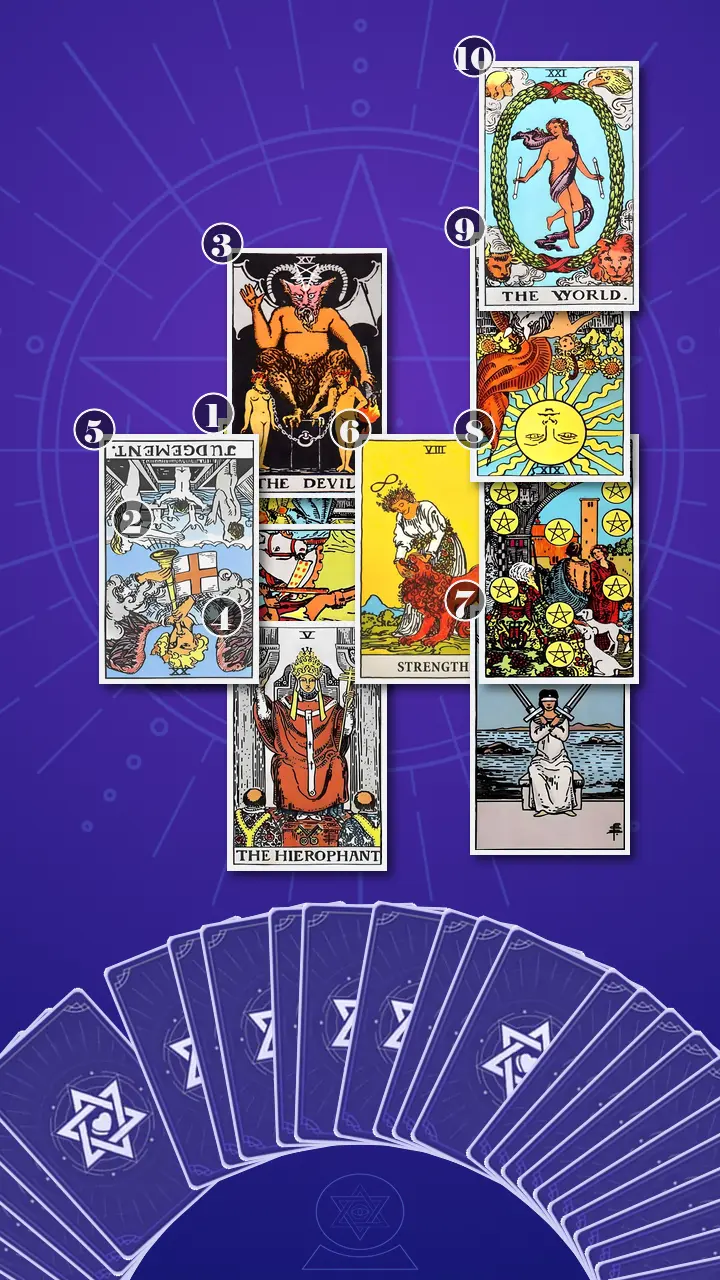
Reading the Map: When Old Medals Turn Into New Pressure
Position 1 — The immediate, observable reaction in the present
“Now flipping over,” I said, “is the card representing the immediate, observable reaction to receiving the medals and how self-worth feels in the present moment.”
Six of Cups, reversed.
I let the image sit between us for a breath. Two children. A cup of flowers. A courtyard that looks like a place you’re supposed to remember fondly.
“This is complicated nostalgia,” I said. “Not the sweet kind. More like: you receive a ‘gift’ from the past and it doesn’t land as comfort—it lands as pressure.”
And I anchored it in her real life, exactly as the card demanded: “This is like when you opened the package expecting pride, but instead your chest tightened and your hands couldn’t stop picking up the medals and putting them down. Your body recognized the medals as a message: prove you still deserve that kind of attention.”
Reversed energy here feels like blockage—the past trying to offer something, but the receiver can’t actually receive it. Not because she’s ungrateful, but because receiving has been wired to evaluation.
Jordan gave a small laugh that wasn’t amusement, more like a reflex to keep it from getting too real. “That’s… too accurate,” she said, and her smile carried a thin edge. “Like, it’s kind of rude.”
Her reaction came in a clear three-beat chain: her breath paused (freeze), her eyes unfocused as if rewatching the tape-tearing moment (cognition), and then her shoulders dropped a millimeter with a quiet, resigned exhale (release). She wasn’t being pitied. She was being seen.
Position 2 — The main block: the pattern that keeps worth stuck to validation
“Now flipping over,” I said, “is the card representing the main block: the pattern that keeps self-worth stuck on achievements and external validation.”
Six of Wands, reversed.
“This is the ‘audience pressure’ card when it’s reversed,” I told her. “Recognition doesn’t land as nourishment. It lands as a raised bar.”
I brought in the modern translation bluntly, because this card is blunt: “LinkedIn notifications become a crowd. Likes become laurel leaves. And your nervous system acts like if you don’t have a headline-worthy win, you shouldn’t take up space.”
The reversed energy here is deficiency and distortion at once: not enough internal confidence to feel steady, and too much dependence on being seen as impressive to feel safe.
Jordan winced, like she’d felt the laurel wreath tighten around her ribs. “Praise makes me anxious,” she said. “Even at work—if someone’s like, ‘Great job,’ I’m already thinking, ‘Okay, now I have to do that again, but bigger.’”
“Exactly,” I said. “This isn’t envy. It’s a safety equation. Visibility got linked to worth.”
Position 3 — The underlying attachment beneath the surface
“Now flipping over,” I said, “is the card representing the underlying attachment or compulsion that runs beneath the surface when worth feels threatened.”
The Devil, upright.
In my work with sound, I’ve learned something simple: if you play one frequency long enough, the body starts to anticipate it. The Devil is like that—an internal contract that has been rehearsed so many times it feels like truth.
“This isn’t ‘you’re bad,’” I said quickly, because The Devil gets unfair PR. “This is attachment. The belief that worth must be earned through performance and kept through constant proof.”
I tapped the image gently. “Notice the chains. In most decks, they’re loose enough to remove. That’s the point. You’re not trapped. But you’ve been living as if you are.”
In modern terms: “This is like telling yourself you’re being ‘responsible’ by obsessing over achievements… when what you’re really doing is trying to buy certainty about your worth.”
The energy here is excess: too much compulsion, too much proving, too much ‘if I just fix my image I’ll feel okay.’ Proof becomes calming—but it’s not nourishing.
Jordan nodded, slower this time. “It feels like relief for like… ten minutes,” she admitted. “Then it’s worse.”
Position 4 — The earlier conditioning: who taught you what “counts”
“Now flipping over,” I said, “is the card representing the childhood or earlier conditioning that taught you what counts and why medals still carry emotional power.”
The Hierophant, upright.
“This is internalized authority,” I said. “School systems. Coaches. Parents who meant well. Rubrics. Gold stars. The idea that being ‘good’ is something you can prove.”
I could almost hear it in her language: the way she said ‘productive’ and ‘tidy’ like moral words.
“Medals fit perfectly inside this framework,” I continued. “They’re official proof you met the standard. So when they show up at your door, you’re not just holding metal. You’re holding a whole old grading system.”
The energy is structure—useful, stabilizing, but also limiting when it becomes the only way you know how to value a life.
Jordan looked down at the card and said, very quietly, “My parents didn’t even say anything intense. They were just like, ‘We found these, thought you’d want them.’ And I still felt… judged.”
“Because the judgement isn’t coming from them in that moment,” I said. “It’s coming from the internal rubric you learned under their roof.”
Position 5 — The conscious story: the verdict you keep trying to reach
“Now flipping over,” I said, “is the card representing your conscious story about what should make you worthy, and the mental verdict you’re trying to reach.”
Judgement, reversed.
I felt my own chest tighten in recognition—not personal, professional. As a radio host, I’ve spent years editing audio: replaying one sentence, one breath, one “um,” trying to make it perfect. Judgement reversed is that, but applied to the self. Endless replays. No release.
“This is the trial that never adjourns,” I told her. “You re-open old achievements like Exhibit A, and your mind cross-examines you with leading questions: ‘Was it real? Would it count today? Did I earn it enough?’”
Then I said the line that always lands, because it’s painfully precise: “You’re not chasing success—you’re chasing a verdict.”
The reversed energy here is blockage: the card wants awakening, but instead it gets stuck in evaluation. Waiting for permission. Waiting for the trumpet to announce you’re allowed to start a new chapter.
Jordan’s gaze went still. A pause opened between us where no one reached for a joke. “I’m literally doing that,” she said. “I’m waiting for something to… clear me.”
Position 6 — The near-term leverage point: the bridge out of proof-seeking
When I reached for the next card, the room felt quieter—not dramatic, just focused, like when a song drops out and you realize you were relying on the beat to keep moving.
“Now flipping over,” I said, “is the card representing the most accessible near-term leverage point: what helps you shift from proof-seeking into self-trust.”
Strength, upright.
Jordan’s eyes widened, just slightly. The lion. The gentle hands. The infinity symbol like a calm loop instead of a panic loop.
Setup. I mirrored her actual scene back to her, because that’s where the leverage lives: “You’re in your condo kitchen at night, medals on the counter, laptop open ‘just to tidy LinkedIn,’ and suddenly your chest goes tight like the room turned into a silent performance review. Your hand hovers over ‘Edit headline’ because that’s the lever you’ve always pulled to feel safe.”
Delivery.
Stop treating your life like it needs a crowd and a laurel wreath to count; start practicing quiet courage that tames the lion from the inside.
I let the sentence hang in the air the way a good chorus does—long enough for the body to catch up to it.
Reinforcement. Jordan’s reaction came in layers. First, her breath hitched like she’d been bracing for a scold and got something kinder instead. Then her mouth tightened—not in resistance, in grief. A quick blink, and her eyes shone. Her shoulders, which had been lifted and rigid like she was holding her own head up by force, slowly dropped. Her hands unclenched on her lap, fingers uncurling one by one. When she finally exhaled, it was long and audible, the kind of exhale that tells me the nervous system just got new data.
“But if I stop…,” she started, and for a second there was heat—almost anger. “Doesn’t that mean I was wrong? Like I wasted all that time?”
I nodded, not rushing her out of it. “No,” I said. “It means you did what worked to get love and safety then. Strength isn’t shaming the old strategy. It’s giving you a new one.”
This is where my own practice comes in—my Generational Echo lens. “Can I try something a little different?” I asked. “In my work, I sometimes listen for a three-generation ‘music memory’ pattern—like a household playlist nobody chose, but everyone learned.”
Jordan leaned in, cautious but curious.
“Your medals are one track,” I said. “A ‘win’ track. Your LinkedIn spiral is another track—‘keep proving’ track. And I want you to imagine the third track, older than you: the family song about what counts. Stability. Respectability. Being impressive. Not because your family is bad—because that’s the survival music many families inherit.”
“Strength,” I continued, tapping the card, “is you changing the playlist without smashing the radio. It’s the moment you notice the ‘prove it’ impulse—and choose to hold it gently instead of letting it drive your next move.”
Then I gave her the micro-practice exactly as we’d planned, because insight without a next step just becomes a prettier spiral:
“Set a 7-minute timer. Put one medal on the table. Place one hand on your chest or throat—where you feel the tightness—and name the impulse out loud: ‘I want to prove I still count.’ Then write two lines:
1) ‘If I didn’t have to prove anything tonight, I would choose ___.’
2) ‘A respectful next step would be ___ (small, doable, no audience).’
And if you feel yourself spiraling or getting numb, stop early on purpose—closing the notebook is part of the practice, not a failure. No posting. No rewriting your bio afterward.”
I watched her eyes flick, involuntarily, as if seeing her laptop in her kitchen. I used the close-up scene the card asked for: “Picture your hand hovering over ‘Edit headline,’ and instead you close the laptop halfway. Not as a punishment. As a choice.”
Then I asked her, gently but directly: “Now, with this new lens—hold the urge, don’t obey it—can you think of a moment last week when you were about to ‘fix your profile’ and what you actually needed was care?”
Jordan stared at the Strength card, then nodded once. “Monday,” she said. “On the TTC. I saw one of those ‘thrilled to announce’ posts and I literally opened Notes like I was performing CPR on my resume.”
“That’s the lion,” I said. “Not your enemy. Just powerful. And trainable.”
In that moment, I could feel the shift we were after: from shame and contraction toward a first taste of grounded self-trust. Not a big declaration—just a new relationship with the impulse.
Position 7 — Your inner posture when nobody is watching
“Now flipping over,” I said, “is the card representing how you’re relating to yourself right now when nobody is watching—your stance, coping style, and inner posture.”
Two of Swords, upright.
“This is protective stalemate,” I said. “The blindfold isn’t ignorance. It’s self-protection. A part of you is keeping your heart and mind split so you don’t have to feel the full weight of this worth question.”
Modern translation: “This is like staying ‘logical’ so you don’t feel the sadness underneath the medals: ‘I thought winning would make me feel secure.’”
The energy here is balance on the surface—calm, competent—but also blockage underneath. Still water. Crossed swords over the chest.
Jordan’s jaw flexed, then softened. “I do that,” she said. “I get practical. I reorganize. I edit. It’s like… safe mode.”
“Noise-cancelling headphones over your heart,” I said, and she gave a small, genuine nod.
Position 8 — Family and environment signals: legacy pressure
“Now flipping over,” I said, “is the card representing family and environment signals—the legacy, expectations, and unspoken messages around success and worth.”
Ten of Pentacles, upright.
“This is the multigenerational storyline,” I told her. “What counts in your system didn’t start with you. It’s been passed down through tangible symbols: credentials, status, ‘making it.’”
I watched her shoulders rise slightly again—just a millimeter. Family pressure has gravity even when it’s unspoken.
“The medals arriving isn’t just a random package,” I said. “It’s a family message about success, even if nobody said a word.”
The energy here is grounding, but also weight. Legacy can be stability. It can also be a rubric you never agreed to.
Position 9 — The hopes and fears: wanting joy, fearing visibility without perfection
“Now flipping over,” I said, “is the card representing what you secretly hope for and what you fear.”
The Sun, reversed.
“You want uncomplicated confidence,” I said. “You want to feel proud and let it be simple.”
Then the reversal: “But you fear being fully seen unless you’re flawless. Like joy will be taken away if it isn’t earned in a visible way—so you dim your own light before anyone else can.”
Modern translation: “You want to post something honest about your life now, but you stop because you can’t package it as a win.”
The energy here is blocked radiance. Not darkness. Just a hand over the dimmer switch.
Jordan whispered, “I miss being proud. Or maybe I miss being praised.”
“Both can be true,” I said. “And neither makes you shallow.”
Position 10 — The integration direction: self-worth as wholeness
“Now flipping over,” I said, “is the card representing integration—what self-worth can grow into if you work with these insights instead of chasing a new trophy.”
The World, upright.
There it was: the wreath again—but this time, not a laurel for applause. A garland of completion. A circle that holds a whole story.
“This is integration,” I said. “Self-worth becoming wholeness rather than a scoreboard.”
I used the wreath transformation motif, because the whole spread had been arguing about it: “The Six of Wands is laurel—approval, crowd, being held up. The World is a wreath of completion. Same shape, different source.”
Then I gave her the future image the card wanted: “Medals on a shelf, not on the table. A life that doesn’t need a pitch deck. Completion isn’t applause. It’s wholeness.”
Jordan’s eyes closed for a second, like she was testing what that would feel like in her body. When she opened them, her voice was steadier. “That sounds… quiet,” she said. “In a good way.”
From Verdict-Seeking to Worth Practice: The Next 7 Days
I gathered the reading into a single, coherent story, because that’s how tarot becomes practical: it turns a messy emotional experience into a readable map.
“Here’s the arc I’m seeing,” I said. “The medals triggered Six of Cups reversed—complicated nostalgia that didn’t feel safe to receive. The crossing Six of Wands reversed shows why: being seen has become a pressure system, not comfort. Underneath, The Devil says the attachment is to proof-as-safety, and The Hierophant shows where it was learned: an inherited grading system for worth. Judgement reversed keeps you stuck in a mental courtroom, waiting for a verdict. The bridge is Strength: not more winning, but gentle authority—the ability to hold the ‘prove it’ urge without obeying it. That opens the path to The World: a wholeness-based identity that can include your medals without requiring them.”
“Your blind spot,” I added, “is that your brain keeps treating proof as the only kind of safety that counts. Proof is calming, but it’s not nourishing. The transformation direction is to move from collecting evidence of worth to practicing worth as a daily relationship with yourself—one honest choice at a time.”
Then I made it concrete. No grand reinvention. No ‘just be confident.’ Just experiments.
- The 7-Minute “Hold-the-Lion” TimerOnce this week, put one medal on the table. Set a 7-minute timer. One hand on your throat/chest. Say out loud: “I want to prove I still count.” Write two lines: (1) “If I didn’t have to prove anything tonight, I would choose ___.” (2) “A respectful next step would be ___ (small, no audience).” Then put the medal away on purpose.If the urge to open LinkedIn spikes, close your laptop halfway—soft close, not a slam. Stopping early is part of the practice.
- The Outcome-Free Respect LogFor 7 days, end your day with one line: “I respect myself today because ___.” Ban outcomes and applause: no numbers, titles, praise, metrics, or “crushed it.” Just values and choices (e.g., “I set a boundary,” “I ate lunch,” “I told the truth”).If your inner critic calls it cringe or unproductive, treat that as proof the old rubric is losing grip. Keep it to one sentence.
- The Soundproof Barrier (a boundary you can feel)At night—especially when the medals or a comparison scroll hits—create a 10-minute “sound wall” before you touch LinkedIn: put on a low-stimulation playlist (no lyrics, steady tempo). Sit in your kitchen or on your couch and let your body downshift before you decide what to do next.Make it easy: one saved playlist called “Not a Verdict.” The goal isn’t to avoid ambition—it’s to separate ambition from self-punishment.

A Week Later: Quiet Proof, Not a Spotlight
A week later, Jordan messaged me. No long essay. Just: “Did the 7-minute thing. Wanted to rewrite my headline. Closed the laptop halfway instead. Wrote: ‘If I didn’t have to prove anything tonight, I’d go to bed.’ Then I actually did. Weirdly proud. Quiet.”
Her follow-up came with a small, bittersweet honesty: she said she slept through the night, but when she woke up, her first thought was still, “What if I’m falling behind?” Then—this was the part that mattered—she noticed it, put a hand on her chest, and whispered, “Hold the lion.”
That’s the Journey to Clarity in real life: not the disappearance of the urge, but the shift in who’s holding the steering wheel. Strength isn’t louder confidence. It’s steadier self-respect.
When proof is the only thing that makes you feel real, even a harmless box of childhood medals can hit like a verdict—tight throat, sinking stomach, and that frantic need to earn your place again.
If you didn’t have to prove you’re impressive this week, what’s one small, private choice that would let you respect yourself in the present tense?