Stuck on the Place-of-Birth Question - How to Submit Without Overexplaining

The Cursor That Felt Like a Confession
If you’re a London tech worker who can ship a whole UX flow at work but will stare at the “Place of birth” box on a passport form until the session times out, you’re not imagining how loaded that one field feels.
Jordan (name changed for privacy) sat cross-legged on their bed in a dim London flat, laptop balanced on a pillow like it might bite. The GOV.UK renewal page was the only bright thing in the room—too-white screen light, blinking cursor, a radiator clicking in the background like it had opinions. Their mug of tea had gone properly cold, skin forming on top, and still that little text box waited.
I watched their throat work when they swallowed. Their jaw held itself like it was clamping down on a sentence they didn’t want to say out loud.
“It’s one box on a form,” Jordan said, half-laughing in a way that didn’t reach their eyes. “But it feels like a whole identity.”
They told me what the last few weeknights had looked like: opening the renewal page around 10 or 11, hovering over the birthplace field, then detouring into what they called “accuracy checks.” Zooming the passport photo to 200%. Renaming PDFs. Searching old records. Opening Apple Notes drafts titled “bio” like they were going to finally find the perfect one-liner that would make them… un-judgeable.
Under it all was the same fear: if they typed their birthplace, it would lock them into a version of themselves they’d outgrown. Like the past would get a microphone. Like a required field could become a verdict.
I leaned in a little, keeping my voice as steady as the low music I keep on in the studio. “You’re not being dramatic. You’re having a very normal nervous system response to something that feels like categorization.” I tapped the edge of the table softly, a tiny metronome. “And we can work with it. A required field isn’t a required story. Let’s try to draw a map through the fog—something you can actually use tonight.”

Choosing the Compass: The Four-Layer Insight Ladder
I asked Jordan to take one slow breath—not as a mystical thing, just as a transition. The way you might pause before hitting “Deploy,” so your system isn’t making decisions while it’s overheating. I shuffled the deck slowly, the soft rasp of cards against cards grounding the room in a rhythm that wasn’t their looping thoughts.
“For this,” I said, “I’m going to use a spread I built for exactly this kind of moment: the Four-Layer Insight Ladder · Context Edition.”
To the reader: this is one of those times where tarot works best as a layered reflection method, not prediction. Jordan’s issue wasn’t, Should I renew my passport? It was, Why does this simple administrative task trigger a whole identity spiral? A ladder spread is efficient because it separates the symptom (the freeze) from the root (the inherited story), then gives you a turning-point reframe and one practical next step. No vague fate-talk—just clarity and actionable advice.
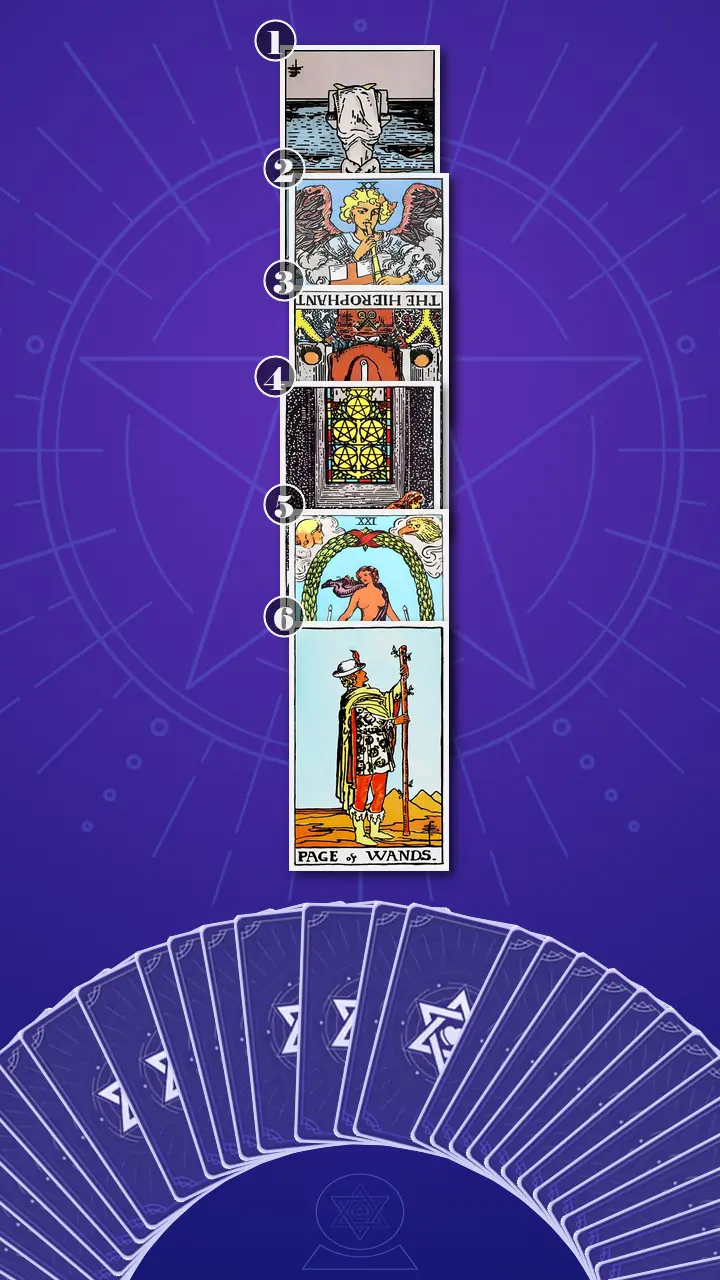
I showed Jordan the layout as I placed the cards in a vertical line: top to bottom, like walking down into a memory and back up with your own keys in your hand.
“Card one,” I said, “is the visible stuck point—what happens in your first minute with the form.”
“Card three goes deeper: the inherited rule that makes ‘birthplace’ feel loaded.”
“And card five is the turning point—the reframe that returns authorship to you.”
Reading the Map: How the Card Meanings Hit in Context
Position 1: The Visible Stuck Point
“Now turning over,” I said, “is the card that represents the visible stuck point: what you’re doing when you hit the birthplace question and why it feels impossible to move.”
Two of Swords, reversed.
The image is blunt: a blindfold. Crossed swords tight to the chest. A body turned into a locked door.
“This,” I told Jordan, “is your ‘admin freeze.’ You have the passport renewal open, you can physically feel your body lock up at the ‘place of birth’ field—so you do productive side quests. Photo retakes, scan settings, file naming conventions—anything that looks like progress while the real task sits untouched.”
Jordan let out a short, bitter little laugh. “That’s… honestly kind of cruel.”
I nodded. “It can feel like I’m reading your browser history. But it’s not cruelty—it’s precision. Two of Swords reversed is decision paralysis leaking into your life. It’s your mind holding everything in suspension because it thinks suspension equals safety.”
I pointed gently at the crossed swords. “Your brain is doing a risk assessment loop like it’s an always-on compliance tool. And it’s convincing you that you’re being accurate—when really…” I paused just long enough to let the truth land without shame. “This is avoidance dressed up as accuracy.”
Energy-wise, it’s Air, but contracted—blocked. Too much thinking used as armor, not as clarity.
Jordan’s shoulders rose, then dropped a fraction. Their fingers fidgeted with their sleeve like they wanted something to hold. They didn’t argue. They just breathed out through their nose, slow, like a tiny surrender.
Position 2: The Trigger That Turns Admin Into a Life Review
“Now turning over,” I said, “is the card that represents the trigger: what the passport renewal is activating psychologically beyond the practical task.”
Judgement, upright.
In the card, an angel’s trumpet calls people up—like a notification you can’t ignore.
“Judgement is the reminder email,” I said, “the calendar alert, the approaching trip, the friend’s Instagram Story—‘Finally renewed my passport—next stop Lisbon!’ It hits like a trumpet blast in your chest.”
That’s when Jordan looked up sharply, like I’d just played a sound they recognized. “It’s always after I see someone else doing it,” they said. “Like… why am I stuck on this?”
“Because Judgement isn’t the form,” I replied, “it’s the feeling of being evaluated. It’s not the admin—it’s the inner alarm that says, ‘This matters, and you will be perceived.’”
I’ve spent a decade studying how sound moves through the body—how a single frequency can make a room feel safe or sharp. Judgement, in a reading like this, always feels like a sudden volume spike: your nervous system hears the ping and assumes it’s a verdict, not data.
Jordan’s jaw tightened again just at the word evaluated. Then they blinked hard and looked down at the card, as if trying to lower the volume with their eyes.
Position 3: The Inherited Story About Who Gets to Define You
“Now turning over,” I said, “is the card that represents the inherited story: the belief or rule about origins/identity that makes birthplace feel like a verdict.”
The Hierophant, reversed.
“Under the freeze,” I said, “is an old rule: institutions and official categories get to define what’s valid. And then there’s your rebellion against that—arguing with the system in your head, trying to craft the perfect explanation, refusing to submit until it feels aligned.”
Jordan’s mouth twisted. “I hate that that’s true.”
“The Hierophant reversed is exactly that friction,” I said. “You’re not wrong for bristling. But here’s the trap: the rebellion can turn into a different kind of obedience. If you won’t move until the system feels fair or emotionally accurate, you stay stuck inside the very gate you’re resisting.”
Energy-wise, it’s structure gone rigid—either you fight it or you try to master it perfectly. Both routes keep you in the building, still asking for permission.
Jordan stared at the card’s keys, then rubbed their thumb against the side of their index finger. A small, private fidget—like they were checking whether they still had their own grip.
Position 4: The Hidden Wound You’re Protecting
“Now turning over,” I said, “is the card that represents the hidden wound/need: what you’re protecting when you stall, and what you actually need to feel safe enough to proceed.”
Five of Pentacles, upright.
The card is cold: two figures in a snowstorm, limping past a warm, lit window.
“This is the part you don’t love admitting,” I said softly. “Beneath the intellectual fight is a belonging wound. A fear that if the birthplace is named, you’ll be treated like an exception—othered, questioned, made to explain.”
Jordan’s face went still in a way I’ve heard a thousand times on-air when someone is trying not to cry. Their breathing paused.
Then came the three-step reaction chain, right on schedule:
First, freeze—their shoulders locked, like they were bracing against cold air.
Second, memory replay—their gaze unfocused past the table, as if watching old conversations scroll by like a feed they never asked to follow.
Third, release—a slow exhale, shaky at the end. Their jaw loosened a millimeter.
“I’m tired of explaining myself,” they said, voice flatter than they wanted it to be. “Even when nobody asked.”
“That makes perfect sense,” I replied. “Five of Pentacles says your stalling isn’t laziness. It’s protection. Your body has learned that ‘official’ can mean ‘unsafe.’ So you keep walking past the warm window by staying over-prepared and emotionally distant.”
When The World Spoke: Finding Clarity Without Erasing the Past
Position 5 (Key Card): The Turning Point
As my fingertips slid under the next card, the room felt quieter—like even the radiator stopped clicking to listen.
“Now turning over,” I said, “is the card that represents the turning point: the reframe that returns authorship and integrates past without letting it run the present.”
The World, upright.
The dancer inside the wreath. The sense of completion that isn’t tidy—just whole.
Jordan’s eyes widened slightly, then narrowed, as if they didn’t trust something that looked that… resolved.
Here’s the setup—the moment right before the reframe snaps into place: it’s late, the laptop glow is the only light in the room, and the cursor is blinking in that one field like it’s asking you to confess something. Jordan’s mind is stuck in the same loop: If I type it, I’m agreeing. If I’m agreeing, I’m trapped.
Stop treating birthplace as a life sentence, start treating it as a single chapter, and let The World remind you that you are more than the label.
I let the sentence hang there. No extra commentary. No soothing. Just air.
Jordan’s body answered before their logic did.
Their breath caught—an involuntary inhale that lifted their chest. Their hands went still, hovering above their knees. Their eyes glistened like they were surprised by the emotional physics of it.
Then their face did this sequence: first a tiny flinch, like the part of them that’s been fighting the form wanted to argue—But it shouldn’t be like this. Then a softening around the mouth, like something heavy unhooked. Then a swallow that wasn’t forced. Their jaw unclenched in a way that made their whole expression look more like themselves.
“But if I let it be a fact,” they said, and their voice wobbled with a sudden edge of anger, “doesn’t that mean… I was wrong to fight it this hard?”
“No,” I said, firm but kind. “It means you were protecting something tender with the only tools you had. The World isn’t telling you you were wrong. It’s telling you you’re ready for a bigger frame.”
As a music therapist, I think in acoustics: a sound can exist in a room without owning the room. It can be loud, true, and still not define the entire mix. This is where my signature lens—Space Tuning—clicks in.
“The wreath in The World is like an acoustic boundary,” I told Jordan. “Not a wall that blocks life out—more like the right treatment in a studio that stops one frequency from taking over everything. Your birthplace can exist inside the paperwork. But the meaning stays inside your own mix—your values, your relationships, your chosen home, your present.”
I tapped the card lightly. “Coordinate vs headline. Fact vs life sentence. Birthplace is a coordinate, not a verdict.”
Jordan blinked again, slower this time. Their shoulders dropped as if they’d been holding a backpack they forgot they were wearing. And then—this part always gets me—they looked briefly dizzy, like clarity comes with responsibility.
“Now,” I asked, “with this new lens—can you think back to last week? Was there a moment when the form, or a ‘Where are you really from?’ question, hit you—and this would’ve let you feel different?”
Jordan stared at the wreath and nodded once. “At drinks,” they said. “Someone asked it. I did the whole… Fleabag thing. Smiled, acted fine, had a whole private monologue in my head.”
“That’s The World’s invitation,” I said. “Not to erase the past. Just to stop giving it the steering wheel.”
And I named it clearly, so it couldn’t slip away: “This isn’t only about a passport renewal. It’s a shift from contracted unease and narrative looping to steadier self-authorship and relief—past acknowledged, not driving.”
Position 6: The One-Week Embodiment
“Now turning over,” I said, “is the card that represents the one-week embodiment: a practical next step that puts the new story into motion with low stakes and high clarity.”
Page of Wands, upright.
“This is the part that people miss,” I told Jordan. “The Page doesn’t wait to feel perfectly resolved. The Page moves, then learns.”
I linked it directly to their real life. “Instead of waiting for a flawless internal narrative, you treat submission as a small act of self-trust: fill the required facts, send it, then do one low-stakes action that expresses who you are now—something exploratory and real.”
Jordan’s lips twitched. “So… less Severance, more… I don’t know, actual human?”
“Exactly,” I said. “Less ‘I am a file.’ More ‘I am a person with choices.’ And—say it with me—save it, then stop—movement counts.”
They nodded, and this time it wasn’t just agreement. It was a plan forming behind their eyes.
The One-Page Plan for Passport Renewal Anxiety
I took a breath and stitched the whole ladder into one story, the way I would build a playlist that actually takes someone from panic to steady.
“Here’s what the cards are saying together,” I told Jordan. “Right now, you freeze (Two of Swords reversed) because your mind thinks the birthplace box is an identity confession. A trigger hits—a reminder email, a deadline, someone else’s travel post—and suddenly it feels like you’re being evaluated (Judgement). Under that is a fight with institutional authority: part of you refuses to let official categories define you, so you try to outsmart the system with perfect wording (Hierophant reversed). But under the fight is something softer: a fear of being othered, of being outside the warm window once a fact is named (Five of Pentacles). The turning point is The World: you’re allowed to be factually from somewhere without being emotionally owned by it. Then Page of Wands says: prove it to your body with one small, present-tense movement.”
The cognitive blind spot was almost painfully simple once it was visible: Jordan had been treating one admin field like it needed to resolve an entire origin story. They were asking paperwork to do emotional work.
“Your transformation direction,” I said, “is exactly this: shift from treating birthplace as a verdict to treating it as a fact—while choosing a values-based story about who you are now.”
Then I gave them what they actually came for: next steps that don’t require a personality transplant.
- The Fact-Then-Choose 10-Minute RunTonight, set a 10-minute timer. Open the GOV.UK renewal page. Type your birthplace exactly as the form requires—no extra context, no commentary. Hit save. When the timer ends, stop even if your brain wants to keep polishing.If your throat tightens, name it as a body reaction (“tight throat, clenched jaw”), not a truth statement. If 10 minutes feels like too much, do the 2-minute version: type + save, then walk away.
- The “Wreath Boundary” Browser SetupBefore you start, create a boundary like The World’s wreath: one browser window with only the renewal tab. No camera roll, no search, no old records. Put your phone in another room for 15 minutes while you fill the required fields.Pre-decide a stopping rule: “If it’s saved, I’m done for today.” If you catch yourself opening a research tab, ask: “Is this required by the form, or required by my anxiety?” Then close the tab without negotiating with yourself.
- A Page of Wands “Proof of Present” Within 24 HoursAfter you save (or submit), do one small present-tense action: book a low-stakes day trip, sign up for a class, or message a friend with a simple plan. Something that says “I’m here now,” not “Please understand my past.”Use my go-to reset from sound therapy: hum one steady note for 30 seconds before you hit save. It physically loosens the throat/jaw clamp and helps your nervous system hear, “This is safe enough.”
Jordan looked at the list like it was the first interface they’d seen in weeks that didn’t punish them for being human.
A Week Later: The Quiet Proof
Five days later, I got a message from Jordan while I was setting up a late-night radio segment—levels checked, mic warm, the city’s hum faint under the studio insulation.
“Did the 10-minute timer,” they wrote. “Typed it. Saved it. Stopped. My whole body wanted to open five more tabs. Didn’t. Then I booked a stupid little day trip to Brighton. I was weirdly shaky after, but… I slept.”
It wasn’t a cinematic ending. It was better: a small, true shift. Clear enough to move. Soft enough to keep going.
That’s the real Journey to Clarity I love about tarot when it’s done well—not predicting a perfect future, but giving you a cleaner relationship to the present. A passport renewal becomes just a task again. A birthplace becomes just one coordinate. And your life stays yours to author.
When a single box on a form makes your throat tighten, it’s not because you’re dramatic—it’s because part of you is tired of being reduced to a place you didn’t choose, and still afraid that naming it will hand your past the steering wheel.
If your birthplace could stay a simple fact on paper—just one coordinate—what tiny present-tense sentence would you choose to write for yourself right now, starting with “What I choose now is…”?