My Work Anniversary Felt Like a Report Card: How I Switched to Review Mode

The 9:14 a.m. Workday Ping
You’re a NYC tech product marketing person who gets a Workday/HR “Happy work anniversary!” email on a packed Monday—and instantly feels the Sunday Scaries cousin: work-milestone dread.
Taylor (name changed for privacy) said it like she was confessing to a crime, not describing an email.
“It’s supposed to feel like a celebration,” she told me, “but it feels like a spotlight.”
Even through a video call, I could see it in the way her body tried to outrun the moment: shoulders lifted like they were bracing for impact, fingers tapping a staccato rhythm against her mug. She was still at her desk in Midtown—glassy office, fluorescent buzz, coffee gone lukewarm—trying to pretend she wasn’t spiraling while Slack notifications kept nudging the edge of the screen.
She described the exact slice of time: 9:14 a.m., subject line pops up—Happy Work Anniversary!—and her chest tightened like a drawstring. A small nauseous drop hit her stomach. She clicked, skimmed the template confetti, and before the “Congrats!” animation could finish, her hand had already opened LinkedIn in a new tab. Then Levels.fyi. Then her resume doc. Then the notes app titled “Next Moves.”
“I want to feel proud,” she said, staring past the camera like she was watching herself do it, “but the second I’m ‘celebrated,’ I start building a case that I chose wrong.”
It landed in my chest too—because I know that move. The mind acts like a lawyer because it’s terrified of being found guilty of wasting time.
I kept my voice gentle, the way I do when I’m guiding school groups under a planetarium dome and I can feel the room getting tense at the word infinite. “Okay,” I said. “Let’s not force this to be a pep talk. Let’s make it a map. We’re going to use tarot the way I use the night sky: as a pattern language to find timing, rhythm, and your next usable step—real clarity, not a vibe.”

Choosing the Compass: The Horseshoe Spread for a Career Crossroads
I asked Taylor to take one slow breath with me—not as a ritual, just as a transition. “Name the question in one sentence,” I said, “and let your body hear it without arguing back.”
She inhaled, held it too long (like she was negotiating with herself), then let it go. “Work anniversary email hits—what past choice am I still living out?”
I shuffled slowly. The sound of cards has always reminded me of turning a telescope’s focus wheel: small movements, big clarity shifts.
“Today we’ll use the Horseshoe Spread · Context Edition,” I explained. “It’s built for reflective questions like this—especially when you’re at a career crossroads and your brain is doing decision-fatigue math.”
For you reading this: the horseshoe arc is useful because it moves like a narrative. It starts with the past choice that set things in motion, travels through the present lived reality and the hidden ‘contract’ beneath it, names the exact blockage that turns reflection into paralysis, and then shows the mindset shift and near-term direction that makes actionable advice possible. It’s empowering, not fatalistic—position 7 is a direction of growth, not a fixed fate.
“Three points to listen for,” I told Taylor. “First: the origin choice you’re still honoring on autopilot. Second: the choke point where planning replaces movement. Third: the wake-up stance—the way to review this without self-punishment.”
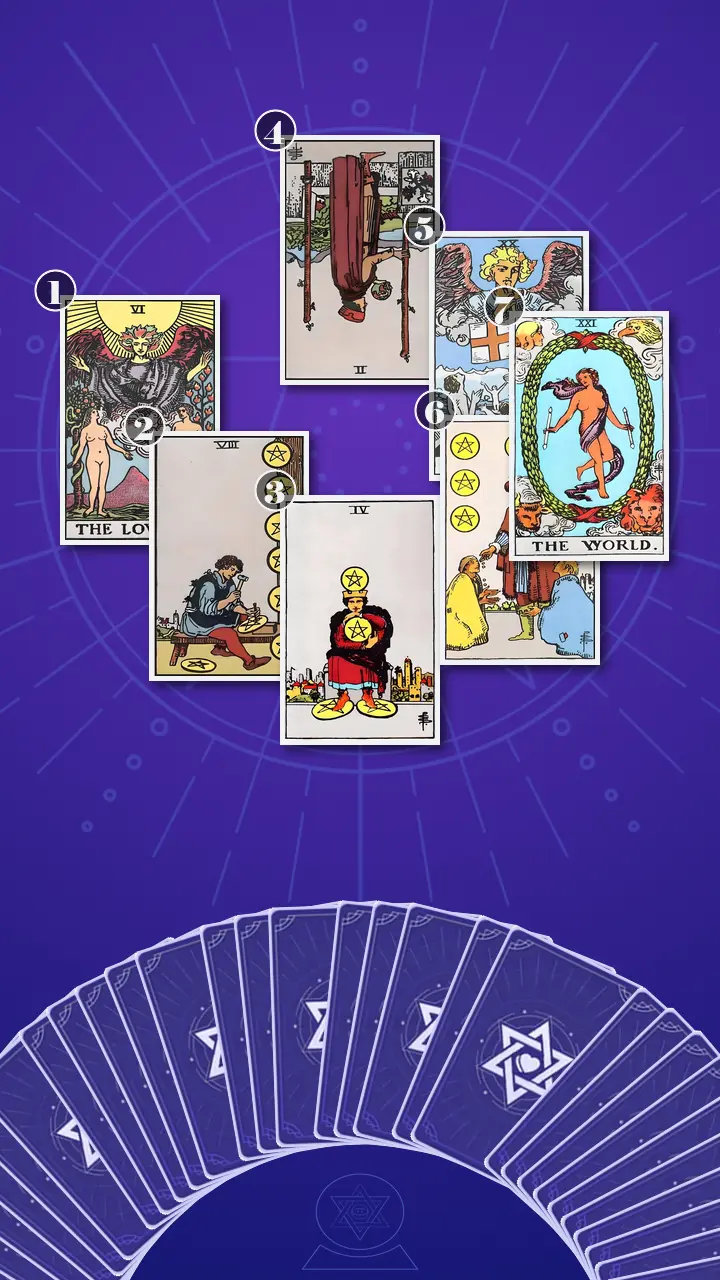
Reading the Arc: The First Four Cards (and the Tab-Switching Trap)
Position 1 — The past choice you made that set the chapter in motion
“Now flipped over,” I said, “is the card that represents the past choice you made that set the current career chapter in motion—the commitment you’re still living out.”
The Lovers, upright.
I watched Taylor’s face shift into that specific expression people get when they’re bracing for a cliché—like, Great, tarot is going to tell me to ‘follow my heart.’
“Stay with me,” I said. “This isn’t about romance. In career readings, The Lovers is about values-based commitment. It’s you back in the moment you accepted the offer: not just choosing tasks and a paycheck, but choosing an identity in NYC—‘stable,’ ‘smart,’ ‘going somewhere.’ Maybe it was the year you wanted to stop feeling financially fragile. Maybe you wanted proof you could make it in tech.”
“Yeah,” she said, and then she let out a small laugh that wasn’t funny. “That’s… brutal.”
That was our first “unexpected reaction” moment: not a nod, not instant agreement—more like a bitter little chuckle. Called out.
“It can feel harsh,” I said, “but I mean it with respect. The Lovers is also the reminder that your past self made a meaningful choice with the information and needs she had—so the question now isn’t ‘was it right?’ but ‘are those same values still leading?’”
Energetically, this card is balance when the choice aligns with your values. But in your story, I can feel it tipping into excess pressure: like the choice has to stay ‘right’ forever for you to feel safe.
Taylor’s hand went to her jaw without her noticing, thumb pressing a spot like she was trying to quiet a headache that lived underneath the skin.
Position 2 — Your current lived reality of that choice
“Now flipped over,” I said, “is the card that represents your current lived reality of that choice—what the anniversary email is reflecting back to you right now.”
Eight of Pentacles, upright.
“This one always smells like office lighting to me,” I said, and Taylor’s eyes flicked up. “Because it’s a normal workday: you’re competent, responsive, and genuinely good at product marketing—writing launches, refining positioning, shipping decks, learning new tools. Your calendar is stacked, your Slack never stops, and your identity is built on being the person who gets it done.”
Her shoulders dropped a millimeter. Not relief—recognition.
“The energy here is steady Earth,” I continued. “Not glamorous, but real. Skill-building. Craft. The tricky part is that Earth can become a hiding place. Eight of Pentacles can turn into: if I just keep shipping, I won’t have to decide what I’m building toward. Competence becomes a substitute for direction.”
I asked her the position’s real-life question: “Hour by hour, where does your competence feel real… and where does it feel like you’re staying busy to avoid the bigger question?”
She swallowed. “I’m good at my job,” she said quietly. “But I can’t tell if I’m building a career or just getting good at coping.”
Position 3 — The hidden contract underneath
“Now flipped over,” I said, “is the card that represents the hidden contract underneath—what you’re protecting or holding onto that keeps the old choice active.”
Four of Pentacles, upright.
“This card is basically NYC rent autopay in a crown,” I said, and this time her laugh was softer—more human.
I leaned into the translation: “Your stability has a tight grip: steady paycheck, benefits, being ‘trusted’ at work, the relief of knowing rent is covered. Underneath, you’re guarding more than money—you’re guarding the identity of being responsible and in control.”
Her eyes went down to her desk as if the words were physically there. I could imagine her bank app balance checks, the internal rule that says: I can’t risk wobbling.
“Energetically,” I said, “this is control as protection. It’s not ‘bad.’ It makes sense. But it becomes a blockage when the grip is so tight you can’t move.”
I used the phrase that tends to unlock this card without shaming: “Stability can be a foundation, or it can be a fence.”
Taylor nodded once—sober, almost annoyed at how true it felt.
Position 4 — The main blockage that turns reflection into paralysis
“Now flipped over,” I said, “is the card that represents the main blockage—the point where planning replaces movement.”
Two of Wands, reversed.
Before I even spoke, Taylor’s mouth tightened like she already knew which scene was about to play.
“Here’s the screen-life montage,” I said, letting it be painfully specific. “Late at night, you can picture a different career with cinematic clarity—different title, different industry, maybe even a different city. You research roles, compare paths, and build a ‘perfect plan.’ But your body stays behind the wall: no messages sent, no single application truly started, no small experiment chosen.”
I slowed down and gave the inner monologue structure the card always carries when it’s reversed: “If I pick wrong, I’m screwed → so I’ll just research more.”
She exhaled sharply—a half-laugh, half-gasp—then rubbed her forehead with two fingers. “I literally had five tabs open during our call setup,” she said.
“Exactly,” I said, warm but direct. “And I’m not judging it. I’m naming it so you can steer it. Research is soothing. Choice is clarifying. Two of Wands reversed is the moment you replace movement with planning because planning still lets you feel in control.”
Energetically this is Fire under-expressed. The desire for a bigger horizon exists, but it’s stalled—so Fire leaks out as browsing, comparing, rehearsing, instead of one committed step.
In my head, I flashed to a memory from the planetarium: the first time I taught kids how pulsars work—how they look like steady beacons until you realize the “signal” is only steady because you’re measuring it with the right frame. Taylor’s signal wasn’t chaos. It was rhythm… misread as a verdict.
When the Trumpet Sounded: Judgement and the Verdict-to-Review Reframe
Position 5 — The wake-up call and inner stance available to you
“We’re flipping what I consider the pivot card,” I said. “Now flipped over is the card that represents the wake-up call and inner stance available to you—how to review the past choice without self-punishment.”
Judgement, upright.
The illustration’s trumpet felt almost loud on my desk. In my apartment, the distant hum of a washing machine in the building’s laundry room started up—a low, steady thrum. It was oddly perfect, like background white noise for a nervous system trying to stop making everything an emergency.
I used the first reframe gently: “The anniversary email is the trumpet. Not a grade—a wake-up ping. This card looks like you closing the courtroom in your head and opening a clean review instead: What did I learn? What did I trade? What do I want to update now that I’m not the same person?”
Then I named the pattern out loud: “You’re not on trial; you’re in a quarterly retro.”
Setup (the stuck moment): Taylor nodded, but I could still feel her mind trying to force a ‘correct’ answer. It was that familiar loop: the subject line hits, stomach drops, and suddenly LinkedIn, Levels.fyi, and a half-edited resume are open like it’s an emergency—because if she can just prove the decision was right, she won’t have to face the grief of trade-offs.
Delivery (the sentence that changes the room):
Not “I’m behind,” but “I’m being called”—let the trumpet of this anniversary move you from silent comparison into one deliberate next step.
I let it sit in the air for a beat. No fixing. No advice. Just the truth of it.
Reinforcement (what her body did before her mind caught up): Taylor’s breath stopped for a second—like her system froze mid-sentence. Her fingers, which had been tapping, went still with the tips hovering above the mug. Then her eyes unfocused, the way people look when they’re replaying a memory with a new caption. Finally, she exhaled from deep in her chest—long, uneven—shoulders dropping in a way that looked almost unfamiliar, like she’d been holding them up for years. Her face tightened, then softened; her eyes got a little glossy, not dramatic, just honest.
And then—complexity—she frowned. “But if it’s a ‘call,’” she said, voice suddenly sharper, “doesn’t that mean I should’ve known sooner? Like… was I just wrong?”
I shook my head. “No. It means you were aligned with what you needed then. And you’re aligned with what you need now by noticing the mismatch. That’s control, actually. Not the fantasy of never changing—real control: being able to update.”
Here’s where I brought in my signature tool, the one I use when people are trapped in an emotional spike that feels bigger than the moment: Pulsar Breathing. “When a pulsar sends a signal,” I told her, “we don’t panic—we sync our measurement to the rhythm so we can read it clearly. Your anniversary email is a pulse. The spiral is you trying to decode it while holding your breath.”
“So when the subject line hits and your chest tightens,” I said, “we do three breaths—inhale for four, exhale for six—like you’re syncing to a cosmic metronome. Not to calm down perfectly. Just to create enough space to choose a response instead of a reaction. The call is external; the response is yours.”
I asked her, exactly as I always do after Judgement lands: “Now, using this new lens—can you think of one moment last week when this would’ve changed how you felt? A time you opened the tab and you could’ve closed it?”
She stared at the ceiling, then nodded slowly. “Friday,” she said. “I got praised in a Slack thread. Ten minutes later I was on LinkedIn looking at someone else’s promotion.” She blinked hard. “I could’ve just… let the praise be data. Not a verdict.”
That’s the shift right there: from dread and comparison toward self-forgiveness and clearer values. From “I’m behind” toward “I’m being called.”
Position 6 — External mirrors: metrics, recognition, and reciprocity
“Now flipped over,” I said, “is the card that represents external mirrors—workplace metrics, recognition, and the give-and-take shaping your sense of worth.”
Six of Pentacles, upright.
“This is the corporate balance sheet translated into human feelings,” I said, tapping the image of the scales. “Your workplace is a system of exchange: effort for recognition, output for praise, time for compensation. Slack kudos threads. Salary bands. Performance review cycles that make your job feel like a scoreboard instead of a craft.”
Energetically, this card is balance when the exchange feels fair—and pressure when you start outsourcing your sense of ‘enough’ to the scale in someone else’s hand.
Taylor’s mouth twisted. “The praise feels good,” she admitted. “And then it’s like… I need more proof. Or I’m nothing.”
“That’s not a personality flaw,” I said. “It’s an environment. Six of Pentacles isn’t saying ‘don’t care’—it’s asking you to define the reciprocity you want next: mentorship, fair comp, clearer scope, more meaning per hour. Otherwise the system will define it for you.”
Position 7 — The direction you step into when you integrate the lesson
“Now flipped over,” I said, “is the card that represents what you’re stepping into if you integrate the lesson and make a conscious re-choice—a near-term direction of growth.”
The World, upright.
“This is the card I want everyone to get on a work anniversary,” I said, and Taylor gave me a tired smile that looked like relief trying to arrive.
“The World is integration,” I explained. “It’s completion without drama. It’s the permission to say: A chapter can be complete without being a mistake.”
I used the modern translation: “It’s like closing a project in Asana—not because it failed, but because it’s complete. It’s like updating your LinkedIn ‘About’ like a README: naming what you’ve built and what you’re building next.”
Energetically this is wholeness, the opposite of the Four of Pentacles clench. Not quitting impulsively. Not hate-watching your own career. Just finishing a season and letting the ending be real.
Taylor sat back, and for the first time her shoulders didn’t look like they were holding up a ceiling. “I’ve been acting like if I admit it’s complete, it means I stayed too long,” she said.
“Or,” I offered, “it means you built a base.”
From Insight to Action: The One-Tab Experiment (and a 10-Minute Retro)
I leaned back and let the whole arc speak as one story—because that’s where tarot becomes practical.
“Here’s what the spread is saying,” I told her. “You made a real values-based commitment (The Lovers). You became highly competent inside the life that choice created (Eight of Pentacles). You’re also gripping stability—money, benefits, the identity of being reliable—so tightly it’s turning into a fence (Four of Pentacles). And when the anniversary email hits, the fear of being ‘wrong’ flips your Fire into private planning, tab-switching, and comparison fatigue (Two of Wands reversed).”
“Judgement is the pivot,” I continued. “It’s the verdict-to-review reframe. It’s the moment you stop trying to win a case and start extracting clean lessons. And The World says you’re allowed to integrate this chapter and step forward—without needing a dramatic rupture.”
Then I named the blind spot I could feel underneath her logic: “Your cognitive blind spot is that you treat changing direction as evidence you lacked control. But evolution is not incompetence. It’s feedback.”
“The transformation direction,” I said, “is exactly this: shift from treating the anniversary as a verdict to treating it as a review—extract the lesson, name the trade-off, and choose one 30–90 day career experiment.”
I kept the next steps small on purpose. Real actionable advice for someone who’s feeling stuck has to fit into a life with meetings, rent, and a nervous system that flinches at risk.
- 10-Minute “Anniversary Retro (Not a Trial)”Set a 10-minute timer. Open a blank note titled “Anniversary Review (Not a Trial)”. Write two bullets: (1) “What this chapter gave me (skills, proof, money, relationships)” (2) “What it cost me (energy, time, identity, bandwidth).” When the timer ends, stop—no extra tabs, no bonus browsing.If your chest tightens or you start bargaining (“I need more info first”), put one hand on your sternum and do three rounds of Pulsar Breathing (inhale 4, exhale 6). If 10 minutes feels impossible, do a 3-minute version: one bullet each.
- Name the Trade-Off (No Shame, Just Accuracy)Write one sentence: “I chose this job because I wanted ______.” Then add: “I traded ______ for that.” Keep it factual. This turns the Lovers card from a moral debate into clear data you can use.Read it once out loud and notice your breathing. If it gets shallow, that’s not ‘proof’ you’re wrong—it’s proof you’re touching something real.
- The 45-Minute One-Tab Career Experiment (Supernova Focus)Pick ONE direction and ONE output. Example A: choose one job posting that genuinely interests you and draft ONE tailored resume bullet for it (not the whole resume). Save it as “Version 1.” Example B: message ONE trusted person with a 2-sentence ask for a 15-minute chat about their role—send it before you can perfect it.Use my “Supernova focus” trick: turn on your phone flashlight and point it at a single sticky note that says ONE TAB. It’s a physical cue to stop opening more windows. Boundary: 45 minutes, one output. One bounded action beats a perfect plan you never touch.
If Taylor wanted a bonus boundary (and she did), I suggested a gentle Four of Pentacles release that wouldn’t threaten rent: “No LinkedIn after 8 p.m. for three nights,” I said. “Not forever. Just long enough to prove to your nervous system that you can close the parapet gate and still be okay.”

A Week Later: Ownership, Not Certainty
Six days later, Taylor sent me a message. Not a novel. Not a strategy deck. Two lines.
“Did the Retro,” she wrote. “I messaged one person before I could talk myself out of it. Also: I didn’t open LinkedIn last night. I felt weirdly lonely for like three minutes, then… calmer.”
I could picture it: she’d done the brave, tiny thing—sent the message—then sat alone in her apartment with the quiet afterward, like the volume had been turned down on the world. Clearer, but still a little tender. (That’s what real change looks like.)
When I thought back to our call, I kept returning to Judgement’s simple truth: a milestone is just a signal. The meaning comes from your response. In astronomy, we don’t shame ourselves for updating a model when new data arrives. We call it good science. Your life deserves the same respect.
When a “congrats” email makes your chest tighten, it’s usually not because you’re ungrateful—it’s because you’re trying to be proud and feel safe while secretly fearing that changing course would mean you were never in control.
If you let this milestone be a review instead of a verdict, what’s one small, reversible experiment you’d actually feel willing to try in the next 7 days—just to prove you can respond to your life, not just explain it?