From 3 a.m. Chirp Panic to Returning to Bed: One-Check Practice
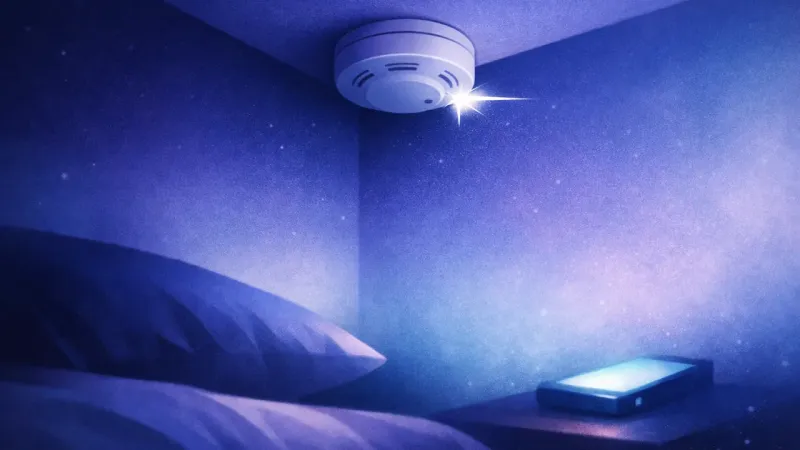
Finding Clarity When a Smoke-Alarm Chirp Triggers Hypervigilance
If you’ve ever been jolted awake at 3 a.m. by a smoke-alarm chirp and immediately launched into full apartment-sweep mode—flashlight, test button, Google tabs—you know what sound-trigger hypervigilance feels like.
Casey (name changed for privacy) sat down across from me in my little consulting room on a rainy Toronto afternoon, but their story began somewhere else: 3:07 a.m. on a Wednesday in a small rental where the walls were thin enough that you could hear a neighbour’s microwave finish its cycle like it was in your own kitchen.
“It’s one chirp,” they said, almost apologetic. “Sharp and high. And my body… it’s like my brain hits a red button.”
As they spoke, I could see the sequence play behind their eyes: cold-blue streetlight through the blinds; phone screen warming the palm; that immediate sit-up—half listening, half already moving. A chest tightening like a drawstring being yanked closed. A jaw that locks before a thought even forms.
“I want my apartment to feel like a refuge,” Casey said. “But the second I hear that chirp, I’m up. I’m checking. I’m testing the button. I’m Googling. And even when it’s obviously just the battery, I still don’t trust my own ‘all clear.’”
That was the core contradiction in plain language: wanting to feel safe and at ease at home vs fearing that relaxing means you’ll miss the one real warning sign.
The emotion wasn’t vague anxiety—it was startled dread with a very specific texture, like trying to fall asleep with your finger hovering over a panic button you don’t remember installing.
I let a quiet beat pass, not to dramatize it, but to honor it. “I believe you,” I said. “And I don’t think you’re overreacting. I think your system is doing a job it learned to do. Today, let’s try to map the mechanism—so you can keep the part that’s genuinely responsible, and retire the part that keeps you awake.”
Choosing the Compass: The Four-Layer Insight Ladder Spread
I don’t treat tarot as a performance. I treat it as a focusing tool—like laying artifacts out on a table after a dig so you can finally see the pattern that was impossible to notice while you were still in the dirt.
I asked Casey to take one slow breath and hold their question in mind: Why does a smoke-alarm chirp trigger hypervigilance—what past? Then I shuffled, not as a ritual of mystery, but as a way to help the mind stop improvising for a moment.
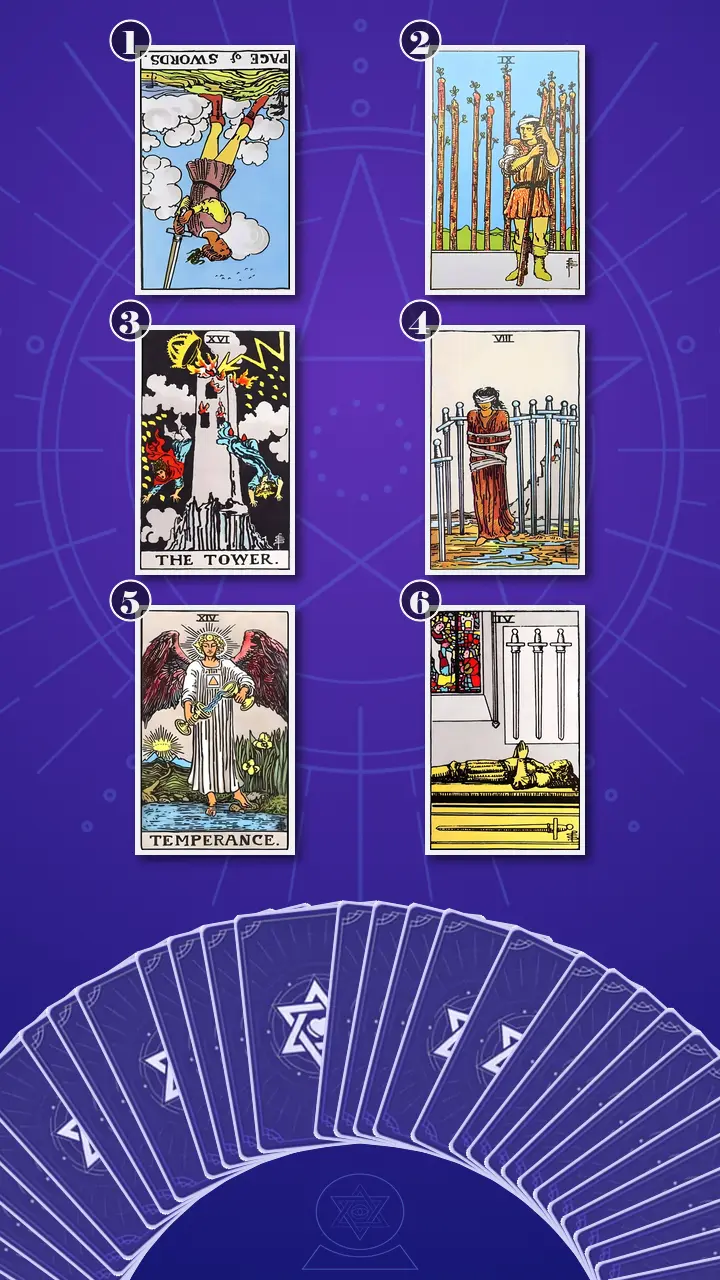
“Today we’ll use a spread I call the Four-Layer Insight Ladder · Context Edition,” I said. “It’s a 2×3 grid. We read it like walking down stairs—from activation to rest.”
For you, reading along: this issue is less about predicting an external outcome and more about tracing an internal loop—trigger → bracing → origin imprint → binding belief → regulation → integration. A classic past/present/future spread can stay too general. This ladder is designed to identify the exact mechanism that turns a tiny chirp into a full-body emergency drill—and then translate that insight into actionable advice you can actually use at 3 a.m.
“The first card,” I told Casey, “shows what your mind does in the first seconds after the chirp—how the safety loop starts. The third card touches the past imprint—what taught your system that sudden signals mean sudden disruption. And the fifth card is the antidote resource: the balancing skill that lets you respond responsibly and come back down.”
Reading the Map: Mind, Body, and the Old Lightning
Position 1 — Surface response: the first seconds after the chirp
“Now we turn over the card that represents Surface response: what your mind does in the first seconds after the chirp,” I said.
Page of Swords, reversed.
I tapped the image lightly. “This is the part of you that’s meant to be alert. In the upright Page, it’s curiosity—clean, sharp, flexible. Reversed, that same alertness becomes hair-trigger interpretation and compulsive monitoring.”
And here, I used the most modern translation possible, because the Page practically begged for it: “The chirp hits and your brain becomes a browser with 12 tabs open. Before you’re even fully awake, you’re listing possibilities—battery, wiring, carbon monoxide, neighbour’s unit, building issue—grabbing your phone, searching the exact phrase ‘smoke alarm chirping’ like the right answer will instantly switch your body off.”
Energetically, it’s a blockage of Air: thought isn’t flowing; it’s spinning in place. It doesn’t move toward resolution—it moves toward more scanning.
I offered Casey a frame I often use from the world of incident response: “Your brain is running an incident-response playbook… but it never hits ‘resolve,’ so the alert stays open all night.”
Casey let out a short laugh that didn’t quite reach their eyes. “Yep,” they said. Then, softer—almost rueful—“That’s… even a bit cruel. Because it feels like I’m being responsible.”
“That’s the trap,” I said gently. “You’re doing something that looks like responsibility. But it’s also your nervous system trying to buy certainty with information.”
Position 2 — Protective stance: how the body braces
“Now we turn over the card that represents Protective stance: how your body/behavior braces and tries to keep you safe,” I continued.
Nine of Wands, upright.
“The bandage. The tight grip. The stance that says, ‘I can handle it—just don’t make me relax.’” I glanced up at Casey. “This is what you described: you’ve checked the kitchen, pressed the test button, told yourself it’s fine—yet you can’t fully lie back down. You stay half-upright in bed, shoulders tense, listening for the next chirp like you’re on night watch.”
Energetically, this is Fire used as defense—excess endurance. It’s admirable. It’s also exhausting.
To make the split-screen clear, I narrated it exactly as it often runs: “Left side: mind opens tabs. Right side: body sits up, jaw clenched, ears straining. Top-layer thought: ‘I’m being responsible.’ Under-layer truth: ‘I don’t trust my own all-clear.’”
Casey nodded once, small and sharp, as if conceding a point they’d argued against for years.
Position 3 — Past imprint: why a signal feels like disruption
“Now we turn over the card that represents Past imprint: the earlier conditioning that taught your system to treat signals as urgent disruption,” I said. “This is where we ask: what did your body learn, even if you don’t have a perfect story?”
The Tower, upright.
Even after decades with these images, The Tower still changes a room. Not with doom—rather with honesty. “The chirp isn’t the whole story—it’s the doorway,” I said.
“This card doesn’t predict disaster,” I clarified, because I never want someone to leave a reading more afraid. “It explains intensity. Lightning is the sudden signal your system learned to take seriously—fast, bright, non-negotiable. Your body doesn’t hear ‘battery.’ It hears, ‘Something can go wrong fast.’”
I used the flashback montage technique without forcing a narrative: present-day Toronto apartment, streetlight through blinds; then a feeling-memory of a sudden drop—an argument that turned in one sentence, a household that could switch from calm to chaotic, being the one who had to notice.
Casey’s shoulders dropped a fraction, like their body recognized itself in the explanation before their mind could argue. They swallowed, once. “So it’s not that I’m broken,” they said. “It’s that my system learned something.”
“Exactly,” I replied. And in my own mind—an archaeologist’s reflex—I thought of stratigraphy: how a single layer of ash in an excavation tells you not what happened today, but what burned long ago. The ash isn’t the fire. It’s the record.
Position 4 — Binding meaning: the rule that keeps you checking
“Now we turn over the card that represents Binding meaning: the belief or rule that keeps the loop going,” I said. “This is the line your brain enforces.”
Eight of Swords, upright.
“This is the permissions loop,” I told them. “Your brain won’t grant ‘sleep access’ until it gets absolute certainty.”
Then I made it concrete, close-up, trapped-in-your-own-head: “Phone glow on your face. One tab open for ‘smoke alarm chirping every 30 seconds,’ another for ‘carbon monoxide symptoms.’ Your thumb hovering over a video of someone pressing the test button, even though you already pressed yours. And the inner monologue doing that brutal little fork: If I stop, I’m reckless. If I keep checking, I can’t sleep.”
Energetically, this is Air in contraction: thought turns into a cage. The blindfold is narrowed attention—only threat-management feels possible. The rope is loose, but in the moment it feels like steel.
Casey went still. Not dramatic stillness—more like their breath paused at the top. Then a long pause. Then, quietly: “Oh… yeah.”
They rubbed their thumb across the side of their phone, absentminded. “I’m not allowed to stop until I’m 100% sure,” they said, as if quoting an internal policy document. “And I never get 100% sure.”
“If your ‘all clear’ doesn’t feel real,” I said, “that’s a pattern—not proof.”
When Temperance Poured Between Two Cups: The Bridge Back to Baseline
Position 5 — Antidote resource: the balancing skill that ends the response
I drew a slow breath myself. “We’re turning over what I consider the heart of this spread,” I said. “The card that answers the question: what lets you be responsible without staying activated?”
“Now we turn over the card that represents Antidote resource: the regulation skill/inner capacity that can interrupt escalation without denying responsibility.”
Temperance, upright.
In the image, the figure pours water from one cup to another with an almost boring steadiness—no drama, no urgency. As a Cambridge man turned archaeologist, I’ve spent half my life around ancient shrines where people came with exactly this request: not certainty, but steadiness. Not an escape hatch, but a rhythm.
Setup: Casey was still living inside that 3:12 a.m. logic—dead quiet apartment, one tiny chirp flipping half-asleep into full “handle this right now” mode: flashlight, test button, Google tabs, ears straining for the next beep. The problem wasn’t knowledge. The problem was that the response had no ending.
Delivery:
Stop trying to ‘think your way out’ of the chirp and start pouring your attention back into balance, like Temperance moving water cup to cup.
I let the sentence hang, the way you let a bell finish ringing.
Reinforcement: Casey’s reaction came in a small chain, like a system rebooting. First, a physical freeze—chin tipped up, breath held, eyes fixed on the card. Then the cognition seeped in; their gaze went slightly unfocused, as if replaying every night they’d refreshed the same Reddit thread—r/HomeImprovement, r/Anxiety, “smoke alarm chirping every 30 seconds”—hoping the next scroll would grant peace. Finally, the exhale: slow, shaky, and longer than the inhale. Their shoulders dropped as if they’d been carrying a backpack they forgot was strapped on. “A middle path,” they murmured, and there was a flicker of anger under it, honest and human: “But… if I stop, what if I’m wrong?”
I didn’t try to talk them out of that fear. I respected it. “Temperance isn’t denial,” I said. “It’s pacing. It’s building a response you trust because it’s structured—and because it ends.”
I leaned in slightly. “Now—use this new lens and look back over the last week. Was there a moment when you heard a sound and your body treated it like lightning? What would have shifted if you’d had a protocol you could follow instead of improvising?”
Casey blinked, then nodded once. “Yesterday. Neighbour’s alarm. I couldn’t even tell if it was mine. I lost an hour to checking and… I didn’t need to.”
“You don’t have to get rid of your alertness to be safe,” I said, echoing the core truth. “What changes everything is having a balanced response that actually ends, so your body can come back down.”
Then I offered a practice—not as a punishment, but as a rehearsal. “Don’t improvise at 3 a.m. Build the protocol in daylight,” I told them. “Seven minutes. Once. So the next chirp doesn’t feel like an exam.”
Here’s the drill exactly as I gave it to Casey:
1) Write one sticky note and place it near your bed or on the inside of a kitchen cabinet: “ONE CHECK, THEN DOWNSHIFT.”
2) Set a 3-minute timer on your phone.
3) Practice the script out loud: “I heard a chirp. I smell no smoke. I see no smoke. I will do one checklist, then I stop.”
4) Walk one pass: quick visual scan (kitchen + hallway), one smell check, look at the alarm light/battery indicator.
5) When the timer ends, you sit back down—no extra Googling—and take 3 slow exhales (longer out-breath than in-breath).
And because autonomy matters: “If you notice yourself feeling dizzy, panicky, or overwhelmed,” I added, “stop immediately and do something neutral—drink water, look out the window, name five things you can see. This is practice, not a test you need to ‘pass.’”
Position 6 — Integration step: making rest part of safety
“Now we turn over the card that represents Integration step: a realistic next action that helps you return to baseline and rebuild trust after a trigger,” I said.
Four of Swords, upright.
“This is rest as a deliberate practice,” I told them. “Not a reward you earn after perfect vigilance.”
I translated it into the most practical modern-life scenario: “You keep spare batteries nearby, a small lamp, and a literal note that says what to do so your brain doesn’t have to problem-solve at 3 a.m. After the chirp, you close the loop: ‘I checked once. I handled it.’ Then you actually return to bed—lights off, phone down, body allowed to stand down.”
Energetically, this is Air in balance: thought becomes a quiet room again, not a spinning cage.
Casey’s mouth tilted, barely. “It sounds… too simple.”
“So do most good field protocols,” I said. “They’re not meant to impress. They’re meant to work when you’re tired.”
The One-Check Chirp Protocol: Actionable Advice That Closes the Alert
When I stepped back and looked at the whole ladder, the story was almost architectural. The Page of Swords reversed showed a mind that treats a chirp as urgent information to process—twelve tabs, no closure. The Nine of Wands showed the body taking up a defensive post: shoulders up, jaw clenched, half awake on watch. The Tower explained the hidden amplifier: somewhere in the past, sudden signals meant sudden disruption, so your system learned to brace early. The Eight of Swords named the binding rule that keeps the loop alive: “I’m not allowed to stop until I’m 100% sure.” Then Temperance offered the bridge—measured regulation, action plus downshift—and the Four of Swords gave the destination: return to baseline calm, faster and with less self-argument.
The cognitive blind spot wasn’t stupidity or weakness. It was this: you’ve been treating continued activation as the price of being a good adult. As if “responsible” must mean “braced.” But responsibility without bracing is a skill.
The transformation direction was clear and workable: shift from treating the chirp as a verdict (“danger now”) to treating it as a signal you can answer with one planned check—and then intentionally return your attention to rest.
I offered Casey three small next steps, designed like a project coordinator’s SOP—because that was a language their nervous system already trusted.
- Build a tiny “Chirp Kit”This week, put a 2-pack of batteries, a mini screwdriver, and a small lamp/flashlight in one drawer you can reach from bed. If you rent and maintenance feels out of your control, this is about containing uncertainty—not solving everything tonight.Pick a drawer you already open daily (kitchen junk drawer works). Make it boring. The goal is fewer decisions at 3 a.m.
- Make an “Inscription” checklist you can’t negotiate withWrite a one-card checklist and tape it where you’ll see it at night: “1) Look 2) Smell 3) Indicator 4) Replace battery 5) Back to bed.” Treat it like an inscription—carved wisdom, not a suggestion your anxious brain can edit mid-crisis.If you feel resistance (“one check isn’t enough”), label it: “That’s the Eight of Swords rule talking.” Then follow the card.
- Use a 5-minute downshift timer + a No-Googling windowAfter the one check, set a 5-minute timer and do a downshift loop: 3 long exhales, unclench your jaw, drop your shoulders, put both feet on the floor for 10 seconds, then return to bed. For the first 3 minutes, put your phone on the other side of the room (or turn on Apple Focus mode) so you’re not pulled into troubleshooting tabs.If your mind insists, “But what if…,” answer with a closing script: “I responded. I’m allowed to stop.” Repeat it like you’re closing a ticket.
Before Casey left, I added one more option—light-touch, two minutes max—drawn from my own archaeological habit of Ancient Reflection: “If you ever want to name the old layer without excavating your whole life,” I said, “try one sentence when you’re calm: ‘My system learned that ____.’ That’s enough to create space. You’re not required to dig deeper than you consent to.”
A Week Later: Ownership, Not Certainty
Six days later, I received a message from Casey. It wasn’t poetic. It was the kind of update I trust most because it’s measurable.
“Chirp happened at 2:41 a.m. I did one pass. No Googling for 3 minutes. I actually went back to bed. Still felt keyed up, but it dropped faster. Also, the sticky note helped more than I want to admit.”
In my mind, I pictured the bittersweet version of progress: sleeping a full night for the first time in weeks, then waking with that old first thought—what if I’m wrong?—and, instead of spiraling, letting it sit there like a harmless bird on a windowsill. Not gone. Just not in charge.
This is what a Journey to Clarity often looks like in real life: not the elimination of alertness, but the reclamation of choice. From startled dread and compulsive checking to measured self-trust and a quicker return to baseline calm.
When you’re desperate to feel safe at home but your body treats relaxing like a gamble, even a tiny chirp can feel like a test you’re terrified to fail.
If you trusted that one responsible check could be enough, what would your ‘closing script’ sound like—the sentence that lets your night actually end?