Money Anxiety After an Eviction Notice—and the Shift from Grip to Rhythm

Finding Clarity in the 9:18 p.m. Kitchen
“You’re a late-20s NYC professional who can design a whole user flow at work,” I said, watching her face for that tiny flinch of recognition, “but one rent-related email can trigger full-on money anxiety and a Chase-app refresh spiral.”
Maya (name changed for privacy) didn’t smile. She did that thing people do when they’re trying not to cry and also trying not to be dramatic about it—she pressed her tongue to the back of her teeth, like she was holding a door closed.
She told me about Sunday at 9:18 p.m., in her tiny kitchen, under an overhead light that felt a little too bright for the hour. She’d been helping her parents sort old boxes. A cracked banker’s box. Dust and cardboard smell. She unfolded a paper that looked like it had been handled a hundred times—an old eviction notice. Official font. A date that didn’t belong to her current life.
“My stomach just… dropped,” she said. “And then my thumb opened my banking app. Like autopilot.”
She described the sequence with the precision of someone who’s done it enough times to hate it: bank app, refresh; notes app, rework categories; bank app again, because the first check didn’t land. The numbers didn’t change. Her body did. Tight chest. Jaw locked. A clenched stomach that made spending—groceries, a dentist appointment, even replacing shoes—feel like breaking a rule.
“I can be fine all week and one piece of paper can ruin my nervous system,” she said, and her voice went sharp on the last word, like she was mad at it for being true.
In my world—ten years guiding people through a Tokyo planetarium—panic looks like when someone sees a meteor shower forecast and suddenly believes the sky is going to fall tonight. But the sky isn’t falling. It’s just a reminder that it could.
“What you’re describing isn’t a math problem,” I told her, gently and plainly. “It’s a safety alarm. And we’re going to treat it like one. Let’s try to find clarity—not by forcing yourself to ‘get over it,’ but by mapping what actually happens in you when that alarm goes off.”

Choosing the Compass: The Four-Layer Insight Ladder
I asked Maya to take one slow breath in through her nose and exhale like she was fogging a mirror—just enough to shift her nervous system from “incident response” into “I’m here.” Then I began to shuffle.
I don’t treat tarot like a spooky performance. For me, the shuffling is a focusing device—like dimming the planetarium lights so your eyes can finally catch the faint stars.
“Today,” I said, “we’ll use a spread I designed for moments exactly like this: the Four-Layer Insight Ladder · Context Edition.”
For readers who wonder how tarot works in a practical way: this spread keeps the card count minimal while still moving in a clean arc—present behavior → root memory → core fear → inner resource → key shift → actionable next step. A traditional timeline spread can miss the loop that anxiety runs (trigger → control ritual → short relief → long-term unsafety). And a full Celtic Cross would add noise when what we need is signal.
I told her what to expect. “The first card will show your money-anxiety ritual—what you do within ten minutes of a trigger. The middle cards go beneath the surface: the emotional memory and the belief your nervous system is trying to prevent. Then we’ll look at what support you already have, the shift that changes the whole dynamic, and one measurable step you can do this week.”
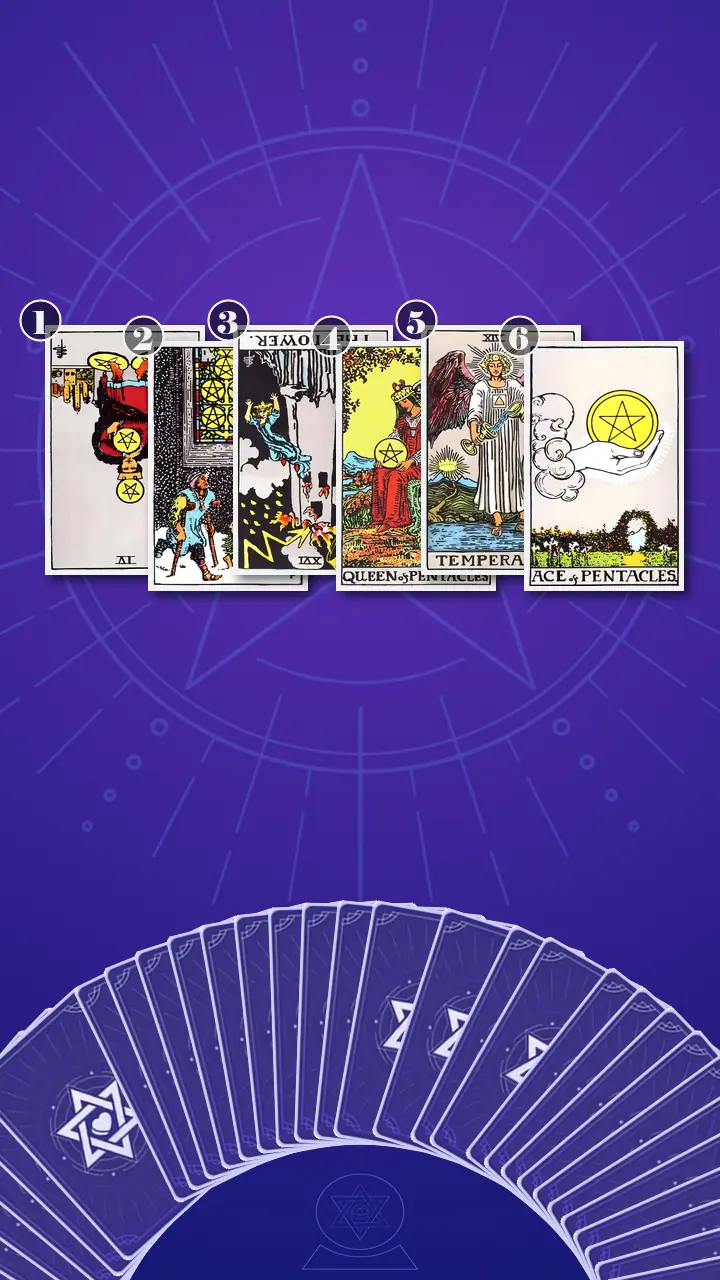
Reading the Map: From Grip to Memory
Position 1: The Visible Money-Anxiety Ritual
“Now flipping over,” I said, “is the card that represents the visible money-anxiety behavior pattern showing up right now—what you do after the trigger.”
Four of Pentacles, reversed.
In the Rider-Waite image, the figure clutches one coin to their chest, pins another to their crown, and traps two under their feet—like safety has to be held, locked, and stood on.
I didn’t over-mystify it. “This is lockdown mode,” I told her. “Right after the eviction notice, you check your balances twice, tighten three budget categories, cancel a plan you were actually looking forward to… and you still don’t feel safe. You feel temporarily in control.”
Reversed, this card reads like an energy that’s gone from balance to blockage. The instinct to be careful is valid—especially in New York. But the grip has gotten so tight it’s starting to backfire.
“Control can feel like safety, right up until it makes your life smaller,” I said. “And I’m hearing that ‘smaller’ part in you—fewer dinners, fewer comforts, fewer yeses—not because you chose it from your values, but because the fear is driving.”
Maya let out a short laugh that didn’t have any humor in it. “That’s… yeah. That’s actually kind of brutal.” Her fingers tightened around her mug, then loosened like she’d been caught holding her breath.
Position 2: The Emotional Memory the Notice Woke Up
“Now flipping over,” I said, “is the card that represents the emotional memory the eviction notice wakes up—the felt story underneath the facts.”
Five of Pentacles, upright.
This card always feels like weather. Snow. Hard sidewalk. Two figures outside a warm, lit window.
“The eviction notice isn’t just paper,” I told her. “It’s a portal.” I watched her eyes flick down to the card like she didn’t want to agree too fast. “Your adult brain reads the date and thinks, ‘That was then.’ But your body hears, ‘You could lose your place.’ And suddenly every rent-related notification, every landlord email, every housing headline feels personal—like you’re back outside looking in.”
Then I gave her the line that often unhooks shame from the story.
It’s not the number—it’s the memory.
Her throat moved like she swallowed something that wasn’t there. A quiet exhale. Not dramatic. Just… honest.
“I’m an adult now,” she said softly, almost like she was testing whether she was allowed to say it. “So why does my body feel twelve?”
“Because your nervous system learned its version of safety during a time when safety wasn’t guaranteed,” I said. “And it doesn’t update just because your spreadsheet says you’re fine.”
Position 3: The Core Fear That Keeps the Loop Running
“Now flipping over,” I said, “is the card that represents the core fear or belief that keeps the pattern running—what your nervous system thinks it must prevent.”
The Tower, reversed.
Even reversed, The Tower is the image of a lightning bolt and a crown knocked loose—stability feeling temporary, accidental, easy to lose.
“This is the hidden engine,” I said. “Not ‘I should budget better.’ Not ‘I need more financial literacy.’ It’s: the floor can drop. Any time.”
I let myself speak in a sharper systems language, because sometimes it’s the only thing that matches what people are living: “This is the emotional equivalent of being on-call for a crisis that hasn’t happened.”
And then, because she’s a New Yorker with a phone and a brain that doesn’t like silence, I painted the montage the card was already showing me—late-night spreadsheet tabs, doomscrolling layoffs headlines, re-running budgets at 1:13 a.m., rewriting the definition of “enough savings” so relief never arrives.
“Your brain calls it planning,” I said. “But your body calls it bracing.”
Planning is finite. Bracing is endless.
She nodded fast, like she wanted to interrupt but didn’t know how without admitting how specific it was. “I do this exact ritual,” she said. “I open Bloomberg, then r/personalfinance, then YNAB templates, then I’m like… why is it 2 a.m. and I’m still not calm?”
“Because the goal of bracing isn’t calm,” I said. “It’s preventing humiliation. Preventing the ‘I didn’t see it coming’ feeling. The Tower reversed is your system trying to stop lightning with vigilance.”
Position 4: The Resource You Already Have (That Isn’t Punishment)
“Now flipping over,” I said, “is the card that represents a supportive inner resource you already have for building real safety without punishment.”
Queen of Pentacles, upright.
She’s seated like someone who knows the difference between control and care. The pentacle isn’t clutched. It’s held like something you steward.
“There’s a version of you,” I said, “that already knows how to create steadiness. Not by restricting joy, but by tending basics. A bill calendar that lives outside your anxious brain. Groceries that actually feed you for two to three days. Rest that isn’t earned by suffering first.”
I saw Maya’s shoulders lift, then drop, like her body was negotiating with the idea.
“And I want to say this clearly,” I added, because the shame in money anxiety always tries to pretend it’s helpful: Your budget isn’t a morality test.
She blinked hard. “That’s… not how it feels.”
“I know,” I said. “That’s why this card matters. It’s the Provider energy—care without punishment.”
When Temperance Poured Between Two Cups
Position 5: The Integration Pivot (The Key Shift)
I paused before turning the next card. The city sounds outside my window—distant traffic, someone’s music leaking through a wall—felt like they turned down a notch, as if the room itself knew we were approaching the hinge point.
“Now flipping over,” I said, “is the card that represents the key psychological shift that transforms control into steadiness—how to integrate fear with reality.”
Temperance, upright.
In the image, an angel pours water between two cups with impossible calm. One foot is on land, one in water. A path leads toward a bright horizon—like progress that happens by repetition, not drama.
Setup. I named the exact moment she’d described: the subway ride where she checks the balance, then checks again because the first time didn’t “land,” and her jaw stays tight anyway. “That’s the loop,” I said. “You’re trying to make numbers do the job of safety.”
“Here’s what Temperance is offering,” I continued, keeping my voice steady. “You don’t become safe by gripping harder—you become safe by building a steady rhythm you can actually keep.”
Delivery.
Stop treating money like a lightning strike you must prevent, and start blending fear and facts like Temperance pouring between two cups—slow, steady, and repeatable.
I let that sentence sit between us. No extra explanation for a beat—just air.
Reinforcement. Maya’s body reacted in layers. First, a tiny freeze: her breath caught, her eyes held on the card like it might move. Second, the cognitive seep: her gaze unfocused for a second, like she was replaying the last week—rent email, bank app, notes app, bank app again. Third, the emotional release: she exhaled from low in her chest, shoulders softening, but her face tightened with a flash of irritation.
“But if I stop… checking,” she said, and her voice went up at the end like a question she didn’t want to ask, “isn’t that how people get blindsided?”
“That’s the Tower talking,” I said. “It thinks vigilance is the only barrier between you and collapse.”
In the planetarium, I teach people that stability isn’t created by tensing your hands around the universe. It’s created by predictable motion—an orbit you can trust. In my work, I call it Comet Cycle Prediction: not ‘will a comet hit us,’ but ‘when do the predictable pass-bys happen, and what do we do so they don’t hijack the whole sky?’
“Rent season is a predictable pass-by for you,” I told her. “So is finding family documents. Temperance says: we don’t pretend those triggers don’t exist. We build a rhythm around them so your nervous system stops living like lightning is scheduled.”
Then I offered her the practice exactly as a small experiment—because integration is built, not declared.
“Set a 7-minute timer. Open your banking app once. Write down three numbers only: (1) current checking balance, (2) next rent date + amount, (3) your ‘floor’ number (the minimum you want to keep in checking). Then close the app and put your phone face-down. If you feel your chest tighten, place one hand on your sternum and take three slower breaths. You’re allowed to stop early—this is a practice, not a test.”
Her eyes went wet, and she looked annoyed about it, which told me we’d hit something real. She put her palm lightly to her chest anyway, like she was trying on a new rule that wasn’t a rule.
“Now,” I asked, “use this new lens and look back at last week. Was there a moment—maybe on the train, maybe in bed at 11:42—where this could’ve changed how you felt by even five percent?”
Maya stared at the edge of the card, then nodded once. “Yeah,” she said. “There was a night I didn’t even need information. I needed… permission to unclench.”
“That’s the shift,” I said. “This isn’t just about a money decision. It’s your nervous system moving from scarcity-triggered hypervigilance and control-based budgeting toward grounded, values-based safety built through consistent routines.”
Position 6: The One Seed You Plant This Week
“Now flipping over,” I said, “is the card that represents one practical, measurable next step for this week that begins rebuilding trust through consistency.”
Ace of Pentacles, upright.
An open hand offers a coin. Not a lecture. Not a test. An offer.
“This is your ‘one seed’ card,” I said. “Not a full financial overhaul. Not a personality transplant. Just one tangible action you can repeat.”
And I watched Maya’s face change in a way I’ve seen a thousand times on starfield ceilings: the moment someone realizes the night sky isn’t judging them for not knowing every constellation. It’s just… there. Mappable. Learnable.
The One-Seed Money Practice: Next Steps That Don’t Require Midnight Spreadsheets
I pulled the whole ladder together for her in one clean story: the eviction notice reopened the Five of Pentacles memory of being outside the warm window. Her system responded with Four of Pentacles reversed lockdown—tightening, checking, canceling—because it believes grip equals safety. Underneath, The Tower reversed runs an internal “other shoe” countdown, turning planning into bracing. But she also has Queen of Pentacles competence—the ability to care for herself with systems that don’t punish. And Temperance is the bridge: integrate fear with facts through a repeatable rhythm.
The cognitive blind spot I named gently was this: she kept treating monitoring as the only form of safety. As if being safe had to be earned through constant checking. The transformation direction is different: consistent, values-based systems create safety—so the system holds the work, not her midnight vigilance.
Then I gave her a few “doable this week” steps. Not to fix her entire financial life—just to start retraining the alarm.
- The Sunday 20-Minute Check-In (finite planning)Pick one 20-minute window this week (for example, Sunday at 5:00 p.m.). Review only: bills due, next rent date + amount, and one small plan for the week. When the timer ends, you stop—even if you want to keep tweaking.Expect the urge to perfect it. Don’t. This is Temperance: a repeatable cadence, not a one-time performance.
- Range-First Budgeting (a middle path you can live with)Choose one category (like groceries). Set a weekly minimum and maximum instead of a rigid cap. Spend inside the range without doing a post-purchase balance check.If checking feels compulsive, write the urge in your notes app instead of acting on it: “I want to check because my body feels 12.” Then breathe for 30 seconds.
- A $10–$25 “Buffer” Auto-Transfer (the Ace of Pentacles seed)Set up (or confirm) one weekly auto-transfer—even a small amount—from checking to savings. Label it something calming like “buffer,” not “catch up.”This is proof-through-repetition. Missing a week doesn’t mean you’re back at zero; you just return to the orbit next pass.
Before we ended, I added one boundary that often matters as much as the numbers: “Outside your scheduled check-in,” I said, “you don’t negotiate with the banking app. If the urge spikes, you do the 7-minute numbers-only practice or you put your phone face-down and do something sensory—tea, face wash, two minutes outside. We’re teaching your body that ‘activated’ doesn’t equal ‘emergency.’”

A Week Later: Ownership, Not Certainty
A week later, Maya messaged me a photo—not of a spreadsheet, not of a perfect budget—just her phone calendar with a tiny recurring block: “Money check-in (20 min).” She said she did it in a café, alone, with headphones in. She felt weirdly proud, then a little sad, like she’d been working this hard for safety for a long time.
I told her the truth I’ve learned under planetarium domes: clarity isn’t a single bright answer. It’s a rhythm that makes the dark feel navigable.
When money anxiety hits, it’s not that you can’t do math—it’s that your body still acts like an eviction countdown is running, so every ‘normal’ purchase feels like the moment you could lose safety.
If you didn’t have to earn safety through constant checking, what’s one tiny, repeatable money rhythm you’d be willing to try this week—just as an experiment?