AI Replaceability Panic at Work—And How to Become Reliably Impactful

The 10:43 p.m. Memo Spiral in a Toronto Bedroom
If you read an “AI rollout” memo at 10:12 AM and spent the rest of the day pretending you were fine while your jaw stayed clenched—welcome to AI-era replaceability panic.
Jordan (name changed for privacy) showed up to my studio call from their Toronto condo, camera angled just high enough that I could see the edge of a neatly made bed and the glow of a second monitor off-screen—like a quiet confession that work had followed them all the way into the room where they were supposed to rest.
They told me about the memo the way people talk about a song that won’t stop playing. Not loud. Not dramatic. Just… stuck. “It wasn’t even a layoff email,” they said, then laughed once—dry, disbelieving. “But the words ‘efficiency’ and ‘enablement’ hit my inbox and my body acted like I’d been served papers.”
When they said body, I noticed their hand. Restless. Thumb rubbing the side of their phone like it was a worry stone. Their jaw tightened and loosened again, like a muscle trying to remember what peace felt like.
“It’s like,” Jordan continued, “I want stability. I want respect. I want to feel… useful. But the second AI shows up in leadership language, it’s like I’m being evaluated for deletion.”
Their question landed exactly as they’d written it for me: “AI rollout memo—what ‘replaceable’ story fuels my career anxiety?”
Career anxiety can be abstract until you watch it in the wild. In Jordan, it looked like a broken monitoring dashboard that only alerts on worst-case scenarios—sirens blaring at midnight because someone, somewhere, used the word optimization.
I kept my voice steady. “You’re not overreacting—you’re reacting to a story your nervous system thinks is true,” I told them. “And today, we’re not here to predict layoffs or fortune-tell your org chart. We’re here to decode that story—so you can get your hands back on the wheel and find actual clarity.”

Choosing the Compass: The Transformation Path Grid (6) for AI Anxiety at Work
I asked Jordan to take one breath that was for them, not for performance. “Just in through the nose,” I said, “and let your shoulders drop on the exhale—like you’re setting a bag down.” While they did that, I shuffled slowly, not as a ritual for the universe, but as a transition for the brain: a way to stop scrolling and start listening.
“Today,” I said, “we’re using an original spread called the Transformation Path Grid (6) · Context Edition.”
For anyone reading who’s wondering how tarot works in a situation like this: a spread is a decision map. It doesn’t declare what your company will do. It shows you what you do—what meaning you assign, what fear gets activated, and what coping strategy you default to—so you can change the part that’s actually in your control.
This case is inner-work heavy: the pain isn’t “Which offer should I take?” It’s “Why does one memo hijack my nervous system and my workflow?” The Transformation Path Grid is the minimum structure that cleanly maps symptom → trigger lens → core fear → protective strategy → key shift → next-step integration. It keeps the reading self-empowering and practical.
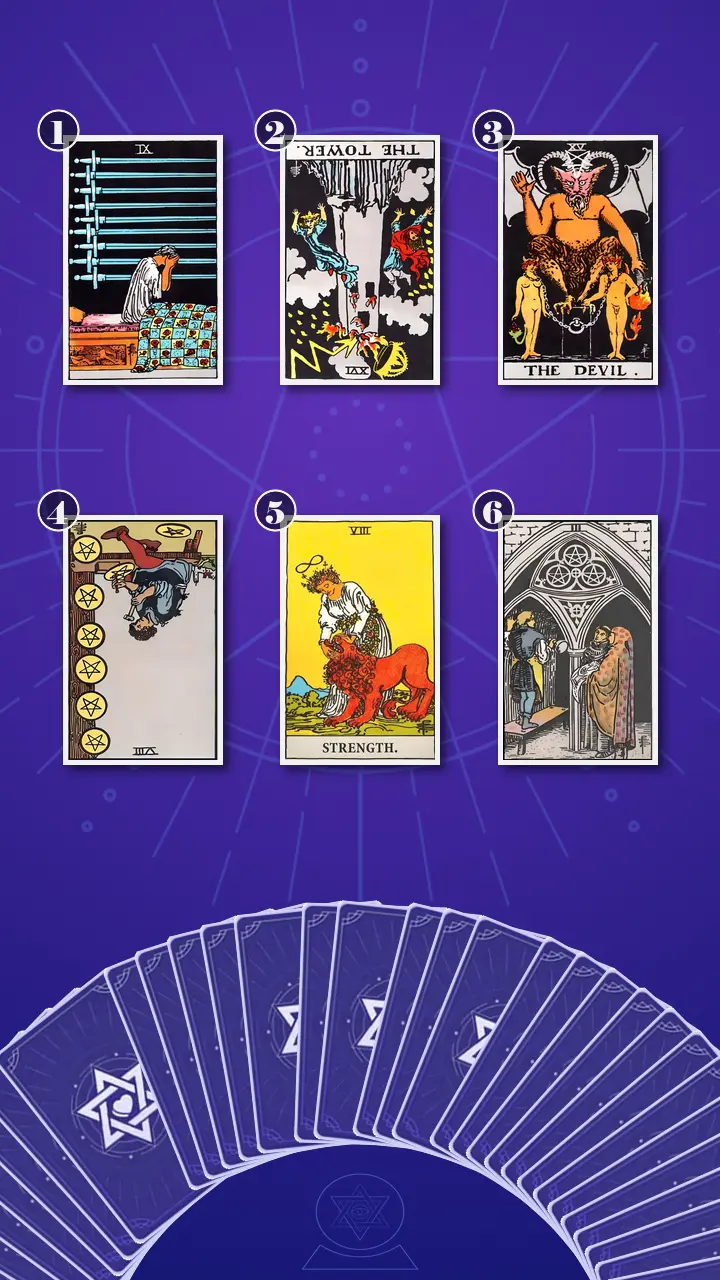
I pointed to the layout on my table as I described it. “We’ll read the top row first—what’s happening right now, what flips the switch, and the deeper belief under it. Then we drop to the bottom row—how you try to earn safety, what inner shift dissolves the spell, and one grounded action you can take this week to be visible and valued without burning yourself out.”
Reading the Top Row: The Replaceability Loop, Card by Card
Position 1 — Surface Symptom: what you’re doing (and feeling in your body) right now when the AI memo hits
“Now we turn over the card representing Surface Symptom: what you’re doing (and feeling in your body) right now when the AI memo hits,” I said.
Nine of Swords, upright.
The image is brutal in its simplicity: a figure sitting up in bed, night pressing in, nine swords lined overhead like thoughts that have decided they own the ceiling.
I didn’t generalize. I used the scene exactly as it shows up in modern life: “You’re in bed in your Toronto condo with your phone lighting up your face, rereading the AI rollout memo and then your calendar invite for tomorrow’s ‘AI Enablement Q&A.’ Your chest feels tight, your jaw is locked, and your thumb keeps doing that automatic refresh on LinkedIn/job boards like there’s going to be a new answer in the feed.”
Jordan’s mouth twitched like they wanted to deny it, but couldn’t. Their shoulders rose a millimeter, then fell.
“This is the late-night brain snapshot,” I continued, keeping it matter-of-fact. “Not the calm you. The 2:07 a.m. you, trying to solve uncertainty by thinking harder.”
Energy-wise, the Nine of Swords is an excess of Air—too much mental processing with nowhere to land. It’s forecasting, benchmarking, rehearsing. The mind becomes a war room with no off-switch.
Jordan let out a small, bitter laugh—an unexpected reaction that was half relief, half sting. “Okay,” they said. “That’s… uncomfortably accurate. Like, it’s almost mean.”
“Accurate isn’t mean,” I said gently. “It’s a starting point. The card isn’t judging you. It’s naming the loop so we can intervene.”
And I watched their thumb—restless, refreshing—and said the question this position always asks in plain English: “When the memo hits, what’s the first thing your body does? Chest? Jaw? Hands?”
“Jaw,” they said instantly. “And then I grab my phone before I even decide to.”
Position 2 — Trigger Lens: the meaning you’re assigning to the AI rollout message (the mental story that flips the switch)
“Now we turn over the card representing Trigger Lens: the meaning you’re assigning to the AI rollout message,” I said.
The Tower, reversed.
Even reversed, the Tower carries that lightning jolt. But here’s the difference: upright Tower is disruption that happens. Reversed Tower is disruption you’re bracing for—a collapse you’re trying to contain with vigilance.
I translated it into Jordan’s actual behavior: “The memo itself isn’t a layoff notice, but your brain reads it like one. The phrase ‘headcount optimization’ becomes: ‘I’m about to be exposed.’ You screenshot the line, search Slack for reactions, scan org updates, and quietly rewrite your role into a list of tasks an AI could do.”
I could almost hear the montage: screenshot. Slack search. Org chart click. LinkedIn Jobs refresh. Otta tab. Back to the memo. Back to Slack. Like a panic-driven documentary edit.
The Tower reversed is a blockage—not of intelligence, but of metabolizing change. Your brain interprets “roadmap update” as “shutdown notice.” It reads corporate language like a push notification: You’re being deprecated.
Jordan swallowed. Their eyes flicked off-screen—probably to the same tabs we were talking about.
“And this is important,” I added, calm and firm. “This position is about facts versus forecasts. The Tower reversed shows the exact second the switch flips. The memo is the spark. Your meaning-making is the gasoline.”
Position 3 — Core Fear: the deeper ‘replaceable’ belief underneath the reaction
“Now we turn over the card representing Core Fear: the deeper ‘replaceable’ belief underneath the reaction,” I said.
The Devil, upright.
The Devil is the part of the psyche that confuses control with safety. Not cartoon evil—more like a private contract you didn’t realize you signed, with terms you’ve been paying for in overwork.
I used the modern-life scenario exactly: “Under the panic is a private contract you’ve been living by: ‘If I’m not exceptional, I’m disposable.’ It shows up when you treat ‘being valuable’ like being the fastest output machine—and when AI enters the picture, it threatens that entire definition.”
Then I said the gut-punch contrast, because the Devil doesn’t respond to vague language: “You’re not scared of AI—you’re scared it will confirm you were only ever a cost line.”
Jordan’s reaction came in a three-step chain I’ve learned to trust more than words.
First: a physical freeze—breath caught, shoulders fixed in place.
Second: the gaze went unfocused for a second, like their brain replayed every “do more with less” line they’d ever heard.
Third: a quiet exhale, almost angry. “I hate that that’s true,” they said. “Because I don’t want to think that way. But… yeah. That’s the story.”
“The loose chains in this card matter,” I told them. “This bind is maintained from the inside. Which also means—this is key—you have leverage.”
I kept it non-mystical, practical. “The Devil often shows up when worth gets attached to one brittle metric. For you, it’s output speed and ‘being indispensable.’ If your safety requires outperforming, you’ll never feel safe.”
Position 4 — Protective Strategy: how you try to earn safety (the behavior that looks productive but keeps the loop going)
“Now we turn over the card representing Protective Strategy: how you try to earn safety,” I said.
Eight of Pentacles, reversed.
Upright, the Eight of Pentacles is craftsmanship—steady improvement, purposeful repetition. Reversed, it’s the apprentice in overdrive: grinding without integration, learning as avoidance, polish as a shield.
I named it in Jordan’s exact browser behavior: “After work, you open a course platform, a job board, and a doc titled ‘AI-proof plan.’ You bounce between tutorials, start one module, abandon it when you see someone else learning a different tool, then spend 40 minutes adjusting a slide’s wording so no one can question you.”
Jordan nodded, then winced like they’d nodded too hard. “The ‘AI-proof plan’ doc is literally called that,” they admitted. “I thought it made me responsible.”
“It makes you human,” I said. “And it makes sense as a defense.”
The Eight of Pentacles reversed is a misdirected Earth energy. Effort is there—tons of it—but it’s not building felt security. It’s buying temporary relief. It’s productivity-as-self-soothing.
I added the line that often breaks the spell between these two cards: “Good and shared beats perfect and hidden.”
Jordan gave me a look that was half “don’t call me out” and half “thank you for calling me out.”
“That’s the loop,” I said, summarizing the top and bottom-left corner we’d seen. “Trigger memo → Tower reversed meaning-making → Devil worth contract → Eight of Pentacles reversed treadmill.”
And then I slowed down. “Now we get to the hinge—what dissolves it.”
When Strength Spoke: The Moment the Story Changed
Position 5 — Key Shift: the inner reframe that dissolves the replaceability spell and restores self-trust
“Now we turn over the card representing Key Shift: the inner reframe that dissolves the replaceability spell,” I said. “This is the turning point.”
Strength, upright.
The room got quieter in a way you can’t manufacture. Even through a screen, I could feel Jordan bracing—like their mind expected another weapon, another sword. But Strength isn’t a sword card. It’s a hand on a lion’s jaw. Not force. Stewardship.
Setup (the moment before the shift): It was easy to picture Jordan at 10:43 PM, laptop open, rereading the memo line about “efficiency” like it was a personal performance review. In that headspace, fear feels like evidence. If you’re scared, you must be behind. If you’re behind, you need ten plans. If you need ten plans, you can’t sleep.
Delivery (the sentence that lands):
Stop treating fear as proof you’re behind; start practicing steady self-trust—like Strength gently holding the lion—so your work becomes grounded and visible instead of frantic.
I let it hang for a beat, the way I used to let a number hang on a trading floor when everyone wanted to talk over it. Silence is sometimes the only place insight can land.
Reinforcement (what changed in their body, in real time): Jordan’s face did that micro-shift I recognize: eyes widening slightly, then blinking hard like they were trying to clear a fogged window. Their jaw unclenched—slowly, like it didn’t trust the room yet. Their shoulders dropped a fraction, then another fraction, and they took a breath that sounded surprised, like they hadn’t realized they were holding their lungs hostage. Then came the new vulnerability: a tiny shake of the head, almost annoyed. “But if I’m not pushing,” they said, voice tight, “won’t I just… fall behind?”
There it was—the protective anger that sometimes shows up right when the door opens. The fear wants credit for your success. It wants to be your manager.
“That’s the Devil talking,” I said, not unkindly. “It’s trying to keep its job.”
Then I brought in my own framework—the one I’ve used in boardrooms and now use in readings—because Strength isn’t just emotional. It’s strategic.
“On Wall Street,” I told them, “we never priced people by keystrokes. We priced them by competencies—judgment under pressure, narrative clarity, stakeholder trust, risk calls. That’s Human Capital Valuation. AI changes the cost of drafting. It does not erase the premium on judgment. Your value isn’t your output speed—it’s the decisions you can stand behind when things get messy.”
Jordan’s eyes went glossy—not tears, exactly. More like their nervous system finally found a handrail. “So… I’m not trying to beat an algorithm at being an algorithm,” they said quietly.
“Exactly,” I replied. “Strength is you updating the metric. AI can draft. You decide.”
I guided them into the micro-practice right there, because insight without a next action turns into another late-night tab. “For ten minutes—stop anytime if it spikes your anxiety—open your current project doc and write two bullets: (1) ‘Where AI can help me go faster (draft/summarize/outline).’ (2) ‘Where my human judgment is the deliverable (trade-offs, stakeholder context, risk calls, narrative).’ Then pick one tiny visibility move: send a rough-but-directionally-right snippet to one teammate with a specific ask, like ‘Can you sanity-check the metric definition?’”
Jordan looked off-screen again, but this time it didn’t read like doom-scrolling. It looked like choosing.
“If you feel yourself wanting a fourth revision first,” I added, “name it out loud: ‘This is me trying to earn safety.’ You can pause there and still be okay.”
I watched their shoulders settle, and I named the transformation plainly: “This is a shift from catastrophic replaceability anxiety to calm self-trust and visible, collaborative craft. Not overnight. But it starts right here—fear becomes information, not a command.”
Position 6 — Next Step Integration: a practical way to be visible, valuable, and grounded in your work this week
“Now we turn over the card representing Next Step Integration: a practical way to be visible, valuable, and grounded in your work this week,” I said.
Three of Pentacles, upright.
Three figures, one shared space, a blueprint held between them. The whole card is a reminder that value is often social and structural—not solitary and perfect.
I translated it without fluff: “Instead of trying to be irreplaceable alone, you become reliably impactful in public. This week, you set up a 15-minute working session with a teammate or stakeholder and ask: ‘What does good look like for this deliverable?’ You show an early outline, invite one specific feedback point, and make your judgment legible—what you chose, what you didn’t, and why.”
Then I added the piece that matters in corporate reality, not just personal growth. “This is also game theory,” I said, because Jordan works in a system with incentives. “If you hide drafts until they’re flawless, the organization can’t update its belief about you in real time. The equilibrium becomes: you work harder, they see less. Three of Pentacles breaks that. Visibility changes the math.”
Jordan’s expression softened into something like relief, but with an edge of grief for how long they’d been doing it the hard way. “So I don’t need to be the hero in a silo,” they said.
“You need to be the builder in a room,” I answered. “That’s how trust gets priced.”
From Insight to Action: The “Reliably Impactful” Plan for the Next 7 Days
I pulled the whole grid into one coherent story, because this is where tarot becomes a tool you can use on a random Tuesday, not just a beautiful moment on a call.
“Here’s what your cards say happened,” I told Jordan. “The Nine of Swords is the symptom—late-night mental spiraling and body-level alarm. The Tower reversed is the lens—interpreting ‘AI rollout’ as ‘collapse is coming, contain it.’ The Devil is the root contract—‘If I’m not exceptional, I’m disposable.’ Eight of Pentacles reversed is the protective strategy—panic-upskilling and perfectionistic over-delivery to earn safety. Strength is the pivot—calm self-trust that holds fear without obeying it. And Three of Pentacles is how it lands in real life—visible craft, collaboration, and making your judgment legible.”
Then I named the cognitive blind spot with care. “Your blind spot isn’t that you’re lazy or behind. It’s that you’ve been measuring value by the one metric most likely to make you feel replaceable: speed. And your perfectionism has been doubling as selective visibility—hiding drafts until they feel unattackable. That hides your thinking, which is the very thing AI can’t replace.”
“The transformation direction,” I said, “is exactly what Strength and Three of Pentacles do together: shift from trying to be irreplaceable to being reliably impactful—choose one domain to deepen, one collaboration lane to be seen in, and practice visibility over perfection.”
I offered the next steps in a way Jordan could actually do, even on a week with meetings and TTC commutes and a nervous system that doesn’t magically reset.
- 10-Minute Impact Lane CheckOpen one current project. Write two bullets: “AI can help with ____ (outline/summary/first draft)” and “My judgment is needed for ____ (trade-offs, stakeholder context, risks, recommendation).” Then choose ONE tiny visibility move: send a rough snippet or outline to one teammate with one specific question.If your chest tightens right before you hit send, label it: “This is me trying to earn safety.” Make it smaller—send only the outline, or ask only one question.
- One-Revision Rule (Good-and-Shared Shipping)Pick ONE deliverable this week to ship with a single planned revision cycle. Draft (AI can help). Take one timed revision pass (10–20 minutes). When the timer ends, you send it—internally counts.Before you send, do my “trading-floor opening” micro-routine: feet flat, shoulders down, one deep breath, speak the ask out loud once. You’re teaching your body: visibility isn’t danger.
- Visible Craft Loop (15 Minutes)Book a 15-minute “definition of done” chat for one project. Ask: “What does success look like, and what trade-offs are acceptable?” After the chat, keep a 3-bullet decision log: what you chose, why, what you’re watching for.If feedback feels vulnerable, constrain it: “One thing you’d change?” or “Is this metric definition what you meant?” You’re building a loop, not performing confidence.
I added one last practical reframe, because Jordan’s world includes LinkedIn whether they like it or not: “Those ‘10x with AI’ posts are marketing. Don’t treat them as a verdict. If you want to be strategic, later we can do a Profile-as-Prospectus redesign—so your public story reflects impact and judgment, not just tools. But this week, the win is simpler: one domain, one lane, one visible artifact.”

A Week Later: The Quiet Proof
Six days after our session, Jordan messaged me. Not a paragraph. Not a manifesto. Just: “Did the Impact Lane Check. Used AI to outline. Sent the rough snippet anyway. My manager replied in five minutes: ‘This is the clearest framing we’ve had—can you walk the team through the trade-offs on Thursday?’”
The proof wasn’t that their company stopped changing. The proof was that their body stopped treating every change like a verdict.
They added one more line, almost sheepish: “I slept. Like, a full night. I still woke up and thought ‘what if I’m wrong?’—but I didn’t reach for my phone. I just… breathed.”
That’s the bittersweet part of real clarity: it’s not a Hollywood ending. It’s waking up with the same world outside your window, but a little more space inside your chest.
In my notes, I wrote the transformation the cards promised and Jordan proved: from frantic proving to steadier self-trust—then into visible, shared craft. A Journey to Clarity that didn’t require them to become fearless. It required them to stop treating fear as a manager.
When stability matters and AI shows up, it can feel like your chest tightens around one thought: “If I’m not exceptional, I’m disposable,” so you keep polishing and preparing like perfection could buy safety.
If you didn’t have to be irreplaceable—just reliably impactful—what’s one tiny way you’d let your work be seen this week?