From Therapy Intake Freeze to Grounded Curiosity: The One-Ask Shift

The Therapy Intake Form You Can’t Submit
You open your therapy intake form after work in London, and suddenly it turns into a late-night editing project—because vulnerability feels like something you can submit wrong.
Jordan (name changed for privacy) sat across from me at my little café table by the window, still in her work jumper, laptop bag hugged tight like it was part of her body. Outside, the streetlights made the wet pavement look lacquered. Inside, the espresso machine hissed and settled, hissed and settled—steady, forgiving, the opposite of the way she was holding herself.
“It’s the intake,” she said, like the word tasted metallic. “I start answering the childhood stuff, then I… polish it. I make it sound neutral. Then I delete it because it doesn’t feel true. And then I just… can’t hit submit.”
She described a Tuesday night in her Zone 2 flat so clearly I could see it: radiator clicking on and off, laptop glow on a cramped kitchen table, a mug of tea going cold until it formed that thin skin on top. She kept rereading one answer, jaw tight, breath held, like she was trying to catch a mistake before someone else did.
The contradiction was sharp and specific: she wanted clarity about what childhood role runs her coping now, but she also feared being judged—exposed—if she named it plainly.
Her unease wasn’t just “anxiety.” It was more like trying to write a clean, professional email while your hands are full of grocery bags cutting into your fingers—refusing to set anything down because asking for help feels more humiliating than the pain.
I leaned in, keeping my voice soft but grounded. “You’re not ‘bad at therapy.’ You’re treating support like something you have to earn with a perfect explanation. Let’s make this less like a performance review and more like a map. We’re here for clarity—one honest step at a time.”

Choosing the Compass: The Four-Layer Insight Ladder
I asked Jordan to take one slow breath with me—nothing mystical, just a nervous-system handrail. While she exhaled, I shuffled the deck the way I tamp espresso: steady pressure, consistent rhythm. When your brain is spinning, your body needs a cue that you’re not in danger.
“Today,” I said, “we’ll use a spread I designed for exactly this kind of moment: the Four-Layer Insight Ladder · Context Edition.”
For readers who’ve wondered how tarot works in a situation like therapy intake form anxiety: this spread isn’t about predicting outcomes. It’s a clean, practical structure for inner work—especially when you’re stuck in decision fatigue and perfectionism. It maps the full chain without getting lost: what you do now, what role you learned, what fear it protected you from, how it loops today, what integrates it, and one gentle next step.
I pointed to the layout as I placed the cards in a vertical line, like rungs. “We’ll read bottom-to-top. The first card is your observable coping on the intake form. Card two is the childhood role underneath. Card three is the fear that role was built to manage. Card five is our integration—your inner adult resource. And the top card is one small step you can actually do this week.”
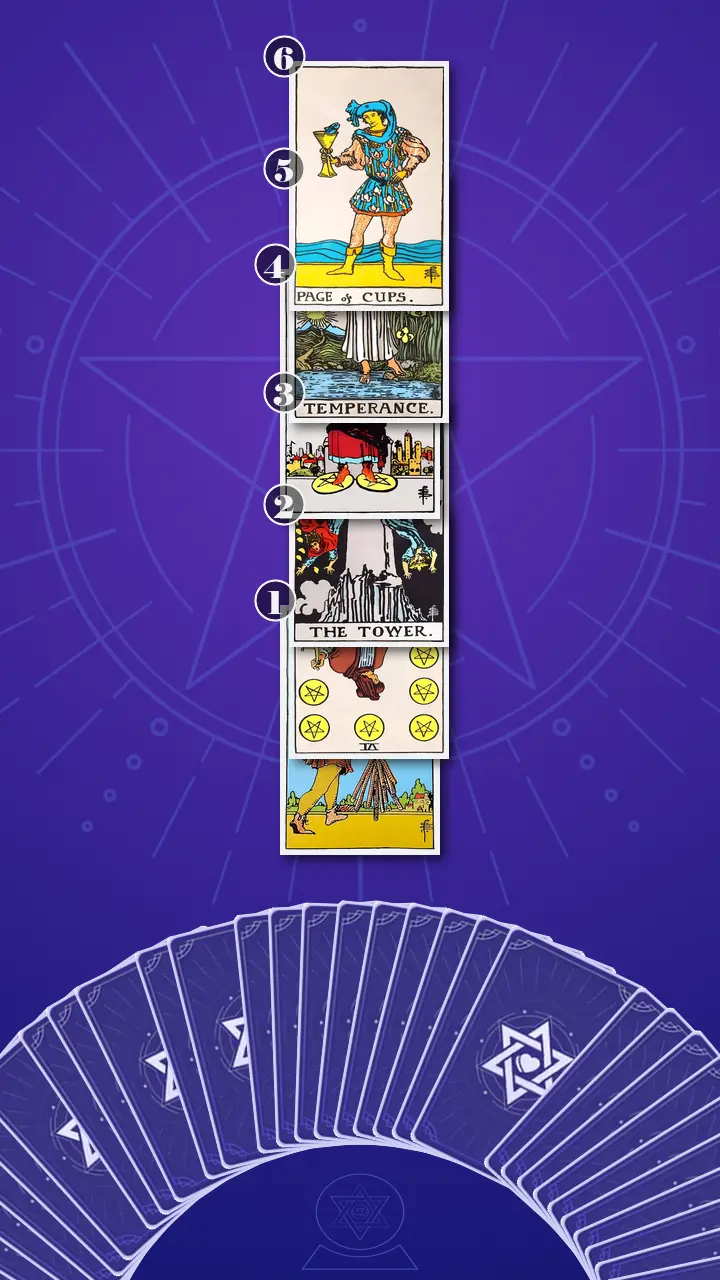
Reading the Map: Card Meanings in Context
Position 1: What You Do That Looks ‘Productive’
“Now flipped,” I said, “is the card representing Present-day coping pattern you can observe right now.”
Ten of Wands, upright.
In the picture, the figure carries a bundle so big it blocks their view. “This is that 9:30 p.m. moment,” I told her, “when you open the therapy intake form and instantly treat it like another deliverable. You carry every detail, every context paragraph, every disclaimer—like you have to prove you deserve help.”
Energy-wise, Ten of Wands is excess: too much responsibility, self-imposed load, ‘manual override’ living. It explains why ‘one step’ feels heavy—because you’re trying to complete the whole emotional project in one sitting, with perfect wording, while also staying employed, organised, and unmessy.
In my café, we have a word for this: over-extraction. When you pull an espresso too long, you don’t get “more coffee.” You get bitterness—because you’re forcing more out than is meant to be taken in one go. Your system does the same thing with the intake: you keep pulling and pulling for the “right” answer until it tastes like self-doubt.
Jordan let out a short, bitter laugh—surprised, like it escaped her. “That’s… kind of brutal. But yeah. I’m treating it like work. Like if I just carry it perfectly, I won’t need anything.”
I nodded. “Exactly. And the cost is that the town in the distance—the actual support—stays out of reach.”
Position 2: The Childhood Role You Learned to Play
“Now flipped,” I said, “is the card representing The childhood role you learned to play.”
Six of Pentacles, reversed.
“This is the quiet scoreboard,” I said, tapping the image of the scales. “As a kid, you learned closeness felt safest when you were giving—being reliable, being the helper, keeping things smooth. As an adult, you try to pay for therapy with coherence and politeness, so asking plainly feels like taking too much.”
Reversed, this card is blockage in the give-and-take flow: care that feels conditional, measured, earned. And here’s the line I want you to remember—because it’s not an insult, it’s a diagnosis without shame:
That scale in your head? It’s emotional accounting—quietly scoring whether you’re allowed to need anything.
Jordan’s eyes flicked away from the table for a second, like she was replaying a dozen texts. “I literally do that,” she admitted. “I’ll type, ‘Can you talk?’ and then I delete it and send ‘How are you??’ instead. Like I haven’t… deposited enough.”
“That role wasn’t fake,” I said. “It was smart. It got you belonging. It just isn’t free anymore.”
Position 3: What The Role Was Protecting You From
“Now flipped,” I said, “is the card representing What that role was protecting you from.”
The Tower, upright.
I watched Jordan’s throat move as she swallowed. The room didn’t get quieter, but it felt like it did—like the espresso machine agreed to pause for one beat.
“This is the submit-button hover,” I said. “One direct question on the form—‘What do you need?’—hits like an internal emergency alarm. Your body reacts before your mind: stomach drop, breath freeze, urge to shut the laptop.”
The Tower is surge—not balance, not deficiency, but a spike. The lightning to the crown is that moment your ‘I must be in control’ voice gets shocked by a simple request for truth.
I kept my tone simple, because this card doesn’t need drama. “Your nervous system is acting like honesty is a crisis. That’s a memory, not a forecast.”
Then I asked the one question that gives the Tower somewhere to land. “If you stopped being the together one for a moment… what would actually happen in 2026 if you wrote one simple line?”
Jordan exhaled through her nose, slow, like she’d been bracing for impact. “I know logically nothing would happen,” she said. “But my body thinks I’m about to get in trouble.”
Position 4: How The Role Runs Your Coping Now (The Loop)
“Now flipped,” I said, “is the card representing How the role runs your coping now as a self-reinforcing loop.”
Four of Pentacles, upright.
In the image, the figure clutches one coin to their chest, pins two under their feet, and keeps one perched on their head—control everywhere, circulation nowhere. “This is drafts-folder living,” I said. “You manage the Tower-feeling by clamping down: schedule tight, feelings private, answers clean. Submitting means someone can see you mid-process.”
Four of Pentacles is excess control. It’s the energy of ‘hold tight to stay safe.’ And I could see it in Jordan’s body: her hand hovering near her sternum like the card was mirroring her without permission.
“The inner monologue here,” I added, “is: ‘If I keep it contained, it can’t be judged.’ But the irony is brutal—containment blocks the very support you want.”
She nodded once, tight. “It feels safer to be unjudgeable than helped.”
When Temperance Poured Between Two Cups
Position 5: The Integration—Your Inner Adult Resource
I held the deck for a second before turning the next card. “We’ve reached the hinge of the whole ladder,” I said. “This is the integration card—the one that changes how the system runs.”
Temperance, upright.
In the picture, an angel pours water between two cups with ridiculous calm. One foot is on land, one in water—half in the world of competence, half in the world of feeling. A path leads toward a bright horizon that isn’t flashy, just real.
“This isn’t ‘find the perfect childhood role label,’” I told her. “This is a method: a controlled pour. Not flooding yourself with a full life story (Tower), and not locking it away (Four of Pentacles). Just regulated truth—enough to move.”
Jordan’s mouth twitched like she wanted to argue with me. “But if I pick the wrong role—”
I cut in gently, like stopping someone from walking into traffic. “That’s the performance rule talking.”
Then I delivered the sentence exactly as it came through this card—my favourite kind of clarity because it’s both kind and actionable:
Stop trying to earn care by carrying everything alone, and start practicing balance through small, steady mixing—like Temperance quietly pouring between two cups.
For a moment, Jordan went still in a way that wasn’t shutdown—more like a download.
Setup: It was that late-night moment she’d described: the intake form open, tea gone cold, cursor blinking while she tried to make her life sound acceptable—like the therapist was a judge and the form was evidence. She was trapped in “I must explain this perfectly to be taken seriously.”
Delivery:
Stop trying to earn care by carrying everything alone, and start practicing balance through small, steady mixing—like Temperance quietly pouring between two cups.
There was a tiny pause after I said it. The espresso machine clicked as it cooled, a soft mechanical sigh. Outside, a bus rolled through a puddle, and the sound was weirdly gentle.
Reinforcement: Jordan’s reaction came in layers. First: her breath caught—an almost-invisible freeze—like her nervous system had been waiting to hear whether we were about to demand a dramatic confession. Second: her eyes unfocused for a beat, like she was replaying every time she’d tried to be “easy to hold” to stay close to people. Third: her jaw loosened. Not fully, not magically—but enough that she swallowed without that tight, effortful swallow, and her shoulders dropped a centimetre like she’d set down one invisible bag.
“But that means…” she started, and a flash of anger surfaced—quick, protective. “That means I’ve been doing it wrong? Like I made it all up?”
I didn’t flinch. “No. It means it worked then. And now it’s costing you. Temperance isn’t shaming the old role—it’s integrating it. You get to keep the strengths: responsibility, clarity, competence. You’re just adding a new skill: receiving support in doses your body can tolerate.”
I glanced at her hands. They were still clasped, but not white-knuckled. “Now, with this new lens,” I asked, “think back to last week. Was there a moment when you could’ve used one small pour instead of carrying it alone?”
She stared at the Temperance card, then nodded slowly. “Friday. I was outside Liverpool Street. I drafted ‘Can you talk?’ and deleted it. I could’ve just sent it.”
I let that land. “That’s the step from uneasy self-doubt and hyper-analysis toward grounded curiosity and steadier self-trust. Not certainty—capacity.”
And because I’m Sophia, and coffee is my native language, I used my Stress Flavor Profile the way I use it behind the counter. “When you over-edit,” I said, “you’re over-extracting. The flavour turns harsh. Temperance is teaching you to stop pulling the shot past the point where it’s good—two cups, a measured pour, then you serve it. Not perfect. Drinkable.”
Position 6: One Gentle Step This Week
“Now flipped,” I said, “is the card representing One concrete, gentle step you can take this week.”
Page of Cups, upright.
“This is the small, human move,” I told her. “Not a grand identity statement. A feeling-first line. Curiosity over self-cross-examination—like tasting a sauce while you cook instead of judging the whole meal before it’s even on the plate.”
The Page holds the cup at heart level, and a fish pops up—unexpected feelings, but not dangerous. “Your one step,” I said, “is to let something slightly awkward be true on purpose.”
From Insight to Action: The Two-Cup Draft and the One-Revision Rule
I gathered the cards into one story—so it didn’t stay abstract. “Here’s what I see,” I said. “You’re coping by carrying (Ten of Wands) because you learned belonging through being the reliable helper (Six of Pentacles reversed). Underneath is an inner emergency alarm that treats being seen as collapse (The Tower). So you clamp down and keep everything in drafts (Four of Pentacles). Temperance is the bridge: regulated honesty plus reciprocal support. And Page of Cups is the first micro-step: one sincere line, not a perfect narrative.”
“Your cognitive blind spot,” I added, “is thinking the intake is a test of whether you ‘count’—so you try to be unimpeachable instead of supported. The transformation direction is exactly this: moving from ‘I have to earn care by being helpful and coherent’ to ‘I can practice receiving support with one small, imperfect ask.’”
Then I gave her a plan small enough her nervous system wouldn’t revolt. I even used my café strategies, because they’re basically regulation tools in disguise: we don’t fix the whole espresso machine at once; we do maintenance, one small adjustment, then test the shot.
- Two-Cup Draft (One Prompt Only)Pick the least-loaded intake question. Write one plain truth sentence (max 12 words), then one context sentence (max 20 words). Stop there—no third sentence, no disclaimers.If your brain screams “not accurate enough,” name it: “That’s my performance rule.” Then do the 12-word sentence only.
- One-Revision Rule (Clarity, Not Tone)Revise your answer once for clarity (remove extra clauses, shorten, fix a typo). Do not revise to sound calmer, nicer, or more “reasonable.” Then move on.If you catch yourself typing “to be fair” or “it wasn’t that bad,” replace one disclaimer with one feeling word: “lonely,” “on edge,” “confusing.”
- 10-Minute Balanced Exchange AskText one trusted person: “I’m doing my therapy intake and I’m freezing. Can you sit with me on a 10-min call while I hit submit?” Keep it time-boxed and specific.Receiving support doesn’t put you in debt. Wait 24 hours before you “pay it back,” and notice the urge to even the score.
Before she left, I added one last tool from my café life—my Cup Temperature Scan. I slid her cappuccino toward her, warm but not scalding. “Notice how fast it cools,” I said. “That cooling rate is your energy loss rate, too. When you start over-editing, you’re burning heat fast. So we’ll work like good equipment maintenance: short burst, then stop. Set a 7-minute timer. When it ends, you either submit or you save-and-close—no second rewriting session.”

A Week Later: The Quiet Proof
Five days later, I got a message from Jordan while I was wiping down the counter for the afternoon rush. “Did the Two-Cup Draft,” it said. “One revision. Jaw still clenched but I exhaled and hit submit. Then I just sat on my sofa for three minutes like… who am I.”
It wasn’t fireworks. It was that specific, bittersweet kind of lightness: she’d done something brave, and then the room got quiet enough for her to feel how tired she’d been. The next morning, she told me, her first thought was still “What if I did it wrong?”—but this time she noticed the thought, made tea, and didn’t reopen the form to punish herself.
That’s the journey I care about most: not from “messy” to “perfect,” but from bracing alone to practicing support in a way your body can survive. The Four-Layer Insight Ladder · Context Edition did exactly what it was built to do—turn a frozen therapy intake moment into a clear, compassionate next rung.
When the form asks you to name your childhood role, your body tightens like you’re about to be graded—because some part of you still believes you only belong when you’re useful, composed, and easy to hold.
If you didn’t need the perfect label to deserve care, what’s one small, slightly-imperfect sentence you’d let be enough tonight?