Half-Zipped Suitcase, Rent Due, "We Need to Talk"—Choosing One Step

Finding Clarity on the Carpet, Between a Suitcase and a Notification
You’re a late-20s city renter with a half-packed suitcase on the floor, rent due notifications popping up, and a “we need to talk” text that turns your brain into a worst-case machine—classic choice paralysis.
Jordan (name changed for privacy) said it like they were confessing a crime, not describing a Tuesday night.
It was 8:47 PM in their small Toronto apartment. They were sitting on the carpet beside a half-zipped suitcase that looked like it was holding its breath. The fridge hummed too loudly in the silence. Through the window, the low rumble of the TTC felt like a reminder that the city was still moving even if Jordan wasn’t.
Their phone screen was warm—hot, honestly—from constant refreshing. I watched their thumb toggle between the banking app, a landlord email draft, and a text thread with the words “we need to talk.” Their jaw was clenched so hard it made the muscles near the ear jump. Their hands kept tapping without landing anywhere, like a cursor hovering over three different fires.
“Packed suitcase. Rent due. ‘We need to talk.’” Jordan swallowed. “And my brain keeps trying to find the right order, like there’s a hidden correct sequence.”
I nodded, letting the quiet settle instead of rushing to reassure. “So the contradiction is brutal, and it’s real,” I said. “Immediate stability—rent and logistics—versus the emotionally risky conversation. And you’re trying to solve both by being perfect before you start.”
The overwhelm wasn’t an abstract feeling in that room. It was a tight band across the chest, like someone had cinched a strap one notch too far. It was jaw-grit and restless hands and that keyed-up hum that makes sitting down to do one simple thing feel weirdly impossible—like trying to thread a needle while a fire alarm is going off.
“Everything feels urgent, so nothing gets done,” Jordan said, and their voice had that half-laugh that didn’t reach their eyes.
“I believe you,” I replied. “And we’re not going to treat this like a personality flaw. Let’s make a map. Tonight is a journey to clarity: one stabilizing step, then we reassess. Not perfect. Just real.”

Choosing the Compass: The Energy Diagnostic Map (7)
I asked Jordan to take one slower-than-normal breath with me—nothing mystical, just a nervous system handrail. Then I shuffled, the sound of cardstock soft against the apartment’s hush.
“Today we’ll use a spread I call the Energy Diagnostic Map (7) · Context Edition,” I said. “It’s built for exactly this kind of collision—money, housing, and relationship pressure landing at the same time.”
For you reading along: a classic Celtic Cross can be powerful, but it’s also a lot of layers when you’re already overloaded. And a simple three-card line can flatten a problem like this into something too neat. This spread stays minimal, but it separates what matters: the visible load, the inner stalemate, the external pressure, the core blockage—then it moves into what can regulate you, what mindset shift unlocks you, and what concrete first step creates traction.
“The first card,” I told Jordan, “shows the surface energy—what your overwhelm looks like in an observable behavior. The center card names the deeper blockage beneath the looping. And the sixth card is our key transformation—the hinge that turns panic into priority.”
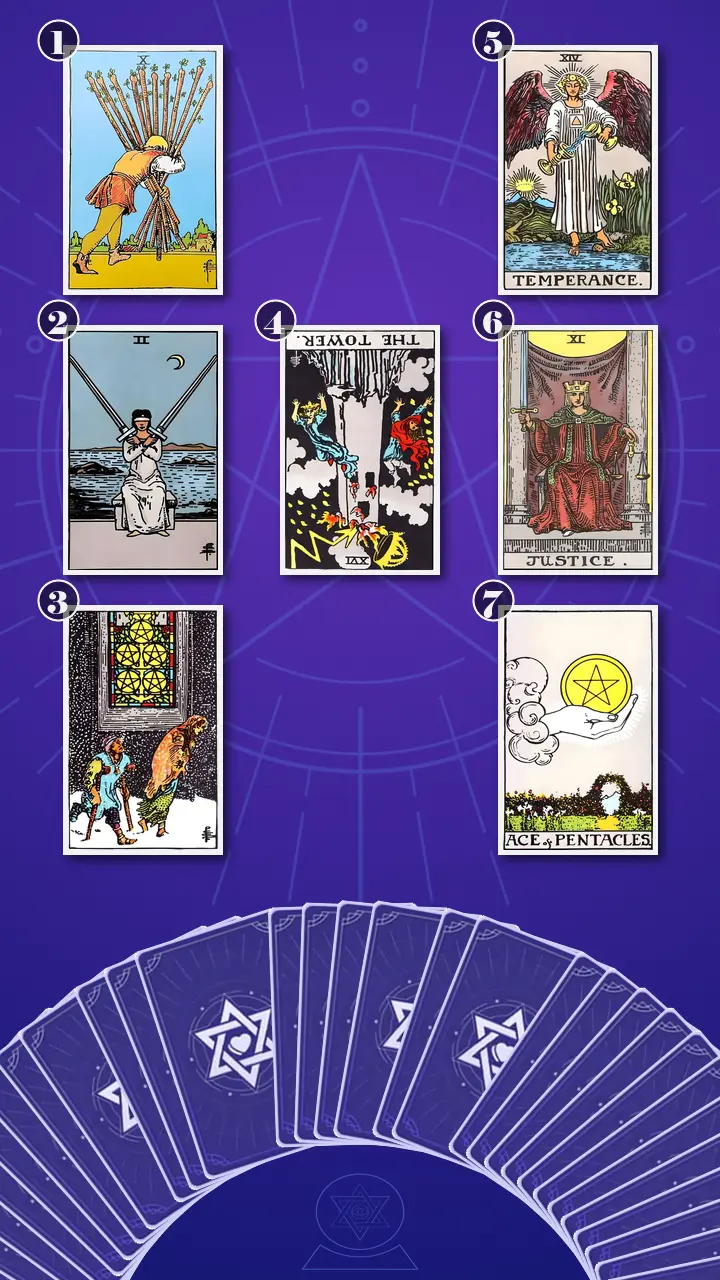
Reading the Map: When Everything Is Urgent, Nothing Gets Done
Position 1 — The Visible Load You’re Carrying
“Now flipped over,” I said, “is the card that represents surface energy: what your day-to-day overwhelm looks like in concrete behavior.”
Ten of Wands, upright.
I didn’t need to dramatize it; the image did that on its own. “This is you carrying three ‘urgent’ threads at once—packing, rent, and relationship tension—so you keep doing micro-actions,” I said. “Fold one shirt, check one balance, reread one text. You feel busy, but you don’t feel safer.”
In energy terms, this is excess—too much load, too much responsibility concentrated in one body, in one evening. The figure’s arms are full, and the bundle blocks their view. “Your horizon is hidden,” I told Jordan. “Not because you’re incapable. Because you can’t see around what you’re carrying.”
Jordan let out a small laugh that sounded like it had edges. “That’s… a little too accurate,” they said. “Like—rude.” They shook their head, but their shoulders didn’t rise in defense. They settled, as if being seen made the room slightly less hostile.
“I’m not here to scold you,” I said gently. “I’m here to make the loop observable. Once it’s observable, it becomes interruptible.”
Position 2 — The Inner Tug-of-War That Freezes the First Move
“Now flipped over,” I said, “is the card that represents your inner tug-of-war: the specific split that keeps you stuck deciding what to do first.”
Two of Swords, upright.
“This is the blindfold moment,” I said. “You sit frozen between ‘handle rent like an adult’ and ‘face the talk like an honest partner,’ so you choose neither. It shows up as drafting messages you don’t send, checking accounts you don’t act on, and calling it ‘overwhelm’ because that feels less risky than deciding.”
Energy-wise, this is blockage. Not laziness. Not lack of intelligence. A protective lock. “The crossed swords at the chest are self-protection,” I said. “You’re bracing for impact. And the longer you brace, the heavier the Ten of Wands becomes.”
Jordan’s fingers went to the suitcase zipper, pulling it a centimeter, then stopping—like their hands were reenacting the stalemate.
“Try this question,” I offered. “If you stopped calling it ‘overwhelm’ for 30 seconds, what decision would you admit you’re avoiding?”
Jordan stared at the card, then at the phone, face-down on the carpet. “I’m avoiding picking the first move. Because if I pick wrong, everything blows up.”
Position 3 — The External Pressure That Tightens the Timeline
“Now flipped over,” I said, “is the card that represents external pressure: the practical constraint tightening the timeline.”
Five of Pentacles, upright.
“This is rent due energy,” I said plainly. “The due date hits and your nervous system treats it like a survival event. You feel alone with the number—even if there are practical moves available like a partial payment, an extension request, or a payment plan.”
This card is scarcity—not necessarily the actual dollars in your account, but the way stress narrows perception until every option looks like a locked door. “The lit window in the image matters,” I added. “Support exists. But shame makes it feel inaccessible.”
Jordan’s mouth tightened. “I’ve been on r/PersonalFinanceCanada at 1 a.m. reading threads like they’re scripture,” they admitted. “And I still don’t do anything.”
“Because research can be relief without risk,” I said. “But relief is not traction.”
Position 4 — The Core Blockage Beneath the Switching Tabs
“Now we move to the center,” I said, slowing down. “This is the card that represents the core blockage: the deeper fear or belief that turns multiple tasks into paralysis.”
The Tower, reversed.
I felt the air change in that quiet Toronto room—the kind of change you notice on an archaeological dig right before a storm: pressure shifting, the earth holding its breath.
“This,” I said, “is resisted disruption. You sense change is coming—living situation, relationship clarity—so you try to keep it contained by managing details: half-packing, rehearsing conversations, over-explaining in your head.”
I glanced at the suitcase. “That half-zipped suitcase is not just a suitcase. It’s a containment strategy. A physical way of saying, ‘If I keep it in pre-impact, nothing has to be real yet.’”
In energy terms, it’s blockage again, but deeper: a belief that if you micromanage perfectly, you can avoid the lightning. “The shadow,” I continued, “is refreshing the same screens—bank app, drafts, that text thread—with jaw clenched, tongue pressed to teeth. It feels like control. But it’s actually you spending your attention like currency.”
Jordan went quiet. The reaction wasn’t theatrical; it was physical. Their stomach seemed to drop. Their gaze lowered to the carpet, then flicked back up in a quick, caught-in-the-act movement. Finally, a small nod—like they’d been found doing something familiar in the dark.
“Yeah,” they whispered. “I keep everything half-done so I can pretend I’m still choosing.”
“Stop trying to find the hidden correct sequence,” I said softly. “That myth is how the Tower stays standing even when the foundation is already cracked.”
Position 5 — The Usable Resource That Brings Your System Back Online
“Now flipped over,” I said, “is the card that represents a usable resource: what helps you regulate and regain capacity before making choices.”
Temperance, upright.
Temperance is one of my favorite cards to see when someone is overwhelmed, because it doesn’t demand a heroic transformation. It offers a method.
“This is pacing,” I said. “Not choosing between ‘adult logistics’ and ‘real feelings’—blending them in manageable doses. Instead of trying to solve the entire week in one late-night burst, you create a rhythm: 20 minutes on one practical task, then a short grounding action.”
Energy-wise, Temperance is balance. “Think of it like interval training for decision-making,” I added. “Short work set, short recovery set. Repeat until you’re back in range.”
Jordan’s shoulders dropped a fraction. Not a full relax—more like a permission slip crossing their face.
“So I don’t have to… fix my whole life tonight?” they asked.
“Exactly,” I said. “Triage isn’t cold—it’s compassionate sequencing.”
When Justice Spoke: Triage, Not a Moral Test
Position 6 — The Key Transformation That Creates a Clean Priority Order
I let my hands rest on the deck for a moment. “We’re flipping the hinge card now,” I said. “This is the key transformation: the mindset shift that creates a clear priority order and boundaries.”
Justice, upright.
My mind, as it often does, flickered to an excavation in Anatolia decades ago—layers of settlement stacked like arguments. When we were unsure where to dig, we didn’t guess based on fear. We used structure: context, strata, what was time-sensitive before the rain collapsed the trench walls. Clarity wasn’t a feeling. It was a method.
“Justice is that method,” I told Jordan. “The scales are your category sort: obligations versus conversations. The sword is the clean cut: decide one next action and do it. Not because you’re numb. Because you respect reality.”
Setup: You’re sitting on the floor beside a half-zipped suitcase, your phone hot in your palm from refreshing your bank app—then that text hits again: “we need to talk.” Your brain tries to find a hidden correct sequence, like one wrong click will collapse everything.
Stop treating overwhelm like proof you’re failing, and start using clear scales and a clean sword-cut to choose what’s time-sensitive and what needs honest scheduling.
There was a pause after I said it—one of those clean silences where the room feels suddenly organized.
Jordan’s reaction came in a chain, not a single emotion. First: a brief freeze, like their breath snagged on the way in; their fingers hovered mid-air as if they were about to open their Notes app and then stopped. Second: their eyes unfocused for a beat, replaying the internal script—If I pick wrong, I’ll prove I’m not in control—and I could almost see that sentence loosen at the edges. Third: a visible exhale, long and shaky, and their shoulders lowered like someone had taken a backpack off.
“Wait,” they said, voice rougher now. “So… rent is a contract. It’s time-sensitive. The talk is important, but it’s not a midnight emergency. It can be scheduled.”
“Yes,” I said. “It’s like triage in a busy inbox: deadlines and contracts get handled first, and the important conversation gets scheduled. Both matter, but they’re different categories.”
This is where my signature skill kicks in—the one I sometimes joke is my academic superpower: Historical Case Matching. “Civilizations don’t usually collapse because of one bad day,” I said. “They collapse when they treat every alarm as equal and exhaust the system. The ones that survive learn governance: what must be handled now, what must be convened, and what can wait for daylight.”
“So your governance move tonight,” I continued, “is Justice. Not the perfect order. The fair order.”
I watched Jordan’s jaw unclench just enough to change their whole face. “Okay,” they whispered, and the word sounded like a decision landing.
“Now,” I added, “use this new lens and look back at last week: was there a moment when rent stress or that text hit, and this ‘triage, not a moral test’ frame would have changed how you acted?”
Jordan blinked hard. “Sunday night. I was in bed. I opened listings, then my calendar, then the same thread again. If I’d just… scheduled it, I could’ve slept.”
“That’s the shift,” I said. “From panic-driven tab-switching and hunting the ‘right order’ to triage-based steadiness and one clean follow-through.”
Position 7 — The Next Practical Step That Creates Traction
“Now flipped over,” I said, “is the card that represents your next practical step: one grounded action you can complete first to create traction.”
Ace of Pentacles, upright.
“This is the opposite of spiraling,” I told Jordan. “One tangible step your body can believe.”
“You pick one money-or-home action you can finish in under 30 minutes,” I said, echoing the card’s plain demand. “Send the payment you can. Set up an e-transfer. Email for an extension. Confirm moving logistics. Then you keep proof: receipt number, sent email, calendar invite. The goal is not impressiveness. It’s completion.”
Jordan nodded, and for the first time their hands stopped performing tiny half-starts. They reached for a pen instead.
The One-Page Justice Sheet: Actionable Next Steps for Overwhelm Triage
Here’s the story the spread told, cleanly: the Ten of Wands showed you carrying too many urgent threads at once; the Two of Swords revealed the protective freeze that happens when choosing feels dangerous; the Five of Pentacles named the real-world pressure (rent) that makes your nervous system treat everything like a crisis. The Tower reversed exposed the deeper bottleneck—trying to contain an inevitable change by keeping everything half-done. Temperance offered a way to regulate your capacity so you can think again. Justice brought the key shift: triage by principle, not by panic. And the Ace of Pentacles insisted on one concrete follow-through that creates traction.
Your cognitive blind spot—because it’s so human—is that you’ve been treating the first move like a referendum on your competence. As if choosing rent first means you’re “pretending” the relationship is fine, or choosing the talk first means you’re “bad with money.” That’s not ethics; that’s panic dressing itself up as morality.
The transformation direction is simpler than it feels: move from “I need the perfect order before I start” to “I choose one stabilizing action, complete it, then reassess.” In my language as an archaeologist, it’s the Time Stratigraphy Method: you separate the immediate surface impulses (panic clicks, draft rewrites) from the deeper, lasting value (stability and honest agreements). You don’t dig everywhere at once. You choose the right layer, take one careful cut, then you look again.
Here are the next steps I gave Jordan—small enough to start tonight, structured enough to hold you when your brain wants to spin.
- The Two-Column Justice Check (10 minutes)Set a 10-minute timer. On paper (not in Notes/Notion), write two headers: “Time-sensitive obligations” and “Emotionally important conversations.” Under each, write ONE next action you can finish today (example: “Send $___ via e-transfer” / “Text: ‘Can we talk tomorrow at 7? I can do 15 minutes.’”).If your chest tightens, pause for three slow breaths. This is a clarity exercise, not a punishment. Stop the timer early if you feel flooded.
- The Temperance Mixing Block (23 minutes total)Do 20 minutes on one practical task (rent payment, landlord email, move confirmation), then 3 minutes of body regulation (drink water, eat something simple, stand in shower steam, or walk one block).Don’t “upgrade” the block into perfectionism. Stop when the timer ends even if your brain begs for one more tweak.
- Schedule the Talk. Don’t Live Inside It.After your one money/home action is completed, send a single-sentence scheduling text—not the whole conversation: “I can talk tomorrow after 6. Can we do 15 minutes to start?” Then put it in Google Calendar like it’s real.If you get stuck on tone, use the shortest version and hit send. One clean follow-through beats ten half-starts.

A Week Later: Proof Isn’t Loud
A week later, I received a message from Jordan. It wasn’t long. It wasn’t inspirational. It was exactly the kind of proof I want for people in a career crossroads / moving-stress moment—something concrete your nervous system can accept.
“Did the two-column thing on paper,” they wrote. “Sent a partial e-transfer + emailed my landlord with a plan. Screenshot the confirmation. Then I texted to schedule the talk for Thursday 7:15. I slept. Not perfectly, but… I slept.”
They added one more line: “It’s weird. The suitcase is still annoying. But my brain isn’t.”
That’s the quiet win of this Journey to Clarity. Not the fantasy of having everything resolved—just the shift from spiraling to traction, from perfectionist order-hunting to fair sequencing, from dread-driven avoidance to a steadier focus that can hold an honest conversation.
When rent is due and ‘we need to talk’ is sitting in your texts, it can feel like every first move is a referendum on whether you’re actually in control—so you keep everything half-done just to avoid being ‘wrong.’
If you let today be triage instead of a character test, what’s one small, reality-based step you’d be willing to complete first—just to give your nervous system something solid to stand on?