When a Friend Only Calls to Vent: Turning Guilt Into Chosen Care

The 6:18 PM Stomach Drop
If your social battery is dead by 7 PM, you've survived Slack all day and a packed TTC ride home, and you still answer because not picking up feels meaner than being drained, I do not call that being dramatic. I call it the therapist-friend pattern, the friend-only-calls-to-vent pattern, the kind of one-sided emotional labor in friendship that hides inside 'I'm just being nice.'
Jordan (name changed for privacy) came to see me at a back table in my café just after work, tote digging into her shoulder, city cold still clinging to her coat. Outside, the streetcar bell rang at the corner; inside, the last hiss of the espresso machine softened into quiet. She wrapped both hands around a cappuccino and described Wednesday at 6:18 PM in her condo near St. Lawrence Market: keys on the counter, microwave humming, leftover pasta warm in her hands, overhead light too bright, phone buzzing with a familiar name before she'd even taken off her coat.
'I keep telling myself it's just one call,' she said. 'Then I'm pacing the hallway with my calm voice on, and my dinner's cold again.'
I nodded. 'You tell yourself it's just one call, but your body already knows the cost.'
What she described lived in the body long before it became a thought: a trapdoor drop in the stomach, shoulders climbing toward her ears, a throat that tightened the second the screen lit up. Guilt stood in front, but resentment and loneliness were right behind it, like coffee left too long on the burner—still technically drinkable, but bitter in a way no amount of sugar can hide.
I told her I was not interested in judging whether she was a good friend. I was interested in the contradiction itself: she wanted quiet, rest, and an evening that still belonged to her, yet she feared that not answering would mean something terrible about the friendship, or worse, about her. 'Let's draw a map through that fog,' I said. 'Finding clarity starts there.'

Choosing the Map: The Relationship Spread · Context Edition
I asked her to take one slow breath before touching the deck. In my café, ritual is not theater. It is a handrail for the nervous system. When the mind is running like ten browser tabs, a shuffle can help the real question land.
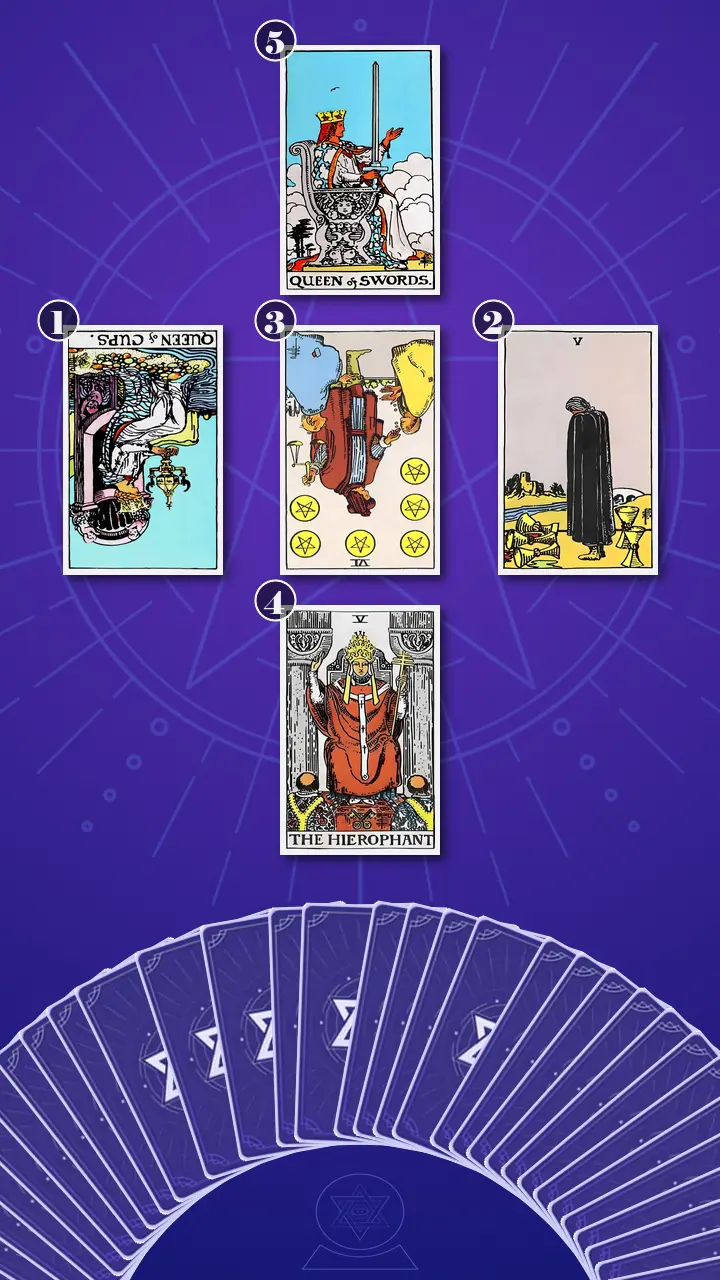
For Jordan, I chose the Relationship Spread · Context Edition, a five-card cross I use for friendship boundaries and emotional labor. Tarot works best for me when it is practical: not a verdict from the sky, but card meanings in context. This spread has just enough structure to answer questions like why do I feel guilty not answering my friend's calls, or how do I stop being the always-available friend, without drowning the person in too much information.
I showed her the layout. The first card would reveal what happened in her body and behavior the moment the phone lit up. The second would show what her friends were bringing when they reached out. The center card would name the exchange rate between them. The lower card would uncover the hidden rule beneath the whole pattern. The upper card would point to the next healthy shift—how care could stay warm without becoming automatic self-abandonment.
Reading the Cross: Where the Pattern Holds
Position 1: The Reflex That Speaks Before Consent
Now the card representing Jordan's internal and behavioral response when the phone rang was the Queen of Cups, reversed.
I told her this card did not mean she cared too much. It meant care was skipping the self-check. It was the exact real-life scene she had already given me: unlocking the condo door, reheating dinner, seeing a familiar name flash on the screen, feeling the emotional weather of the call before a single word was spoken, and answering from reflex rather than from honest time, energy, or desire. Reversed, the Queen of Cups is empathy in blockage. She absorbs first and chooses second.
'Guilt is not always a green light,' I said. 'Sometimes it is just an old alarm.'
Jordan gave a small wince and then a nod, the kind people make when they feel uncomfortably and reliefingly seen.
Position 2: Their Spilled-Cups Weather
Now the card representing what her friends were bringing into the interaction was the Five of Cups, upright.
I was careful here. This card did not make her friends villains. It showed the emotional state that usually arrived at her door: breakup fallout, manager drama, family tension, shame spirals, regret. The calls were real, but they were weighted toward what was wrong, which trained the friendship to activate around distress more than everyday mutual connection. Upright, the Five of Cups is emotion in excess, eyes fixed on the spilled cups while the two standing cups—ordinary closeness, reciprocal check-ins, joy—barely get noticed.
Jordan looked down at the card and let out a breath through her nose. 'They do call me when something is on fire,' she said. 'Not really when it's just... life.'
Position 3: The Uneven Meter Running in the Middle
Now the card representing the recurring loop between both sides sat at the center of the spread: Six of Pentacles, reversed.
This was the hinge. I asked Jordan to stop explaining everyone's intentions and give me receipts instead. How many thirty- to sixty-minute calls had she taken lately? How many dinners had gone cold? When was the last time someone asked whether she had bandwidth before unloading? The modern picture of this card fit perfectly: she kept giving calm attention, perspective, and emotional regulation, while the friendship quietly stopped checking whether those resources were available. Afterward she would go silent, put her phone on Do Not Disturb, and call herself tired instead of admitting she felt overdrawn. Reversed, this card is an imbalance in the exchange—free customer support with no office hours.
When I see Six of Pentacles reversed, my mind never goes first to theory. It goes to the bar behind me, to an espresso shot left running a few seconds too long. In coffee, I call that over-extraction. People think they are getting more, but what they are really getting is bitterness. I told Jordan her Stress Flavor Profile looked the same. She was not failing at friendship. She was over-extracting her empathy until it came out sharp on the back end as resentment.
'Being needed is not the same as being known,' I said. 'And being reachable is not the same as being close.'
Her reaction came in three quiet beats: first her breath paused; then her eyes unfocused as if she were replaying several calls at once; then her shoulders dropped a fraction. 'Yeah,' she said softly. 'That's the part I keep trying not to say out loud.'
When The Hierophant Held Up the Rulebook
Position 4: The Friendship Law You Never Chose
When I turned the fourth card, the room seemed to change temperature. The grinder was off. A spoon settled somewhere behind the counter. Rain ticked once against the front window. This was the card beneath the pattern, the hidden rule that turned a simple boundary into a moral emergency.
Now the card representing the underlying issue at the heart of the relationship pattern was The Hierophant, upright.
I told Jordan this was the inner rule-keeper. Under the behavior sat a code so old it felt like fact: good friends pick up, good friends do not make people feel abandoned, good friends prove loyalty by being easy to reach. In real life, it was her thumb hovering over a drafted text—'I care about you, but I can't do a long call tonight'—then deleting it because the guilt hit before choice did. This card asked the question beneath the phone itself: whose definition of loyalty was she still obeying?
She was already back in that condo doorway in her mind—tote on the floor, microwave humming, shoulders up, guilt arriving faster than her real answer—so I slowed everything down and gave her the sentence the card had been building toward.
You are not bound to the old sermon that care means constant availability; use The Hierophant's keys to unlock a wiser rule where loyalty includes limits.
She froze first, for real: fingers suspended around the cup, mouth slightly open, breath held halfway in. Then her gaze slipped past the cards to the dark window, as if an older version of herself were standing there holding every unanswered call she had ever been afraid to miss. When she looked back at me, the first emotion was not relief but resistance. 'But if that's true,' she said, voice suddenly sharper, 'then I've been grading myself on the wrong exam.'
'Maybe,' I said. 'But that doesn't mean you were foolish. It means you learned a rule before you learned your own limits.' I slid her phone a little closer across the table. 'Within the next ten minutes, write one boundary sentence in your Notes app. Something simple. I care about you. I can't do a long call tonight, but I can check in tomorrow. If that feels too exposed, draft it and stop there. The pause itself already interrupts the old script.' I watched the insight move through her body in layers: jaw unclenching, shoulders lowering, one palm pressed lightly to her sternum as if checking whether the new idea could live there. Then came the strange small dizziness that follows relief—the wobble of standing up too fast after sitting inside one belief for years. A lot of people are not bad at boundaries; they are scared of what boundaries might reveal. 'Use this lens on last week,' I asked her. 'Was there a moment this would have changed how the call felt?' She nodded immediately. 'Sunday,' she said. 'I knew I didn't have it. I just thought that made me a bad friend.'
That was the real turn of the reading: not from care to coldness, but from guilt-driven automatic availability to self-respecting, deliberate care. The Hierophant had not judged her. It had handed her the keys.
Position 5: The Sentence That Protects the Evening
Now the card representing the way forward was the Queen of Swords, upright.
I love this queen when she arrives after a reversed Queen of Cups. She never asks a sensitive person to become less sensitive. She asks them to stop making private emotional containment the only proof of love. In modern life, this card looks like a bandwidth-first reply: texting instead of instantly calling, answering with a time boundary in the first minute, or saying, 'I care about you, and I can't do a long call tonight, but I can check in tomorrow after 6.' Upright, her energy is balanced air—clarity that organizes emotion instead of denying it. The sword is held up, not swung out. This boundary is not an attack. It is office hours for the heart.
'Kind does not have to mean immediate,' I told Jordan.
This time she did not flinch. She repeated the sentence under her breath, as if testing whether it could sound like her and still sound kind.
Finding Clarity: From On-Call Friendship to Care With a Door
When I laid the whole story back out for her, the logic was clean. Jordan's sensitivity was real; she could feel other people's storms before the first hello. Her friends were often contacting her from genuine distress. But the center of the spread showed that care had become a one-way emotional subscription, auto-renewing from her energy budget. The blind spot was not that she cared too much. It was that she kept treating guilt like evidence and access like proof of love. She had been living as if her emotional front door needed no lock screen. The transformation direction was simple, though not easy: from proving she cared through immediate availability to expressing care through stated limits and deliberate choice. Care needs a door, not an open hallway.
I told her that in Italian cafés we have riposo for a reason. A place does not stay warm by never closing. It stays warm because rest is part of the design. Friendship boundaries work the same way.
- Write the clean sentence tonightOpen your Notes app and save one call-back-later script: 'I care about you. I can't do a long call right now, but I can check in tomorrow after 6.' Then add it as a keyboard shortcut so you do not have to compose from guilt in real time.Keep it short. Skip the essay. The goal is clarity, not a courtroom defense.
- Name the old rule before you obey itMake one note with two lines. Old rule: 'If I care, I answer right away.' New rule: 'If I care, I respond honestly about my capacity.' The next time a non-urgent call comes in, read both lines out loud before deciding.If the guilt spikes hard, do not argue with it. Just notice that the moral jolt is a script, not a law.
- Use my Cup Temperature Scan before pickupPlace the phone face down for sixty seconds and check only three data points: shoulders, stomach, and actual time available. If you are holding tea or coffee, notice how quickly the warmth leaves the cup in your hand; that is often how fast your energy is dropping too. If your capacity is under 5, text back instead. If you do answer, state the limit in the first minute: 'I've got ten minutes, what's going on?'Think of this as riposo, not rejection. Even an espresso machine needs downtime to keep serving well.
These are small moves on purpose. No personality transplant. No dramatic friendship purge. Just actionable advice that teaches her nervous system a new truth: warm does not have to mean wide open. This is Bandwidth-First Friendship in practice.

A Week Later, the Quiet Proof
A week later, while I was grinding beans before the morning rush, Jordan texted me. 'I used the script,' she wrote. 'She said okay. I still felt shaky for ten minutes, but my dinner stayed hot.' That was all. It was enough.
I smiled because that is how clarity usually arrives. Not as a cinematic ending. As one intact evening, one cleaner breath, one proof that chosen support feels different from being on call.
When your phone lights up and your stomach drops before you even say hello, it can feel safer to lose an evening than to risk feeling replaceable. If tonight you recognize yourself anywhere in Jordan's cards, remember this: you can care about someone without giving them unlimited access to you. So the next time a non-urgent 'Can I call?' lands on your screen, what one small sentence could become the key on your own lock screen—kind enough to keep the connection, clear enough to keep your night?