Family Dinner Staff Mode—And How a Five-Second Pause Changed Dinner

The Fork Hanging Midair: How to Stop Being the Translator at Family Dinners
When Maya (name changed for privacy) sat across from me, I said the thing I already knew would make her exhale because it was too specific to miss: if the phrase “Can you tell them...?” hits your body before it hits your brain, you are not just being helpful at family dinner. You are probably carrying default-translator burnout.
She was twenty-eight, living in Toronto, working a hybrid creative-agency job that already demanded half her nervous system. But the scene that had brought her to me was not work. It was 7:42 p.m. at a family dinner table: steam from the takeout fogging her glasses for a second, a chair leg scraping the floor, her fork hanging in midair while one relative said something half-finished, another looked confused, and someone turned to her before she had taken two real bites. “I don’t even notice I’m doing it until my food is cold,” she told me. “I want to help without disappearing.”
I could see the contradiction living right in her body. She wanted to show up as herself at the table, and she was afraid that if she stopped translating, smoothing, and buffering, the whole room would snag and somehow become her fault. The exhaustion had the texture of running live captions for a room that had stopped checking whether it could hear itself—tight jaw, shallow breath, shoulders half-raised through the whole meal, like a private Severance switch had flipped from guest mode into staff mode. I told her, softly, “That makes sense. And we can work with it. Let’s make a map for the fog, not a bigger job description.”
She was not asking me how to cut her family off. She wanted what so many people quietly search for when they type things like how to stop being the translator at family dinners or how to set family boundaries without sounding rude: a way to stay connected without becoming the unpaid infrastructure of connection.

Choosing the Compass: A Seven-Card Tarot Spread for Family Role Overload
I asked Maya to put both feet on the floor and take one slower breath. Then I slid a blotter strip touched with neroli and cedar across the table. One of my go-to tools is dialogue atmosphere enhancement with calming scents; I do not use it to make a session feel mystical, but to give the body a clean signal that we are shifting from bracing into noticing.
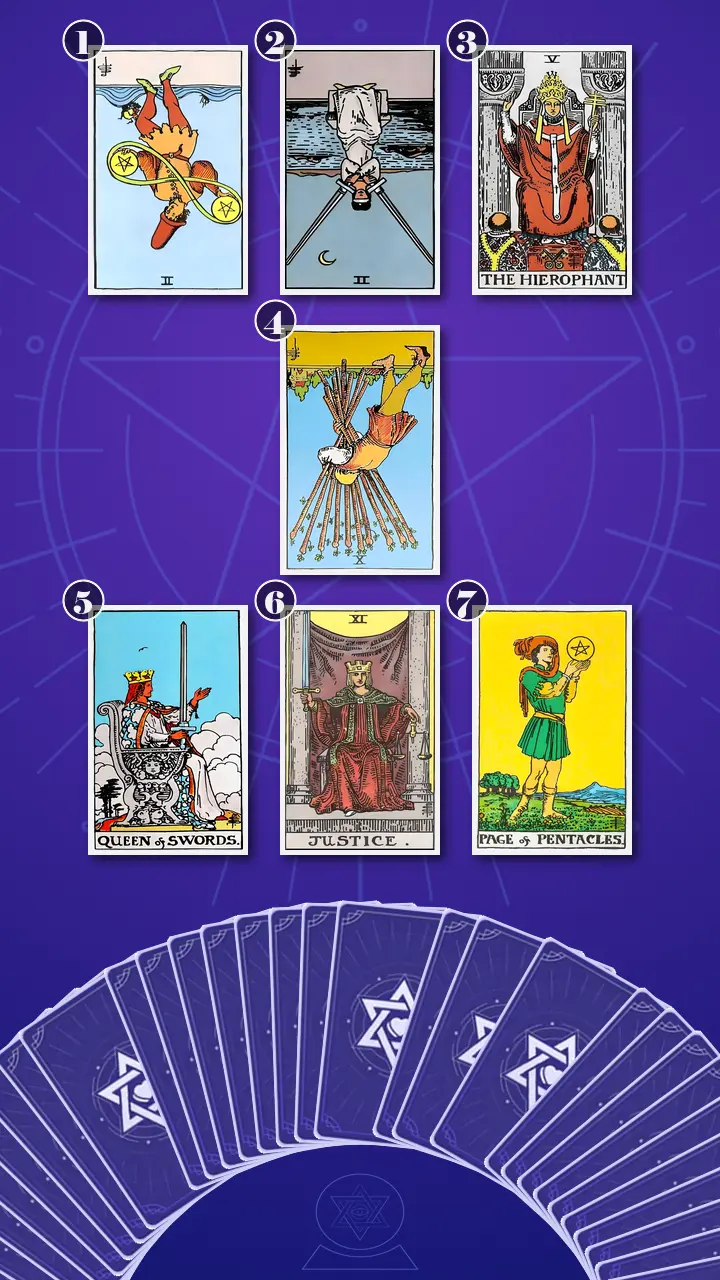
For her question, I chose a seven-card spread I designed called the Energy Diagnostic Map · Context Edition. I use it when the issue is not a simple conflict with one person and not a binary stay-or-go decision, but a repeating system role. This was not really about one awkward dinner. It was about a family mechanism: visible over-functioning, private self-silencing, inherited expectation, one central burden belief, and the need for practical next steps.
If I had used a standard relationship spread, it would have over-focused on one relative and missed the larger loop. This map works better like a transit diagram with one congested hub and a clear line leading away from it. The first card shows the visible symptom at the table. The second reveals the inner split underneath it. The third identifies the family pressure that keeps the pattern alive. Card four sits at the center as the choke point. Then the final three cards show the resource, the key turning point, and the next actionable experiment. That is how tarot works best for me: not as fortune-telling for whether next Sunday will be peaceful, but as card meanings in context that make a pattern visible enough to change.
Reading the Table Like a System
The Visible Symptom — Two of Pentacles Reversed
I turned over the card representing the most visible layer of the issue: Two of Pentacles, reversed. I told Maya this was the exact dinner-table symptom we had started with. In real life, it is that 7:40 p.m. moment when you are holding a fork in one hand while mentally tracking who understood which sentence, whose tone needs softening, whether your partner looks lost, and how fast you need to step in before the mood shifts. No one has officially assigned you the job, but your body has already started crowd control.
This is overload energy. Too many moving parts for one pair of hands, one mouth, one nervous system. In the card, the juggling looks almost impressive until you notice the unstable footing. That is the point I wanted her to see: the moment she begins balancing everyone else before anyone has clearly asked for help, usefulness turns into automatic service.
Maya let out a short laugh with a little bitterness in it. “Okay,” she said, shaking her head once. “That’s accurate to the point of being rude.” I smiled, because sometimes recognition has that flavor. Her shoulders were still high, but the laugh loosened something. The card was not accusing her of helping too much; it was showing how quickly her choice disappeared.
The Inner Split — Two of Swords Reversed
The next card represented the inner tug beneath the surface: Two of Swords, reversed. I spoke first about the blocked feeling in it—the blindfold, the crossed swords over the chest, the way the energy is all held inside rather than expressed clearly. In modern life, this is the pause at the table when Maya runs three versions in her head at once: the literal translation, the kinder version, the version least likely to offend. Everyone else experiences two seconds of silence. She experiences a full private decision storm.
This is blocked air: not a lack of intelligence, but too much analysis with nowhere clean to land. It keeps her so busy protecting peace that she never asks the more useful question—whether this discomfort is actually hers to manage. I asked her, “When you imagine not stepping in right away, what flashes first: awkwardness, guilt, or the fear that they will think you are selfish?”
She looked down at her tea and rubbed one thumb over the mug handle. “Honestly? That I’ll look disloyal.” She said it quietly, and I felt the reading drop a level deeper. Now we were no longer talking about translation alone. We were talking about belonging.
The Script That Boots on Startup — The Hierophant
Then I turned to the position identifying the external pressure that keeps the pattern alive: The Hierophant, upright. I told her this card often appears when a role feels sanctioned long before anyone consciously agrees to it. Same seating pattern. Same language choices. Same rules about respect, tone, and what counts as keeping the evening smooth. It is less one awkward interaction than an old family operating system that still boots up on startup, even when the current version of you wants different settings.
In energy terms, this is structure in excess. Structure can hold people; it can also freeze them into inherited positions. Before anyone even sits down, the room already knows who is expected to smooth things over. That is why the role feels bigger than one dinner. No one needs to announce it for it to feel sacred.
Maya gave me the tight half-laugh I hear when someone realizes a burden was assigned before it was chosen. “Yeah,” she said. “It felt assigned before anyone asked.” I nodded. “Exactly. That means we are looking at a script, not a personal defect.” When a pattern becomes legible, shame loses some of its authority.
The Load You Keep Carrying — Ten of Wands Reversed
At the center of the spread sat the core blockage: Ten of Wands, reversed. I always slow down for this card, because reversed tens often show a burden that is already too heavy, with relief nearby, and yet the body still acts as if putting anything down would be dangerous. I described it the way I see it in city life all the time: like carrying every grocery bag into a condo lobby in one trip, even though the door is already open, because setting one bag down for ten seconds feels more shameful than letting your hands ache.
This is blocked release. In her real life, it looks like two relatives being close enough to try speaking directly, and Maya still hovering—adding context, correcting tone, making sure nothing lands wrong. Beneath that, I could hear the real conflict in its clearest form: If I stop now, I look careless. If I keep going, I disappear.
Her reaction came exactly the way this card often lands. First, her breath caught. Then her eyes unfocused, as if she were replaying a dozen dinners in fast cuts. Then she let out one long exhale and said, very quietly, “Yeah. This is exactly it.” I answered with the gentlest truth I had: “Care is still care when it does not require self-erasure. Right now, the card is showing me that you have been measuring love by how much weight you can carry.”
The First Clean Sentence — Queen of Swords Upright
After that center knot, I turned over the usable internal resource: Queen of Swords, upright. I loved seeing her here. I told Maya this was the first clean breath in the spread. The Queen of Swords is the part of her that knows direct is not cruel. In contemporary terms, I read this card like the one clean Slack message that solves more than six anxious follow-ups. You do not need a speech. You need one accurate sentence.
The energy here is balanced air—clear, adult, relational, not icy. The upright sword says truth; the open hand says connection. At a dinner table, this might sound like, “Give them a second—they can try directly first,” or, “I can help in a minute if you still need me.” The point is not to win the room. The point is to stay in it as a person.
Maya blinked and sat back a little for the first time since we had begun. “That sounds so small,” she said. “Exactly,” I replied. “Small is what makes it usable. Small is what gets you out of performance and into practice.”
When Justice Rebalanced the Table
When I reached the next card, the room changed in that subtle way it does when a reading is about to stop being descriptive and start being catalytic. Rain ticked once against the studio window. The neroli on the blotter had softened into something brighter, almost like the air itself had more edges. We had arrived at the key transformation point.
The Fairness Card — Justice Upright
I turned over the card representing the shift that could reorder the whole dynamic: Justice, upright. In real life, this is the moment you stop asking, “Can I handle this?” and start asking, “Why is this automatically mine?” The scales take vague guilt and turn it into a concrete ownership question. Just because you can pick up every loose task on a shared project board does not mean those tasks belong in your column.
In my Conflict Transformation System, this is the line I watch for most carefully: the moment support turns into substitution. Once one person starts doing the meaning-making for everyone else, the relationship can look smoother while becoming less mutual. I learned the same thing years ago at the perfume bench in Paris. When one note keeps compensating for every missing facet simply because it is strong enough to do it, the whole fragrance goes flat. Families flatten that way too.
You know that split second when two people miss each other, someone turns toward you, and your body reacts before your brain does—fork mid-air, shoulders up, meal getting cold, like the whole room just got assigned to you again.
Not every silence is yours to fix; let the scales replace the reflex, and let one clear sentence do more than ten anxious translations.
You can care deeply without becoming the unpaid infrastructure of connection.
Maya’s reaction came in layers. First there was the physical freeze: even her fingers stopped moving on the edge of the card. Then came the cognitive hit—her gaze went past me, unfocused, like she was replaying last Sunday from the inside: dessert plates, someone saying her name, her own voice entering before anyone else had even tried. And then the feeling that surfaced was not relief right away. It was anger. “But if that’s true,” she said, and her voice sharpened for a second, “then I’ve trained everyone to expect it.” Her jaw tightened, then loosened. Her shoulders dropped a fraction. She breathed in slower the next time. I stayed with her there. “You adapted to a system that rewarded it,” I said. “That is different from choosing it forever.” The redness in her eyes did not spill into tears; it stayed where insight often stays—in the body, as a small unclenching mixed with a brief dizziness from standing somewhere new. I asked, “Now, with this new perspective, think back to last week. Was there a moment when this insight would have made you feel different?” She nodded almost immediately. “My uncle had already started explaining. I still jumped in.” I tapped the Justice card once. “That is the doorway. This is the move from unpaid bridge mode and tight resentment to chosen participation and steadier self-respect.”
Before I moved on, I gave her a five-minute drill right there. “Write one line you could actually use at the next dinner,” I said. “Something like, ‘Give them a second—they can try directly first,’ or, ‘I can help in a minute if you still need me.’ Read it out loud twice with both feet on the floor. Then practice counting to five before you imagine yourself stepping in. If your chest tightens or you feel flooded, stop there. The smallest version is simply noticing the urge without acting on it.”
The Practice Card — Page of Pentacles Upright
Finally, I turned over the grounded next step: Page of Pentacles, upright. I was glad the spread ended here, because this card refuses drama and rewards repetition. It treats boundaries the way I treat scent training: not as a personality trait you either have or do not have, but as a real skill built through small reps. One note at a time. One dinner at a time.
This is steady earth. No big boundary speech. No family referendum. No final exam on whether she is a good daughter. Just one low-stakes beta test at the next gathering: wait to be asked before translating, let one pause last five seconds longer, or use one prepared line once and let it stand. Maya smiled then—small, skeptical, but real. “So I don’t have to win dinner?” she asked. “No,” I said. “You just have to notice when the job is real and when it is only familiar.”
From Staff Mode to Chosen Participation
By the time I laid the seven cards back into a loose line, the story was clear. The top row showed how the pattern begins: visible overload, then mental gridlock, then an inherited script that makes the role feel respectable instead of exhausting. The center card named the choke point—Maya has been carrying the role as if connection only counts when it costs her something. The lower row gave us the exit route: one clean sentence, a fairness standard, and a practice card that turns insight into repeatable behavior.
The blind spot was simple and brutal: because Maya is capable, everyone around her—including Maya—has been treating capability as obligation. The transformation direction was cleaner: stop translating every gap by reflex, pause long enough to check whether help was actually requested, and let responsibility return to the whole table. That is exactly why I had chosen the Energy Diagnostic Map · Context Edition tarot spread for family role overload, fairness-based boundaries, and small dinner-table experiments. It let us see the loop, the knot, and the next steps without pretending this was just one awkward comment.
I gave her three practical actions, and I made them deliberately unglamorous. Real change usually starts that way.
- Five-Second Table PauseAt the next family dinner, choose one recurring cue—an awkward pause, a confused look, or hearing your name from the other end of the table. Keep one hand on your fork or water glass, count to five, and silently ask, “Was I asked, or am I predicting?” before you translate.If five seconds spikes your chest, start with three. The body antsiness is old training, not proof that the pause is wrong.
- One-Sentence Boundary BridgeBefore you leave home, save two versions in your Notes app: “Give them a second—they can try directly first,” and “I can help in a minute if you still need me.” Use one line once with the relative who drafts you most often, then stop talking.I asked her to dab a light neroli-citrus scent on her wrist before dinner. In my practice, that kind of calming scent is not magic; it is a body cue for “feet down, breathe, one sentence only.”
- Dinner Fairness CheckOn the TTC ride over or in the condo elevator, ask yourself, “What is mine tonight, and what is not?” After dinner, jot down one exchange you carried and one exchange you intentionally did not carry.Treat it like a project-board review, not a courtroom. “I could do this” is not the same as “this belongs to me.”
Those became her real next steps: replacing reflexive mediation with a five-second pause, a one-sentence boundary bridge, and a fairness standard that returned responsibility to the whole table. Helping by choice lands differently than helping by reflex. That was the entire point.

A Week Later, Her Plate Was Still Warm
A week later, a message from Maya lit up my phone just as I was leaving the studio. “Used the line with my mom before dessert,” she wrote. “My stomach dropped. They actually tried directly. It was awkward for maybe four seconds and then... fine. Also, my food stayed warm.” That was the proof I wanted for her—not a transformed family system overnight, just one visible inch of space where her own presence got to exist.
She sent one more message from the TTC on the ride home: “I still had the thought that maybe they were annoyed. But I also noticed I wasn’t exhausted in that same dead way.” Clear, but still vulnerable. That is how real change usually looks to me—firm, useful, and a little tender around the edges.
When I think about her reading now, I do not remember a dramatic boundary speech. I remember a warm plate, a lowered shoulder line, and the first moment she stopped confusing usefulness with belonging. For me, that was the whole Journey to Clarity: from unpaid bridge mode and tight resentment to chosen participation and steadier self-respect.
When I have watched someone spend years catching every silence before it lands, I know that even keeping both feet on the floor at your own family table can feel like risking your place in the room. If that is where you are, I do not read it as weakness. I read it as the exact threshold where another kind of belonging can begin—one that does not require you to vanish in order to keep connection intact.
At the next dinner, what might change if you let one pause last five seconds longer before deciding it belongs to you?