Post-Family-Visit Regression: How Re-Entry Protects Your Whole Week

Finding Clarity in the Sunday Train Spiral: Why Work, Money, Sleep, and Dating Slide After Seeing Family
If you're the city-working twenty-something who gets back from a family visit and somehow turns the ride home into a three-tab panic between your work inbox, bank app, and Hinge, this is for you.
When Maya (name changed for privacy) came onto my screen, she was still on the train back into Toronto at 8:47 on a Sunday night, half-slumped against the window. The carriage hummed under her, the phone light made her face look washed out, and her thumb kept flicking between Outlook, her banking app, and a dating message she had already opened twice. She told me later her phone felt hot in her hand. I believed her. Even through the screen, I could see the way her shoulders had climbed toward her ears, as if her whole body was bracing for Monday before she had even reached home.
"I swear I was fine before I went home," she said. "And now I feel like I need to fix work, money, sleep, and my entire personality by tomorrow morning."
That was the real knot. She wanted steady work, sensible money, actual sleep, and the ease to text someone back without overthinking it. But underneath that, she was scared the visit had proved something humiliating: that she was still not fully together, and maybe her family could see it more clearly than she could. Shame had that stalled-elevator feeling in her chest—too tight to breathe easily, too public to relax in—while her limbs buzzed with that wired-tired static that makes even answering one normal email feel weirdly expensive.
I told her gently, "A trigger is not a verdict. Old family energy loves to apply for full access to your week, but that doesn't mean we have to approve the request. Let me help you map what actually came home with you, and what doesn't belong to your adult life."

Choosing the Compass: The Energy Diagnostic Map for Emotional Spillover
I asked her to put both feet on the floor before she opened her apartment door, take one slower breath than she wanted to, and hold the question in plain language: why do I spiral after visiting family, and why do work, money, sleep, and dating all slide with it? Then I shuffled slowly. For me, that moment is never about theater. It is about helping the nervous system cross a threshold—from swirl into sequence.
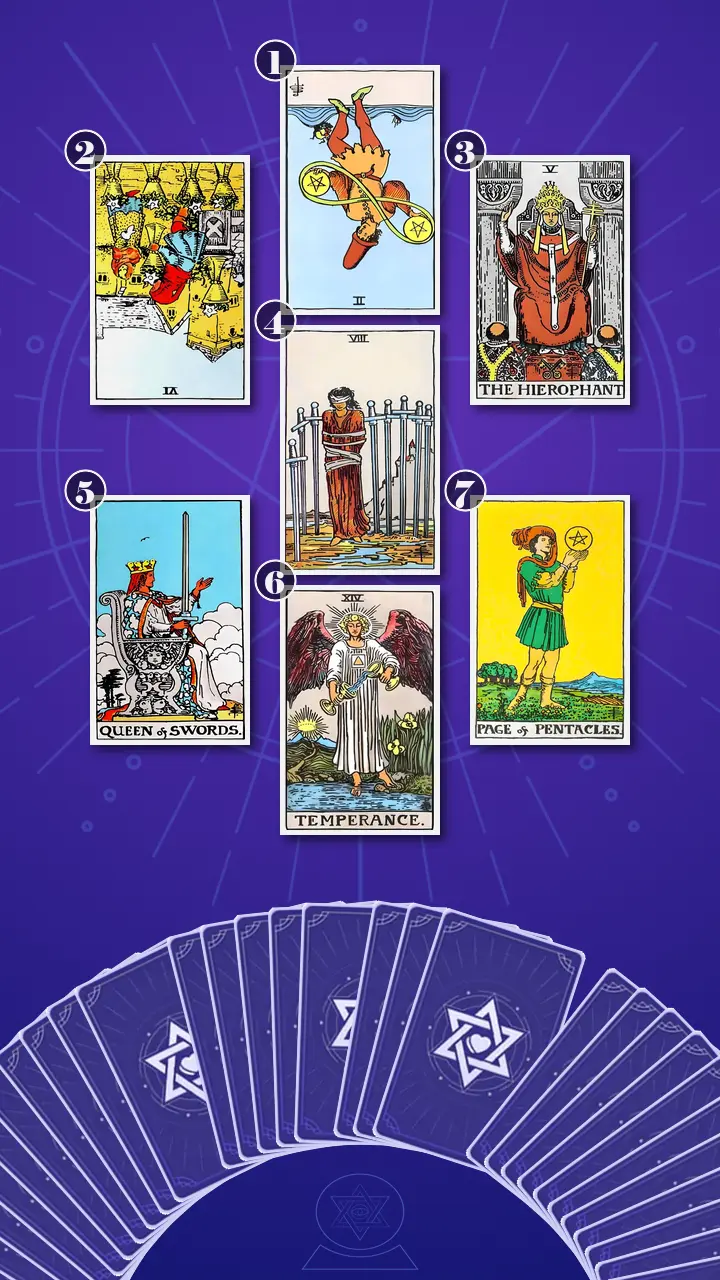
For a pattern like this, I used my Energy Diagnostic Map · Context Edition, a seven-card tarot spread for post-family-visit overwhelm. When people ask me how tarot works in real life, this is the answer: I do not use a spread to predict drama. I use it to separate a tangled experience into parts clear enough to work with. Tarot card meanings in context matter here, because this was not one problem. This was post-family-visit regression that disrupted work focus, spending, sleep, and dating momentum all at once.
I chose this spread because Maya's issue was a networked cascade, not a single decision. I needed one position to show the visible symptom cluster, another to reveal the younger emotional role family contact had reactivated, another to expose the inherited standards following her home, then the central blockage, the inner boundary already available, the turning point, and finally the next practical step. In short: storm front, knot, bridge, and route home.
I told her where I would pay closest attention. The first card would show the immediate slide across work, money, sleep, and dating. The fourth would name the belief loop turning one visit into a whole-week destabilization. And the sixth—our bridge card—would tell us what actually helps her come home affected, but not taken over.
Reading the Storm Front: The Week That Starts Slipping
The Loop That Feels Like "Research"
I turned the first card and said, "Now I am opening the position that shows the immediate post-visit slide across work, money, sleep, and dating."
It was Two of Pentacles, reversed.
I smiled a little—not because it was funny, but because it was exact. This card is the image of juggling everyday life while the sea behind you has already turned rough. Years ago, when I trained intuition aboard transoceanic ships, I learned that weather shifts show up first in small practical things: a glass edging across the bar, a step taken half a beat too late, a tray that suddenly feels heavier than it should. That is how this card works. The problem is not ignorance. The problem is unstable footing.
I told Maya what I saw: Sunday night after the family trip, she gets off the train back into Toronto, opens her work inbox, checks her bank balance, glances at Hinge, and then closes all three because even choosing what to tackle first feels weirdly high-stakes. Inbox tab. Bank alert. Dating notification. Uber Eats checkout. Back to inbox. "Okay, start with work. No, money first. Actually I can't deal with any of this." It looks casual from the outside, but inside it is like trying to answer Slack, check your account, and text someone back while your internal Wi-Fi keeps dropping.
This is reversed earth: practical energy in overload. Too many moving parts, not enough internal steadiness. The overcorrection is predictable too—an overpacked reset plan, a Notion board full of colored blocks, promises to wake up early and fix everything at once. And then, because the plan was built in panic, it collapses under its own weight and seems to prove the worst story.
Maya let out one short laugh that carried a lot more than humor. "Why is that literally my Sunday night?" she said, then added, "That is so accurate it feels a little rude." Her mouth smiled, but her fingers tightened around her keys. Recognition had landed.
The Version of You That Comes Home Younger
I turned the second card. "This position reveals the younger emotional state, or old role, reactivated by family contact."
Six of Cups, reversed.
I felt the whole reading drop beneath the surface. I told her this card is not about immaturity in the insulting sense. It is about emotional time travel. In Toronto, she pays her rent, manages deadlines, lives alone, buys her own groceries, decides who gets access to her time. But after one comment from family about work or dating, everyday choices start feeling graded. She knows she is an adult, yet part of her feels sixteen again. Like walking into your apartment but your nervous system still thinks it is back in your teenage bedroom.
This is water pulled backward, not flowing freely. The card shows me a familiar old role stepping back in: the self who expects correction, comparison, or subtle evaluation. So when she gets home, work is not just work anymore. A grocery order is not just a grocery order. A dating message is not just a dating message. Everything gets filtered through an older emotional courtyard that feels smaller, tighter, and far less free than her actual life.
As I said it, her breathing paused for a second. Then her eyes lowered to the edge of the screen. "Yes," she said quietly. "I know I'm an adult, but after a visit I feel younger in my own place. It's honestly embarrassing." I shook my head. "Not embarrassing. Specific. And specific patterns can be interrupted."
The Family Rulebook That Sneaks Into Monday
I opened the third position. "This card shows the family rules, comparisons, or inherited standards that follow you home."
The Hierophant, upright.
Here, the issue widened. I told her this was not really about one villainous relative or one dramatic conversation. It was about a whole value system. Be productive. Be financially smart. Be less up-and-down. Be on track romantically. Be easier. Be clearer. Be more impressive without looking like you're trying. The Hierophant is inherited structure, and in this reading that structure was in excess: an outside authority overreaching into an inner life it no longer gets to govern.
In real life, it looked exactly like what she had described to me. No one needed to explicitly say, "You are behind." The script was already installed. It was like being dragged back into a comment thread she never agreed to join, where the rules of respectable adulthood were somehow obvious to everyone else.
I watched her give one long exhale through her nose. "That's the part that makes me feel crazy," she said. "Sometimes they barely say anything. But I hear the whole thing anyway."
"Exactly," I told her. "The reading is already showing me that the visit did not create the rulebook. It activated it."
The Mental Cage in the Apartment Kitchen
When Every App Is Open but Nothing Gets Sent
I turned the center card last among the upper arc and let the pause sit for a beat. "This position identifies the belief loop that turns a visit into a full-life destabilization."
Eight of Swords, upright.
This was the knot.
I told her that by Tuesday night, this card becomes painfully modern: unread messages, a small work task that could be done in ten minutes, no actual emergency, and yet every option feels emotionally dangerous. Reply too casually and you are irresponsible. Spend too freely and you are immature. Go on the date and you are pretending. Stay home and you are failing. So you freeze. Doomscroll. Watch one more video. And then experience the freeze as evidence that you were right to doubt yourself in the first place.
That is the Eight of Swords. Congested air. Blockage. Like having every app open but being unable to press send anywhere. The room is dim except for your phone light. The fridge hum is too loud. Your chest is tight, your jaw is set, your stomach never fully settles, and freedom starts to feel less safe than staying stuck because every move seems like it might become evidence against you. The blindfold in this card matters to me because the ropes are looser than they look. The trap feels total, but part of what keeps it alive is the story itself.
I leaned in a little and asked her the question this position always asks: "After a family visit, what sentence do you start believing that makes ordinary choices feel heavy?"
She did not answer immediately. Her face went still first. Then her gaze drifted away from the screen as if she were replaying a moment in her kitchen. Finally she said, very softly, "If I can't keep it together after a normal visit, maybe I'm not as stable as I thought."
"There it is," I said. "That is the cage sentence. And I need you to hear this clearly: a trigger is not a verdict."
The First Clean Line Through the Noise
I turned the fifth card. "This position points to the inner boundary and discernment you can use instead of collapsing into old scripts."
Queen of Swords, upright.
Relief entered the spread immediately. After the blindfold of the previous card, here was a clear gaze. I told Maya this is her adult self with the mic back on: the part of her that can ask, "Is this actually a problem I need to handle, or am I hearing my family's voice in surround sound right now?" The Queen of Swords is air in balance—not coldness, not shutting down, but accurate naming. The difference between fact and commentary. The difference between belonging and self-betrayal.
I often explain this moment like editing a shared document and finally turning on track changes. You can see what is yours and what was inserted by someone else. "I missed one small deadline" is a fact. "I am falling behind in adulthood" is commentary. "A comment affected me" is a fact. "Therefore they were right about everything" is commentary. Not everything that feels true after a visit belongs to your adult self.
Her posture changed so subtly that many people would miss it, but I never do. She sat a fraction straighter. Her shoulders lowered a few millimeters. "Wait," she said, "I can actually separate it out."
"Yes," I said. "And that is the first break in the pattern. You are not trying to win an argument with your family in your head. You are turning down background noise so you can hear the actual track."
When Temperance Poured Between Two Cups
The Re-Entry Window
When I reached the sixth card, the room on both sides of the screen seemed to quiet. The TTC murmur behind her window thinned into a softer background hush. In my studio, evening water tapped the canal wall below in slow, even intervals. It felt like the reading itself had moved from static into rhythm.
I placed the card down carefully. "This is the turning point," I said. "The card that names the regulating shift that stops family energy from spilling into every domain."
Temperance, upright.
This is the card I wanted for her.
Before I gave her the breakthrough, I used one of the lenses that has become second nature to me, something I call Generational Echo Mapping. I grew up around Venetian canals, where sound behaves differently in narrow spaces. A small voice can bounce off stone and water and come back sounding larger, harsher, almost official. Family dynamics do that too. A single comment is the original sound. Shame makes the canal narrow. Then the echo returns bigger than what was first said and applies for control over work, money, sleep, and dating. Temperance does not waste energy arguing with the echo. Temperance widens the channel so the sound loses its power to rule the whole night.
I told her the setup as plainly as I could: she gets home from the visit, drops her bag by the door, opens her inbox, bank app, and dating app in one swirl of dread, and somehow ends up watching videos past 1 a.m. while her whole week starts feeling judged.
A family visit can stir the old story without earning the right to run your week. Stability is not never being triggered; it is noticing the spillover early and choosing what gets to cross the threshold with you.
You are not broken just because old family emotion spills over; follow Temperance's two cups and pour yourself back into balance one measured choice at a time.
She froze first. Not dramatically—just that tiny stop where the breath catches and the face forgets its performance. Then I saw the second wave: her eyes lost focus, as if some Tuesday-night scene was replaying behind them—the fridge light, the unopened email, the message she meant to answer, the whole private jury of it. Then came the release. Her shoulders dropped. Her mouth trembled into something halfway between a laugh and the beginning of tears. She pressed one hand flat against her chest as if checking whether the space inside it had changed shape. "Oh," she said, and the word came from lower in her body than the rest of the conversation had. "So I don't need to solve my family that night. I need to get back into my own life."
"Exactly," I said, and let the silence support her instead of filling it too fast. "Now, with this new perspective, think back to last week. Was there a moment when this would have changed how you felt?"
She nodded slowly. "If I had done that on Sunday," she said, "I probably wouldn't have turned one comment into proof that I was failing everything."
This was the hinge of the entire reading: the move from shame-driven shutdown after family contact to steady self-trust through regulated re-entry. Not certainty. Not perfection. But the first real shift from feeling graded to feeling self-led.
Not a New Life. Just the Next Solid Thing
I turned the final card. "This position shows how to re-enter adult routines in a small, concrete way this week."
Page of Pentacles, upright.
I love this card after Temperance because it refuses drama. It does not ask for a glow-up, a six-category life overhaul, or a comeback montage. It asks for one real thing. One grocery order before 8 p.m. One email answered before overthinking sets in. One honest dating reply instead of disappearing until you feel perfect. This is grounded earth in balance: the beginner builder studying one pentacle instead of juggling five.
I told her, "Not a new life. Just the next solid thing."
For the first time that evening, she smiled without wincing afterward. "That I can do," she said.
Re-Entry, Not Reset
When I stepped back and looked at the whole spread, the story was clean. First, practical life wobbled on the surface: inbox, bank balance, sleep, dating, all slipping at once. Beneath that, an older emotional role came online—the younger self waiting to be evaluated. Around it sat the inherited family rulebook, still quietly defining what a good adult life should look like. All of that fed the central knot: the shame sentence that made ordinary choices feel like evidence. But the reading did not leave her there. It showed the counterforce too: clear discernment through the Queen of Swords, regulated re-entry through Temperance, and one grounded act through the Page of Pentacles.
I named the blind spot for her directly. "You keep trying to think your way out of the family atmosphere before you let yourself resume your own life. That is why the crash lingers. You are waiting to feel fully reset before you act, when what actually helps is acting in a measured way before the old story gets full access."
Then I gave her the direction of change. "Your path is not to mentally solve old family dynamics on the ride home. Your path is boundaries, nervous-system reset, and one grounded routine at a time. Re-entry beats reset."
She looked doubtful for a moment and said, "But what if Monday is already packed? Sometimes I feel like I don't even have fifteen minutes to do this right."
I nodded. "Then we make it smaller. I use something I call the Bollard Marking Method. On a Venetian dock after rough water, I do not secure a boat by grabbing every rope in sight. I choose one clean post and tie there first. You do not need to stabilize your entire life on Sunday night. You need one place to moor."
- The Adult Voice CheckWithin 10 minutes of getting home from the next family visit, open your Notes app and make two columns: "Facts" and "Family commentary." Put one fact in the first column, like "I missed one small deadline," and one inherited script in the second, like "I am falling behind in adulthood." If a family comment starts replaying, add the sentence: "That may be their view; it is not automatically my truth."Keep each column to three bullet points max. If writing feels annoying or dramatic, record a 30-second voice note instead.
- The Boundary-First LandingFor the first 15 minutes after you get home, do not open all your life-admin apps at once. Drink water, shower, change into indoor clothes, and eat one real meal before you check work, money, or dating. If the family text thread keeps reopening the emotional tone of the visit, mute it for one evening.If your body gets more activated, stop there. Put both feet on the floor, take a sip of water, and let regulation count as progress.
- The First Domino RoutineChoose one 20-minute task for the first workday back and put it on your calendar under the title "Re-entry, not reset." Make it concrete: answer one work thread before 10 a.m., place one grocery order before dinner, or send one honest dating reply to one person instead of trying to revive your entire social life.When the 20 minutes end, stop. Do not turn one completed task into a demand to become a new person overnight.
Those were not random self-care tips. They were the exact practical translation of the cards: sort the story, calm the system, then rebuild confidence through visible follow-through.

A Week Later: The Quiet Proof
A week later, Maya sent me a message. "I did the note on the train," she wrote. "Muted the family thread for the night. Ordered groceries before I let myself scroll. Answered one campaign thread Monday morning. Also sent one Hinge reply without trying to become a fully healed woman first." I laughed when I read that, because it was perfect.
She slept a full night, but the first thought at 7:03 a.m. was still, What if I'm behind? This time she smiled, put water on for coffee, and answered one email before opening anything else.
That is what a real Journey to Clarity often looks like when I witness it. Not a life transformed by force. A person coming home to herself a little faster. A little cleaner. A little less willing to let an old scorecard set the terms of the week.
If tonight your chest still feels tight, as if the family scorecard is somehow still in the room, remember this: noticing that tension is already movement. You do not need a full reset. You need a re-entry. If you did not have to solve the whole family story tonight, what is one small way you might want to step back into your own life this week—one glass of water, one honest text, or one email that brings you back to your own side of the threshold?