Car Clicking, Brightspace Pinging—Until the Two-Coin Rule Set the Order

Crisis Stacking in a Toronto Parking Lot
You’re a Toronto student with a part-time job, staring at a car that only clicks while Brightspace pings “assignment due” and your bank app looks like a warning label—classic crisis stacking.
Taylor (name changed for privacy) told me that sentence felt “uncomfortably accurate,” like I’d been sitting in her passenger seat all morning. We were on a video call—Toronto daylight on her side of the screen, the soft after-hours glow of my Tokyo planetarium office on mine. Even through Wi‑Fi, I could see how her body was doing math before her mind could form words.
“8:41,” she said, and held up her keys like they were evidence. “I turned the key and it just… clicked. No turnover. It’s sharp-cold outside, my breath is literally fogging the windshield, and the dashboard lights felt too bright. And my brain immediately went: tow bill.”
She swallowed, jaw locked the way I’ve seen a hundred people clench when the planetarium’s simulated meteor shower hits and they don’t expect it. “Then I got the Brightspace notification. Then I checked my bank balance. Forty-six dollars. I just… need one thing to work today.”
Her overwhelm wasn’t an abstract feeling. It was physical: a tight chest like a seatbelt yanked too suddenly, restless hands that couldn’t find a safe place to land, and a wired-but-stuck buzz that made every option feel like it came with hidden fees—money fees and dignity fees. Wanting to take decisive action fast vs fearing any move will cost money or expose you as “not on top of it.” That contradiction ran the whole room.
I leaned closer to the camera, voice steady. “First—this isn’t a personality flaw. It’s crisis stacking. And our goal today isn’t to fix your entire life in one morning. It’s to find clarity on your next step: stabilize the next 30 minutes, protect the deadline, and stop the time bleed.”

Choosing the Compass: The Five-Card Cross Tarot Spread for Crisis Triage
I asked Taylor to take one slow breath and notice where the tension lived—jaw, chest, hands. Not to fix it. Just to locate it. Then I shuffled, not as a mystical performance, but as a focusing tool—like adjusting a telescope: you don’t create the stars, you line up your view.
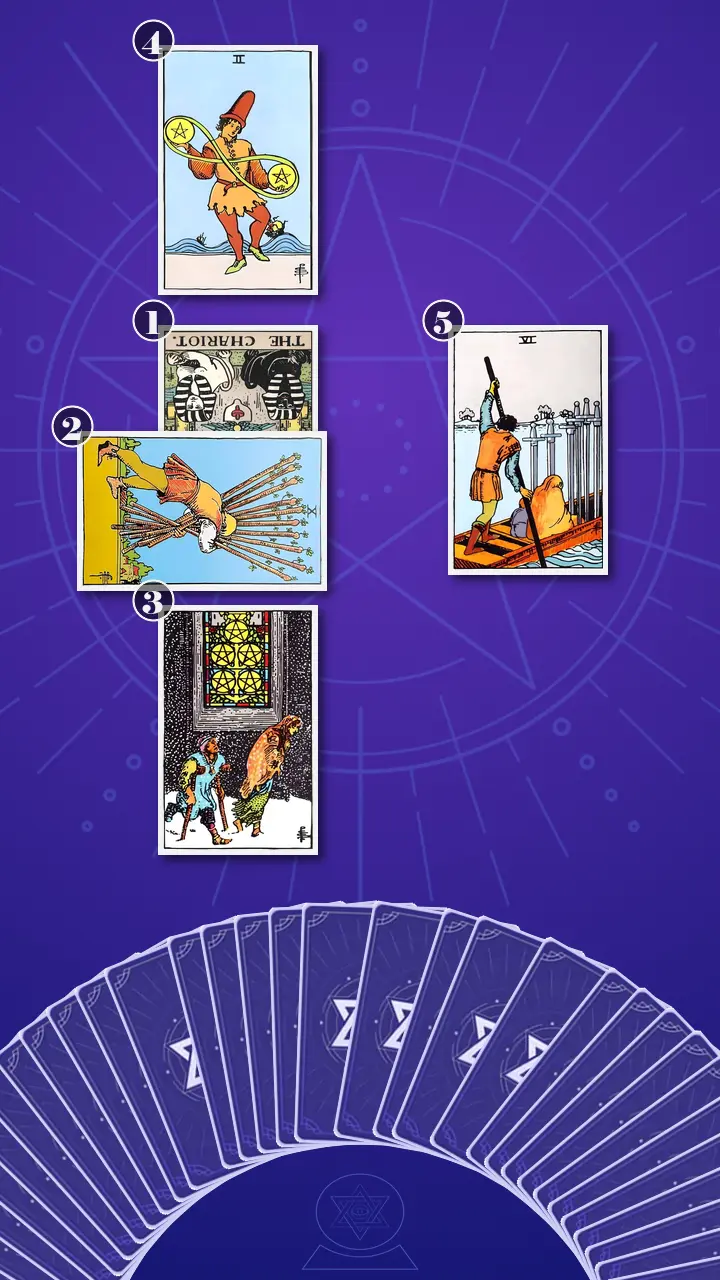
“Today we’ll use a Five-Card Cross,” I said. “It’s my go-to tarot spread for overwhelm and urgent decision making—especially when the problem is real-world triage: mobility, a deadline, and money stress all at once.”
For you reading this: the reason this spread works in moments like “car won’t start and assignment due—what should I do first” is that it doesn’t overcomplicate the story. It separates the situation into five practical questions: what’s stuck, what’s pressuring you, what’s underneath tightening your options, what stabilizes you right now, and what direction reduces turbulence over the next 24–48 hours. Tarot, used well, doesn’t predict the tow truck; it clarifies the order of operations.
“Card 1 is the current jam,” I said, “what’s most stuck in your lived reality. Card 3 will show the root constraint—often the thing turning logistics into shame. And card 4 is the stabilizer: the single best leverage point you can use immediately to regain agency and sequence.”
Reading the Map: How Tarot Works When Everything Hits at Once
Position 1 — The current jam: what’s most stuck right now
“Now flipped over,” I told her, “is the card representing the current jam—what is most ‘stuck’ right now in your lived reality.”
The Chariot, reversed.
I watched her eyes narrow like she was trying to decide whether to trust it.
“This is you in the parking lot turning the key again and again, then rushing back inside to open your laptop, then back to your phone to check your balance—trying to brute-force momentum,” I said, using the scene exactly as it lived in her day. “It’s not that you don’t have willpower. It’s that your usual ‘I’ll push through’ strategy has no traction today, so every extra push just burns time and tightens your chest.”
Reversed, The Chariot reads like energy in a blockage state: plenty of drive, but the wheels aren’t gripping the road. The two sphinxes—pulling in opposite directions—show up as ‘fix the car now’ vs ‘finish the assignment now.’ Split focus stalls movement.
I leaned into an image I use often, because it’s brutally modern: “It’s like mashing refresh on three apps—bank, email, ride-share—and calling it problem-solving.”
Taylor let out a small laugh that landed with a bitter edge. “Okay… that’s rude,” she said. Then, quieter: “But yeah. That’s literally what I’m doing.”
I nodded. “Certainty isn’t the requirement—traction is. The card is asking: what can you control in the next 30 minutes, not the whole day?”
Position 2 — The pressure point: what’s making it urgent or heavy
“Now we’re looking at the pressure point—what’s crossing you and making everything feel heavier than it technically is,” I said.
Ten of Wands, upright.
“Your day feels like you’re carrying three full-time jobs at once,” I told her, grounding it in her real life: “student deadlines, part-time shifts, and adult logistics—car plus money. Overload doesn’t just exhaust you; it blocks your view. Like carrying every grocery bag in one trip until you can’t see the door handle.”
This one is Fire energy in an excess state: urgency and responsibility burning hot. It’s why you end up jumping between five tabs—car troubleshooting, late policy, budget math, Uber prices, campus map—without finishing any one action. Not because you’re lazy. Because you’re overloaded.
I pictured her on the TTC platform from her earlier messages: phone buzzing, speaker crackling, knee bouncing like it was trying to run on her behalf. “Here’s the practical question,” I said gently. “What burden can be set down for four hours? Not solved. Set down.”
Her shoulders lifted—then dropped a millimeter. “I really am trying to do everything at once,” she said, and this time her laugh was sad instead of sharp.
Position 3 — The root constraint: what’s tightening your options underneath
“Now flipped over is the card representing the root constraint—the underlying factor tightening your options,” I said.
Five of Pentacles, upright.
“This is the bank-app moment,” I told her. “The low balance turns this from ‘annoying car issue’ into ‘I’m not safe.’ So you go into scarcity mode: don’t ask, don’t spend, don’t admit you need flexibility.”
Earth energy here isn’t calm and stable; it’s in a deficiency state—too little buffer. And when there’s not enough buffer, the mind starts treating every decision like it’s an identity test.
“The image shows a lit window in the snow,” I said. “Warmth exists nearby, but shame can make you walk past it without noticing. Support systems don’t feel ‘for you’ when you’re stressed.” I kept it concrete: a friend with jumper cables, a campus resource, a small extension, even a payment plan—options that exist in Toronto the same way certain stars exist even when clouds cover them.
Taylor went still for a second. Her thumb, which had been rubbing the corner of her phone case, stopped mid-motion. “I do act like I’m not allowed to need help,” she said, almost like she was surprised by her own sentence.
When the Two Coins Found Their Orbit
Position 4 — The stabilizer: the most practical leverage point right now
“We’re flipping what I consider the stabilizer,” I said, letting the moment slow down. “This is the most practical leverage point you can use immediately to regain agency and sequence.”
Two of Pentacles, upright.
In my office, the planetarium’s projector fans were a soft hush—like distant wind. On Taylor’s side, I could hear the faint click of a notification she didn’t open. For once, she didn’t reach for it.
“Here’s the camera shift,” I told her. “Early today, your brain is doing jump cuts: tab, tab, tab, refresh, rewrite. The Two of Pentacles is the shot getting longer. It’s you stopping the spiral and running a two-track plan: pick one mobility backup for the next few hours, protect the deadline with one simple message, then do a focused work sprint. Balance isn’t calm—it’s adaptive skill on moving waves.”
For about forty words, I mirrored her setup, so she could feel how the card was meeting her reality: “You’re at the kitchen table with the assignment open, the bank app staring back, and the same car troubleshooting tab reloaded for the third time—like you’re sprinting between alarms without turning any one off.”
You don’t need a perfect rescue plan. You need a sequence.
Stop trying to force a perfect rescue plan and start juggling two realistic priorities at a time, like the Two of Pentacles keeping balance on moving waves.
She froze—breath held, eyes widening just a fraction. That’s the first micro-reaction: the nervous system pausing like it’s waiting for impact. Then her gaze slid off-camera, unfocused, like her brain was replaying the morning in fast-forward: key click, Brightspace ping, bank refresh, Reddit r/MechanicAdvice, back to the empty Google Doc. Finally, her shoulders dropped and she exhaled, long and shaky, like someone setting down a backpack they forgot they were carrying.
“But… if I only pick two things,” she said, voice tight with a flicker of anger, “doesn’t that mean I’ve been doing it wrong? Like—I should be able to handle more than two things.”
I didn’t rush her past it. “That reaction makes sense,” I said. “When money is tight, your brain equates ‘doing everything’ with ‘staying safe.’ The Two of Pentacles is telling you something different: safety comes from sequence. From choosing, not from spinning.”
Then I brought in my signature tool—the one I reach for when someone’s attention is scattering like starlight through fog. “I call this Black Hole Focus,” I said, “because it’s based on an event horizon: a boundary where certain things simply do not get to enter the system for a set time.”
“For the next 30 minutes, your event horizon is two priorities. Everything else—bank-app reassurance checks, new troubleshooting threads, rewriting the email until it sounds ‘competent’—doesn’t cross. Not because it’s unimportant. Because you’re creating traction.”
I kept my voice soft, but the structure crisp. “Now, with this new perspective, think back—was there a moment last week when this insight could have made you feel different?”
She blinked hard. “Yeah,” she said. “Tuesday night. I was rewriting a message to my manager asking to swap a shift. I rewrote it so long I just… didn’t send it. And then I lost the shift anyway.”
“That’s exactly it,” I said. “This card is your pivot from panic-driven scatter and shame-avoidance to grounded triage and regained agency through sequencing. Not a personality makeover. A new order of operations.”
Position 5 — The next-step direction: what helps for the next 24–48 hours
“Now we’re looking at the next-step direction—the path for the next 24–48 hours if you apply that stabilizer,” I said.
Six of Swords, upright.
“This is choosing quieter water,” I told her. “Not ‘fix everything,’ but ‘get through the next day or two with a steadier route.’ It’s the idea that if you can’t drive the chariot today, take the boat.”
Air energy here is in a balance state: clearer thinking, problem-solving, a transition away from mental turbulence. The card doesn’t promise the car magically starts. It promises something more realistic: you stop treating every minute like an emergency because you’ve chosen a workable vessel—transit, a capped ride-share, a friend’s lift—and you’ve made one clear communication that buys you time.
Taylor nodded slowly, like she could feel the difference in her chest just imagining it. “Quieter water sounds… embarrassingly good,” she said.
The 30-Minute Stabilizer Checklist (Actionable Advice, Not Vibes)
I set the cards down and gave her the integration in plain language, the way I’d explain an eclipse to a group of teenagers: simple, honest, and specific.
“Here’s the story your spread tells,” I said. “You started in a stalled-momentum moment (Chariot reversed) under real overload (Ten of Wands). Underneath, the root isn’t laziness—it’s scarcity pressure (Five of Pentacles), which turns every choice into a shame test. The stabilizer is adaptive prioritization (Two of Pentacles): two priorities, one sequence. And the direction is a supported transition (Six of Swords): a quieter-water plan for the next 24–48 hours.”
“Your cognitive blind spot,” I added, “is that you’re secretly trying to prove you’re competent by handling this perfectly and alone. But the transformation direction is different: redefine control as sequencing and communication, not forcing outcomes.”
Then I made it executable. “We’re going to do this like a tiny solar system,” I told her, borrowing my Planetary Memory Palace strategy. “One orbit for mobility, one orbit for communication, then you protect a work block like it’s your atmosphere. The rest can exist, but it doesn’t get to crash into you right now.”
- Two-Coin Rule Sticky NoteOn a sticky note, write exactly two lines: (1) Mobility plan for the next 4 hours (choose ONE: jump start attempt OR transit OR capped Uber/Lyft OR ask a friend/coworker for a lift). (2) Deadline protection message (who you’ll message: instructor/TA/manager).If your brain argues (“But what if the other option is cheaper?”), treat it like background noise. You’re not choosing the best plan—you’re choosing a plan that stops the time bleed.
- Cash-Floor Check (Spending Cap)Before you troubleshoot anything else, set a cap: “I’m willing to spend up to $___ today for mobility.” If you’re taking transit, the cap might be your PRESTO fare plus a small buffer; if it’s ride-share, it’s a hard limit you won’t exceed.If picking one number spikes your anxiety, choose a range (e.g., $15–$25) or start with a “$0 plan first” and give yourself permission to revise later.
- The One-Message Shield (Send the Draft)Within 10 minutes, send a 4-sentence message to your instructor/TA: what happened (“transport issue this morning”), what you can submit today, how much extra time you’re requesting, and when you’ll deliver the rest.Set a 6-minute timer. When it ends, hit send—even if the message isn’t perfect. The goal is protection, not performance.
- Black Hole Focus Work Sprint (45 Minutes)Do one 45-minute sprint on the assignment (Google Docs open, phone on Do Not Disturb, bank app closed). If money thoughts intrude, use “Shooting Star Notes”: capture the thought in 30 seconds on paper (“Check CAA wait times at 2:00”) and return to the doc.Make it a rule: “Not during the sprint.” Close the bank app for 45 minutes. You can reopen it after you’ve bought time.

A Week Later: The Quiet Proof of Finding Clarity
Six days later, Taylor sent me a message I could practically hear in her lungs: “I did the sticky note. I emailed my TA without rewriting it ten times. I took the TTC and finished the draft at Robarts. It wasn’t a cute day. But I didn’t spiral.”
She added, almost as an afterthought: “I still woke up thinking, ‘What if I’m wrong?’ But then I looked at what I’d already sent and… I laughed. Like, okay. I’m doing it.”
That’s the part I love about this kind of tarot reading for crisis stacking and overwhelm: the win isn’t a dramatic rescue. It’s a sequence that returns you to yourself. A small proof that your life can move even when your car can’t.
When three alarms go off at once, it can feel like your body is bracing for impact—tight chest, clenched jaw—because choosing one step means risking money or judgment, and not choosing feels like the only way to stay ‘safe.’
If you let yourself aim for ‘stable for the next 30 minutes’ instead of ‘fixed forever,’ what would your first two-step sequence be?