Sunday Night Calendar Tetris—and the 25-Minute Call That Defined 50% Travel

Finding Clarity in the PDF That Lives in Your Recents
You’ve opened the promotion details so many times the PDF basically lives in your Recents—yet you still haven’t had the one conversation that would make “50% travel” real instead of terrifying.
Jordan (name changed for privacy) said that to me like it was a confession, then immediately tried to laugh it off. They were 29, a project manager at a mid-sized tech company in Toronto, and the laugh didn’t land. It caught in the throat the way a yawn does when you’re too wired to sleep.
They’d booked a video session, but I could still picture the scene because they described it with the kind of detail people only give when they’ve lived it too many times: 8:47 PM on a Tuesday, condo quiet except for the radiator clicking. Laptop balanced on their knees. A half-folded hoodie catching the screen glow like a reflector. One tab with the promotion doc, another with travel policy, another with Pearson flight routes. Then—bzzzt—a Slack notification vibrating the phone against their palm.
“My shoulders lock up,” they said, rolling one shoulder like they could shake the tension loose. “And my stomach does that drop. Like I’m about to step onto an escalator that’s moving faster than I expected.”
On paper, it was a win: a real promotion, more visibility, bigger scope. In real life, it came with a requirement that read like a lifestyle rewrite: 50% travel. Jordan wanted the title—wanted the growth—wanted to feel proud when they typed it into their email signature. And at the exact same time, their body reacted like Monday morning flights were a threat.
The dread wasn’t abstract. It was a jaw held so tight their molars felt like they’d been grinding down in secret. A wired-but-tired hum in the chest that made stillness feel itchy. A stomach drop at the thought of a 5:41 AM alarm and dry cabin air before they’d even sat up in bed.
“I want it,” they said, voice low, “but I don’t want what it costs.”
I nodded slowly, letting that line sit between us without trying to fix it. “That makes sense,” I said. “We’re not here to force you into a yes or a no. We’re here to get you out of the loop and into clarity—so you can choose without self-abandoning.”

Choosing the Compass: The Decision Cross Spread
I asked Jordan to take one breath that was slightly longer on the exhale than the inhale—nothing mystical, just a nervous system nudge. While they did, I shuffled slowly, the way I used to square up a stack of trade confirms on a desk: deliberate, tidy, no drama. Tarot works best for me when it’s treated like a decision tool—pattern recognition, not prediction.
“For this,” I said, “I’m going to use a spread called the Decision Cross.”
To you, the reader: this is why I picked it. Jordan’s question is a true two-path career crossroads—take the promotion with heavy travel versus protect stability and recovery time. Clarity here doesn’t come from guessing the future or doing twenty more tabs of research. It comes from naming capacity, defining terms, and spotting the hidden complication that keeps turning the choice into decision fatigue.
The Decision Cross stays compact while still covering what matters: Card 1 shows the current burnout pattern in daily behavior; Cards 2 and 3 contrast what each path amplifies; Card 4 reveals the looping complication; Card 5 anchors the inner decision criterion; Cards 6 and 7 bring it down to supports and the next grounded move.
“We’ll start with what’s already happening in your body and calendar,” I told Jordan, “then we’ll look at what each option asks of you, and we’ll end with the one conversation that makes this real.”
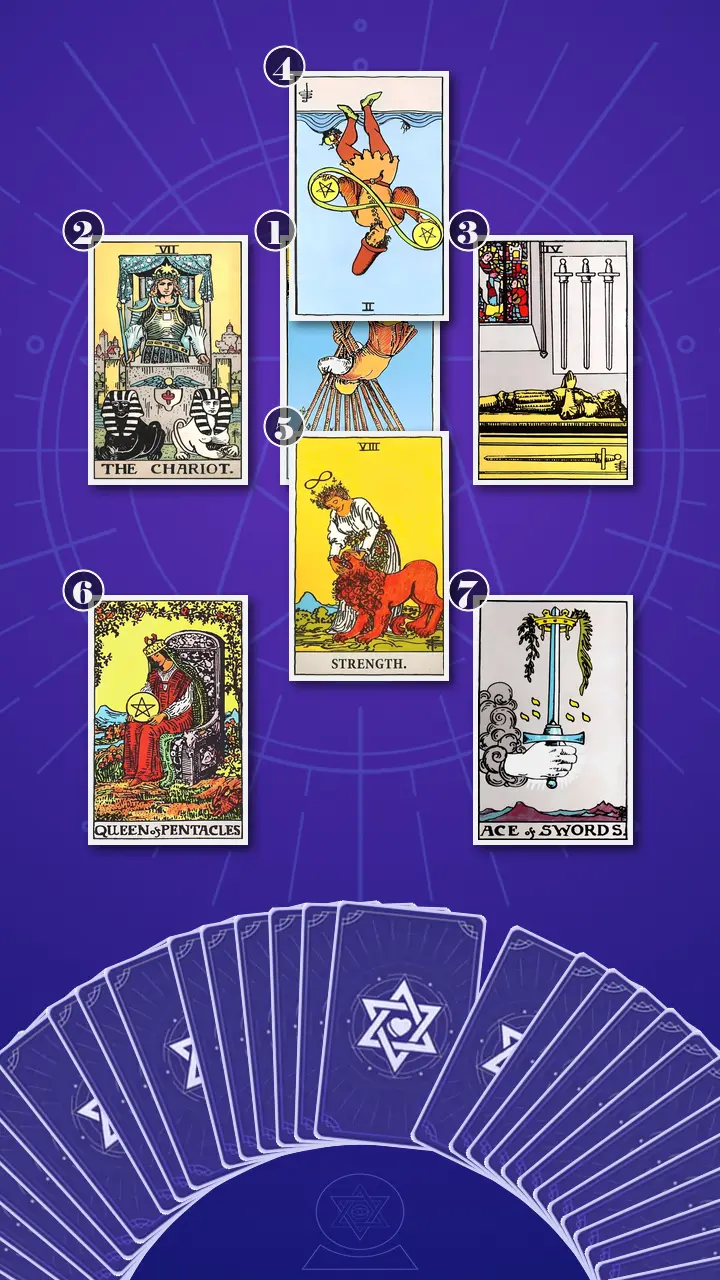
Reading the Map: Burnout Heat, Ambition Momentum, and the Loop
Position 1: The visible stress point
“Now flipping over,” I said, “is the card that represents the visible stress point: what your current burnout pattern looks like in daily behavior right now.”
Ten of Wands, reversed.
It’s 9:40 PM and you’re “just checking” the promotion/travel details again while your body feels wired-but-tired. Your week is already packed, but you keep stacking responsibilities like you can carry them if you grip harder. The stress isn’t only the promotion—it’s that you’re making this decision on top of an already overloaded baseline.
In energy terms, this is blockage through overload. Not “you’re bad at choices.” Not “you’re ungrateful.” It’s simply: the system is already maxed out. When you try to decide from that state, your brain does what brains do under strain—it reaches for control. More pros/cons lists. More rewriting. More “I’ll decide after one more check-in with my energy level.”
I watched Jordan’s face tighten, then soften into something like reluctant recognition.
They let out a short, bitter little laugh. “That’s… yeah. That’s too accurate. Almost rude.”
“I’ll take ‘rude’ if it gets us honest,” I said gently. “Because the Ten of Wands reversed is also asking: what can be set down this week, even temporarily, so your decision isn’t made in survival mode?”
And before we even moved to the next card, I named the fear I could hear under their careful logic. “You’re not afraid of travel. You’re afraid of the version of you who disappears when the pace gets brutal.”
Position 2: Path A (taking the promotion)
“Now flipping over,” I said, “is the card that represents Path A: taking the promotion—what this choice would ask you to embody and what it tends to amplify in you.”
The Chariot, upright.
You picture yourself leading across cities—confident in the airport, running meetings like a machine, getting that ‘I’m leveling up’ rush. But the same energy can turn into constant availability: you start believing you have to be unstoppable to deserve the role, which makes every travel week feel like a high-stakes performance.
This is excess energy when it’s unbounded: willpower as a substitute for support. I’ve seen this in finance and tech both—people confuse “leadership” with “being reachable everywhere.” The Chariot wins by direction, not by speed alone. If the promotion path becomes a test of worth, you’ll end up armoring up instead of steering.
Jordan’s eyes flicked away from the screen for a second, like they were watching an internal highlight reel: airports, meetings, the new title—and then the crash.
Position 3: Path B (guarding burnout)
“Now flipping over,” I said, “is the card that represents Path B: guarding burnout—what this choice protects and what it tends to cultivate if you commit to it consciously.”
Four of Swords, upright.
You choose the path that protects rest: fewer flights, more consistent sleep, more evenings where you’re not recovering from time zones. But it’s not passive avoidance—it’s deciding that restoration is strategic, and then backing it with boundaries so rest doesn’t just happen after you crash.
This card is balance through deliberate pause. It’s the protected space your nervous system keeps trying to claw back at 12:11 PM lunches you can’t remember because you ate while answering messages. The Four of Swords isn’t saying “quit.” It’s saying: stop treating white space like something you must earn.
Jordan swallowed. “That’s what I want,” they admitted. “Like… five minutes where I’m not bracing for the next ping.”
Position 4: The hidden complication
“Now flipping over,” I said, “is the card that represents the hidden complication: the practical or mental factor that turns this decision into a loop.”
Two of Pentacles, reversed.
You’re trying to mentally schedule a travel-heavy role while assuming your current workload, routines, and relationships stay intact. The math doesn’t add up—so you keep looping, researching, and optimizing instead of naming what must be delegated, re-scoped, or supported if you say yes.
This is deficiency of structural capacity. Not deficiency of character.
And I could feel the exact micro-scene in my bones because I’ve lived my own version of it—dragging calendar blocks around like it’s Tetris, trying to make a week “work” without removing a single demand. In my mind, I saw Jordan on a Sunday night, Google Calendar loading, meetings stacked like bricks. They’re rearranging tasks—shift one call, move one prep block—while the fluorescent kitchen light buzzes overhead. It looks like problem-solving. It feels like control. But nothing actually changes.
Your calendar is already full. The question is what gets removed—not what you can endure.
Jordan went very still. Then their shoulders dropped about half an inch, like something unclenched on its own.
“Oh,” they said quietly. “It’s… it’s not that I can’t balance. It’s that the container is too small.”
“Exactly,” I said. “And that’s why you’re stuck. Not because you need more research. Because you need to renegotiate the container.”
When Strength Held the Reins: The Decision Criterion
Position 5: The decision criterion
I paused before turning the next card. The air in my office felt suddenly quieter, like the city outside had lowered its volume. “We’re flipping the pivot now,” I said. “This is the card that shows the inner strength or mindset that makes the ‘right for you’ choice possible.”
Strength, upright.
In the meeting with your manager, you don’t over-explain or apologize. You calmly say: ‘I’m excited about the role. To make 50% travel sustainable, I need clarity and support around workload and recovery time.’ This is strength as leadership—limits as guardrails that protect performance, not as weakness.
This isn’t ‘Can I tough it out?’ It’s ‘What would make this sustainable—and will I ask for it?’
Setup: Sunday night, the week’s calendar loads and your stomach drops before you even touch the mouse—your body already knows the current container is full. And your mind, trying to protect you, starts demanding certainty: “Just tell me the right answer so I don’t risk my reputation or my health.”
Delivery:
Stop proving strength by pushing through; practice Strength by holding your limits like reins you can trust.
There was a beat of silence after I said it. Not awkward—more like the silence after someone finally names the real problem in a meeting and everyone realizes the room has been orbiting it for weeks.
Reinforcement: Jordan’s breathing changed first. A tiny pause on the inhale, then a longer exhale, as if their ribs had been held by invisible hands and were finally allowed to move. Their eyes went glossy—not full tears, but that hot edge of it. Their jaw worked once, like they were deciding whether to argue. Then their face tightened with a flash of frustration.
“But if I need all that,” they said, voice sharper, “doesn’t it mean I’m… not cut out for it? Everyone else just—does it.”
I held that without flinching. This is where people either get shamed into self-erasure or they learn a new definition of leadership.
“Needing terms doesn’t mean you’re not cut out,” I said. “It means you’re reading reality. In my old life, we valued people’s output, sure. But we also valued risk management. You’re talking about your human capital—your skill, judgment, and stamina. Stamina is an asset. If you burn it down to prove something, that’s not toughness. That’s bad valuation.”
I leaned in slightly, switching into the strategist voice that still lives in my spine. “And here’s the game theory piece: if you accept without terms, the equilibrium becomes ‘they ask, you stretch.’ If you negotiate now, the equilibrium becomes ‘scope is defined, performance is protected.’ That’s not being difficult. That’s leadership.”
I gave them something concrete, because insight without an anchor can evaporate by morning. “Set a 10-minute timer. Write two headers: ‘Yes, if…’ and ‘No, because…’. Under ‘Yes, if…,’ list 3 conditions that would make 50% travel sustainable—workload changes count. Under ‘No, because…,’ write the one cost you refuse to pay again—sleep, health, relationships, sanity—your words. If you feel your body spike, stop early; you’re collecting data, not forcing a decision.”
Jordan stared at the card on their end of the screen like it was a mirror. Their shoulders softened again. Their hands, which had been gripping their mug, loosened. And then came the subtle vulnerability that always follows real clarity: a tiny blankness, like stepping off a moving walkway and having to trust your legs.
“Okay,” they whispered. “I can… ask.”
“And I want you to do one more thing,” I added. “Right now, with this new lens, look back at last week. Was there a moment—maybe a Slack ‘quick turnaround?’ message, maybe you saying yes in a meeting—where holding your limits like reins would have changed how you felt?”
Jordan blinked, eyes unfocusing for a second as if replaying footage. Then they nodded once, slow. “Thursday,” they said. “Glass-walled room. I said, ‘Sure, I can own that,’ and my foot wouldn’t stop tapping. I could’ve asked what gets deprioritized. I didn’t.”
“That,” I said quietly, “is the shift from dread-driven overthinking to calm self-trust. Not perfect. Just real.”
The Queen’s Infrastructure and the Ace’s Clean Sentence
Position 6: What support makes sustainability real
“Now flipping over,” I said, “is the card that represents what support makes sustainability real—resources, boundaries, or structures you can build regardless of the outcome.”
Queen of Pentacles, upright.
You design a sustainable travel life on purpose: recovery blocks on the calendar, realistic meal/laundry systems, spending a little money to buy back energy, and asking for admin support. Instead of willpower, you build infrastructure—so your baseline doesn’t collapse every time you’re on the road.
This is balance through grounded support. It’s the difference between “I’ll be disciplined” and “I’ll be resourced.” The Queen of Pentacles is the part of you that stops treating recovery as an afterthought and starts treating it like operational planning.
Jordan’s expression shifted into something like cautious relief. “So it’s not just… meditate harder,” they said.
“No,” I said, smiling. “This is not self-care aesthetics. This is logistics that protect your nervous system.”
Position 7: The next grounded move
“Now flipping over,” I said, “is the card that represents the next grounded move—the clearest conversation or action that turns the decision into a clean, empowered step.”
Ace of Swords, upright.
You stop trying to decide in private and create clarity in the real world: you send a short email or book a meeting that defines what ‘50% travel’ means week-to-week, what changes in workload, what recovery time is protected, and what support comes with the title. One clear conversation replaces a hundred late-night tabs.
Clarity is one clean sentence, not twenty more tabs.
This card is excess clarity used well—a sharp, simple truth that stops the spiral. Not a manifesto. Not an apology tour. Just a scope statement, like the ones that stop a project from silently doubling.
Jordan exhaled, then gave a tiny half-smile that looked like they’d just put something heavy down. “So the next step isn’t deciding,” they said. “It’s defining.”
“Exactly,” I said. And I meant it: tarot, at its best, doesn’t make you psychic. It makes you specific.
From Insight to Action: The Yes-With-Terms Framework
I leaned back and stitched the whole spread into one story, the way I’d write a post-mortem after a complex quarter: clear causality, no shame.
“Here’s what I see,” I told Jordan. “You’re already carrying too much (Ten of Wands reversed), so the promotion isn’t landing on a stable baseline—it’s landing on a system that’s been running hot for a year. The promotion path amplifies your ability to drive and achieve (The Chariot), but it also risks turning you into a person who equates leadership with constant availability. The burnout-protection path offers real recovery (Four of Swords), but only if you choose it intentionally, not as collapse.”
“The reason you’re stuck,” I continued, “isn’t that you’re weak. It’s that you keep imagining travel on top of everything else (Two of Pentacles reversed). The container is too small. Strength is the pivot: you don’t prove worth by enduring. You lead by negotiating terms, building support, and protecting capacity. And the Ace of Swords says: make it real with one clean conversation.”
The blind spot was obvious once it was named: Jordan had been treating stamina like a private flaw—something to hide—rather than like a strategic asset to manage. That’s the transformation direction in plain language: from “Can I survive this travel?” to “What conditions would make this role sustainable—and am I willing to ask for them?”
I gave them what I’d give a client on a trading desk: next steps that could be done in under an hour, not a new personality.
- Build your 15-minute Capacity Swap ListOpen a note titled “Capacity Swap List.” Write: “If travel increases, what must decrease?” List 3 tasks you would drop, delegate, or re-scope. Then add: “What support would make travel sustainable?” Pick one item from each list to bring to your manager as a concrete trade.Set a 15-minute timer. When your brain argues, “I need more info first,” tell it: “We’re making the load visible, not solving life.” One slow exhale whenever your shoulders creep up.
- Write your Three Non-Negotiables / Three NegotiablesDraft 3 non-negotiables for travel (examples: max travel weeks per month, protected recovery time after travel, workload adjustment) and 3 negotiables (flight times, hotel tier, which cities). Then draft one clean paragraph: “I’m excited about the role. To make 50% travel sustainable, I need clarity on X and support on Y. Can we define what 50% looks like week-to-week, and what changes with my current workload?”If “I’ll look difficult” spikes, treat this like project scope. Clear inputs prevent failure later. You can request a follow-up meeting; clarity can be a two-step process.
- Run a two-week Recovery Budget (time + money)Choose 1–2 paid supports you’ll allow yourself if travel happens (meal delivery once, laundry drop-off once, rideshare to/from Pearson once). Add two calendar placeholders called “Recovery Block” (45 minutes). No productivity allowed.When shame shows up (“I should be able to handle this”), label it as noise. Return to: “What protects stamina?” This is Queen of Pentacles leadership—building infrastructure, not relying on heroics.
Before we wrapped, I offered one optional tool from my own weird toolbox—because sometimes confidence needs a physical handle.
“For the manager meeting,” I said, “pick one ‘power accessory’—a ring, watch, earrings, whatever feels like you—and make it your ‘reins’ reminder. When you touch it, you’re remembering: you’re here to define terms, not to audition for being low-maintenance.”
“And if you want a quick nervous system reset right before you hit ‘Send’ on the meeting invite,” I added, “do a 60-second ‘opening bell’ routine: feet grounded, shoulders down, voice one notch slower. It’s like you’re opening the trading floor—calm, precise, ready. Your body will follow your posture more than your fear.”
I could have told them to update LinkedIn or rewrite their profile like a prospectus—my old habit dies hard. But this decision didn’t need branding. It needed boundaries.
“One more thing,” I said. “If you choose no, it doesn’t have to be a collapse. A ‘no’ with self-respect is still a career move. That’s the no-with-pride path.”

A Week Later: Ownership, Not Certainty
Six days later, Jordan emailed me a screenshot: a calendar invite titled “Role scope + travel expectations” set for 25 minutes. Under it, three bullets—simple, blunt, adult. They wrote: “I didn’t decide yet. But I stopped spiraling. I slept through the night for the first time in a while. Still scared. Just… not stuck.”
That’s what I think a real Journey to Clarity looks like most of the time. Not fireworks. Not certainty on command. Just the quiet moment you stop treating your limits like a secret weakness and start treating them like something you can hold—like reins you can trust.
When the offer looks shiny on paper but your body drops at the thought of Monday flights, it can feel like you’re forced to choose between being “successful” and staying yourself.
If you let stamina be part of the negotiation instead of something you hide, what’s the first condition you’d be curious to ask for—just to see what becomes possible?
Author Profile