When Lease Renewal Became a Loyalty Test, Maya Took Back the Wheel

The Lease Email That Started Feeling Like a Verdict
If your browser has rental listings, your family group chat, and your partner’s last message open at the same time—and you keep calling it lease renewal anxiety even though your whole body knows it’s bigger than that—you are not imagining the pressure.
That was exactly how Maya (name changed for privacy) introduced herself to me. She did not begin with destiny or card meanings. She began with a sentence I have heard in different forms from many late-20s city renters: “My lease is up, my parents want me home, my partner doesn’t, and I keep reopening the same tabs like they’re going to decide for me.”
As she described the night before, I could practically sit inside it with her: 10:38 p.m. in a small Toronto rental near Bloor, half-curled into the sofa, Rentals.ca open beside a lease PDF and a family WhatsApp thread. The radiator clicked in thin metallic bursts. Cold takeout still smelled faintly of soy and ginger. Her phone had gone warm in her palm from being held too long, and her jaw was so locked she only noticed it when she swallowed.
A lease email should be admin; somehow it had become a referendum on love. The pressure was not abstract. It sat in her body like someone gripping both doorframes at once—one marked home, one marked future—so hard she could not step through either. When she said, “I keep thinking there has to be a version of this where nobody feels hurt,” I felt the real shape of the reading immediately. “This is not just a housing question,” I told her. “It’s belonging wearing admin clothes. Let’s make a map for the loop, not just the deadline.”
Choosing the Compass for a Housing Decision That Won’t Stay Practical
I asked Maya to place both feet on the floor, take one slow breath, and hold the question in the simplest possible form: What loop am I in around home, partnership, and this lease deadline? Then I shuffled. In my practice, that moment is never about theatre. It is a threshold for attention—a way of asking the nervous system to stop sprinting long enough for the truth to catch up.
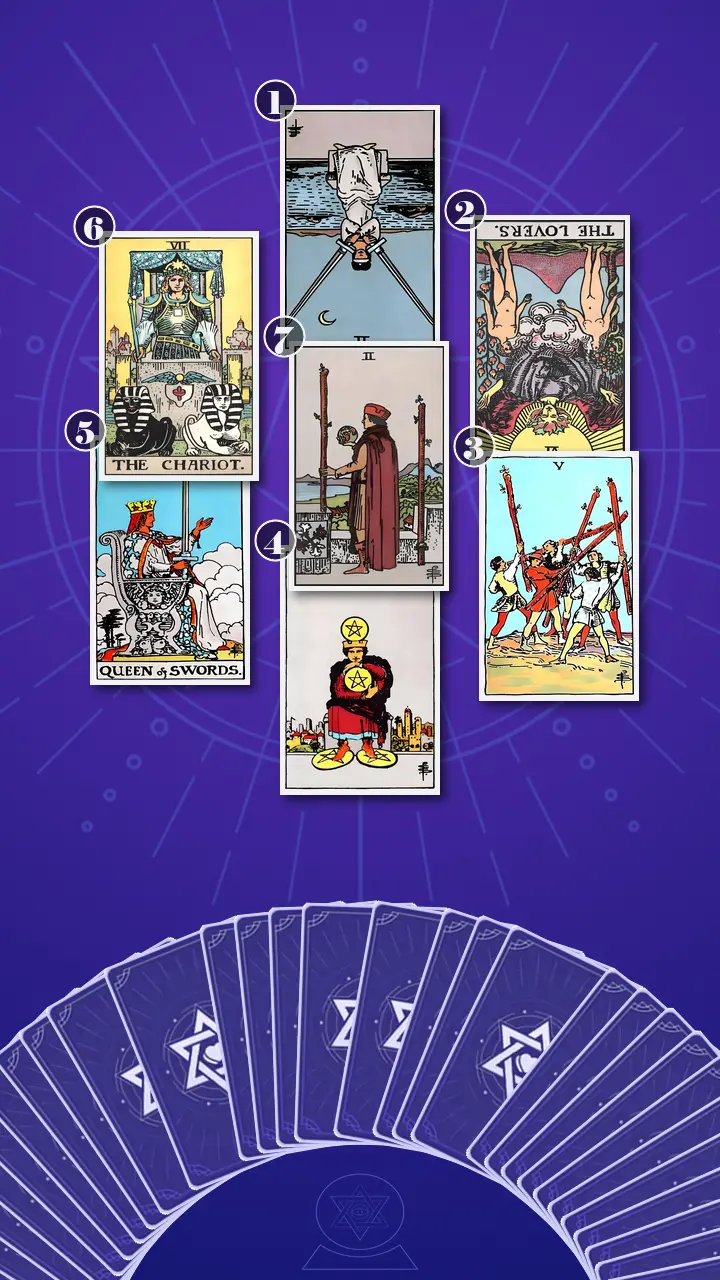
I chose my Energy Diagnostic Map (7) · Context Edition. When someone feels stuck between parents and partner, or starts googling things like tarot for lease renewal decision, how to tell parents I’m not moving home, or why does one housing decision feel like an identity crisis, a yes-or-no spread is too flat. This is not really a question of “Which option wins?” It is a question of what repeating emotional system keeps turning one practical choice into a loyalty test.
That is how tarot works best in my hands: not as prediction, but as card meanings in context. This seven-card map lets me trace the visible symptom, the inner tug-of-war, the outside pressure, the core blockage, the available resource, the key transformation, and the next actionable step. I told Maya I was especially watching the first card for the freeze-response around the lease, the fourth for the safety strategy underneath it, and the sixth for the bridge that could shift her from decision fatigue into real, self-directed clarity.
Reading the Tightening Half of the Wheel
Position 1: The Tab That Keeps Reopening
Now turned over was the card representing the presenting problem: the visible freeze-response around the lease deadline and the habit of delaying clear replies. It was the Two of Swords, reversed.
In modern life, this is the exact moment Maya opens the lease PDF for the fourth time after work, types half a text to her mum, deletes it, and jumps to apartment listings as if one more tab will somehow remove the emotional cost of one clear sentence. The slipped blindfold on the card told me she was not truly lacking information. She already sensed more than she wanted to admit. This was blocked Air tipping into overload.
I explained that reversed, this card often shows the moment a stalemate can no longer pretend to be neutral. Silence stops feeling restful and starts feeling expensive. “Keeping it open is still a choice your body has to carry,” I said gently. “The loop keeps calling itself research, but your jaw and stomach already know it’s not.”
She gave a short laugh, dry and a little bitter. “That feels accurate to the point of being rude,” she said. Her fingers tapped twice against her mug, then went still. I nodded. The first card had done its job: it named the freeze without shaming it.
Position 2: Fleabag-at-Dinner, Different Self in Each Room
The next card was the one representing the inner split driving the issue. It was The Lovers, reversed.
This card did not speak to romance alone. It spoke to alignment, values, and the cost of editing oneself to preserve attachment. In Maya’s life, I saw the split-screen instantly: on FaceTime with her parents, she says she is “still thinking about what makes the most sense”; at dinner with her partner, she says she is “just trying to be practical.” Same issue. Slightly different self. Very Fleabag-at-dinner energy—outwardly composed, inwardly split, hyper-aware of what everybody might read into one sentence.
Reversed, the energy here is not a lack of love. It is misalignment. Too much of her attention goes toward harmony, not enough toward truth. The mountain between the figures on the card felt like the invisible ridge between two attachment bonds. “This,” I told her, “is where the housing question becomes a relationship poll instead of a life choice. You keep asking how to soften the impact on each side, but not what kind of life you are actually trying to build.”
Her shoulders rose toward her ears, then dropped a fraction. She looked away from the cards and out toward the wet light beyond my window. “I think I’ve been editing myself for both rooms,” she said quietly. And there it was: the loop beneath the loop.
Position 3: Too Many Voices, No Inner Center
The third card represented the outside pressures keeping the pattern alive. It was the Five of Wands, upright.
I always read this card as noise with elbows. In Maya’s world, it looked painfully familiar: one week where her dad sends mortgage math, her mum talks savings and stability, her partner sends apartment links, and friends offer five incompatible takes over drinks. None of those voices is absurd. That is the trouble. Each one carries enough logic to keep her listening. Together, though, they create heat, not center.
This is Fire in excess—activation without coordinated movement. I told her that once the nervous system stops distinguishing input from pressure, even a normal text can land like an emergency alert. The phone feels heavy. The chest goes buzzy. Lists get longer, not sharper. Outside, a bus hissed through wet pavement at the exact moment I said, “Not every voice in the room gets equal voting power in your body.” The room felt briefly quieter after that, as if the environment itself agreed.
She nodded slowly. “That’s exactly it,” she said. “I keep talking to more people, and somehow I know less.”
Position 4: The Grip That Calls Itself Being Careful
The fourth card exposed the underlying fear and security strategy maintaining the loop. It was the Four of Pentacles, upright.
This card always changes the texture of a reading. A coin pressed to the chest. Feet pinned in place. A city behind him that he will not fully enter or leave. In modern life, it is Maya keeping the possibility of moving home alive, keeping her partner hopeful that she is still leaning toward staying, and keeping the lease unresolved because committing to one version of home feels more dangerous than carrying ongoing tension. This is compressed Earth: safety sought through gripping.
“Where are you calling it being careful,” I asked her, “when it is really fear of locking in one direction and disappointing someone?” Her body answered before her mouth did. First, the breath caught. Then her fingers tightened against the edge of the sofa. Then her gaze drifted—not avoiding me, exactly, but replaying memory. When she finally spoke, her voice came from deep in the chest. “Everywhere,” she said. “I keep one foot in Toronto and one foot in home so I don’t have to lose either.”
I leaned toward the card. “That is the heart of the blockage. You are mistaking standing still for staying safe. But the delay is not neutral. It’s simply making the tension more expensive.” She let out one long exhale—the kind that says the body has recognized itself before the mind fully catches up.
Position 5: The Sentence Your Notes App Has Been Trying to Write
The fifth card showed the inner resource already available to her. It was the Queen of Swords, upright.
After the crowd-noise of the previous cards, this queen felt like a window opening. In modern life, she is the part of Maya that can open Notes and write one clean sentence: “What works for me is staying in Toronto through the summer,” or, “What works for me is moving home with a defined plan.” No twelve-paragraph apology. No cushioning so elaborate that the meaning disappears. Just one accurate truth delivered with care. This is balanced Air: clarity, honesty, and boundary without cruelty.
Whenever the Queen of Swords appears, my mind flashes back to late winter in the Highlands where I grew up. We pruned old apple trees before spring, not because we wished them harm, but because too much tangled growth would choke the fruit. I have carried that lesson into every reading I do. “Clarity is not cruelty,” I said aloud.
Something shifted visibly in Maya’s face. Her jaw unclenched almost all at once. She rubbed her palms down the front of her jeans and gave a small, disbelieving smile. “So I don’t need the perfect explanation?” she asked. “No,” I told her. “You need the truest sentence you can stand behind.”
When The Chariot Took the Wheel
Position 6: The Route You Can Own
By the time I reached the sixth card, the radiator had gone quiet. This was the key transformation—the bridge card, the one that interrupts the whole pattern. It was The Chariot, upright.
In modern life, this is the moment Maya stops waiting for conversations to manufacture a decision and instead lets a real decision change the conversations. Parents on one side. Partner on the other. Two legitimate pulls, yes—but they do not both get to drive. This is purposeful movement: self-direction, emotional steadiness, and the courage to move while conflicting feelings still exist. The goal is not universal approval. The goal is a route you can own.
I asked her to picture that Tuesday-night sofa again: lease PDF open, family chat buzzing, partner waiting, radiator clicking, jaw tight. Nothing dramatic had happened, yet the deadline was now close enough that silence felt louder than speech.
“The loop is not ‘I can’t decide,’” I said. “The loop is ‘I keep turning choice into proof of love.’”
You do not need the black and white sphinxes to agree before you move; take the reins, choose your route, and let direction replace the freeze.
The Old Family Bargain Beneath the Lease
She went still in three clear waves. First came the physiological freeze: her breathing paused and her thumb stopped against the rim of her mug. Then came cognitive seepage: her eyes lost focus, not from checking out, but from replaying something inwardly—the TTC text from her mother, her partner’s message underneath, the old pressure to phrase everything so nobody would feel left behind. Then came the emotional turn, and it was not immediate relief. It was irritation, almost anger. “But doesn’t that mean I’ve been letting everyone else steer?” she asked. “Doesn’t that mean I’ve been doing this wrong?”
This was the exact moment I brought in one of the lenses I am known for: what I call Generational Pattern Reading. “Not wrong,” I told her. “Inherited.” I explained that in some families, love gets translated into proximity, return, availability, being the one who comes back when life gets expensive or uncertain. That family script can be deeply caring and deeply binding at the same time. It teaches the nervous system that choosing your own route may be interpreted as rejection. “That is an old bargain,” I said. “It may belong to your family weather, but it does not have to become your climate.”
Her eyes filled then—not with collapse, but with recognition. Her shoulders dropped. The grip in her mouth softened. And with the release came that very human wobble I often see at real turning points: the small dizziness of realizing the wheel is back in your own hands. “Okay,” she whispered after a long breath. “That’s different.”
“Now,” I said, “with that new lens, think about last week. Was there a moment when this would have changed how you felt?” She nodded slowly. “On the subway,” she said. “I read my mum’s text, then my partner’s, and I felt twelve years old and thirty at the same time. If I’d had this framing, I think I would’ve known I wasn’t choosing who I loved. I was avoiding being seen choosing myself.”
That was the real crossing: from pressure-driven, guilt-heavy consensus-seeking to self-directed clarity and calmer ownership of the next move.
The View After the Turn
Position 7: From Split Attention to Chosen Horizon
The final card translated that shift into a grounded next step for the week ahead. It was the Two of Wands, upright.
I loved the symmetry immediately. The reading had opened with a Two that trapped her between people; it closed with a Two that let her stand between possibilities with agency. In modern life, this is a Saturday morning with one page only: ‘Stay in Toronto’ and ‘Move Home,’ compared against budget, commute, relationship impact, daily routine, and emotional reality. Not imagined reactions. Real scenarios. This is balanced Fire—planning that points toward a horizon instead of another spiral.
I told her that this card does not ask for a five-year guarantee. It asks for one chosen line of sight. The figure in the image holds a globe, not a crystal ball. Ownership, not certainty. She sat a little straighter when I said that, as if her spine had finally been given a better job than bracing.
From Pressure Loop to Driver’s Seat
When I looked at the full circle of cards, the structure was beautifully blunt. The top and right side showed the tightening loop: visible freeze, divided loyalty, outside noise, defensive grip. The left side revealed the exit corridor: clarity, self-direction, planning. Why had Maya become so stuck? Because she was trying to solve belonging with logistics. The deepest blind spot was not that she lacked data. It was that she kept treating delayed pain as reduced pain, and a housing choice as proof of loyalty. The transformation direction was simpler, cleaner, and harder: choose home from values, logistics, and emotional truth—not as evidence that nobody will be disappointed.
I told her she did not need a dramatic reinvention. She needed a small, adult boundary she could repeat. Then I gave her three grounded next steps.
- Write the one clean sentence Open Notes tonight and finish this line in under 20 words: ‘What works for me is...’ Read it out loud twice before you text or call anyone. If your mind says you need a full courtroom brief first, that is the loop talking. I sometimes use my 3-minute family energy check here: look at a houseplant and ask whether it needs more watering or simply better space. More words are not always better care.
- Book a 24-hour driver’s-seat window Choose one 24-hour block this week, put it in your calendar like a real appointment, and text both your parents and your partner: ‘I’m sorting this out by Thursday night and I’ll share a clear update after that.’ For those 24 hours, do not take new opinions unless they change budget, timing, or housing logistics in a concrete way. A timeline is not an attack. It is a container.
- Make the two-scenario home map On one page only, create two columns: ‘Stay in Toronto’ and ‘Move Home.’ Under each, list budget, commute, relationship impact, daily routine, support system, and emotional reality. Then circle the option that fits your values better, not the option most likely to produce the least immediate disappointment. Set a 20-minute timer so it does not turn into a giant spreadsheet that delays the choice again. Messy but honest is already enough.
Those were her next steps: one honest preference, one clear boundary, one practical map. Small enough to do this week. Strong enough to interrupt the loop.

A Week Later, the Quiet Proof
A week later, Maya sent me a message shorter than any of the drafts that had been haunting her. “I did the 24-hour window,” she wrote. “I sent the sentence: What works for me is staying in Toronto through this lease cycle while I plan from there. My mum was sad. My partner was relieved. Nobody became the villain. I was shaky for an hour, and then I felt... calmer.”
Later, she told me she sat alone in a café after sending it, hands wrapped around a latte gone lukewarm, the folded one-page map beside her. Not euphoric. Not wrecked. Just strangely quiet—the bittersweet kind of steady that arrives when you stop waiting for the next notification to tell you who you are.
When I think back on that reading, I do not remember a perfect ending. I remember an adulthood threshold. She stopped asking the bonds in her life to approve the route before she would name it. She let grief exist without turning it into self-erasure. That, to me, is a real Journey to Clarity.
There is a specific kind of ache in trying to keep both sides close while your jaw locks, your stomach drops, and the word home starts sounding like a test you could fail. If tonight you find yourself in that same three-tabs-open pause—parents on one side, partner on the other, your own voice somewhere in the middle—remember this: you can disappoint someone without abandoning yourself.
If this stopped being proof of who you love more and became one honest steering move, what would your next true sentence sound like?