Proctoring Pop-Up Choice Paralysis: Pick a Lane, Then Prep for Test Day

The Proctoring Pop-Up That Feels Like a Verdict
You open five tabs about proctoring rules and privacy policies, then close your laptop like you accomplished something (hello, analysis paralysis).
Jordan (name changed for privacy) sat across from me in my tiny studio office—Toronto gray light in the window, streetcar bell somewhere down the block—holding their phone like it was still warm from the same loop. They were 22, juggling coursework and a part-time shift schedule, the kind of person who can genuinely study fine… right up until the screen forces a choice.
They described it with the precision of someone who’s watched themself do it too many times: “It’s Tuesday, like 8:47. I sit down at my kitchen table to just handle admin. I open Quercus, the exam portal loads, and then—bang—the proctoring pop-up blocks the whole screen. Online or On campus. I hover over both buttons. The laptop fan gets loud. The blue light makes everything look… mean. And I can feel my jaw clamp, like I’m bracing for impact.”
They weren’t crying. They weren’t panicking in an obvious way. It was subtler than that—like uncertainty had taken physical form as a tight chest and a clenched hinge in the jaw, the kind of tension that makes you scroll with one finger while the rest of your hand grips the phone. A low-level adrenaline buzz, like your body’s already on test day even when it’s just a pop-up.
Jordan let out a breath that sounded almost annoyed with themself. “Why does this feel like I’m being graded just for choosing a format? I’m not scared of the exam, I’m scared of the setup going sideways.”
I nodded, slow and plain. “That makes sense. When the choice is forced and the stakes feel personal, your nervous system treats the click like a cliff.” I leaned in, palms open on the table between us. “Let’s make this practical. We’re not here to predict a perfect outcome—we’re here to find clarity and a next step that puts you back in the driver’s seat.”

Choosing the Compass: The Decision Cross Tarot Spread
I asked Jordan to take one breath in through the nose and out through the mouth—not as a ritual, just as a reset. Then I shuffled slowly, the same way I used to slow my own heartbeat before a high-stakes meeting back when I worked on Wall Street: not mystical, just deliberate focus.
“For this,” I said, “we’ll use a Decision Cross—a five-card tarot spread built for a forced two-option moment like ‘online vs on campus.’”
For anyone reading who’s wondered how tarot works in real life: spreads like this don’t magically choose for you. They structure your attention. The Decision Cross holds the binary choice cleanly (Path A and Path B), but it also does two things most spirals don’t: it names the hidden driver behind the freeze, and it ends with guidance you can execute immediately.
“Card 1,” I told Jordan, “shows the exact stuck point—what the pop-up triggers in the first sixty seconds. Card 4 is the one people don’t expect: what’s really inflating this choice under the surface. And Card 5 is the best next step—how to move forward in a way that restores agency, even if you can’t eliminate every risk.”
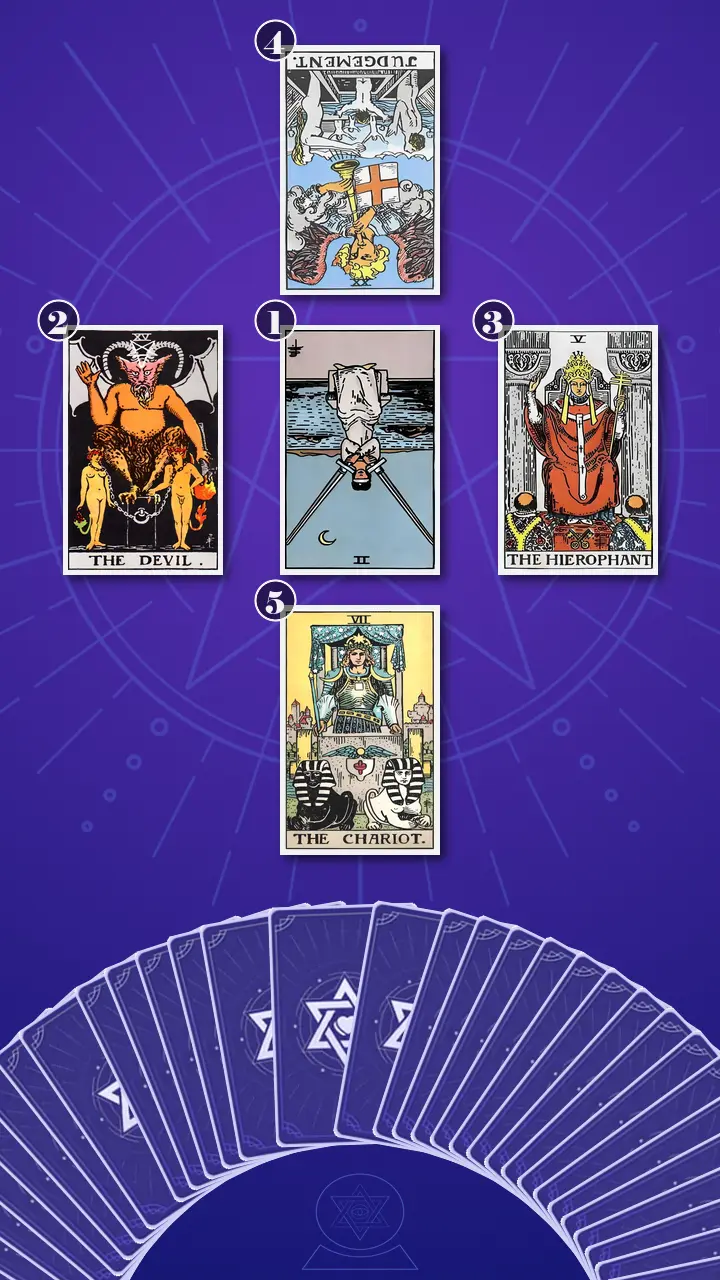
Reading the Map: Online vs On-Campus Proctoring in Context
The Center of the Cross: The Freeze Response
“Now flipped over,” I said, “is the card that represents the immediate decision tension—how the forced pop-up choice is showing up in your behavior and attention.”
Two of Swords, in reversed position.
I didn’t over-spiritualize it. I just pointed to what was obvious: a blindfold, arms crossed tight, swords held like tension made visible. “This is the exact posture of hovering over both buttons. You’re on the exam portal at night, the proctoring pop-up is blocking everything, and you keep toggling between ‘Online’ and ‘On campus’ without clicking confirm. You open tabs for privacy policies, minimum system requirements, campus testing rules, and a Reddit thread—then you close them all because none of it delivers certainty.”
I let the words land, then mirrored the split-screen I could feel in them: “On one side: the pop-up. On the other: the tab spiral. The inner monologue goes short and clipped—Just one more check. Just in case. Don’t mess this up. Your studying can be calm, almost still-water calm. But this choice triggers the adrenaline buzz.”
Jordan gave a small, bitter laugh—more air than sound. “Okay. That’s… too accurate. Even the ‘just one more check’ part.”
“You’re not avoiding the exam—you’re avoiding the moment your choice becomes real,” I said gently. “And that’s not a character flaw. It’s a holding pattern. The energy here is blocked: too much thinking trying to do the job of choosing.”
Path A (Online): Convenience With Invisible Strings
“Now flipped over,” I said, “is the card that represents Option A—Online: what this choice would feel like in practice, including the main tradeoff you’re reacting to: control, privacy, convenience.”
The Devil, in upright position.
Jordan’s eyes flicked to the card and then away, like they already knew where it was going.
“Choosing online feels like relief for five seconds—no commute, no testing center—until the surveillance vibe hits,” I said. “Room scan. Webcam framing. Permission prompts. The fear of being falsely flagged for normal movements. You start pre-performing calmness for the software: controlling where your eyes go, how you sit, whether you move.”
I tapped the image’s loose chains. “This is key: the chains aren’t welded. That’s what makes it psychologically messy. The energy is excess control—not because you’re controlling the system, but because you start trying to control yourself inside it. It’s like accepting app permissions on autopilot and then feeling gross when you remember what you agreed to.”
Jordan swallowed. Their shoulders rose a millimeter, then dropped. “I literally practiced ‘how to exist’ on camera,” they admitted. “Like… sitting still. It’s embarrassing.”
“Not embarrassing,” I corrected softly. “Logical. Your brain is trying to reduce the chance of being misunderstood by a system.”
Path B (On Campus): Structure That Can Soothe—or Tighten
“Now flipped over,” I said, “is the card that represents Option B—On campus: what this choice would feel like in practice, including the tradeoff: structure, logistics, pressure.”
The Hierophant, in upright position.
“This is the official container,” I said. “Set time. Set place. Set rules. Fewer unknowns, more formality.”
I described it the way Jordan had described the TTC: “It’s Thursday morning, you’re tapping PRESTO, fluorescent lights buzzing. You’re already tracking time. You picture the testing center sign-in, the quiet, the rule-bound room. That structure can be stabilizing because the environment is designed for assessment.”
Then I added the part they didn’t want to say out loud: “But the energy can also become excess pressure if you interpret formality as judgment. Human-visible instead of software-visible.”
Jordan pressed their tongue to the back of their teeth, a tiny tell. “It’s like… the room itself is watching,” they said. “Even if no one’s doing anything.”
“Exactly,” I replied. “Online is ‘watched by software.’ Campus is ‘watched by structure.’ Different nervous-system costs.”
The Hidden Driver: When a Notification Lands Like a Summons
“Now flipped over,” I said, “is the card that represents the hidden driver—the deeper fear that’s making this decision feel higher-stakes than it objectively is.”
Judgement, in reversed position.
I felt the room go quieter, like the radiator had decided to stop clicking just to listen.
“Here’s the pivot,” I said. “In the old Rider-Waite image, it’s a trumpet—a call. In 2026 Toronto student life, that trumpet is a notification: the pop-up. And your nervous system isn’t hearing it as ‘choose a format.’ It’s hearing it as ‘prove you’re competent.’”
I kept it simple and surgical: “Under the debate about online vs campus, there’s a quieter fear—that whichever format you choose will prove something about you. Online becomes ‘careless if anything glitches.’ Campus becomes ‘weak if I need structure.’ You replay imaginary scenes of being questioned or judged, and you delay the click so you don’t have to face that imagined evaluation.”
Jordan’s face did a three-beat reaction chain I’ve learned to respect: first, a tiny freeze (their breathing paused); second, their gaze unfocused like they were replaying an old thread of shame; third, a long exhale that softened their shoulders.
“I hate that that’s true,” they said quietly. “Like if I choose wrong, I’ll blame myself the whole time.”
I nodded. “This isn’t an intelligence problem. It’s an agency problem.”
Then I gave them the line that tends to loosen the knot: “A testing format is a setup choice, not a personality test.”
The Bridge Card: Taking the Reins
“Now flipped over,” I said, “is the card that represents best next step—how to make and execute a decision in a way that restores agency and reduces spiraling.”
The Chariot, in upright position.
The instant it appeared, something in Jordan’s posture changed—not relaxed exactly, but more upright, like their body recognized the concept of forward motion.
The Charioteer’s armor, the reins, the two sphinxes pulling opposite directions. “This is you with two loud voices,” I said. “One says convenience. One says structure. The goal isn’t to silence them. It’s to steer.”
In my head, I flashed back to Oxford case studies and trading-floor checklists—how panic shrinks when you turn it into a plan with inputs you can actually control. Not because risk disappears, but because you stop negotiating with it at 2 a.m. in your own skull.
When the Click Becomes Real
Setup: It’s Tuesday night, you’re staring at the pop-up like it’s a fork in the road with a countdown timer, and your body is tense even though you know the material. Your mind keeps trying to buy safety by imagining every failure scenario—tech failure vs logistics and pressure—until choosing feels unsafe.
Delivery:
Stop waiting for certainty; take the reins, choose the lane, and let The Chariot turn a stressful fork into forward motion.
I let it hang in the air for a second, the way you let a final number settle before you decide whether to take the trade.
Reinforcement: Jordan’s reaction wasn’t a movie-moment smile. It was messier—and more real. Their hands, which had been clenched around their phone, loosened one finger at a time. Their jaw shifted like it had been locked for hours. Their eyes went glassy, not with tears exactly, but with that stunned recognition of, Oh. I’ve been trying to do the impossible. They inhaled, then laughed once—small, shaky, almost annoyed—because relief can sound like disbelief when you’re used to bracing.
“I keep trying to find the one format where nothing can go wrong,” they said. “But that’s… not a thing.”
“Exactly,” I replied. “You don’t need a perfect format—you need the driver’s seat. And ‘in charge’ doesn’t mean you feel calm. It means you’re directed.”
Then I brought in one of my own tools—the thing that makes my readings feel less like vibes and more like decision architecture. “I want to use my 5-Minute Decision Tool here—three axes: Advantage, Risk, Breakthrough. Not to overthink. To stop the overthinking.”
I drew three quick columns on paper. “Online: advantage—no commute. Risk—surveillance discomfort and tech variables. Breakthrough—if we can build a consent-and-control setup, you stop performing for the camera.” I did the same for campus: “Advantage—standardized container. Risk—logistics load and visibility pressure. Breakthrough—arrive early and let structure calm you instead of judge you.”
Jordan watched the pen move like it was the first time the decision had edges instead of fog.
“Now,” I asked, “using this new lens—can you think of one moment last week where you were about to open another Reddit thread, and this would’ve changed how you felt?”
They stared at the table, then nodded once. “Sunday night. I was in bed, doomscrolling proctoring horror stories. If I’d told myself, ‘I’m not choosing to be un-blameable, I’m choosing to protect my focus’… I think I would’ve slept.”
That’s the shift right there: from evaluation-driven analysis paralysis to agency-based commitment and steadier confidence through follow-through. Not magic. A move.
The Driver’s Seat Plan: Actionable Advice for a Stressful Fork
I stitched the spread together for Jordan the way I’d stitch together a case narrative in finance—clean cause-and-effect, no shame.
“Here’s the story,” I said. “Two of Swords reversed shows the freeze: your brain trying to hold both options until certainty arrives. The Devil and The Hierophant show two different rule-worlds: online feels like surveillance and misinterpretation risk; campus feels like structure and visible evaluation. Judgement reversed is the real fuel—fear of a verdict, fear that the ‘wrong’ choice proves you aren’t competent or in control. And The Chariot resolves it: you choose a lane and you plan the controllables. More tabs won’t give you certainty—only a plan will.”
“Your blind spot,” I added, “is thinking the decision itself must remove stress. But the transformation is different: choose the format that best supports focus, then control what you can with a concrete prep plan. That’s how you get traction.”
- The Two-Nonnegotiables Rule (7 minutes)Open the exam portal once. Set a 7-minute timer. Write 3 test-day nonnegotiables (examples: stable internet, minimal commute, privacy comfort, quiet space). Choose the format that meets at least 2 of the 3—no extra research during the timer.If your chest gets tight, shorten it to 3 minutes. You’re not picking “best.” You’re picking “workable.”
- The 24-Hour Click (commit, then close)When the timer ends, book/confirm the chosen option immediately. Then close the portal—one clean ending. If you truly need clarification, draft one clear question and send it once (no follow-up spiral unless a new fact appears).Treat the urge to reopen tabs like a reflex, not a command. Label it: “my brain wants guaranteed safety.”
- The 3-Item Driver’s Seat ChecklistMake a checklist with only 3 items for your chosen format. Online example: Wi‑Fi check, ID ready, desk cleared. Campus example: transit route saved, arrive 20 minutes early, water/snack plan.Keep it in a pinned Apple Notes note. If you add a fourth item, you have to delete one—anti-burnout by design.

A Week Later: Ownership, Not Certainty
Six days later, Jordan messaged me a screenshot: the portal, the choice made, the booking confirmed. Under it: “I did the 7-minute timer. Picked campus. Booked it. Closed the portal. Felt nauseous for five minutes. Then… weirdly lighter.”
They told me they went to a café afterward and sat alone with their coffee for an hour—no celebration, no victory speech—just the quiet proof of having moved. The next morning, their first thought was still, What if this is wrong? They said they smiled anyway, because the plan was there, pinned, and real.
That’s the Journey to Clarity I trust: not certainty, but ownership. A choice made from priorities, followed by follow-through that builds steadier confidence.
When a simple pop-up makes your chest go tight, it’s not because you’re incapable—it’s because you’re trying to choose in a way that guarantees you’ll never have to regret or explain yourself.
If you stopped trying to prove you can’t be blamed, what would the ‘driver’s seat’ version of your next click look like—just for today?