

The Moon Tarot Card Meaning
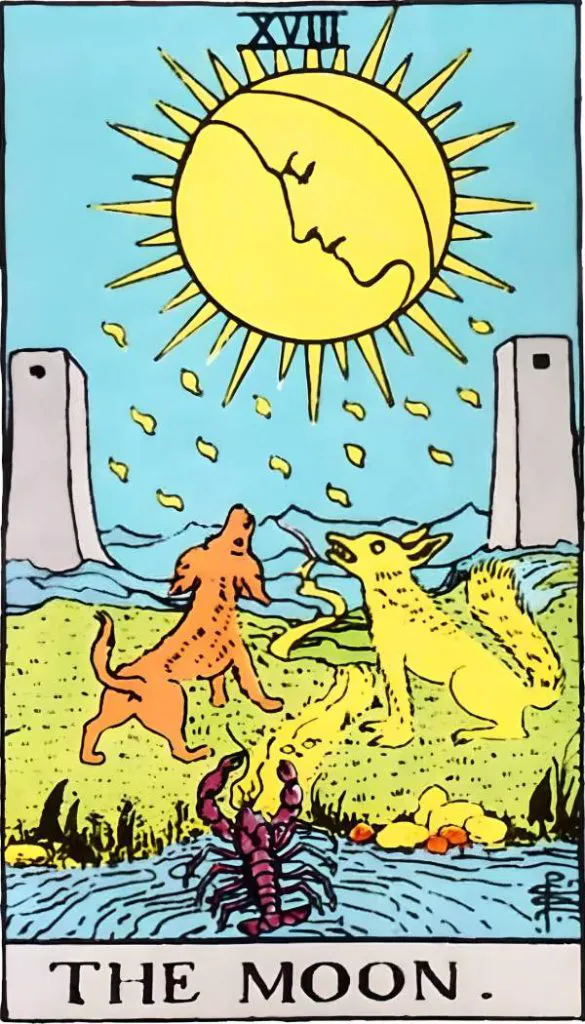
The Moon card conveys the atmosphere of a dimly lit night, filled with an eerie and frightening aura. The moon appears in the dark sky, radiating light and casting dew. The scene on the ground is complex, with a path leading from the water's edge to a gap between two towers. On the land, two animals are howling at the moon, and a crayfish emerges from the water's surface.
The moon hangs high in the night sky, centrally positioned, with a detailed facial expression within its circular shape. The moon's appearance is divided into two parts within the circle, with the crescent-shaped face on the right looking downwards to the left. A thin crescent is added to the far right, resembling hair. The entire moon is of a yellow hue, with the non-facial part being darker, and the illuminated part is on the visible face. The human-like face shows a solemn expression with closed eyes and pursed lips, looking downwards. We can also perceive its compassion, as this face represents the compassionate aspect of the moon, situated above the two towers on the right side, which symbolize mercy.
This depiction of the moon is a common representation, not only found in many tarot decks but also in common illustrations of the moon. The portrayal of the moon's face within a full circle, combining the crescent and the full moon, is an intentional expression of the moon's phases and fluctuations, symbolizing the three aspects of femininity. It also implies that the moon does not emit its own light, unlike stars and the sun.
Outside the moon's disc, there are rays similar to the sun, with two uneven rows. The number of rays is primarily sixteen, with each row having sixteen. The moon's circumference is connected to the spiky rays, totaling sixteen longer primary rays and sixteen shorter secondary rays, making thirty-two rays of varying lengths. This expresses the significance of the number sixteen and its multiples.
Sixteen is the number of court cards in tarot, linking various character images and elemental changes. The number 16 itself is also a mystical number for the moon, as it equals two times eight, or 'two eights,' which is the moon's 'twenty-eight' day cycle. This cycle is also the moon's 28 constellations. Twenty-eight can be transformed into 4 times 7 equals 28, representing a month's four weeks, thus linking the Moon card to the week. Two 'two times eights' can be considered double 28, which is fifty-six, the great cycle of the moon—fifty-six years for the moon to meet the sun at the same point. Of course, 56 is also the total number of minor arcana cards in tarot, and the number of rays connects the major arcana Moon card to the minor arcana.
The two rows of rays actually total thirty-two, half of 56 but representing the minor arcana. This mysterious arrangement creates a connection between the arcana and the 'Kabbalah.' The number thirty-two is also the number of paths on the Tree of Life in Kabbalah, with ten spheres (Sephiroth) and twenty-two channels, totaling thirty-two elemental paths. Thirty-two also represents detailed directional indicators, as a compass has thirty-two directions.
Beneath the moon in the sky, yellow dewdrops are scattered, these droplet-shaped fifteen points are the moon's rays and the night's dew, combined to form yellow-rayed points. This night dew is like tears from the moon, referred to as 'tears of pearl' or the tears of the goddess Isis, nourishing the earth. A closer look at these fifteen points reveals the shape of the Hebrew letter Yod, the finger of God. This indicates that these are not ordinary droplets but a mystical force. These points also serve to connect the moon with the ground.
The number fifteen also holds significance. Naturally, this number is closely related to the moon itself, as the moon's movement causes the phases to change every fifteen days. The fifteen points tell us that all aspects of the moon are contained within them. From a further perspective, the number of droplets from the moon, one less than the number of moon rays (sixteen), indicates the presence of a hidden factor, suggesting the meaning of these fifteen points.
The theme of fifteen has always been associated with religious legends related to the Virgin Mary and the Passion of Christ, and the connection to sixteen is even more significant. This set of numbers is related to the Virgin Mary and the Passion of Christ, often depicted with fifteen rose petals surrounding the Virgin Mary, representing the fifteen joys and sorrows in the life of Mary and Jesus Christ. These experiences are the themes of (MYSTERY), and many European literary, musical, and artistic works have been based on this theme, often presented in sets of fifteen continuous works, representing the three stages of joy, suffering, and glory in the lives of the Virgin Mary and Jesus Christ, culminating in glory or angelic protection after suffering.
In the foreground, there is a body of water, with the shore being land, and the distant view consists of rugged hills, with the two towers forming a gateway. The ground includes both land and water, representing the dual nature of the moon. This body of water is the river of the underworld. The land holds more wonders. The boundary between the land and the pool, right in the middle, is where a path begins, from the shore's center, leading to the realm of death. The winding path stretches long, traversing green fields, mountains, and into the gap between the two towers, extending to the horizon, the unknown territory. This shore is the critical line between water and land, with an undulating meeting point; part of this path is submerged by the current seawater, suggesting it may be even longer, potentially leading to the abyss of the depths.
A crab or a freshwater crayfish emerges from the water. The crayfish is a symbol of Cancer, and in ancient times, the animal of Cancer was indeed this type of crustacean. It pokes its head out of the water, about to climb onto the shore, touching the vertical path by the central shore. At this moment, the crayfish is on the shore and right at the beginning of the path, seemingly coincidental or precise, yet it is just following its natural habit. It moves from the unseen abyss to the visible land, heading towards the land, as if to continue along this path, but perhaps it will sink back.
This path leads to the distance, and if the crayfish climbs up from here and walks on this path, it must endure a painful period to reach the far unknown. Especially since it must pass through the guard of other animals along the way. The journey is full of unknown variables and is difficult to traverse. And this path is only illuminated and guided by the moon's reflected light, not very clear or bright.
On the land by the shore, there are two canine animals, usually dogs (other tarot decks may use two dogs). The two animals in the Waite Tarot's Moon card are similar yet different; the one on the left with drooping ears and a reddish color is a dog, while the one on the right, yellow with erect and pointed ears, is a wolf. They guard the entrance to the Hall of Death, representing a change in the state of life, serving as a warning and guiding force.
These two canines are barking at the moon, representing a reaction to something, filled with feelings or fear, with their fur standing on end. It could be the moon's influence or the unease facing the unknown territory between the two towers, where some message might be revealed, causing primal fear to arise.
The two towers in the card are similar to the towers in the 'Death' card, representing death and the unknown, as well as an area that is difficult to explore. Behind the two towers is a cold, low-lying hill, symbolizing isolation and desolation. The night sky is a dark blue tone, adding to the feeling of loneliness and desolation. Even though the moon in the sky is bright, the unknown territory remains mysterious, creating a great contrast and tension.
The Moon
The primary symbol representing the subconscious, the realm of dreams, intuition, and the ebb and flow of emotions. It sheds a mysterious and fluctuating light on our path, highlighting that not everything is as it seems.
Two Towers
Guarding the distant horizon, they symbolize the boundaries between the conscious and the unconscious. They can also be viewed as dualistic elements present in life: good and evil, male and female, light and shadow.
The Path
The winding path signifies the soul’s journey, representing the complex route we must traverse, filled with illusions and ambiguities, as we navigate life’s challenges and uncertainties.
The Dog and Wolf
These animals symbolize the tamed and wild aspects of our minds. The dog represents the domesticated, familiar parts of our nature, while the wolf embodies the wild, primal, and untamed.
The Pool
The pool at the base of the card represents the subconscious mind, where memories, instincts, and deeply rooted emotions reside.
Fifteen Yods
The drops falling from the Moon, resembling tears, are fifteen in number and reference the Hebrew letter Yod. They symbolize the spiritual gifts or energies descending upon the Earth and also hint at the mysteries of the subconscious.
Crayfish or Lobster
Emerging from the pool, this creature signifies the early stages of consciousness unfolding. Its presence reminds us of the primal feelings and instincts arising from our deepest self.

DNA Match Contact Limbo: From Drafting and Deleting to Self-Trust

Belonging Is Not a Tone Check: How to Adapt Without Erasing Yourself

Three Slack Drafts Before 8:47 a.m.: Keeping One Point at Work

The Ten-Minute Compatibility Verdict Meets One More Conversation

She Reopened the Chat Until a 24-Hour Pause Changed the Question
