Post-Apology Silence Isn't a Verdict: Naming Shame and Setting One Boundary

Finding Clarity in the “Delivered” Check on the TTC
If you’ve ever stared at “Delivered” (or “Read”) for hours and started rewriting your apology in your Notes app like you’re doing crisis comms, you already know this loop.
Alex (name changed for privacy) came to me with that exact question: “They go silent after my apology—what old shame story is running me?”
She described 8:47 p.m. on a Wednesday, riding TTC Line 1 north. Her phone was warm in her palm, screen brightness turned down like she could dim the feeling too. She kept flicking Messages → Instagram → Messages again. The station announcement crackled, the overhead lights buzzed, and every time she saw her apology sitting there—untouched by a reply—her throat tightened like it was bracing for a grade.
I’ve heard this a thousand ways, and it still lands the same: shame-driven spiraling after apologizing when someone doesn’t reply (compulsive checking, mind-reading, and overexplaining). Wanting to repair the connection, while treating the silence like proof you’re fundamentally unworthy of belonging.
It’s a particular kind of pain—like standing outside a closed door with your hands full, trying to decide whether to knock again or disappear, because both options feel humiliating. I told her, gently, “Let’s make a map of what’s happening. Not to force an outcome—but to find clarity about your next step.”

Choosing the Compass: The Four-Layer Insight Ladder Tarot Spread
I asked Alex to take one slow breath with me—not as a ritual for luck, but as a way to shift from reaction to observation. I shuffled while she held the question in mind: not “Will they reply?” but “What story does their silence wake up in me, and what would repair look like without self-erasure?”
For this, I used my original method: the Four-Layer Insight Ladder · Context Edition—a Four-Layer Insight Ladder tarot spread for post-apology silence and shame spirals.
Here’s why this spread works (and how tarot works in moments like this): Alex wasn’t asking for a prediction. She was stuck inside an inner mechanics problem. A ladder structure is perfect when you need to separate: what you do on the surface, what you assume in the gap, what older wound gets touched, and what practical communication boundary can bring you back to self-trust.
I told her what we’d be looking at: the first card would show her surface pattern (what she does with her phone, her hands, her attention). Then we’d name the activated meaning (the story her mind assigns to silence). Then we’d touch the old shame root. And finally, we’d move into a clean next step and an integration practice—the part that makes change possible in the real world.
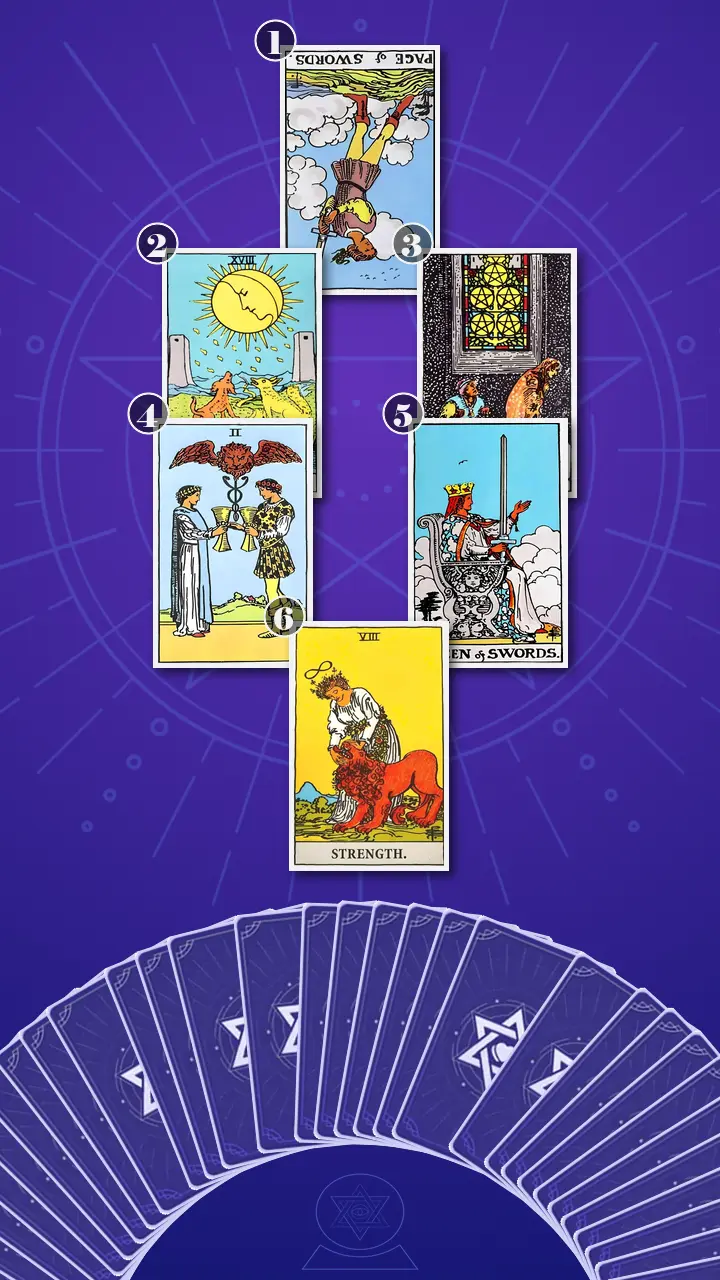
Reading the Map: When “No Reply Yet” Becomes a Whole Trial
Position 1: Surface pattern — what you do after you’ve apologized and they go silent
Now turning over is the card that represents your surface pattern: what you do (observable behaviors) after you’ve apologized and they go silent.
Page of Swords, reversed.
It landed like a screenshot of her commute: phone unlocked in her palm, refreshing the thread like it’s live news. Rereading her apology and tone-policing herself—comma by comma—then opening Notes to draft a “better” version. The Page is vigilance; reversed, it becomes surveillance. Not of them, exactly—but of yourself. Every word gets cross-examined.
Energetically, this is blockage: Air (mind, messaging, analysis) running too hot and too jittery to tell the truth from the fear. The checking feels like control. It’s actually a way to stay braced for impact.
I let it get very specific, because that’s where the spell breaks. “It’s like you’re rereading your apology like it’s a legal document,” I said, “trying to find the one line that will prove you’re a good person.”
Alex gave a short laugh—sharp and a little bitter. “That’s… awful,” she said. “Also, yeah. That’s exactly it. Like it’s rude how accurate that is.”
Position 2: Activated meaning — what their silence symbolizes to you in the moment
Now turning over is the card that represents your activated meaning: what their silence symbolizes to you in the moment.
The Moon, upright.
The Moon is what happens when there’s not enough information, and your nervous system tries to finish the story anyway. Alex sees “active 5 minutes ago” and her mind fills in the blanks: They’re ignoring me. They’re done. They’re telling someone else about how annoying I am. Her stomach drops as if she’s been rejected—despite the fact that all she actually has is ambiguity.
Energetically, this is excess: Water (emotion, intuition, imagination) overflowing into projection. The silence becomes a projector screen, and the worst-case story starts playing on loop.
I described it the way it shows up in real life—like a thriller montage: the blue glow of a screen in a dark bedroom, a thumb pulling down to refresh, rereading one line like it’s evidence. And then the inner monologue clicks in like an auto-generated script: “If they don’t reply, it means I made it worse. If it means I’m too much, then I have to fix it right now.”
I paused and gave her one of my plainest anchors: “Silence isn’t proof. It’s ambiguity—and ambiguity is where your old story gets loud.”
Her eyes dropped to the card. She stopped moving her phone in her hand, like she’d suddenly realized she’d been gripping it the whole time.
Position 3: Old shame root — the earlier belonging/worth story being replayed underneath
Now turning over is the card that represents your old shame root: the earlier belonging/worth story being replayed underneath.
Five of Pentacles, upright.
In the card, two figures move through snow while warm light shines behind stained glass. It’s not just “I’m uncomfortable.” It’s I’m outside. Support exists—but your shame says it’s not for you.
I translated it into her Toronto life: walking past a warm-lit café on Queen West, slush and salt underfoot, and thinking, “Everyone else gets warmth. I get iced out.” That same cold hits when her apology sits unanswered. The Five of Pentacles doesn’t whisper “They need time.” It shouts, “You’ve been exiled.”
Energetically, this is deficiency: Earth (belonging, stability, safety) feels scarce. So your system tries to earn warmth through labor—extra apologies, extra explaining, extra shrinking.
Alex’s mouth twisted into a smile that wasn’t happy. “It’s like… I didn’t just mess up,” she said quietly. “I got disqualified.”
I nodded. This is where my family’s way of reading always returns to the body and the seasons. In the Highlands, winter isn’t punishment—it’s the season where there’s less signal. Less warmth. Old survival instincts get louder. “Of course your nervous system calls this an emergency,” I told her. “It learned that quiet meant cold.”
Position 4: True intention — what your apology was genuinely trying to create
Now turning over is the card that represents your true intention: what your apology was genuinely trying to create or protect.
Two of Cups, upright.
This card is mutual recognition. Equal exchange. Repair as meeting in the middle.
I said, “Two of Cups is the part of you that wasn’t auditioning. You were reaching for respect. For closeness that doesn’t require you to beg.”
And then I named it clearly, because this is where a lot of people get stuck: “A clean apology is an invitation—not an audition for instant forgiveness.”
Alex inhaled like she’d been holding her breath since she hit send. “That’s what I wanted,” she said. “Not… this courtroom thing.”
Position 5: Clean next step — how to communicate with clarity and boundaries without chasing
Now turning over is the card that represents your clean next step: how to communicate (or not) with clarity and boundaries without chasing reassurance.
Queen of Swords, upright.
The Queen doesn’t perform. She speaks once, clearly, and then she stops feeding the spiral.
I framed it the way she’d actually use it: “This is you drafting one follow-up—two sentences max—no new apology, no essay, no ‘just to clarify.’ You send it or you don’t. And either way, you close the app. You stop being on-call for the response.”
Energetically, this is balance: Air matured. Precision over pleading. Truth over mind-reading.
I even gave her the line, because sometimes relief is having words you can stand behind: “Clarity is not chasing. It’s choosing one sentence you can stand behind.”
Alex nodded fast—like she was taking a mental screenshot. “I can do two sentences,” she said. “I can’t do… whatever I’ve been doing.”
When Strength Spoke: Holding the Lion Instead of Texting It
Position 6: Integration — the inner capacity to practice so you can tolerate uncertainty
The room got very still when I reached for the final card. This one isn’t about what to say. It’s about what you become while you wait.
Now turning over is the card that represents your integration: the inner capacity to practice so you can tolerate uncertainty and stay self-respecting.
Strength, upright.
Here was the setup, exactly as she’d lived it: that moment on the TTC when her apology is sitting there—delivered, maybe even read—and every time her screen lights up she feels her throat tighten like she’s about to be judged again.
Stop treating silence like a sentence—practice Strength by gently holding your inner lion until you can respond with self-respect.
I let the sentence hang there for a beat.
Alex’s reaction came in layers. First, her breathing froze—like her lungs forgot their job for half a second—and her thumb hovered over her phone without moving. Then her eyes unfocused, not on me, not on the card, but somewhere behind both of us, as if her brain was replaying every “no reply” gap it had ever mistaken for exile. Finally, she exhaled, long and shaky, and her shoulders dropped an inch like a coat sliding off.
“But… if I stop treating it like a sentence,” she said, and there was a flash of anger underneath the vulnerability, “doesn’t that mean I’ve been wrong this whole time? Like I’ve been making it all up?”
I didn’t rush to soothe her out of it. I honored it. “It means your system has been trying to protect you with an old script,” I said. “Not that you’re stupid. Not that you’re dramatic. It’s just a pattern.”
This is where I used my Relationship Pattern Recognition—not as a label, but as a lantern. “I see the recurring script,” I told her. “Apology → silence → ‘I’m unworthy’ → control attempt. The control attempt can look like overexplaining, or it can look like disappearing. Either way, it’s the same shame story running the show.”
I leaned closer to the table and softened my voice. “Strength is not ‘be chill.’ Strength is soothing intensity. The lion is that shame-panic. It’s loud, it’s physical—jaw tight, throat tight, hands restless. But it’s not a command you must obey.”
Then I asked her, exactly as I always do when the card hits home: “Now, with this new lens—can you think of one moment last week when the silence showed up, and this perspective could have changed how you felt?”
Alex swallowed. Her hand went to her chest without thinking. “Yesterday,” she said. “I saw they were active and I… I literally started drafting a fourth apology. Like—fourth. And I hated myself while doing it.”
“That’s the gap,” I said. “Not a trial. A gap. And you can practice being steady inside it.” In that moment, I could feel the emotional shift beginning: from shame-tight spiraling and reassurance-chasing to grounded self-compassion and self-respecting communication. Not perfect. But real.
The Repair-Without-Chasing Protocol: Next Steps You Can Actually Do
I pulled the whole ladder together for her, as a single story—because clarity comes from sequence, not from scattered advice.
The Page of Swords reversed showed how Alex’s hands and attention go into surveillance mode the minute uncertainty appears. The Moon showed how quickly ambiguity becomes a story factory—mind-reading the silence until it feels like proof. Five of Pentacles named the true root: an old belonging wound that translates “mistake” into “exile.” Two of Cups reminded us the apology’s real purpose was mutual respect, not self-erasure. Queen of Swords offered the practical pivot: one clean line, one calm boundary. And Strength anchored it all: soothe the inner alarm so you don’t text from panic.
The cognitive blind spot was simple and brutal: Alex had been treating response time like a verdict on her worth—like a KPI in a relationship performance review. That’s not attachment theory. That’s just modern life + an old shame story + a phone that never stops lighting up.
The transformation direction was equally simple: move from trying to earn reassurance through over-explaining to practicing self-trust through one clear repair attempt and a calm boundary.
Then I gave her a small, practical plan—nothing that required a personality transplant. Just next steps.
- The Two-Sentence QueenIf a follow-up is truly needed, write it in Notes first (not in the message thread). Two sentences max: “I meant what I said in my apology. I’m going to give you space, and I’m here to talk when you’re ready.”Expect your brain to call this “cold.” That’s the shame story shopping for certainty. Wait 10 minutes after drafting, then decide.
- The 24-Hour No-Double-Text BoundaryAfter you send the follow-up (or choose not to), close the app and set a 24-hour “no more messages” rule. Put a calendar reminder for tomorrow at the same time to reassess with a clear head.Clarity isn’t control; you’re not forcing a response, you’re protecting your side of the street.
- The Strength Reset (90 seconds)Before you check your phone again: inhale for 4, exhale for 6. Drop your shoulders. Unclench your jaw. Then name it: “This is shame-panic, not a verdict.”If 90 seconds feels impossible, do three slow exhales. This is practice, not punishment.
And because conflict repair is still about two humans, not just one nervous system, I offered one optional add-on from my own toolkit: a couple breathing sync exercise for when they do come back to talk. “If you end up having the conversation,” I said, “try two minutes of breathing together before words—four in, six out. It changes the whole temperature in the room. Not magic. Physiology.”
If you want to take it one notch further, you can even schedule the actual repair talk when you both have bandwidth—Alex laughed when I said “moon cycles,” so I translated it into what I mean in 2026: pick a night you’re not depleted, not mid-doomscroll, not between meetings. Put it on the calendar like it matters.

A Week Later: The Quiet Proof
A week later, Alex messaged me. Not a paragraph—two lines.
“I sent the two-sentence follow-up. Then I put my phone on Do Not Disturb for 24 hours. I felt like I was crawling out of my own skin for the first ten minutes… and then it got weirdly quieter.”
Her bittersweet detail mattered most: she told me she sat alone in a Queen West café afterward, hands around a hot mug, watching other people talk and laugh. She didn’t feel “cured.” Her first thought the next morning was still, What if I messed it up?—but this time she exhaled and didn’t pick up her phone.
That’s the Journey to Clarity, in real life. Not certainty on demand—ownership, steadiness, and one choice you can respect when the gap tries to swallow you.
When someone goes quiet after you’ve apologized, it can feel like you’re standing outside a closed door, holding your breath—trying to decide whether to knock again or disappear, because either way the silence feels like it’s grading your worth.
If you didn’t have to earn your way back inside, what would one self-respecting, two-sentence version of “repair” look like for you today?