Hovering over “Save” on LinkedIn—And a calmer way to choose pronouns

The Cursor That Wouldn’t Stop Blinking
“If ‘Save’ feels like a press conference, it’s not because you’re dramatic—it’s because you’re doing belonging-math in public.”
Jordan (name changed for privacy) said that was exactly it—two words, and yet their body treated it like a podium moment. They were 27, Toronto, corporate/tech-adjacent, the kind of person who could ship a deck by Friday but somehow couldn’t ship a pronouns line without reopening the editor five times.
They told me they kept circling the same loop: they wanted to add pronouns so they weren’t hiding, but they kept deleting them because they were scared it would “turn into a whole thing.” They cared about inclusion. They also cared about professionalism and ease. And they were exhausted by how much weight this tiny field seemed to carry.
I could picture the moment before they even described it—because it has a specific texture. The after-work couch-scroll window, when the condo is quiet but your phone is loud. LinkedIn open on a screen that’s just bright enough to make your eyes feel slightly gritty. The device warming your palm. The cursor blinking like a metronome, keeping time with a throat that tightens as soon as you hover over “Save.”
Jordan said, “It’s two words, why does it feel like a press conference.” And then, softer: “I want to be seen accurately. I’m just… scared of being targeted or misunderstood.”
The contradiction was clear and brutally human: torn between being accurately seen vs being socially targeted or reduced to a label.
The apprehension didn’t look like “panic.” It looked like a swallow that didn’t fully land, like a subtle stomach drop when their thumb paused over the button—like their nervous system had poured cold water down their spine the second visibility became real.
I nodded, slow and steady. “We’re not going to force certainty today. Let’s map what’s actually happening—on the screen, in the mind, and in the body—so you can take one step that feels both true and safe enough. That’s our Journey to Clarity.”

Choosing the Compass: The Four-Layer Insight Ladder
I asked Jordan to take one breath that was just for them—not to “calm down,” but to come back into the room. While they held their question in mind, I shuffled slowly. The point wasn’t mystique; it was focus. A clean transition from doom-scroll simulations to an honest look at what’s underneath.
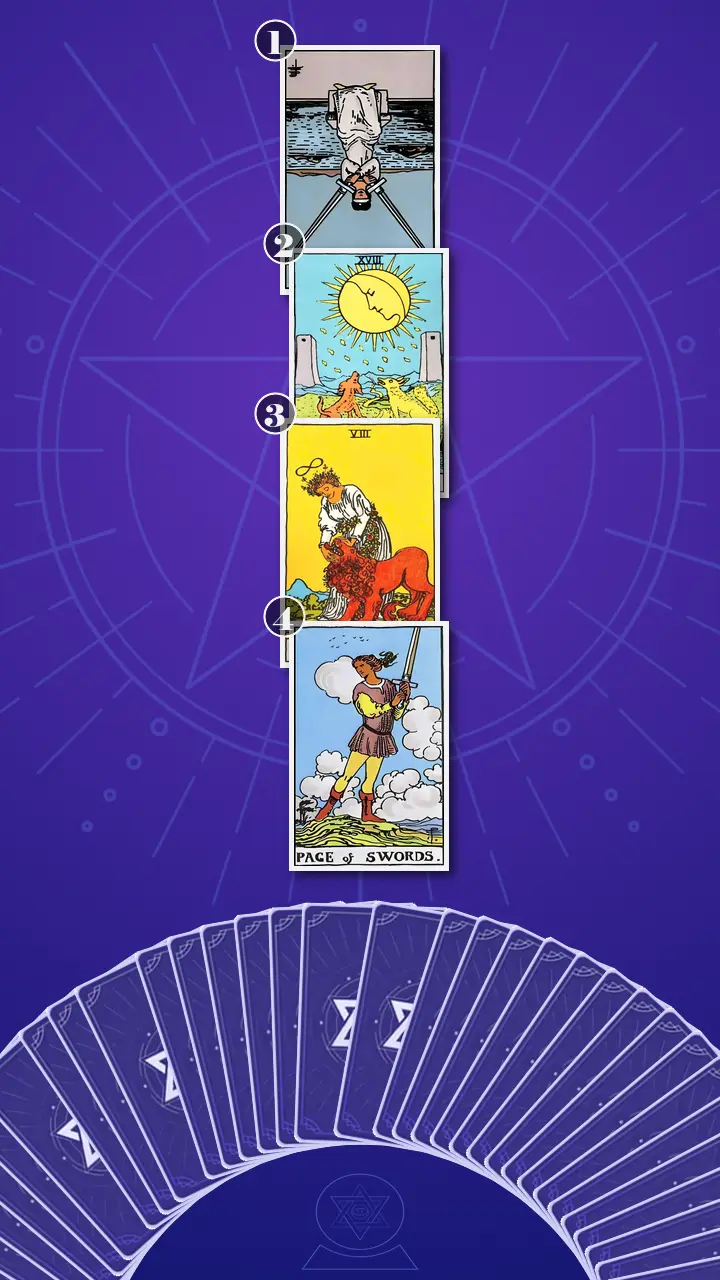
“For this,” I said, “I’m using the Four-Layer Insight Ladder · Context Edition—a four card tarot spread for identity-linked micro-decisions, like pronouns in your bio.”
To you reading this: I like this spread because the real question isn’t Which option is correct? It’s What fear is driving my hesitation, and what’s one step forward? The ladder gives us that sequence—surface behavior → root fear → inner pivot → one-step action—without turning it into a dramatic “final answer.”
I showed Jordan the layout: a simple vertical line, like descending out of a noisy headspace.
“The first card will name the observable loop—what you literally do in the editor. The second card goes underneath that: the identity fear being projected onto a tiny line of text. The third is the pivot—what inner capacity loosens the grip enough to choose without needing perfect certainty. And the last card is one small step this week, something testable.”
Reading the Map: The Loop and the Night-Walk
Position 1 — The observable loop: what you keep doing around pronouns
“Now we turn over the card that represents the observable loop—what you keep doing around pronouns in your bio and how it keeps you stuck in indecision.”
Two of Swords, reversed.
I tapped the image gently. “This is the edit-delete loop in a single frame. The blindfold says, ‘I’m trying not to feel this.’ The crossed swords over the chest say, ‘I’m holding two opposing arguments right here—protecting my heart with logic.’ And the still water behind her? That’s the frozen emotional movement underneath the ‘it’s just two words’ story.”
Then I translated it the only way it matters—into the exact modern-life scenario: “You open LinkedIn after work, tap ‘Edit intro,’ type ‘they/them,’ then delete it. You try ‘they/she,’ delete that too. You’re not undecided about grammar—you’re bracing for what each choice might trigger socially. The cursor blinking becomes its own pressure, and exiting without saving feels like the only way to stop the tight-throat, stomach-drop moment.”
I watched Jordan’s shoulders lift a fraction, almost as if they were bracing against an invisible comment section.
“This reversed Two of Swords isn’t ‘you’re indecisive,’” I said. “It’s protective indecision. Your nervous system is trying to keep you safe by not choosing. Short-term, it works: no immediate questions, no DMs, no awkward ‘Hey, quick question…’ in Slack. Long-term, the cost is that you keep reopening the editor—type → hover → backspace → scroll—like the cursor is counting down your right to belong.”
Jordan let out a quiet laugh, but it had a bitter edge. “That’s… kind of cruelly accurate.”
“I know,” I said, keeping my voice soft. “But accuracy is kind. It means we’re not lost—we can see the loop.”
Position 2 — The identity fear underneath: what uncertainty is inflating the stakes
“Now we turn over the card that represents the identity fear underneath—the deeper meaning you’re projecting onto a tiny piece of text.”
The Moon, upright.
“Of course,” I murmured, almost to myself. The Moon always shows up when the mind is trying to survive on partial information—and turns that into a full cinematic universe.
I pointed to the path between the towers. “This is the bio field: a narrow walkway where you can’t fully see who’s watching. Online, the audience is mixed—coworkers, recruiters, friends, acquaintances, strangers. Your brain hates not knowing what any of them will make it mean.”
I used the modern-life translation exactly as it lived in Jordan’s world: “You’re not just thinking about pronouns—you’re thinking about the unknown audience. A coworker you like, a manager you haven’t clocked yet, a recruiter, an old classmate, a stranger on the internet. In your head, their reactions play simultaneously, and because you can’t verify any of it, your brain treats every imagined outcome as equally probable—and equally risky.”
“The Moon is projection,” I added, “and it’s also ambiguity. It’s like reading tone into a ‘Seen 9:41 PM’ timestamp and building a whole story from it. There’s no data, so the mind fills in the blanks.”
Jordan’s reaction came in three small beats: their breathing paused; their gaze unfocused as if they’d opened three tabs behind their eyes; then they swallowed—hard—and nodded once.
“Yeah,” they said. “It’s not just ‘what will they think.’ It’s… being discussed without me there. Like I’m not even in the room.”
“Exactly,” I said. “The fear isn’t only being seen. It’s being reduced. It’s being corrected or managed. It’s being turned into a workplace conversation.”
I leaned in slightly. “Let’s name the cleanest version: you’re scared a label will replace your belonging.”
Jordan’s jaw flexed. “And I hate that I’m thinking this hard. I keep checking other people’s bios like it’s market research.”
“Comparison isn’t clarity,” I said. “It’s just a way to borrow safety for ten seconds.”
When Strength Held the Lion at “Save”
Position 3 — The pivot: the inner capacity that dissolves the fear’s grip
I let the room get quieter on purpose. The city sounds outside—distant traffic, the faint hush of a building vent—felt like they stepped back. “Now we turn over the card that represents the pivot—the inner capacity that dissolves the fear’s grip enough to choose without needing perfect certainty.”
Strength, upright.
Jordan stared at the card, and I could feel how badly they wanted it to mean: Tell me the correct answer. Tell me which pronouns are safe. Tell me what will happen.
Setup. In my mind, I saw the exact scene: after work, LinkedIn open, cursor blinking in the bio field—pronouns typed, deleted, typed again—while their throat tightened like they were about to give a statement to a room they didn’t agree to walk into. They were stuck inside a rule: if they couldn’t be 100% sure forever, they didn’t deserve to be visible today.
Delivery.
Stop treating your bio like a verdict and start treating it like gentle courage—Strength is the calm hand that hits “Save” without wrestling the lion of other people’s opinions.
I didn’t rush to fill the silence after that. I let the sentence sit between us the way moonlight sits on water—long enough for the nervous system to decide if it’s safe to believe it.
Reinforcement. Jordan’s body answered before their mouth did. First, their eyebrows lifted—an almost disbelieving “wait, really?” Then their lips pressed together, not in resistance but in containment, like they were holding back something tender. Their shoulders dropped a millimeter, then another, as if they’d been wearing a backpack they forgot they put on. I watched their throat move as they took in air—slowly this time—and their hand went to the base of their neck in a protective, familiar gesture.
This is where my work is partly tarot and partly what I learned on long voyages: energy always tells the truth first. I’ve trained thousands of people—travelers, staff, executives—to notice the moment their body contracts before their brain starts negotiating. And I’m also careful here: “I’m not giving medical advice,” I told Jordan, “but in an energy lens, throat tightness often shows up when your truth wants to speak and your system is bracing for consequences.”
“Strength isn’t dominance over fear,” I continued. “It’s staying present while fear exists. The lion is that surge: the urge to over-explain, to pre-empt, to control interpretation so no one can misread you. Strength says: regulate first, then choose.”
Jordan exhaled—long, shaky, real. Then they frowned, like a second wave arrived. “But if I change later… won’t that prove I was performing?”
I didn’t brush past it. “That question is the whole knot. And Strength answers it with a reframe: pronouns don’t have to be a verdict. They can be a ‘right now’ preference.”
I asked gently, “Now, with this new lens—can you think of a moment last week when you hovered over Save, and this would have changed how it felt in your body?”
Jordan blinked, then nodded, eyes glossy but steady. “Monday morning. Slack. I almost added them. I pictured my manager DMing me and I froze.”
“That’s the shift,” I said. “From cursor-blink anxiety to steady self-trust. Not perfect confidence—just enough steadiness to be seen without turning it into a trial.”
The Page’s One-Week Experiment
Position 4 — One step this week: a small communication move that creates real feedback
“Now we turn over the card that represents one step this week—a small, concrete communication move that reduces rumination by creating real-world information.”
Page of Swords, upright.
I smiled. “This is the part of you that can treat communication like a skill—not a final exam.”
I anchored the meaning in their life exactly: “You post a straightforward pronouns line (pronouns only), then treat the next week as a small experiment: you notice what actually happens in real conversations, what shifts inside your body, and whether anyone even comments. If it needs changing later, you update it the way you’d update any profile detail—quietly, clearly, without making it a spectacle.”
“The Page doesn’t over-announce,” I said. “They test. They learn. They adjust.”
Jordan’s shoulders stayed down this time. Their voice sounded more practical. “Okay. That feels… doable. But what if I still spike when I go to actually do it?”
“Then we plan for the spike,” I said. “We don’t shame it. We work with it.”
The One-Platform Test: Actionable Advice for Pronouns-in-Bio Anxiety
I threaded the cards back into a single story for Jordan—because clarity isn’t four separate meanings; it’s one coherent pattern.
“Here’s what this spread is saying,” I told them. “You’re not stuck because you lack information. You’re stuck because you’ve been treating a tiny line of text like it has to carry a permanent identity verdict. The Two of Swords reversed shows the protective loop—type, delete, scroll—because choosing feels like stepping into exposure. The Moon shows why exposure feels dangerous: your mind is running worst-case audience simulations in the dark, especially in mixed workplace contexts. Strength is the turning point: you regulate your system and choose what’s true today without demanding forever-certainty. And the Page of Swords turns that into a low-drama experiment—simple, testable communication that gives you real feedback instead of imagined feedback.”
“The blind spot,” I added, “is that you’ve been trying to become un-criticizable instead of simply clear. And the transformation direction is straightforward: shift from treating pronouns as a verdict to treating them as a current communication preference you’re allowed to revisit.”
Then I gave them a plan that matched the cards and their actual life—small steps, time-boxed, and respectful of safety.
- The “Good-for-Now” Pronouns Line (One Platform Only)Pick a pronouns-only line for one platform you use most (LinkedIn or Instagram). Example template: “Jordan | Product Ops | they/them” (or your chosen set). Save it there—don’t do all platforms at once.If you feel the urge to keep tweaking, remind yourself: consistency is not the same thing as honesty. Your job is “good-for-now,” not “perfect forever.”
- The 7-Day Pronouns Check-In ReminderSchedule a calendar reminder titled “Pronouns check-in (7 days).” Until that date, no bio edits—only noticing what actually happens (in conversations, in your body, in your mood).If posting feels unsafe, your valid smallest version is “draft in Notes.” You still set the 7-day check-in, so your nervous system learns: we can revisit without spiraling.
- A 3-Minute Energy Reset Before You Hit SaveBefore you open the bio field, do a quick body scan (throat, jaw, shoulders). Put one hand on your chest or throat, take two slow breaths, and drop your shoulders on the exhale—like releasing a backpack strap.I call this my Energy Flow Diagnosis moment: if your shoulders are up by your ears, your “visibility channel” is basically kinked. Think of Venice: water has to circulate. If you force it, it floods; if you guide it, it moves.
I also offered Jordan a boundary line—simple, no speech required, straight from the Page of Swords energy: “These are the pronouns I’m using right now.”
“Make it simple. Make it testable,” I said. “Let reality give you the next piece of information.”

A Week Later: The Quiet Proof
Eight days later, I got a message from Jordan: “I did the one-platform test. LinkedIn only. I set the 7-day reminder. No one said anything. Two people used they/them in a comment thread without making it weird. I didn’t realize how much energy the loop was taking.”
They added one more line: “I still had a ‘what if I’m wrong’ thought the next morning. But I didn’t spiral. I just… left it. And went to work.”
That’s what a real Journey to Clarity often looks like: not fireworks, but a quieter nervous system. Not a final identity contract, but low-drama, updateable visibility built on self-trust.
When a two-word line in your bio feels like it could decide whether you belong, it makes sense that your body braces—because you’re not just choosing pronouns, you’re trying to avoid being misunderstood or turned into a conversation.
If you treated pronouns as a ‘right now’ clarity tool—not a forever verdict—what’s the smallest version of visibility you’d be willing to test this week?