Typing Bubbles Vanish After 'I Can't Tonight'—Staying Steady in the Gap

Finding Clarity in the 11:47 p.m. Screen Glow
If you can say “No, I can’t” but the second the typing bubbles stop you get hit with full-body panic—welcome to boundary-setting whiplash.
Taylor (name changed for privacy) came into my café the next afternoon in Toronto, still wearing that look people get when they’ve slept, technically, but their nervous system didn’t. They held their phone like it might buzz at any second. Their shoulders were up near their ears, as if they were bracing for impact.
“It was 11:47 last night,” they said, and even the timestamp sounded sharp. “Weeknight. I’m in bed. Phone on low brightness. I send, ‘I can’t tonight.’ I see the typing bubbles… and then they vanish. And then nothing.”
I could picture it because I’ve watched a thousand versions of it play out in the streetlight glow outside my own apartment: the phone screen as the only lamp, the air too dry, your thumb hovering over the keyboard like it’s trying to undo the last five minutes. You meant your no, but you’re already drafting a yes-shaped apology.
“I said no,” Taylor whispered, like it was a confession, “but now I feel like I did something wrong.”
The panic they described wasn’t abstract. It was a stomach-drop like an elevator cable snapping in a dream. A tight chest that turns each breath into a shallow sip. Restless hands that want to grab the phone the way you grab a railing when you don’t trust the stairs.
I nodded, slow. “That reaction makes so much sense—especially if you’ve been trained by group chats and Slack green dots that fast replies equal safety. But we’re not here to shame the panic. We’re here to map it. Let’s find clarity in the exact moment the quiet hits, and figure out one next step that doesn’t abandon you.”

Choosing the Compass: How This Tarot Spread Works (Without Predicting Your Future)
I slid a small cup of espresso toward them—not as a fix, just as a familiar anchor—and asked them to take one slow sip and notice their body. In my café, tarot isn’t a theatrical ritual; it’s a way of focusing attention. Like turning down background apps so you can hear what your system is actually doing.
While they breathed, I shuffled slowly, the cards clicking softly against the wood table. “Today,” I said, “we’ll use a spread I designed for moments like this: Transformation Path Grid (6) · Context Edition.”
For you reading this: I chose this spread because Taylor’s question—‘After I say no and they go quiet—why do I panic, one step?’—isn’t about predicting whether someone will text back. It’s about tracking an internal loop triggered by relational ambiguity. This layout is compact on purpose: it shows the symptom, the meaning assigned to silence, the deeper fear underneath, then the specific inner lever that changes everything—followed by a practical communication step and a sustainable new rhythm.
I tapped the space where the first three cards would go. “Top row: we diagnose. What happens right after you say no. What makes the silence feel unbearable. And what fear is actually underneath all that.” Then I tapped the bottom row. “Bottom row: we shift. The turning point. The clean next step. And what it looks like when your nervous system learns a new pace with silence.”
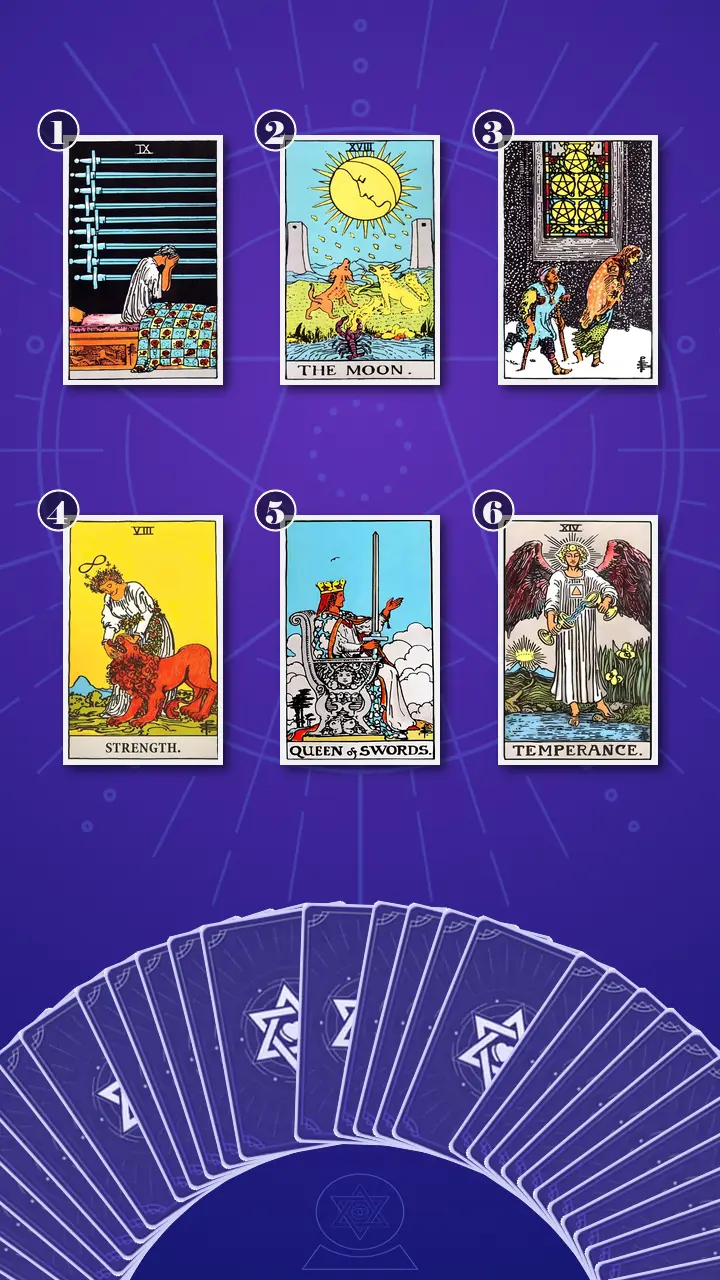
Reading the Gap: The Cards That Name the Spiral
Position 1: The observable symptom right after you say no and they go quiet
“Now flipping over,” I said, “is the card that represents the observable symptom right after you say no and they go quiet—what you do, think, and spiral into.”
Nine of Swords, upright.
The image is almost unfairly accurate: someone sitting up in bed, face in hands, nine blades lined up behind them like accusations. “This is the 2 a.m. sent-message post-mortem,” I told Taylor. “The courtroom tab open in your head.”
I used the card’s modern translation because it was basically their night in one paragraph: It’s late and you’re in bed re-reading the exact wording of “I can’t tonight” like it’s a contract you might have violated. You keep toggling between the chat and Notes, drafting follow-ups you don’t even believe—one explanation, one joke, one apology—because doing nothing feels like letting something bad happen.
“That’s exactly it,” Taylor said, then let out a small laugh that didn’t feel like humor. “It’s… brutal. I’ll write ‘follow-up v3’ in Notes like I’m doing project management on my own friendships.”
Energetically, the Nine of Swords is excess Air—thoughts moving too fast, too sharp, turning incomplete information into a verdict. It’s not that you’re “dramatic.” It’s that your brain is trying to create control by creating certainty. And the fastest kind of certainty is usually the worst kind.
Taylor’s eyes flicked from the card to their phone and back, like their attention was trying to escape the room. Their knee bounced under the table. That body-level urgency mattered more to me than the words.
Position 2: What specifically makes the silence feel unbearable
“Now flipping over,” I said, “is the card that represents what specifically makes the silence feel unbearable—the meaning you assign to the quiet.”
The Moon, upright.
I’ve always loved how honest The Moon is. It doesn’t promise clarity. It just tells the truth about being in the in-between—the winding path between two towers, the dog and the wolf reacting to what they can’t fully see.
“Here’s the lived version,” I said, using the modern scenario as promised: The message thread is quiet, and your brain starts producing a full plot: you imagine their expression, their tone, the future awkwardness, the slow fade-out. You check ‘last active’ and read receipts like they’re clues. The gap becomes a screen for your worst-case story to play on repeat.
This card is a blockage through distortion—not because you’re lying to yourself, but because The Moon turns silence into a projection screen. The unread thread becomes a blank Google Doc, and your fear starts typing.
So I walked Taylor through the “projection screen” structure: “(1) What you saw: no reply. (2) What you assumed: they’re mad, you’re difficult, you’re getting dropped. (3) What you did: you started drafting apologies.”
Then I held up a finger. “The contrast that matters is this: incomplete information versus final judgment. Silence is a gap, not a verdict.”
Taylor went still in a way that looked like their mind had bumped into something solid. Their lips parted slightly, and there it was—the quiet, involuntary “oh.” Not agreement as performance. Recognition as relief.
Position 3: The deeper belonging/worth fear underneath the panic
“Now flipping over,” I said, “is the card that represents the deeper belonging fear underneath the panic—the emotional root driving the repair impulse.”
Five of Pentacles, upright.
Toronto knows this card. The cold that gets into your cuffs. The wind that makes you question your own life choices. Two figures in the snow outside a warm-lit window—light inside, cold outside.
I used the modern scenario because it lands in the body: After you say no, the quiet doesn’t just feel like a pause—it feels like you’ve been downgraded. Like you’re outside the relationship looking in, trying to earn your way back with extra niceness. You start offering compromises you don’t have capacity for because being ‘easy’ feels safer than being honest.
Taylor swallowed, hard. Their hand went to their chest like they were checking if their heart was still doing its job.
“A clean ‘no’ can feel mean when you’re used to earning your place,” I said gently. “This is the part of you that believes: One no = I’m not ‘in’ anymore. And that’s why the silence feels unbearable. Not because silence is inherently dangerous—but because it activates that old bouncer-at-the-door feeling.”
In the café, the espresso machine hissed in the background, steady and indifferent. The sound made the moment feel even more exposed—like the world was continuing while Taylor’s body was bracing for exile.
“Don’t turn your boundary into customer service,” I added, because this is where people-pleasing likes to dress itself up as kindness. “Capacity is not the same thing as worthiness.”
Taylor looked down at the card, then up at me, eyes shiny but focused. Their jaw unclenched by a millimeter. “I hate how true that is,” they said. “It really does feel like I’m outside.”
When Strength Put the Phone Face Down
Position 4 (Key Card): The inner turning point that helps you stay steady without backtracking
I took a breath before turning the next card. The air in the café felt quieter, even with the grinder going—like we were about to touch the actual lever.
“Now flipping over,” I said, “is the card that represents the inner turning point that helps you stay steady without backtracking on your boundary.”
Strength, upright.
On the card, a woman holds a lion not with force, but with gentle hands. Above her head, the infinity symbol—patience that keeps returning.
I tied it directly to the modern moment: You feel the impulse to send a fourth message rise fast—heat in your face, tight chest, restless fingers. Instead of negotiating your boundary, you put the phone face down, breathe slower than you want to, and let the discomfort exist without treating it like an emergency. You don’t become cold; you become steady.
Strength is warm Fire, balanced—not rage, not dominance, not “powering through.” It’s self-soothing courage. It’s staying present with discomfort without performing reassurance to earn safety.
This is where my café brain always jumps in. I’ve spent twenty years tasting what happens when you try to get comfort out of urgency. There’s a term we use: over-extraction. When you run water through the grounds too long, you don’t get more sweetness—you get bitterness. And I told Taylor, “Your follow-up texts are like over-extracting your boundary. You keep running hot water through the same ‘no’ because you want it to taste safer. But it doesn’t get safer. It just gets harsher on you.”
Taylor blinked, like the metaphor hit a place words hadn’t reached. Their fingers loosened around the phone.
The Aha Moment (Setup)
In their face I could see the exact trap: the belief that the right message could prevent pain. That if they could just soften it enough, explain it enough, be lovable enough, they could avoid the awful hallway of not knowing.
The Aha Moment (Delivery)
Stop treating the silence like a verdict; start practicing gentle control like the woman with the lion, and let your calm be the proof you can handle what comes next.
I let it sit. No extra commentary. Just the sound of the espresso machine releasing steam—like the room itself was exhaling.
The Aha Moment (Reinforcement)
Taylor’s reaction came in layers. First, a freeze: their breath paused mid-inhale, eyes locked on the card, pupils slightly wider, as if their nervous system was checking whether this idea was safe to believe. Then the “cognitive seep”—their gaze unfocused for a second, like they were replaying last night’s typing bubbles disappearing, watching themselves open Notes, watching themselves bargain with their own boundary. Then the release: a long exhale that started shaky and ended steady, shoulders lowering like they’d been holding up a backpack they forgot they were wearing.
“But if I don’t fix it,” they said, and there was a flash of anger under the fear, “doesn’t that mean I’m just… letting them be mad at me?”
I kept my voice calm, the way I do when a customer is convinced their coffee is ruined and I need them to stay with me for ten seconds. “Yes,” I said. “It means you’re letting them have a reaction. That’s not cruelty. That’s reality. You can care about them and still not manage their feelings in real time.”
“And here’s the micro-practice,” I added, sliding their phone a few inches away from the edge of the table. “Put it face down. Set a timer for 90 seconds. Do six slow exhales—longer out than in. One hand on your chest. Name what’s happening: ‘stomach-drop, tight chest, urge to fix.’ Then write one line in Notes: ‘My boundary is allowed to exist while they have a reaction.’ If 90 seconds feels like too much, 30 counts.”
Then I asked the question that turns insight into memory: “Now, with this new lens—can you think of one moment last week when silence hit, and this would’ve changed how you felt in your body?”
Taylor’s eyes went to the window, where late-afternoon light was turning the streetcars into moving gold. “Last Tuesday,” they said softly. “I could’ve… just gone to sleep. Like, actually sleep. Instead I stayed up trying to write a perfect apology for having a limit.”
That was the pivot in real terms: not from panic to perfection, but from panic-driven reassurance-seeking after they say no to calm tolerance for silence and steady self-trust—one small breath at a time.
One Clean Sentence: Turning Self-Trust Into a Text
Position 5: A practical communication step that protects your no without escalating
“Now flipping over,” I said, “is the card that represents a practical communication/behavior step that protects your no without escalating the situation.”
Queen of Swords, upright.
Her sword is upright and steady, not dramatic. Her gaze is direct. This is clarity without apology.
I anchored it in the modern scenario: You write the message you actually mean and stop there: “I’m not available tonight. I can do Thursday.” No extra paragraph. No preemptive apology. You allow the possibility of temporary misunderstanding without chasing it down in real time.
Queen of Swords energy is balanced Air—precision instead of spiraling. Discernment instead of mind-reading. This is where I often tell people: If you’re panicking, make it smaller—not longer.
I used the “drafts graveyard” image because Taylor had already described it. “Right now you have three unsent follow-ups,” I said. “One that over-explains, one that jokes, one that apologizes. The Queen says: pick one clean line that stands on its own.”
Taylor’s mouth twitched into a real smile for the first time. “A one-line calendar invite,” they said. “Not a Notion doc.”
“Exactly.”
Temperance and the 24-Hour Window
Position 6: What integration looks and feels like—a new rhythm with silence
“Now flipping over,” I said, “is the card that represents how it looks and feels when you integrate the lesson—a new relationship rhythm with silence and response time.”
Temperance, upright.
The angel pours water between two cups with impossible steadiness. One foot on land, one in water. Not rushing. Not withholding. Just pacing.
I grounded it in the modern scenario: You start letting conversations breathe. If someone goes quiet, you don’t treat it like a relationship fire—more like normal human timing. You wait, you sleep, you do your day, and you notice your body can survive the gap. Over time, the ‘silence panic’ becomes a signal to slow down, not to chase.
This is integration through rhythm. Not “I never get triggered again,” but “I have a container for the trigger.” Temperance doesn’t demand you like the silence. It asks you to stop treating it like an emergency.
Taylor stared at the pouring cups. “I want that,” they said. “I want to be able to wait without… turning into a little detective.”
I nodded. “Temperance is the part where you go to sleep, wake up, do your TTC commute, answer your emails, and the world doesn’t end just because someone didn’t reply fast. It’s learning that urgency is a feeling—not a fact.”
From Verdict to Gap: Actionable Next Steps for Post-Boundary Panic
When I looked across the full grid, the story was clean: the Nine of Swords shows the immediate spiral—your mind interrogating the “no” like evidence. The Moon shows the mechanism—silence becomes a projection screen, so you turn incomplete information into final judgment. The Five of Pentacles names what’s actually getting hit—belonging fear, the “I’m outside now” sensation that makes your hands reach for the phone. Then Strength arrives as the bridge: you don’t need a better apology; you need the capacity to stay with discomfort long enough that your boundary isn’t renegotiated by panic. Queen of Swords turns that steadiness into one clean sentence. Temperance makes it sustainable: a 24-hour rhythm where time does some of the work.
The cognitive blind spot here is subtle but powerful: you treat silence like feedback on your worth, so you respond as if you’re in danger. The transformation direction is the exact opposite: from “silence means danger” to “silence is space I can tolerate long enough to stay aligned with my no.”
I gave Taylor a plan that was deliberately small—because in moments of panic, small is what your nervous system can actually execute.
- The 90-Second Phone-Down Pause (Strength)Right after you send a boundary text, place your phone face down. Set a 90-second timer. Do 6 slow exhales (longer out than in). Put one hand on your chest and name three sensations: “stomach-drop, tight chest, urge to fix.”If 90 seconds feels too intense, do 30 seconds. Counting still trains your system that you can survive the gap.
- Facts vs. Guesses List (Moon Interrupt)Open Notes and write two columns: Facts (“I sent a message. They haven’t replied.”) and Guesses (“They’re mad. I’m getting dropped.”). Read the facts out loud once with your feet pressed into the floor.Your brain will argue. That’s normal. The point isn’t to feel calm—it’s to stop treating guesses like evidence.
- One Clean Sentence Method (Queen of Swords)If you truly need a follow-up, send only one sentence that adds logistics—not reassurance. Example: “I’m not able to tonight. I’m free Thursday if you still want to.” Then stop. No second paragraph.Draft the longer version, but don’t send it. Copy/paste into Notes and extract the one line that’s actually new information.
Before Taylor left, I added my café-specific tool because it makes the pause feel physical: “Do a Cup Temperature Scan,” I told them. “Make tea or coffee. Don’t drink it. Just notice how fast it cools. That’s your energy loss rate when you’re activated. Your job isn’t to force the cup hot again—it’s to stop reheating the panic with extra texts.”

A Week Later: The Quiet Proof
Five days later, during the lull between the morning rush and lunch, I got a message from Taylor. “Did the phone-down thing,” they wrote. “Only made it to 45 seconds. But I didn’t send the apology text. They replied this morning like normal. I slept.”
It wasn’t fireworks. It was something better: a tiny, real proof.
They told me they still woke up with the first thought—What if I was too much?—but this time they noticed it like weather instead of prophecy. They made coffee. They went to work. The boundary stayed intact.
That’s the journey I care about: not certainty, but ownership. Not controlling the other person’s reaction, but building the internal steadiness to let a normal pause exist.
When you finally say no, the quiet afterward can feel like standing outside the warm window—chest tight, stomach dropped—wondering if one boundary just cost you your place with them.
If you treated the next silence as space instead of danger, what’s one tiny way you’d stay aligned with your no for just the next 10 minutes?