The Emergency Contact Box Kept Blinking—Until a Two-Sentence Text Went Out
Finding Clarity in the “Emergency Contact” Box
If you can ship features at work but still freeze on an “Emergency Contact” field like it’s a personality test, you’re not alone (emergency contact anxiety).
Alex (name changed for privacy) sat down across from me with the kind of controlled posture I’ve seen in bright people who are used to being “fine.” They were 28, Toronto-based, early-career tech—hybrid schedule, competent calendar, a brain that could build an airtight Notion system for anything except this one small, blank field.
They didn’t even start with a dramatic story. They started with a form.
“It’s literally one name and I can’t do it,” Alex said, and the words came out a half-laugh, half-exhale—like they were trying to make it sound casual, even as their hands worried the edge of their phone case.
In my mind, I could see the scene before they described it: 9:41 PM on a Wednesday in a Toronto condo living room. Laptop balanced on knees. Workday onboarding open to “Emergency Contact.” Stark white screen. Cursor blinking like a metronome you can’t unhear. Fridge hum filling the silence. Type a name → pause → feel the chest tighten → delete → refresh Slack “just to check something” → suddenly you’re scrolling reels with a warm phone in your hand, pretending it’s a break—not avoidance.
Alex looked at me, eyes a touch too steady. “It makes me feel… embarrassing. Like I’m failing at adulting. Like I’m supposed to already have a person.”
The feeling around them was not just nervousness. It was like trying to swallow with a too-tight collar on—an anxious hesitation that lived in the body: tight chest, small knot in the stomach, shoulders creeping up as if an email notification had become a threat.
I nodded, slow and plain. “We can work with that. Not by forcing you to pick a name in five seconds—but by figuring out why this one form field turns into a whole identity spiral. Let’s treat today like a Journey to Clarity: we’ll map the mechanism, and then we’ll choose a next step you can actually do this week.”

Choosing the Compass: The Four-Layer Insight Ladder Spread
I asked Alex to take one breath with me—nothing mystical, just a nervous system handoff. In through the nose, longer out through the mouth. Then I shuffled slowly, not as theatre, but as a way to put the question somewhere outside the panic loop for a moment.
“Today,” I said, “I’m going to use a spread I call the Four-Layer Insight Ladder · Context Edition.”
To you, the reader: I chose this spread because this situation looks like a simple decision—why can’t I choose an emergency contact?—but it’s actually a very tight psychological mechanism. A larger spread like the Celtic Cross can add noise. This ladder keeps the logic clean: freeze on the form → protective control → old scarcity imprint → the hidden rule → the reframe → a grounded next step. It’s root-cause analysis, but for the heart.
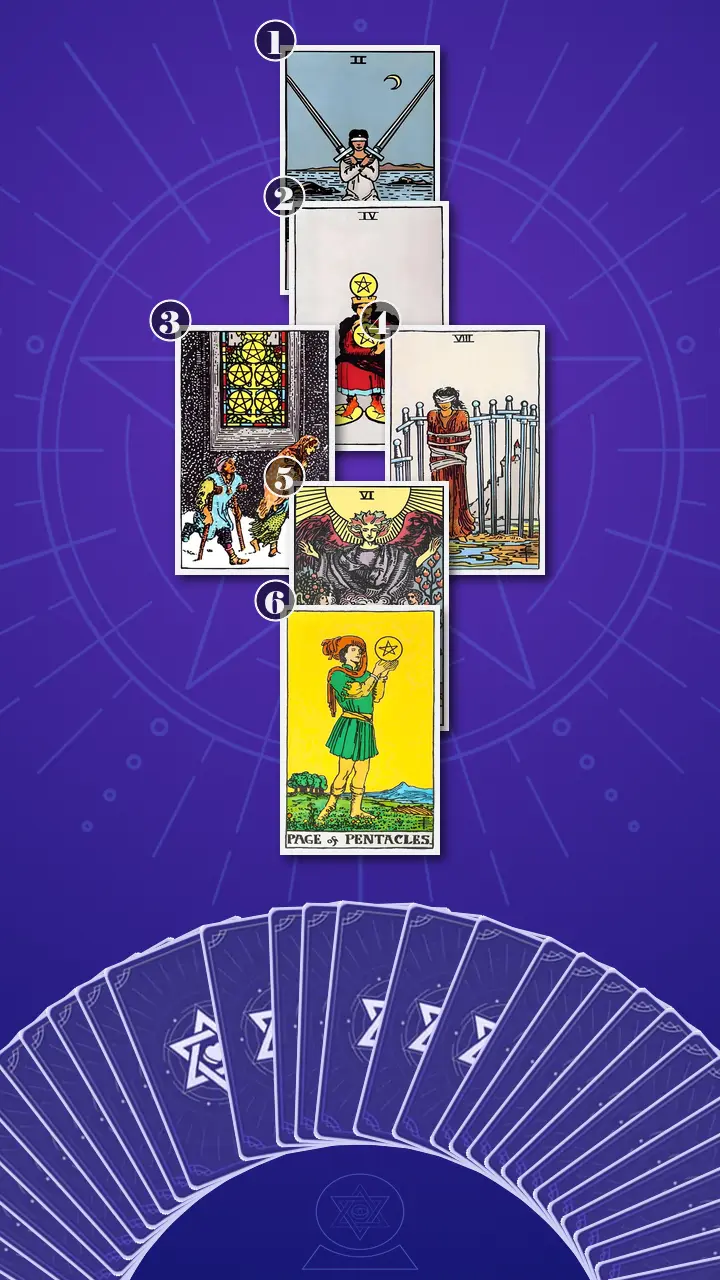
I laid the cards in a vertical line like rungs. “We’ll read top-to-bottom,” I told Alex, “as a descent from surface behavior into what’s driving it. Then there’s a hinge card—the pivot—and finally a practical action you can do within a week.”
Reading the Ladder: Why the Blank Field Feels Like a Belonging Test
Position 1 — The surface stuck moment
“Now flipped,” I said, “is the card that represents the surface stuck moment: what you’re doing and feeling when you can’t enter a name on the emergency contact form.”
Two of Swords, upright.
I pointed to the image—the blindfold, the crossed blades held close to the chest, the moonlit water behind. “This is choice paralysis, but not the casual kind. It’s protective stalemate.”
And then I translated it into Alex’s real life, because tarot that can’t land in a Tuesday night is just decorative.
“This is you in the Workday onboarding portal, cursor blinking in ‘Emergency Contact.’ You type a name, pause, and your brain turns into a risk analyst: What if they don’t pick up? What if they think it’s too intimate? What if I picked wrong? You delete it and tell yourself you’ll come back when you’re ‘more sure.’ But the blindfold is the point—you’re trying to make a relational decision while keeping your feelings muted.”
Alex let out a small, grim laugh—almost impressed, almost annoyed. “That’s… wow. That’s exactly it. It’s accurate in a way that’s kind of rude.”
I accepted that with a soft smile. “Tarot can be blunt. But it’s not judging you. It’s showing you the posture. Two of Swords energy is blocked—not because you’re incapable of choosing, but because choosing feels like exposure.”
Position 2 — The protective strategy underneath the freeze
“Now flipped,” I continued, “is the card that represents the protective strategy underneath the freeze: how control or guardedness is shaping the decision.”
Four of Pentacles, upright.
The figure on the card clutches the pentacle to their chest like it’s the last warm thing in winter. “This,” I said, “is control-as-safety.”
“In modern life it looks like this: you treat needing someone like giving away access to your soft parts. So the emergency contact field feels like you’re handing over a key to your life. You grip independence harder—keep relationships ‘fine,’ keep asks minimal, keep everything manageable—because being self-sufficient feels safer than risking someone seeing you need them.”
Alex’s shoulders were slightly hunched without them noticing, laptop-body language even with no laptop in front of them. The posture reminded me of a crowded TTC streetcar: that instinctive curl around your space like someone might take it.
“Control can feel like safety—until it becomes isolation with good branding,” I said, letting the line sit there without pushing it.
Alex nodded once, jaw tight, then loosened it as if they’d just noticed they were clenching. “Yeah. I do that. I’m always trying to make it… un-messy.”
“And it’s a brilliant strategy,” I said gently, “for avoiding surprise. It just has a cost.”
Position 3 — The past pattern this is echoing
“Now flipped,” I said, “is the card that represents the past pattern this situation is echoing: where the ‘I’m on my own’ script was learned or reinforced.”
Five of Pentacles, upright.
Two figures limp through snow beneath a lit window. Not empty, not hopeless—just outside. “This card rarely means ‘you have nobody,’” I told Alex. “It means the nervous system expects scarcity. It means support can be visible and still feel inaccessible.”
I gave it the Toronto translation. “It’s that cold evening moment—walking past a bright café window, seeing people laughing inside, and feeling that internal drop: Other people have people. Then your mind rushes in to cover it with, I’m fine. This isn’t a current failure of friendship. It’s an older belonging story that still runs on autopilot.”
Alex swallowed. Their eyes moved to the side, unfocusing for a second the way people do when a memory taps them on the shoulder. A lump-in-throat moment arrived quietly, not theatrically.
“I learned to keep needs small because it felt safer,” Alex said, voice lower. “Like… don’t ask unless you’re sure. Don’t be annoying. Don’t make it a thing.”
I nodded. “That rule kept you protected once. But it’s now interfering with adult logistics. And that’s why a form field feels like it’s asking you to prove you belong to someone.”
Position 4 — The core limiting belief keeping the loop running
“Now flipped,” I said, and I slowed down a touch, “is the card that represents the hidden rule—the core fear that keeps the pattern running even when support exists.”
Eight of Swords, upright.
The blindfold appeared again. Different card, same theme. I felt the room get quieter in that way it does when a pattern shows itself twice.
“This is the mental trap,” I told Alex. “It’s the belief that you have no good options, when the real constraint is a private rulebook.”
I leaned into the echo technique, because the Eight of Swords is best understood in the language it uses against you—short, clipped vetoes that masquerade as ‘being reasonable.’
Too much.
Too needy.
We’re not that close.
They’re busy.
It would be weird.
I can’t ask unless I’m 100% sure.
“It’s like you’re on the TTC ride home, tunnel lighting flickering, phone warm in your palm, thumb hovering over ‘send’—and you’re stuck from a rule, not a lack of people,” I said. “Look at the card: the bindings are loose. There’s open space. The trap feels airtight, but it isn’t.”
Alex’s reaction came in a three-step sequence I’ve learned to respect because it’s the body telling the truth before the mind catches up: their breathing paused; their eyes went distant as if replaying every unsent draft; then their shoulders dropped in a small, involuntary surrender.
“Mind-reading is not a support plan,” I added, because sometimes a clean sentence cuts through an entire maze.
Alex whispered, “Oh.” Not agreement like a polite nod. An oh like a door unlatched.
When The Lovers Turned the Light On
Position 5 — The key reframe (the turning point)
I touched the next card before flipping it. “This,” I said, “is the hinge. The re-choice. The moment we stop treating this as fear management and start treating it as values.”
The Lovers, upright.
The scene is open, witnessed, sunlit—no blindfolds. An angel above, not as a surveillance camera, but as a kind of truth spotlight: what’s real becomes sayable.
“Here’s the reframe,” I told Alex. “The emergency contact question is not ‘who won’t reject me?’ It’s ‘who is mutually real with me—and what kind of support agreement fits the reality of that relationship?’”
I could feel Alex’s resistance twitch. Not disagreement—more like grief at how simple it sounded compared to how hard it felt. They sat back, then forward, then back again, as if their body couldn’t decide whether to accept relief.
And because I’m not only a tarot reader but an archaeologist by training—an emeritus professor who has spent years reading meaning from fragments—I let my own mind flash, briefly, to a dig site: the way you don’t excavate by imagining the perfect artifact. You excavate by revealing what is actually there, layer by layer, under full daylight. Certainty isn’t the prerequisite. Exposure is.
“In my work,” I said, “we never demanded perfect proof before we lifted a trowel. We chose an ethical method and let reality answer.”
Then I brought in my signature lens—Mythic Archetypes—because The Lovers is an ancient story wearing modern clothing. “In a lot of legends,” I told Alex, “the hero doesn’t survive by pretending they need no one. They survive by choosing allies clearly. Not blindly. Not dramatically. Just honestly. The mythic move here is stepping out of secrecy and into consent.”
The Aha Moment (Setup → Delivery → Reinforcement)
Setup: I watched Alex’s gaze lock on the card, then flick away—like it was almost too exposed. “Right now,” I said, “you’re trapped in the thought that you must make the correct choice privately, so nobody can see you wanting anything. The cursor blinks, your chest tightens, and it feels like you’re about to publicly admit you’re not as ‘fine’ as you look.”
Delivery:
Stop treating the form like a test of whether you belong, and start treating it like The Lovers: a clear, consenting choice made in the open.
I let a quiet pause happen—no rushing to soften it, no overexplaining. Just space.
Reinforcement: The reaction hit Alex in layers. First, a tiny flash of anger—protective, human. Their eyebrows pulled together. “But if I ask… doesn’t that mean I’m admitting I don’t have it together?”
Their breath caught, then they exhaled sharply through the nose. Their hands went still on their lap. For a second their eyes shone as if tears were possible but not yet allowed. Then the tension in their shoulders dropped—slowly, like a backpack sliding off after a long walk.
“No,” I said, calm and precise. “It means you’re doing normal planning. Also: you’re not demanding a vow. You’re requesting consent for a narrow, practical role. ‘Only in a true emergency.’ You’re giving them a boundary that protects both of you.”
Alex stared at The Lovers again, and this time they didn’t look away. Their mouth opened as if to argue, then closed. Their face softened into something like relief with a thin edge of vulnerability—like stepping into warm air and realizing how cold you’d been.
“Okay,” they said, voice quieter. “So it’s not… a declaration. It’s a mutual agreement.”
“Exactly,” I said. “And now I want to ask you this: with this new lens, can you think of one moment last week—maybe on the Line 1, maybe in bed at 11:27 PM with an unsent iMessage—where you were hovering over ‘send’ and this insight could have changed how you felt?”
Alex’s eyes unfocused again—then returned. “Tuesday,” they said. “I drafted, ‘hey random question…’ and I kept rewriting it to sound chill. If I’d just… asked with a boundary, I could’ve been done.”
I nodded. “That’s you moving from vulnerability paralysis and shame-tinged avoidance to values-based clarity. Not by proving you belong, but by letting connection be negotiated in reality.”
The Bottom Rung: Version 1.0 Support Counts
Position 6 — A grounded next step within a week
“Now flipped,” I said, “is the card that represents a grounded next step you can take within a week to make real progress and complete the form with integrity.”
Page of Pentacles, upright.
The Page stands steady, studying the pentacle with beginner seriousness—no drama, no overcomplication. “This is the energy of small and real,” I said. “Like setting up autopay. Like updating your health card. Boring, practical, quietly life-saving.”
I watched Alex’s face change here—less haunted, more capable. The Page of Pentacles doesn’t demand emotional perfection. It asks for a concrete step.
“Version 1.0 support counts,” I said, because sometimes people need permission to start imperfectly.
A One-Week Plan for Emergency Contact Anxiety (Consent, Boundary, Reality)
I stitched the whole ladder together for Alex in one clean story, because clarity comes from coherence:
The Two of Swords shows the freeze: you stall because choosing feels like exposure. The Four of Pentacles shows the strategy: you grip independence to stay safe, but it also keeps you unsupported. The Five of Pentacles shows the old imprint: an internal expectation that warmth exists, but not for you—not without earning it. The Eight of Swords names the loop’s engine: a fear-based rule (“I can’t ask unless I’m certain”) that creates a maze of vetoes. The Lovers pivots you into a different method—values-based, consent-led agreement instead of mind-reading. And the Page of Pentacles grounds it into a small action you can do this week.
The blind spot I wanted Alex to see was simple and sharp: you’ve been treating a logistics checkbox as a high-stakes claim about closeness. That’s why it feels impossible. The transformation direction is equally simple: move from “I need certainty before I ask” to “I can make a respectful ask and let the relationship respond in reality.”
Then I gave Alex a plan that didn’t require becoming a different person overnight.
- The Two-Sentence Consent + Boundary TextOpen Notes. Pick one person who is most reachable and steady. Draft exactly two sentences: (1) the ask, (2) the boundary. Example: “Hey—quick admin question. Would you be comfortable being my emergency contact for work? It would only be if something serious happened and they couldn’t reach me. Totally okay to say no.”Set a 24-hour “no-edit” timer. Your job is to let reality answer you, not to perfect the wording.
- Reality-Not-Rumination Check (5 minutes)Before you send, do a quick list—no feelings debate, just facts: “Who answered me in the last month?” “Who lives closest?” “Who would take this seriously?” Choose based on reachability, not symbolic ‘perfectness.’If your brain starts writing a legal brief, stop at three bullet points. That’s enough data for Version 1.0.
- Inscription Affirmation (My “Carved Wisdom” Shortcut)Write one sentence at the top of the Notes message—like an inscription you’d carve into stone: “Mind-reading is not a support plan.” Or: “The goal isn’t the perfect person. It’s a mutual yes with a clear boundary.” Read it once before you hit send.If you feel flooded, put your hand on your chest, exhale longer than you inhale, and come back later. This only works if your body feels safe enough.
I also offered Alex my simplest calibration tool—Clay Disc Meditation—reimagined for modern life: “Hold a coin or a TTC token if you have one,” I said. “Feel the weight. Let it remind you this is a practical agreement. You’re not auditioning for love. You’re building a safety plan.”
A Week Later: The Quiet Proof
Eight days later, I got a message from Alex. No essay. No emotional debrief. Just a screenshot: a simple iMessage thread, two sentences sent while the kettle boiled, Workday open in the background like a dare.
Under it, Alex wrote: “They said yes. I filled the form in right away before my brain could re-argue it.”
There was a bittersweet honesty in what they added next: “I still felt shaky after. Like… I kept thinking, what if I asked the wrong person. But I also slept. Like actually slept.”
That’s what I mean when I talk about a Journey to Clarity. It’s not a fireworks moment. It’s a small, consenting agreement that turns a blinking cursor from a verdict into a checkbox. It’s moving from vulnerability paralysis and shame-tinged avoidance to values-based clarity—one respectful ask at a time.
Sometimes the panic isn’t about the form—it’s the moment your chest tightens because you want real support, and you’re terrified that wanting it will make you “too much” for anyone to choose back.
If you didn’t need certainty to earn the right to ask—what’s one small, respectful support agreement you’d actually be curious to try this week?
Every reading at AceTarot is a journey to connect with inner wisdom and empower your next step. The stories shared here are psychological mirrors, not private records—crafted to reflect universal emotional loops and help you find your own clarity. Learn more about our Journey to Clarity.
Author Profile