Hovering Over the iMessage Cursor—And Choosing One Clean Sentence

Finding Clarity in the 8:47 p.m. TTC Scroll
You say yes to a last-minute plan, then immediately start drafting a “just so you know…” text like you’re filing paperwork for approval—because your nervous system treats independence like betrayal.
Taylor (name changed for privacy) met me over a video call from Toronto, hair still damp like she’d debated going out and showered anyway—half hope, half obligation. When she described it, I could almost hear it: 8:47 PM on a Tuesday, on the TTC Line 1 heading south, the flicker of fluorescent lights, her tote bag strap biting into her shoulder, the phone warming her palm. She’d typed “I’m in!” in a King West group chat… and then immediately switched to her best friend’s iMessage thread, cursor blinking like a metronome for panic.
“It’s so stupid,” she said, rubbing the heel of her hand against her sternum like she could physically smooth something down. “I want to make plans freely, but it instantly turns into… this whole loyalty thing. Like I’m cheating on my own friendship.”
I watched her eyes do the familiar micro-scan people do when they’re reading tone into everything: the imagined “k.”, the delayed reply, the Instagram Story that could mean anything. Her chest wasn’t just tight—it was braced, like she was waiting for someone to open a door too fast and catch her doing something wrong.
Guilt has a particular texture in the body. For Taylor it showed up like a sinking drop in the gut, then a tightening around the ribs—as if her lungs needed to ask permission to expand.
“You don’t need permission slips for your life,” I told her, gently, because the words landed best when they were simple. “And we’re not here to put your friendship on trial. We’re here to get you clarity—why this guilt spikes, what it’s protecting, and what your next step can be without shrinking your world.”

Choosing the Compass: The Four-Layer Insight Ladder Spread
I asked Taylor to take one slow breath in, then out—nothing mystical, just a nervous system handrail. While she held her question in mind, I shuffled on my side of the screen, the cards making that soft papery whisper I’ve always loved. In my day job at a Tokyo planetarium, I teach people to find patterns in darkness; tarot asks for the same skill, just aimed inward.
“Today I’m going to use a spread called the Four-Layer Insight Ladder · Context Edition,” I said. “It’s a tarot spread for friendship guilt and boundaries—less about predicting an outcome, more about diagnosing the mechanism and turning it into actionable advice.”
For you reading: this spread works like descending levels in a building. We start with the visible symptom (what you’re doing on your phone), then the everyday trigger (what sets it off), then the root belief (the rulebook you didn’t consent to but still obey), then the shadow need (the missing self-soothing skill). Finally, we land on the key reframe and a grounded next step you can actually live.
“The first card will name the guilt loop as it shows up right now,” I told Taylor. “The middle cards will show what you’re believing and what you’re trying to soothe. And the last two will give us the clearest path forward—what to text, what to practice, what to repeat.”
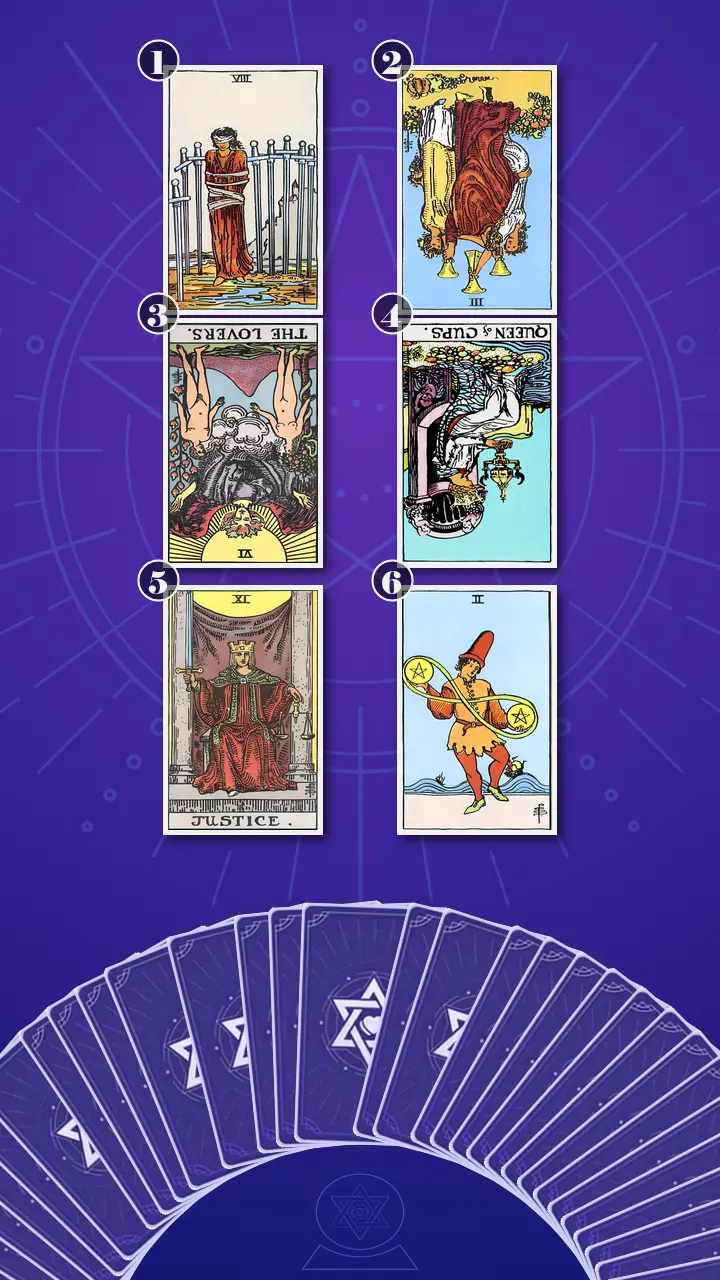
Reading the Map: When Guilt Turns Into a Rule
Position 1: The visible guilt loop right now
“Now we’re turning over the card that represents the visible guilt loop right now—the observable way guilt restricts your choices,” I said.
Eight of Swords, upright.
This card’s modern translation could’ve been pulled straight from her week: You’ve already agreed to meet coworkers for drinks, but instead of getting ready you sit on your bed with your phone in both hands, rewriting a long “just so you know…” text to your best friend. Your chest is tight, your stomach sinks, and the plan starts feeling like something you have to earn permission for.
In the image, she’s blindfolded, bound—surrounded by swords like a fence. But the detail I always zoom in on is the looseness of it. The bindings aren’t iron. The cage is real in feeling, but it’s maintained by the story running in the background.
Energy-wise, Eight of Swords is blockage: not a lack of options, but a mind that turns options into danger. It’s the “hyper-vigilant social math” you described—replaying conversations, predicting disappointment, trying to pre-empt conflict with perfect wording.
Taylor let out a small laugh that sounded like it had sharp edges. “Okay,” she said. “That’s… too accurate. Almost rude.”
I nodded. “That reaction makes sense. Eight of Swords can feel exposing. But it’s also hopeful—because if the tightest part is the blindfold, then clarity is an exit.”
I asked her, “What rule are you obeying in that moment—right before you start drafting the paragraph?”
She stared at the card, then looked away from the screen like she was watching her own behavior in replay. “That if I don’t tell her right away,” she said, “it’ll look like I’m hiding it. And if she feels left out, it means I failed as a best friend.”
Position 2: The everyday trigger
“Now we’re turning over the card for the everyday trigger—the situation that spikes the guilt and makes it feel urgent,” I said.
Three of Cups, reversed.
In real life, this looks like: A group chat is making spontaneous plans and your first move is not excitement—it’s scanning: who’s invited, who’s closest, what it means. You notice your best friend isn’t included and you feel a sudden urge to either pull her in or back out entirely, like social fun is a loyalty test.
Reversed, Three of Cups isn’t “no friends.” It’s the subtle flip where togetherness becomes a scoreboard. The raised cups become “who’s in the circle,” and your brain treats the guest list like emotional data—like iMessage read receipts or “Delivered” timestamps you keep checking even when nothing is actually wrong.
Energy-wise, this is excess—too much meaning-making. Too much comparison. The kind of social anxiety that feels like you’re reading the room the way people read “Seen.”
“This makes a lot of sense with social media,” I added. “Stories are basically tiny ambiguous broadcasts. If your nervous system already thinks separation equals danger, a single sad-song caption can feel like evidence.”
Taylor’s mouth tightened, almost embarrassed. “I do that,” she admitted. “I’ll be out and then I’m half-present because I’m… monitoring.”
“And monitoring feels like loyalty,” I said, “but it’s actually control. The intention is love. The mechanism is fear.”
Position 3: The underlying conflict and belief
“Now we’re turning over the card that represents the underlying conflict and belief—the hidden rule that turns autonomy into ‘betrayal,’” I said.
The Lovers, reversed.
This is the moment where your brain frames any plan without her like you’re choosing against her: You feel a jolt of panic and start thinking in absolutes—‘If I’m not including her, I’m being disloyal’—so you stall, over-explain, or undo the plan to avoid the feeling.
Here’s the conflict contrast I want you to hear clearly: autonomy vs loyalty-as-constant-access. In your inner monologue it sounds like: “If I choose X, it means Y about me.”
“If I go out with coworkers,” you tell yourself, “it means I’m replacing her.”
“If I don’t invite her,” you tell yourself, “it means I’m hiding.”
“If she’s disappointed,” you tell yourself, “it means I failed.”
It’s a courtroom drama happening in your group chat. Screenshots as evidence. Timestamps as motive. And you—exhaustingly—acting as your own defense attorney.
Taylor didn’t nod right away. She went still first. Her breath paused. Her fingers hovered near her lip. Then she gave one small, uncomfortable nod like she’d been called out by something she already knew.
“But if I stop doing that,” she said quietly, “what if she really does pull away?”
“That fear is honest,” I replied. “And it’s important we name it. But we also need to notice what your current strategy costs you—because right now, avoiding the discomfort of choosing is also a choice.”
Position 4: The shadow need
“Now we’re turning over the card for the shadow need—the emotional boundary or self-soothing skill that’s underdeveloped, so you end up managing her feelings,” I said.
Queen of Cups, reversed.
This card is painfully modern: You read tone into tiny signals—short replies, delayed responses—and then try to fix feelings you only guessed at. You send extra texts to soften the idea you’re out with other people, because you’ve quietly taken on the job of preventing her disappointment.
Queen of Cups is sensitivity and care. Reversed, it becomes porous—empathy sliding into emotional labor you didn’t agree to. Energy-wise, it’s imbalance: too much responsibility for what you can’t actually control.
And I want to use one of my own “astronomy brain” tools here, because it fits so precisely. I call it Cosmic Redshift Communication: in space, redshift is how we detect that something is moving away—light stretches, signals change. In relationships, people often panic at imagined redshift—tiny changes in response time or tone that get treated like proof of distance.
“When your best friend texts ‘k’ or takes longer to reply,” I said, “your system reads it like the friendship is receding into space. So you send more messages to pull it closer. But the problem is: you’re responding to a signal you inferred, not a truth you verified.”
Taylor swallowed. Her shoulders lifted toward her ears—then she noticed herself and forced them down, like she was trying on the idea that she could soothe herself first.
“Yeah,” she whispered. “I refresh. I reread. I… try to fix it before it becomes real.”
“If you’re writing a defense, you’re not sharing—you’re managing,” I said. Not as a scold. As a lantern.
When Justice Spoke: Ending the Group Chat Trial
Position 5: The key reframe
I slowed my hands before turning the next card. Even over video, the room felt quieter—like the moment in the planetarium right before the stars come up and everyone stops whispering.
“Now we’re turning over the card that represents the key reframe—the most direct path to transforming guilt into clarity,” I said.
Justice, upright.
Justice is scales and sword: fairness plus clean truth. In modern life, it’s this exact pivot: You stop drafting a courtroom-style explanation and send a simple message: ‘I’m out tonight, but I love you—free tomorrow?’ You don’t narrate every detail. You choose what’s fair: you get a life, and the friendship gets honesty instead of appeasement.
Setup (the moment you recognize): You accept a last-minute invite, then your thumb hovers over your best friend’s chat. Suddenly the plan feels like a moral issue. You’re not even at the bar yet, but you’re already in court—rehearsing your defense in a text bubble.
Delivery (the sentence that cuts through):
Stop treating your social life like a trial you must win, and start using Justice’s scales and sword to choose what’s fair and say it plainly.
Reinforcement (what I saw happen in her body): Taylor’s face did a whole quiet series of shifts. First: a freeze—eyes widening just slightly, like her brain had to stop and re-render the whole situation. Second: her gaze unfocused for a beat, as if she’d flashed to a dozen nights of rewriting texts under blue light, the phone heating her palm while the fun drained out of the plan. Third: the exhale—visible, slow, almost surprised. Her shoulders dropped, not dramatically, but enough that I could see the tension release at the base of her throat.
Then came the complicated part: her brow pinched. “But… if I do that,” she said, voice sharpening with a quick flare of anger, “doesn’t it mean I’ve been doing it wrong? Like I made it into a whole thing for no reason?”
I let that land. “It means you’ve been doing the best you could with an outdated rulebook,” I said. “Justice isn’t here to shame you. It’s here to update the terms.”
In my head, I saw a familiar astrophysics image: tidal locking in a binary star system—two bodies so gravitationally entangled they always show the same face to each other. I use that as another lens sometimes: my Binary Star System framework. “A lot of friendship guilt,” I told her, “is basically emotional tidal locking. Your life stops rotating freely because you’re trying to stay perfectly aligned at all times. Justice says: closeness doesn’t require constant locking. It requires fair orbit rules.”
I leaned in slightly. “Let’s do the Justice Check right now. Open Notes. Two columns: ‘What I owe’ vs ‘What I’m afraid I owe.’ Then one sentence you could actually send. If your chest tightens and you start drafting a paragraph, pause. No forcing. We’re practicing clean truth.”
She blinked, then did it. I watched her eyes move left to right as she typed. Her lips parted on a silent “oh.”
“Now,” I said, “with this new lens—fair to you, fair to the friendship—can you think of one moment from last week where this would’ve changed how you felt?”
She nodded slowly. “Wednesday,” she said. “Meeting room at work. She texted ‘What are you up to tonight?’ and I already had plans. I literally smiled at my coworker while my stomach dropped. I could’ve just said the truth… without… prosecuting myself.”
“Exactly,” I said. “This is the shift from guilt-driven loyalty-proofing to boundary-based closeness and autonomy. And it’s not cold. It’s adult.”
“Guilt is a signal,” I added, “It’s not a verdict.”
Position 6: The next grounded step
“Now we’re turning over the card that represents the next grounded step—the practical habit that stabilizes closeness while giving you room,” I said.
Two of Pentacles, upright.
This card always makes me think of modern logistics: You set a recurring weekly catch-up with your best friend (walk, coffee, FaceTime), so closeness isn’t something you have to constantly prove. Then when new invites come up, you can say yes or no based on your actual energy and schedule—without turning it into a friendship emergency.
Energy-wise, it’s balance—not rigid. Not “we must do everything together.” It’s a practiced rhythm, like Google Calendar holds: some are anchors, the rest stays flexible.
Taylor’s expression shifted here into something like relief with a little skepticism. “But what if I can’t even keep up with that?” she asked. “My job is… a lot. And then if I miss it, I’ll feel like I failed again.”
That was the real-world obstacle, and I was glad she said it out loud. “Then we make it smaller,” I replied. “Two of Pentacles doesn’t demand perfection—it teaches you to keep the balls in the air by adjusting. If weekly feels like pressure, do biweekly. Or set a 20-minute call. The point is: you build emotional infrastructure so your nervous system doesn’t demand constant proof.”
“Clarity can be kind without being a whole paragraph,” I reminded her. “And structure can be kind without being a cage.”
The One-Line Justice Text: Actionable Advice That Doesn’t Require a Big Talk
Here’s the story your cards told, start to finish: you’re caught in a self-imposed rule system (Eight of Swords) that activates most in group contexts and social comparison (Three of Cups reversed). Under it is a belief that autonomy equals betrayal (The Lovers reversed), and a shadow pattern of over-responsibility—trying to manage feelings you can’t actually verify (Queen of Cups reversed). Justice interrupts the false moral charge and brings an adult standard—reciprocity, truth, fair boundaries. Two of Pentacles turns that clarity into a repeatable rhythm so you don’t have to white-knuckle each invite.
Your cognitive blind spot isn’t “you’re too sensitive.” It’s this: you’ve been treating guilt as evidence instead of information. You assume the feeling means you did something wrong, so you try to undo the feeling by over-explaining—when the real move is to separate guilt from responsibility and let fairness guide your communication.
The transformation direction is clear: shifting from “proving loyalty by including her” to “practicing loyalty through honest communication and fair boundaries.” In plain terms: separating guilt from responsibility through reciprocity-based boundaries, honest concise communication, and a steady connection rhythm that doesn’t require constant proof.
Here are your next steps—small enough to start this week:
- Send the “Justice Text” onceThe next time you already have plans, send one clean sentence: “I’m out tonight, but I love you—free tomorrow?” Don’t add who/where/how long unless you genuinely want to share.If you feel the urge to write a paragraph, that’s your cue to downshift. Add warmth (one caring line), not justification.
- Do a 7-minute “Justice Check” in NotesMake two columns: “What I owe” vs “What I’m afraid I owe.” Then write one line that’s fair to you and fair to the friendship—no debate, no defense.Set a timer so it doesn’t become another overthinking spiral. Stop at 7 minutes even if it feels unfinished.
- Build an “Anchor Hang” using my Social Star MapChoose one recurring touchpoint with your best friend (Sunday walk + coffee, or a 20-minute call). Put it in your calendar as a real event. Then keep one separate “other people” slot open—your second bucket.Keep it light: weekly if it feels good, biweekly if it feels sustainable. Missing one doesn’t mean the friendship is dying—it means you’re human.
And one extra micro-boundary, if you want it: after you send a simple message, put your phone face down for 15 minutes. No refreshing. That’s you teaching your body, we’re safe without constant monitoring.

A Week Later: A Secure Friendship Survives Space
A week after our session, I got a message from Taylor. She didn’t write a paragraph—she sent a screenshot of a single line in her thread: “I’m out tonight, but I love you—free tomorrow?” Then, underneath, her best friend’s reply: “Have fun. Tomorrow works.”
She added: “I still felt my stomach drop when I hit send. But I didn’t spiral. I put my phone down. I went anyway.”
Her follow-up was quieter, almost bittersweet: she said she woke up the next morning after a full night of sleep, and the first thought was still, What if I messed up?—but this time she exhaled, made coffee, and didn’t reach for her phone like it was an emergency button.
In my work—whether I’m pointing out Saturn’s rings to a room full of strangers or laying out tarot on my desk—clarity rarely arrives as fireworks. It arrives as one clean sentence. One fair boundary. One small orbit adjustment.
When you want a life that’s yours and your chest still tightens like you’re about to get in trouble for it, that’s not proof you’re a bad friend—it’s fear of losing belonging dressed up as loyalty.
If you didn’t have to prove anything tonight, what would one small, honest message—and one small, free choice—look like?