Rereading Hinge After 'Low-Maintenance Girls'—Then She Stops Editing

The 11:18 p.m. Scroll After “I Have a Type”
If you have ever left a decent date, opened Instagram before taking off your shoes, and started quietly adjusting your style, tone, or opinions to match someone’s “type,” I know exactly how that spiral begins.
When Maya (name changed for privacy) sat across from me, she was polished in the way a lot of twenty-something city women are polished: great coat, clear voice, the kind of face that says “I’ve got it” while the nervous system is doing laps underneath. She told me about 11:18 p.m. on a Thursday in her small downtown Toronto apartment—kitchen light still on, radiator clicking, takeout garlic hanging in the air, phone bright against the dark room. She was half-sitting on the edge of her bed with her jeans still on, rereading a Hinge chat after a pretty good date. He had said he liked “low-maintenance girls.” Within minutes, she had screenshotted three “effortless” outfit posts, deleted the sharper line from her draft reply, and started editing her whole vibe before she had even asked herself whether she liked how she felt around him.
“The annoying part,” she said, wrapping both hands around the cup I’d set in front of her, “is that I know I’m doing it while I’m doing it. One offhand comment and suddenly I’m editing my whole vibe. I want to be chosen, but not at the cost of disappearing.”
That was the heart of it: wanting genuine connection, and at the exact same time fearing she would not be chosen if she stayed fully herself. The insecurity didn’t feel abstract. It moved through her like winter air sneaking in under a badly sealed window—straight to the chest, down into the stomach, followed by that restless, almost electric urge to fix how she was coming across.
I nodded. “That makes sense to me. You wanted connection, and now you’re managing perception. Let’s not moralize it. Let’s map it. We’re not here to make you ‘better at dating performance.’ We’re here to find clarity about what happens in you the second attraction starts to feel uncertain.”

Choosing the Compass: A Five-Card Cross Tarot Spread for Dating Self-Abandonment
I asked her to take one slow breath and hold the question in plain language: Why do I start reshaping myself when someone mentions their type? Then I shuffled slowly, not as theater, but as a way of helping the mind step out of its usual doomscrolling groove and into something more honest.
For this reading, I chose a Five-Card Cross tarot spread. I use this spread when the question is less “What will happen with this person?” and more “What keeps happening inside me?” Five cards are enough to separate the visible behavior from the deeper wound underneath it. They let me see the present symptom, the pressure crossing it, the root fear, the conscious strategy that keeps the loop alive, and the direction that leads back to self-trust. Clean structure. No extra fog.
I told her what I tell readers all the time when they ask how tarot works in real life: a good spread is not about being dramatic. It is about putting the right questions in the right places. In this cross, the center would show how the self-editing appears on the surface. The crossing card would reveal the tension between being real and being chosen. The card below would point to the older belonging wound. The card above would show the mental strategy she reaches for to feel safer. And the card to the right would offer the integrating move forward—the next step that could interrupt the pattern instead of just explaining it.
The layout looked the way this kind of dating trigger feels: like a road sign at an emotional intersection.
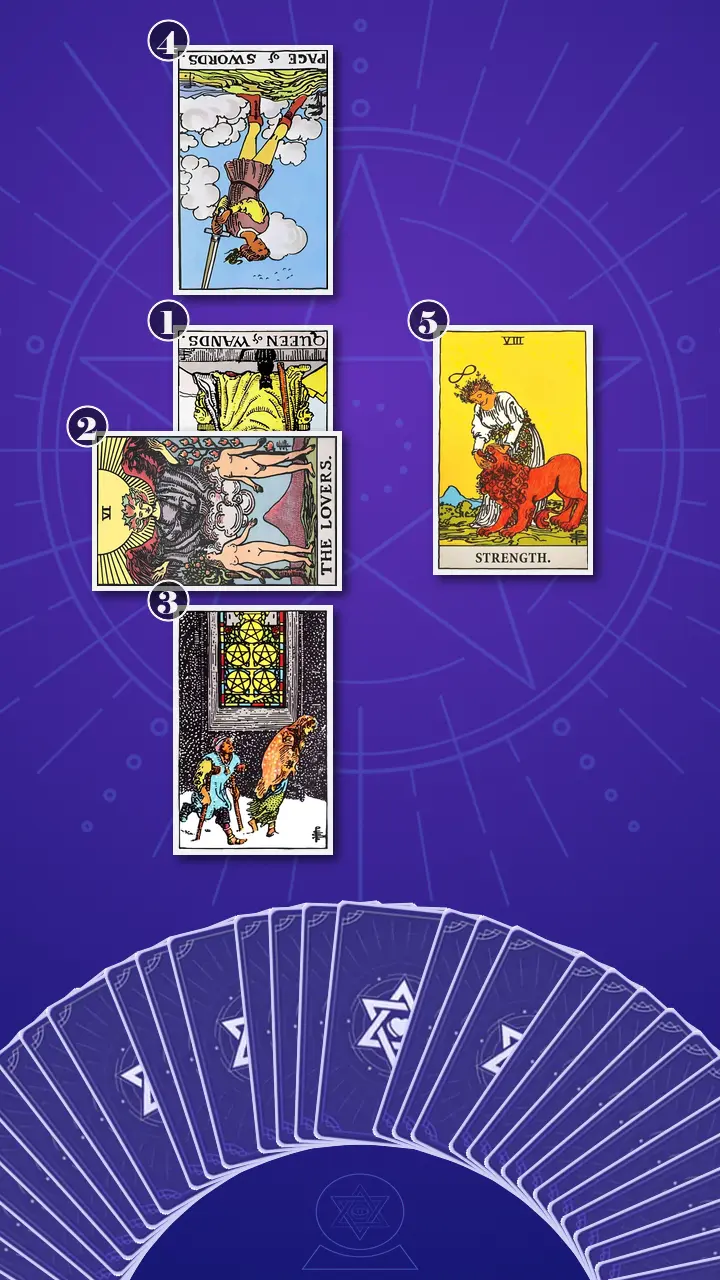
The Cards That Named the Spiral
The Rebrand Nobody Asked For — Queen of Wands Reversed
I turned over the first card. “This is the position that presents the observable self-reshaping behavior—how you edit appearance, tone, and opinions right after hearing another person’s type. And here we have the Queen of Wands, reversed.”
This card did not show a lack of personality. It showed personality getting redirected into impression management. I told Maya what I saw immediately: right after a date says he likes “low-maintenance girls,” she gets home and begins a quiet rebrand. She saves different outfit ideas, softens her next text, filters out the most vivid parts of herself so she can come across as more effortless, less intense, more likely to be picked. The Queen of Wands upright is warm, alive, instinctive. Reversed, that fire contracts. It is not gone; it is busy asking for permission.
“This is like turning yourself into a dating app A/B test instead of a person having an experience,” I said. “The problem isn’t that you’re too much. The problem is that the second attraction matters, your natural magnetism gets replaced with managed desirability.”
Maya gave a short laugh that landed with a little sting in it. “That’s so accurate it’s rude.” Her fingers tapped the side of the cup once, then stopped.
I smiled. “Good. Sometimes accuracy sounds rude before it sounds relieving. But this is useful, because now we know the first ten minutes of the spiral. The queen’s sunflower and black cat usually speak of style and instinct. In your case, those are exactly the things that go dim first.”
When Connection Turns Into an Audition — The Lovers Reversed
I placed the next card across it. “This position reveals the crossing tension: the conflict between authentic connection and fear of not being chosen as you are. The card is The Lovers, reversed.”
This is where the issue stopped being about style and became about loyalty to herself. A simple preference comment starts feeling like a referendum on whether her real self is lovable. Instead of using the date to find out whether they actually match, she begins treating the interaction like an audition. One person is quietly rebranding in real time while the other person may have only made an offhand comment about what they usually go for.
“Compatibility is not a solo audition,” I said, and I let that sit there. “This card shows the moment dating stops feeling mutual and starts feeling like an approval test. The mountain between the figures is that split you feel inside: ‘Do I even agree with that, or am I already adjusting?’”
Her whole face went still for a second. Not blank—more like the stillness that comes when a line hits too close. She looked down at the card, then back up at me. “That’s exactly it,” she said softly. “I don’t even know if I like them, and somehow I’m already trying to fit their settings.”
The Cold Room Underneath It — Five of Pentacles
I turned the third card and placed it below the center. “Now we’re looking at the foundation—the deeper fear of rejection and not belonging that fuels the self-editing pattern. This is the Five of Pentacles, upright.”
In this card, the image is cold before it is anything else: snow, hardship, a lit window nearby, warmth visible but not felt. I told her this was the card that translated a date’s casual “my type” comment into something her body heard much more loudly: I might be outside the warm room. Before anyone has rejected her, she already feels excluded. So she adapts fast to get back inside.
“You are not overreacting,” I said gently. “You are reacting from the part of you that thinks belonging is scarce.”
Her response came in a clear little chain I’ve learned to watch for over years of readings. First, the physical freeze: her breath paused halfway in, and her hand stopped around the cup handle. Then the cognitive slip inward: her eyes unfocused slightly, as if she were back on the TTC, hearing train brakes squeal while replaying some tiny line from a date. Then the emotional recognition arrived. She nodded hard once and said, almost to herself, “Nobody said no, but my body already heard a no.”
“Exactly,” I said. “And that matters. Because if you think the problem is only the other person’s preference, you’ll keep trying to optimize around it. But if you see that an older belonging alarm has gone off, you can meet the alarm instead of obeying it.”
Doomscrolling for Clues and Calling It Research — Page of Swords Reversed
I lifted the fourth card. “This position shows the conscious defense strategy—the hyper-analysis, cue-reading, and impression management you use to feel safer. And here is the Page of Swords, reversed.”
I laughed a little, not at her, but in recognition. “This is the card of opening their profile, checking who they follow, rereading the chat, drafting three versions of a reply so you can sound interesting but never too eager. It feels smart in the moment. Especially for someone like you—a UX writer, someone who already knows how to shape language, catch tone, optimize clarity. But in dating, that same skill becomes surveillance.”
Looking at that Page, I had one of those café thoughts that still visit me after twenty years behind the espresso machine: when the grounds in a demitasse keep spinning, you cannot read the pattern yet. You have to let the cup go still. Too much stirring does not create clarity; it blurs the residue. That is what this card was doing in her life—refreshing Slack in her head for tone changes that probably were not there.
“This is overloaded Air,” I told her. “Too much mental scanning, not enough body contact. It’s like treating attraction as a UX research problem—if I collect enough data, maybe I can stop feeling exposed. But the false safety here is control. The cost is that you lose the clean signal of what you actually feel.”
Maya rubbed the heel of her hand against her sternum, then gave me a look that was equal parts called out and relieved. “I really do make it into a case file,” she said. “Group chat, screenshots, all of it.”
“Of course,” I said. “Because control feels safer than uncertainty. But safer is not always truer.”
When Strength Put Her Hands on the Lion
The Antidote — Strength Upright
When I turned the final card, the room felt quieter. Even the espresso machine in the front of the café had gone still for a beat, and the late light on the tiled floor seemed warmer. “This position offers the key shift,” I said. “The embodied next step that can interrupt self-abandonment in dating. The card is Strength, upright.”
I looked at the woman in the card with her open hands at the lion’s mouth, and then back at Maya. “This is not a ‘be more confident’ card. It is a ‘stay with yourself for one extra beat’ card.”
When you are back in your apartment after a decent date, rereading the chat, screenshotting outfit ideas, and trimming your text so you sound a little more easy and a little less like yourself, it can feel weirdly practical in the moment. That is the exact moment this card cares about: the second your stomach drops and your fingers want to edit.
Not “become easier to pick,” but “stay steady enough to be known”—like the woman meeting the lion with open hands instead of a disguise.
Being their type can get you through the door; being yourself is what tells you whether the room is actually for you.
Then I gave her the coffee-language version I’ve come to trust enough to use when the real insight is close. “In my café, I call this Relationship Stage Diagnosis. Espresso is your essence—small, clear, unmistakable. A latte softens the edges, but the shot is still there. An Americano is what happens when too much water gets added and the flavor travels farther than the truth. Right now, the moment you hear a preference, fear reaches for the hot water. You dilute yourself before anyone has even tasted who you are. Strength is not about becoming harsher. It is about keeping the shot intact.”
She did not relax right away. First came the freeze: her thumb hovered over her phone on the table as if there were a draft text sitting on the screen. Then came the memory-flood: her gaze went slightly past me, replaying some radiator-clicking Thursday night where she had deleted the truest sentence. Then the resistance surfaced, sharp and honest. “But if I stop doing that,” she said, “won’t I just get rejected faster?”
“Maybe by the wrong person,” I said. “But also by the wrong fantasy. And much sooner by the right information.”
Her jaw unclenched. Her shoulders dropped a fraction, then more. She let out a long breath that sounded like it had been stuck under her ribs for weeks. There was relief in it, but also that strange, slightly dizzy feeling people get when a heavy script falls away and they have to stand there without it. I watched her press her palm lightly to her stomach, as if checking whether she was still allowed to stay soft. “Okay,” she said at last, giving one small nod. “That actually landed.”
I leaned in a little. “Try this sentence the next time you feel the urge: I can feel the urge to make myself easier. I do not have to obey it immediately. That is the move from softness into self-respect, instead of softness into self-erasure. The urge to become easier is not the same thing as a sign to become smaller.”
Then I asked her, “Now, use this new perspective and think back to last week. Was there a moment when this would have changed the feeling in your body?”
She nodded almost immediately. “Yes,” she said. “I would’ve kept the original text.”
That was the hinge point of the whole reading: not from nervousness to perfect confidence, but from auditioning for romantic approval to embodied self-trust in mutual compatibility. From being easier to pick to being easier to know.
From Performance to Mutual Fit
Once all five cards were on the table, the story was clean. The Queen of Wands reversed showed the visible symptom: the quick self-rebrand, the quiet shrinking, the managed desirability. The Lovers reversed named the true conflict: she was no longer asking whether there was mutual fit, only how to avoid losing her chance. The Five of Pentacles showed why the trigger hit so hard: somewhere inside, “not their type” translated into “outside the warm room.” The Page of Swords reversed showed the coping strategy—social media reconnaissance, text rewrites, emotional forensics on tiny comments. And Strength offered the direction home: not a better performance, but a steadier body, clearer boundaries, and enough calm to keep one real preference visible.
I told her the blind spot was simple and brutal: she had been confusing being chosen with being safe. But those are not the same thing. Sometimes the real red flag is how fast you leave yourself. The transformation direction in this reading was to stop treating compatibility like a test she had to pass and start using dating as a place to find out whether her real pace, preferences, and personality could actually be met.
So I gave her three small practices, the kind that belong in real life—not in a perfect healing montage.
- The Cup-Bottom CheckThe next time someone mentions their type, open your notes app before Instagram and write two lines within five minutes: “What I heard” and “What my fear added.” Do it in your hallway, on the TTC, or in the office bathroom—wherever the trigger actually lands.Keep it short. One sentence per line is enough. You are not trying to be profound; you are trying to catch the belonging alarm before it runs the whole night.
- One Honest Preference ReplyIn your next date conversation or chat, answer one preference statement with one of your own in a clean sentence. For example: “That makes sense. I actually like a bit more clarity than mystery.” Say it to the person directly or text it in your normal tone.Start tiny if you need to—food, timing, movie taste, texting pace. Honesty does not require a dramatic speech.
- The One-Reread WindowSend one message this week after one reread only, then put your phone face down for five minutes. No profile checking, no mutual-friend recon, no reopening the chat unless there is a practical reason.If your chest tightens, just name it: tight chest, dropped stomach, urge to fix. Naming the body cue is already progress. A tiny version counts.

A Week Later: The Quiet Proof
A week later, Maya messaged me. “He said he likes spontaneity,” she wrote, “and I said I actually like a plan. Tiny, but I said it.” Then another line: “I still stared at the chat after, not gonna lie. But I didn’t rewrite myself out of it.”
That is what finding clarity usually looks like in real life. Not a personality transplant. Not the end of fear. Just one moment where the old reflex reaches for the emergency rebrand button and you keep your hands open instead.
A lot of us know the feeling of hearing one small preference, feeling our chest tighten before the date is even over, and quietly deciding it would be safer to edit ourselves than risk finding out whether our real self actually fits. If that feeling visits you too, then the next time attraction starts pushing you into edit mode, what is one small preference, pace, or part of your personality you could let stay visible for thirty seconds longer?