The Night I Deleted the Soft-Launch Draft—Then Asked for Terms

The Drafts Folder at 11:12 p.m.
If you work in marketing/social and can write a whole campaign about “clarity,” but you still can’t say out loud, “I’m not okay being a secret,” without your throat tightening—yeah, this is for you.
Alex (name changed for privacy) showed up on my screen from Brooklyn with that particular kind of tired that isn’t about sleep. It’s about too many tabs open in your mind, and none of them loading. They were curled on their bed, AC rattling like it had an opinion, phone screen warming their palm. The light from it turned their cheeks a little blue—harsh, late-night, unflattering in the way our thoughts get unflattering after midnight.
“I keep drafting a soft launch and deleting it,” Alex said. Their voice stayed controlled, but their hand kept tugging at the collar of their T-shirt like their throat was literally holding something back. “They want to be ‘low-key.’ I don’t even want a hard launch. I just don’t want to feel like… a secret.”
As they spoke, I watched their eyes flick down and back up—the reflex to check. The body version of refreshing an app. Tight throat when they imagined bringing it up. Clenched stomach when they scrolled. Restless urge to see if the other person had posted anything. Their unease wasn’t abstract; it was physical, like trying to swallow a sentence that keeps catching on the way down.
Under it, the contradiction was clean and painful: wanting clarity and public acknowledgement, versus fearing that asking for it will make you seem demanding—and that they’ll pull away.
“Wanting clarity isn’t ‘too much,’” I told them, steady and plain. “Living in ambiguity is. Let’s make this practical. We’re not here to predict what they’ll post. We’re here to find the boundary that stops your nervous system from living inside their Story ring.”
“Okay,” Alex whispered, and the word landed like someone setting a glass down carefully, hoping it won’t shatter.

Choosing the Compass: Relationship Spread · Context Edition
I asked Alex to take one slow breath—not as a ritual for the universe, but as a transition for the brain. The same way you shake out your hands before typing an email you’re scared to send. I shuffled while they held the question in mind: They want a soft launch—what social media boundary now?
“We’ll use a spread called the Relationship Spread · Context Edition,” I said. “It’s based on the classic You/Them/Connection/Challenge/Advice/Direction layout, but tuned for exactly this kind of modern relationship problem—visibility, privacy, consent.”
For anyone reading along who’s ever Googled how to set social media boundaries with someone you’re dating at 1 a.m.: this spread works because it doesn’t treat the situation like a mystery you solve by collecting clues. It treats it like a boundary-and-consent conversation. It shows what’s happening in you, what might be happening in them, what’s real offline, what’s corroding trust, the clearest boundary you can propose, and how to practice it without turning your relationship into content.
“The most important positions today,” I added, “are the one that names your relationship-to-visibility—what you need online to feel respected—and the advice card, which we’re narrowing to: the boundary to set now. Then we’ll look at how that boundary lives in practice over the next few weeks.”
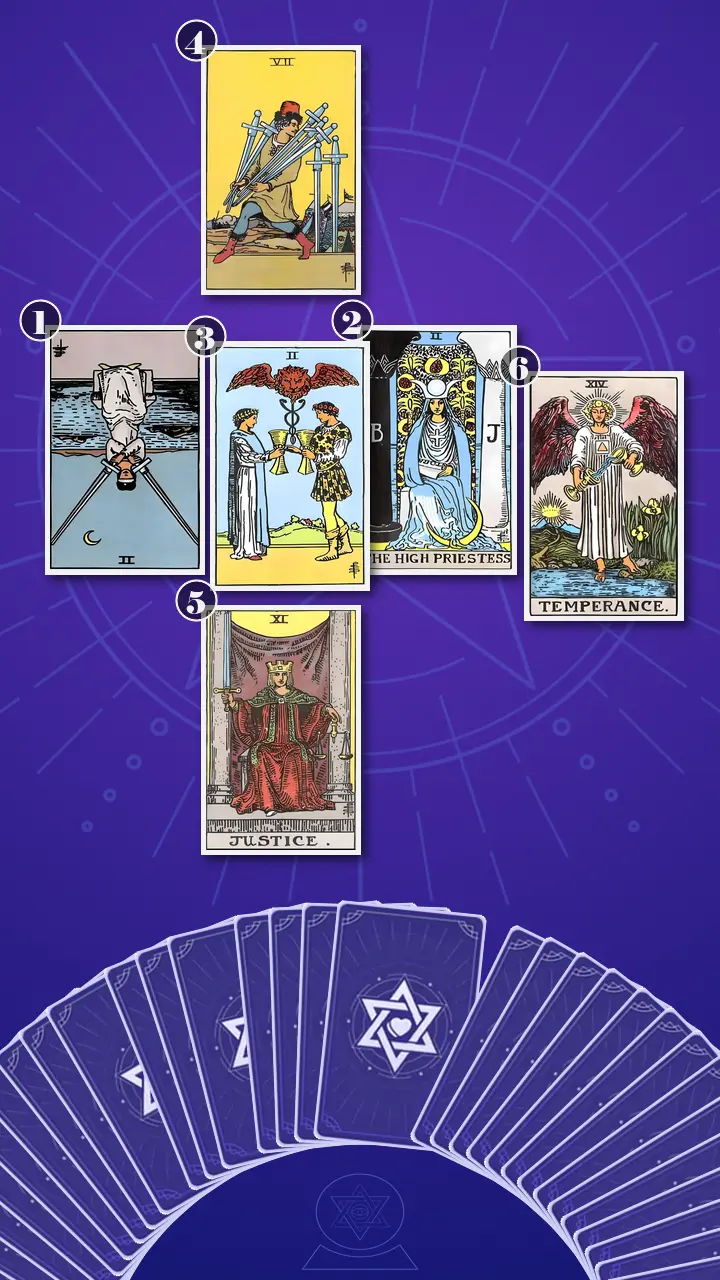
Reading the Map: From Veils to Micro-Signals
Position 1: Your relationship-to-visibility — Two of Swords (reversed)
I turned over the first card. “Now revealed is the card representing your relationship-to-visibility: what you need online to feel respected and secure,” I said. “It’s the Two of Swords, in reversed position.”
I tapped the image gently—blindfold slipping, swords crossed tight across the chest. “Here’s the lived version of this card,” I told Alex, keeping it real and specific: You’re on your couch after work, still half in “brand voice” from your marketing job, trying to act unbothered. You’ve got a soft-launch photo in drafts with three captions, but instead of posting or asking directly, you keep toggling between their profile and your own Story composer. The blindfold slipping is that moment you realize: you already know guessing is making you miserable—yet you’re still choosing the safest-looking silence.
“This is Air energy—thought, analysis, narratives—stuck in a blockage,” I continued. “Reversed, it’s not calm neutrality. It’s pressure building. Two competing scripts run in your head like split-screen.”
I let my voice mirror what I knew they heard in themselves:
Script A:Be chill. Don’t make it a thing. Don’t be cringe.
Script B:Ask for clarity. Ask for terms. Stop living in drafts.
“And the action loop that follows,” I said, “is so concrete it could be a screen recording: draft, delete, check their Story ring, re-check, rewrite a caption, close the app. Short-term relief because you avoid an awkward conversation today. Long-term cost because the ambiguity grows teeth.”
Alex gave a small laugh that wasn’t amusement—it was recognition with a bite. “That’s… wow,” they said. “That’s exactly what I do at night. It’s kind of cruel how accurate that is.”
“I hear you,” I replied. “But accuracy can be merciful if it leads us to the right next sentence. This card doesn’t say you’re needy. It says you’re trying to protect yourself—and the protection is accidentally blocking the clarity you need.”
Position 2: Their intention behind “soft launch” — The High Priestess (upright)
“Now revealed is the card representing their intention behind ‘soft launch’: what privacy or pace is trying to protect or control,” I said. “We have The High Priestess, upright.”
High Priestess is privacy, yes—but not always secrecy. I pointed to the veil and pillars. “Here’s the modern-life translation,” I told Alex: They say “soft launch” the way someone says “I don’t want strangers in my business.” Their privacy might be sincere—less performance, more protection. But the High Priestess problem is translation: if they won’t define what ‘low-key’ means in real behaviors (tags, introductions, what they’ll say if asked), you’re left reading tea leaves in Stories instead of having a shared plan.
“This is Water energy in a balance—intuition, boundaries, what’s sacred,” I said. “But when Water doesn’t get translated into language, Air tries to compensate. That’s where your mind starts scanning micro-signals like it’s doing ‘research.’”
I watched Alex’s shoulders lift slightly, then lower. They weren’t relaxing; they were adjusting to a new possibility: that the other person’s ‘low-key’ might not be a verdict on Alex’s worth, but it still needed terms.
“The question isn’t ‘Are they hiding me?’” I added. “It’s: ‘Are we choosing privacy on purpose, or drifting into secrecy by default?’”
Position 3: What’s real offline — Two of Cups (upright)
“Now revealed is the card representing what’s real between you two offline: the connection that exists regardless of posting,” I said. “It’s the Two of Cups, upright.”
Before I even explained, Alex’s face softened in a way that made the whole screen feel warmer. Two of Cups does that—it’s not about performance; it’s about mutual recognition.
“This is the anchor,” I told them, and I made it concrete: Offline, it’s real: they text back, they make plans, they show up, you feel chosen in the small ways that don’t fit into a grid post. Two of Cups is the reminder that your conversation isn’t about forcing visibility—it’s about protecting mutuality so social media doesn’t become the relationship’s scoreboard.
“Water energy here is in balance,” I said. “Mutuality exists. That matters because it reframes the boundary conversation. It’s not a test—maintenance.”
I could almost see Alex replaying a scene: fries in Williamsburg, an inside joke, being remembered. They exhaled like they’d been holding air at the top of their lungs without realizing.
“Okay,” they murmured. “Maybe I can talk about this without making it a fight.”
“Exactly,” I said. “Two of Cups says: approach this as teamwork, not prosecution.”
Position 4: The core friction — Seven of Swords (upright)
“Now revealed is the card representing the core friction: where secrecy, ambiguity, or mixed signals are creating stress,” I said. “It’s the Seven of Swords, upright.”
The figure on the card carries blades away and looks back over their shoulder. I didn’t sensationalize it. I grounded it in what Alex already knew.
“Here’s the modern scenario,” I said: The stress point is that posting has turned into strategy: cropped frames, no tags, vague captions, and just enough closeness to keep you invested—without any shared clarity. You start monitoring because the information is uneven. This isn’t about proving they’re ‘bad’; it’s about naming the corrosive dynamic: selective visibility without consent creates a trust tax you end up paying every time you open the app.
“This is Air energy in excess but in shadow form,” I explained. “Strategy, selective disclosure, managing perception. And when one person controls the ‘privacy settings’ alone, the other person becomes a detective.”
I gave Alex a receipt-style list—not to inflame them, but to validate how the mind gets hijacked:
“Tags. Captions. Close Friends vs main feed politics. Who they follow. Who they like. Whether you’re cropped out as a shoulder. Whether they introduce you with context. Whether they say ‘you’re overthinking’ when you ask.”
“The pain isn’t the lack of a post,” I said. “It’s the unequal control of the story.”
Alex swallowed. Their jaw tightened, then released. “The cropped shoulder thing is so real,” they said quietly, and for a second their eyes looked wet, like they were embarrassed to be affected by something so modern and so stupid—and yet so loaded.
“It’s not stupid,” I replied. “It’s belonging. The app is just the stage where the belonging question gets amplified.”
When Justice Spoke: The Scales Check
Position 5 (Key Card): The boundary to set now — Justice (upright)
I let the room—my small studio, Alex’s bedroom, the invisible bridge between us—go a touch quieter. Even the AC hum seemed to fade behind the moment.
“Now revealed is the card representing the boundary to set now: the clearest, fairest rule you can propose,” I said. “This is the heart of the reading. It’s Justice, upright.”
Justice sits straight. Scales in one hand. Sword in the other. No drama—just structure.
I gave them the modern-life translation first: You stop trying to win the soft launch and instead propose terms: ‘I’m okay with privacy, and I need us to be aligned. No denial if friends ask. No misleading posts. And if we’re going to stay low-key online, I need an offline commitment we both treat as real.’ Justice looks like calm eye contact, a simple checklist, and the dignity of not having to decode.
“Justice is Air energy in balance,” I said. “Not anxious Air. Not strategic Air. Clean Air. Clear language. Fair terms.”
As a perfumer, I’ve spent years learning that balance isn’t a vibe—it’s a formula. In Paris, my early training was brutal in the best way: too much jasmine and the whole thing turns loud; too little and the heart disappears. I’d stand over blotters, adjusting by a single drop, because clarity in a fragrance is structure, not wishful thinking. That’s what Justice is asking of you here: a structure that holds your dignity so your nervous system doesn’t have to keep adjusting by the drop all night.
And this is where my own toolkit clicked in—a way that wasn’t mystical, just oddly precise. “Alex,” I said, “I want to use something I call my Emotional Repair Pathway. It’s a phased system I use when intimacy needs a rebuild after a trust-tax moment—like this soft-launch limbo.”
“Phase one is Name: the clean sentence. Phase two is Agree: the shared terms. Phase three is Practice: the paced follow-through. Justice is Phase Two. It’s the agreement that stops you from negotiating your worth through hints.”
Alex nodded once, sharp—like their mind wanted to argue, but their body said yes.
Setup
It’s midnight, you’re staring at the same draft photo again, and your throat tightens because you can’t tell if you’re being “private” or being hidden. You keep thinking, If I ask, I’ll look needy. If I don’t ask, I’ll stay in this weird gray zone. So you do the one thing that feels safe: you keep scrolling for proof.
Delivery
Stop negotiating your worth through hints and half-posts—set a clear agreement like Justice’s scales and let the boundary do the protecting, not your overthinking.
Reinforcement
Alex’s breathing paused—one beat too long. Their eyes went slightly unfocused, like their brain had started replaying a week of Story rings and drafts and “it’s fine” texts on fast-forward. Then their shoulders dropped, not in relief exactly, but in that heavy way a body lets go when it realizes it has been holding tension on credit.
They pressed their lips together, and the corners trembled for a second. “But if I say it that clearly,” they said, a flash of heat in their voice, “doesn’t that mean I’ve been doing this wrong? Like… I’ve been making myself small and then blaming them for not seeing me.”
The anger was clean. Protective. Honest. I respected it.
“It means you were coping,” I said. “Two of Swords coping. And it makes sense—you’re conflict-avoidant, you work in a world where perception is everything, and you didn’t want to scare them off. But Justice isn’t about you being wrong. It’s about you being done paying the trust tax.”
I held the moment gently but firmly. “Now—using this new lens—think back to last week. Was there a specific moment where you checked their Story ring, felt that stomach clench, and thought, I hate that an app is deciding how secure I feel? How would that moment have changed if you already had an agreement?”
Alex blinked, slow. Their eyes returned to the camera. “Thursday,” they said. “They reposted a friend’s birthday thing. I was… not in it. I remember my throat tightening and then I went straight to drafts.” They swallowed. “If I had an agreement, I wouldn’t have made it mean I’m unwanted. It would’ve just been… a Story.”
“That’s the shift,” I said. “Not from craving attention to being ‘chill.’ From decoding to consent-based terms. From self-doubt to grounded self-respect. This is you moving one step from that uneasy starting state toward the desired steadiness: privacy chosen on purpose, not used as a fog machine.”
I added, because it mattered: “The boundary isn’t the post. The boundary is the agreement.”
The Scales Check (a screenshot-worthy version)
I slid the idea forward like a clean piece of paper across a table. “Here’s what Justice looks like in words—two or three terms you can repeat in the same language,” I said.
Privacy by consent. Not secrecy by default.
No denial / no misleading: if asked, neither of you minimizes what you are.
Public-language agreement: you decide together what you’ll say when friends ask “Are you two official?”
Timeline check-in: pick a date to revisit what ‘low-key’ means and whether it still fits both of you.
Position 6: How the boundary evolves when practiced — Temperance (upright)
“Now revealed is the card representing how this boundary evolves when practiced: the tone and pacing that makes it sustainable,” I said. “It’s Temperance, upright.”
I softened my voice here, because Temperance is gentle but not vague. “Here’s the modern-life version,” I said: Instead of a dramatic ‘hard launch’ moment, you practice consistency: a paced, mutual plan that you revisit in a couple weeks. Maybe it’s Close Friends now, a clear label in real life, and a shared check-in date. Temperance is the relationship rhythm that keeps you from swinging between ‘hint-posting’ and ‘deleting the apps’—slow, agreed, and sustainable.
“Temperance is integration,” I continued. “Energy in balance. Slow is fine. Fog isn’t.”
Then, because I’m me—and because sensory psychology can turn an idea into something your body remembers—I offered a practical, grounded add-on from my perfumer’s world. “If you want a tool that helps you hold the boundary without spiraling,” I said, “use a scent anchor.”
“Pick one simple scent you associate with calm and self-respect—maybe a clean musk, maybe something like bergamot, maybe even the smell of your shampoo that makes you feel put-together. Wear it the day you have the conversation. It’s not magic. It’s conditioning. It tells your nervous system: This is the version of me who speaks plainly.”
Alex’s expression shifted—curious, relieved, slightly amused. “That’s… actually kind of genius,” they said. “Like giving my body a cue that it’s safe.”
“Exactly,” I replied. “Temperance is the slow pour between cups. We’re giving you a steady drip coffee, not an espresso shot.”
From Insight to Action: A Consent-First Soft Launch
I leaned back and stitched the spread together into one coherent story, the way I would build a fragrance accord: top note, heart, base—each one explaining the next.
“Here’s what the cards say in plain language,” I told Alex. “You’re starting from a split inside you—part of you wants to be chill, part of you wants clarity—and that split is keeping you in a loop of drafting, deleting, and clue-hunting (Two of Swords reversed). They may genuinely value privacy, but they haven’t translated it into behaviors you can consent to, so you’re left interpreting silence (High Priestess). Meanwhile, the connection itself is real and mutual offline (Two of Cups)—which is why this hurts; there’s something worth protecting. The real corrosion is strategic ambiguity: selective visibility that makes you pay a trust tax and turns you into a detective (Seven of Swords). The way out is Justice: a clear, fair agreement—privacy by consent, not secrecy by default—followed by Temperance: paced, sustainable integration.”
“Your blind spot,” I added gently, “is that you’ve been treating social media like a judge and jury—like if you can just find the right post, you’ll finally get a verdict. But Instagram can’t give you consent. Only the two of you can.”
“The transformation direction is clear,” I said. “Shift from decoding social media to naming your boundary plainly and asking for a shared agreement you can both stand behind.”
- The Two-Line Boundary (Non-negotiable + Flexible)Open your Notes app tonight and write exactly two lines: (1) one non-negotiable (e.g., “No denial—if friends ask, we don’t minimize what we are.”) and (2) one flexible piece (e.g., “Posting timeline can be gradual.”). Bring only those two lines into the conversation.If your throat tightens, time-box it: write the two lines in 3 minutes. Stop. Don’t perfect it like a caption.
- The One-Sentence Clarity AskSend (or say) this clean opener: “I’m okay with privacy, and I’m not okay with ambiguity. Can we agree on what ‘soft launch’ means for us?” Use it verbatim—no preamble, no jokes, no hinting.Practice it once out loud with a 5-minute timer. One rep counts. You’re building muscle, not performing confidence.
- The Public-Language Agreement (So You’re Not Flinching in Group Settings)Propose one shared line for real life: “Yeah, we’re dating—we’re keeping it low-key online for now.” Agree to use that exact sentence if a friend asks, “Are you two official?”If they hesitate, don’t debate. Ask: “What part doesn’t feel true for you?” That answer is data.

A Week Later: The Quiet Proof
Six days later, I got a message from Alex while I was blotting a strip of neroli in my studio—bright, clean, the kind of scent that makes you sit up straighter without realizing.
“I did it,” their text said. “I used the exact sentence. My throat still got tight, but I didn’t back out. They admitted ‘low-key’ was just them avoiding being asked questions. We agreed on what we’ll say if friends ask. We set a check-in date. Also… I moved Instagram off my home screen. I still want to check, but it’s not running my night.”
It wasn’t a fairytale. There was still tenderness in the new clarity—like stepping out of a dark movie theater into daylight and blinking hard. Alex told me later they slept through the night for the first time in weeks, and in the morning their first thought was still, What if I scared them off?—but this time they noticed the thought, exhaled, and didn’t open the app to soothe it.
That’s the Journey to Clarity I trust the most: not certainty, but ownership. Not a perfect launch, but a consent-based boundary that makes you stop guessing.
When you’re trying to be “chill” while your stomach clenches every time you open Instagram, it’s not the app that hurts the most—it’s having to guess whether you’re being included.
If you let yourself stop decoding for one week, what’s the one clean sentence you’d want to be able to say—out loud, directly, and without apologizing for needing clarity?