The EOB Email That Exposed My Therapy—and the Boundary I Finally Spoke

Finding Clarity in the 12:06 a.m. Portal Scroll
If you’re a 20-something NYC professional who can lead a meeting but still freezes when your parent’s name pops up next to an insurance EOB, this is your exact flavor of “adult but not really” shame.
Alex (name changed for privacy) showed up to our session with that specific kind of New York tired—the kind that looks functional until you notice the way someone’s jaw never quite unclenches. She’d taken the call from her Brooklyn sublet, laptop already open like it had been waiting for us.
“It’s so stupid,” she said, and immediately shook her head like she was trying to erase the sentence. “My parents saw a therapy claim. Like… the insurance thing. And now it feels like my brain is… stuck.”
She described the scene like it was a looped clip: 12:06 a.m., the insurance portal in one tab, her Notes app in another, and that cold blue light that makes your own hands look unfamiliar. Her phone warm from doom-scrolling. A claim line item she kept clicking like it would morph into something less humiliating if she stared long enough. When her mom’s name popped up, her chest tightened and her teeth pressed together so hard she got a headache in her temples.
“I’m an adult,” she said, eyes flicking to the corner of her screen. “But this makes me feel like I’m twelve. I don’t mind them caring, I mind them having access. And if I say the wrong thing, it turns into a whole thing.”
I nodded, slow and steady, the way I do on-air when a caller starts minimizing a real ache. “You’re not being dramatic—you’re reacting to a system where money quietly turns into access.”
In my studio, the small one I rent off a noisy avenue, the acoustic panels did their job: the city softened into a hush. I watched Alex’s shoulders—still lifted, still braced—as if the next notification could be a verdict.
“Let’s make today simple,” I told her. “Not easy—simple. We’re going to separate access from conversation, logistics from privacy, and come out with a clean boundary you can actually hold. A Journey to Clarity. No courtroom speeches required.”

Choosing the Compass: A Relationship Spread for Medical Privacy
I asked Alex to take three breaths with me—nothing mystical, just a nervous system handoff from frantic to present. While she exhaled, I shuffled slowly, the sound of cards a dry, steady whisper—like turning pages rather than predicting fate.
“Today I’m using a Relationship Spread,” I said. “Not because this is about romance—because the core issue is relational boundary-setting under a shared financial system.”
For anyone reading along and wondering how tarot works in moments like this: I’m not trying to forecast whether Alex’s parents will react perfectly. I’m using the spread as a decision map. This layout cleanly separates (1) Alex’s current coping reflex, (2) her parents’ default stance, (3) the shared money/insurance dynamic that’s blurring consent, and then (4–5) what each side actually needs—before we land on (6) the most balanced, enforceable next step.
“Think of it like audio mixing,” I added, because it’s the language I live in. “If everything is blasting at once—shame, fear, anger, logistics—you can’t hear the lead vocal. This spread helps us isolate the tracks.”
I pointed to the key positions we’d lean on: “The first card shows what you’re doing on autopilot since the privacy breach. The center card will name the real blockage—the power dynamic. And the final advice card will give us a policy-level boundary, not a perfect explanation.”
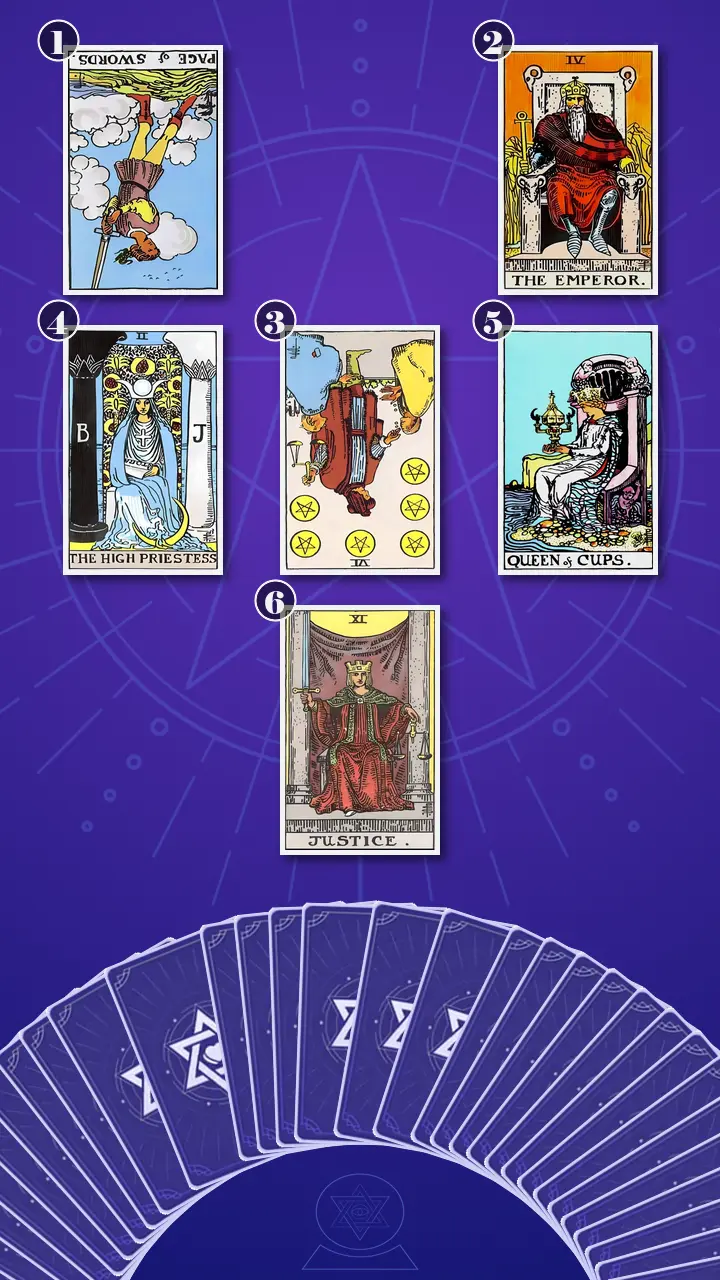
Reading the Map: Six Cards, One Real Boundary
Position 1: Your immediate reaction and coping behavior since the privacy breach
“Now we turn over the card that represents your immediate reaction and coping behavior since the privacy breach—what you’re doing on autopilot,” I said, and flipped the first card.
Page of Swords, reversed.
“This is… brutal,” Alex let out a small laugh that didn’t reach her eyes. “Like, too accurate.”
I kept my voice steady. “It’s after midnight and you’re treating the insurance portal like a threat dashboard: refreshing claim details, scanning codes, and rehearsing replies in your head. You’re trying to regain safety through information and perfect wording—but it keeps your body in ‘on alert’ mode, like the conversation is already happening and you’re already losing.”
As an energy state, Page of Swords reversed reads like Air in excess: too many thoughts, too much scanning, not enough ground. The raised sword in the wind isn’t a calm tool; it’s a reflex—ready to defend before anyone speaks.
I leaned in a little. “I want to name the open tabs I’m hearing.”
“Portal tab,” I said. “Notes tab. Imagined conversation tab. And then the secret tab underneath: ‘If I don’t write this perfectly, I’ll get judged or controlled.’”
Alex’s fingers tightened around her mug, then loosened. She gave one tight nod—the kind that says, yeah, that’s exactly what I’m doing at night.
“More information won’t equal more safety here,” I said gently. “Not when the real need is a boundary.”
Position 2: Your parents’ stance and the role they default to
“Now we turn over the card that represents your parents’ stance and the role they default to in this situation,” I said.
The Emperor, upright.
“Administrator mode,” I said, before Alex could even speak. “Your parents are in ‘administrator’ mode: they believe handling logistics—insurance, paperwork, plans—gives them a reasonable right to visibility and questions. Even if they call it concern, the default posture is oversight—like they’re still the manager of the system, and you’re still the dependent user.”
The Emperor is structure and authority in balance—until you’re on the receiving end of it and it feels like a locked door. His armor under the robe is the tell: protection that can land as rigidity.
Alex exhaled through her nose. “My dad literally said, ‘We just want to make sure everything’s okay, because we handle the plan.’ Like that sentence is supposed to end the discussion.”
“That’s Emperor language,” I said. “Rules equal safety. And in their world, access can feel like responsibility.”
Position 3: The money/privacy power dynamic created by shared insurance
“Now we turn over the card that represents the money/privacy power dynamic created by shared insurance—the place where the boundary gets blurry,” I said, and placed the third card in the center.
Six of Pentacles, reversed.
I watched Alex’s throat move as she swallowed. This card has gravity for anyone who’s ever felt “help” come with invisible fine print.
“The shared insurance plan has created a quiet power tilt,” I said. “Coverage feels like a gift with strings, and you start acting like privacy must be purchased with full transparency. You feel torn between ‘I’m grateful’ and ‘I’m exposed,’ and the ambiguity keeps you stuck—resentful, guilty, and still not protected.”
Six of Pentacles reversed is Earth out of balance: the system of support isn’t clean, so your nervous system treats every question like a bill you owe. It’s like being added to a shared workspace where someone else is still the owner—and you can see the activity log, so you start living like you’re always being watched.
Alex’s eyes dropped to the lower corner of her screen—where, I knew, her budgeting spreadsheet lived. “My rent just went up,” she said quietly. “And my loans. Everyone says ‘just get your own plan,’ like it’s… a neutral option.”
I nodded. “That’s the shame math this card points to: If I need help, I owe access. And it’s not true—but it’s powerful.”
She let out a breath she’d been holding, small but real. “Exactly,” she said. “Privacy starts feeling like a privilege.”
Position 4: What you actually need to feel respected and safe
“Now we turn over the card that represents what you actually need to feel respected and safe—your non-negotiable privacy line,” I said.
The High Priestess, upright.
“You don’t need a better cover story—you need your ‘inner room’ back,” I said. “This is the moment you realize therapy is health information, not a family group chat topic. You’re allowed to choose discretion: what you share is a decision, not a confession.”
High Priestess is Water in balance: quiet, self-contained, not defensive. The veil and the scroll are basically a visual reminder that some information is meant to be protected—not performed.
I asked Alex, “Put one hand on your chest for a second. When you imagine saying, ‘I’m keeping this private,’ where does your body tense first—jaw, throat, shoulders, stomach?”
She did it, and her shoulders dropped about half an inch. “Throat,” she said. Then, after a beat: “And… stomach.”
“Good data,” I said. “Not a moral failing. Data.”
Outside my window, a siren dopplered past—loud for a moment, then gone. The room felt like it got quieter after. Environment co-conspiring with the card: noise passing, the inner room returning.
Position 5: What they may be needing underneath their behavior
“Now we turn over the card that represents what they may be needing underneath their behavior—without giving them control,” I said.
Queen of Cups, upright.
“Under the intrusive questions is often a simpler need: reassurance,” I said. “They may be trying to feel close, helpful, less scared—so they reach for details. You can meet the emotion without giving them the file: ‘I’m okay and supported’ is not an invitation to interrogate.”
Queen of Cups is Water in abundance—care, attunement, emotional bonding. But that closed cup matters. It’s literally a symbol for care that wants closeness… and still doesn’t automatically get access.
I looked at Alex. “You can offer reassurance without handing over receipts.”
Her mouth twitched like she almost smiled. “That’s… the option I keep forgetting exists.”
When Justice Held the Scales Steady
Position 6: The most balanced boundary to set and how to communicate it
I slowed down before the last card. “We’re about to turn over the advice card,” I said. “This is the one that tells us how to move from feeling watched… to having terms.”
Justice, upright.
“You set a policy-level boundary that separates logistics from your inner life,” I said. “Being on the plan doesn’t equal permission to ask about therapy. You deliver it calmly, in two sentences, and you repeat it without debating. If they cross the line, you end the interaction. Clean terms create dignity—without requiring you to ‘win’ their understanding.”
Justice is Air in balance: clear language, clean lines, accountability. Not harsh—precise. Like an auto-reply that doesn’t change depending on the mood of the inbox.
And this is where my own work always comes in—the part of me that’s spent years studying how sound shifts us before meaning even lands. “Alex,” I said, “I want to use one of my tools here. I call it Generational Echo.”
“Okay,” she said, cautious but curious.
“In every family, there’s a ‘default soundtrack’ for stress,” I said. “Not literally music—though sometimes it is. More like: what happens when things feel scary? Do people clamp down, get loud, go silent, fix things, ask questions, demand proof?”
She blinked, and I watched the recognition arrive. “In my parents’ house,” she said slowly, “it’s always… the news. Always on. Like, if something’s happening, you monitor it.”
“Exactly,” I said. “That’s the echo. Monitoring equals caring. And when your insurance system gives them a dashboard, they treat it like a news feed: they refresh it because they think that’s love.”
“But Justice says adulthood is not ‘who cares more.’ It’s who has what access.” I tapped the card gently. “Stop trying to manage what they know. Decide what access they get.”
Setup. Alex was still caught in that instant when an EOB email hits and the body reacts first—tight chest, clenched jaw—and suddenly she’s back in the portal like it’s the control panel for her dignity. Her brain kept insisting: If I could just explain therapy in the most reasonable way… maybe they won’t react.
Delivery.
Stop trying to win the conversation with the perfect justification; start setting a fair policy you can stand behind, like Justice holding the scales steady.
There was a beat of silence. The kind that would be “dead air” on the radio—except in a studio, dead air can be holy. I could hear my own HVAC kick on. Alex didn’t move.
Reinforcement. I watched the reaction chain happen in layers: first, a small freeze—her breath paused mid-inhale, like she’d been startled. Then her eyes unfocused, not drifting away from me, but inward, as if her brain was replaying every drafted message that tried to convince, soften, justify. Then her shoulders sank, slowly, like she’d been holding up a weight she didn’t realize was optional. Her jaw worked once, unclenching. Her voice came out thinner than before. “But… if I’m not explaining,” she said, and there was a flash of anger behind it, “doesn’t that mean they’ll think I’m hiding something?”
I didn’t rush her. “It might,” I said plainly. “And that’s the hard truth of Justice: you can’t control their conclusions. What you can control is your policy. A boundary isn’t a TED Talk. It’s a policy you can repeat.”
Alex’s eyes watered, not a full cry—just that bright edge of relief mixed with grief. “I hate that this is even a thing,” she whispered.
“Of course you do,” I said. “And this—right here—is the emotional pivot I want you to notice. This isn’t just about one claim. It’s a shift from shame-driven hypervigilance to policy-level clarity and grounded self-respect. It’s the first step toward consent-based privacy.”
I asked her, exactly as I always do at the Justice moment: “Now, with this new lens—policy over persuasion—can you think of one moment last week where this would’ve changed how you felt?”
She stared at the card, then nodded once. “Sunday,” she said. “My dad asked, ‘So what was that claim?’ and I started… building a case. If I’d had a policy, I could’ve just… said it. And stopped.”
The Justice Script: Actionable Advice That Doesn’t Require Overexplaining
I gathered the whole spread into one story for her, clean and connected: Page of Swords reversed shows the spiral—checking, drafting, rehearsing—as a substitute for an actual boundary. The Emperor shows the parental default: authority-as-care, especially around systems they administer. Six of Pentacles reversed is the core snag: support that feels like leverage, making privacy feel like a privilege you must earn. High Priestess brings the inner truth—discretion as self-respect, not secrecy from shame. Queen of Cups reminds us: their questions may be rooted in worry, and you can acknowledge care without opening the vault. Justice is the grown-up move: fair terms, spoken plainly, backed by follow-through.
The cognitive blind spot I named for Alex was simple: she’d been treating the problem as a messaging problem—find the perfect explanation—when it was actually a permissions problem—define access. The transformation direction was equally clear: move from managing perception to setting consent-based boundaries.
Then I gave her next steps—small, specific, and doable in a high-stress week.
- The Two-Sentence Boundary (60 seconds a day)Open your Notes app. Write two sentences: (1) appreciation for the coverage, (2) a clear limit. Read it out loud once a day for 60 seconds with a timer. Example: “I appreciate the coverage. I’m keeping my health care private, so I won’t discuss therapy details, and I need you not to ask.”Your brain will insist you need the “perfect” wording. That’s Page-of-Swords energy—your cue to go shorter, not longer.
- One Channel, One Container (15 minutes)Pick one channel: one phone call OR one text. Set a 15-minute container with a planned exit line: “I’m going to hop off now—thanks for hearing me.” If they push for details, repeat your boundary once, then use the exit line.If guilt shows up (“After everything we do…”), remind yourself: “Gratitude doesn’t equal unlimited access.”
- The Access Audit + One Real Call (20 minutes)Do a 20-minute audit: who has logins (insurance portal, shared email, employer benefits site), where EOB notifications go, and what you can change this week (passwords, 2FA, mailing address, notification settings). Then call the insurer or HR benefits line and ask: “What options do I have to keep EOBs/claim communications confidential or directed to me?” Write down the answer + date + rep name.If calling feels intimidating, do the smallest version: draft the question, dial, hang up if you need to, then try again later. Practice is still progress.
Before we ended, I added one of my favorite practical supports from my sound-based toolkit—my Soundproof Barrier strategy. “Before you practice the script,” I told her, “put on noise-canceling headphones or play steady brown noise or a low-tempo playlist. Not to hide—just to give your nervous system a contained space, like closing a studio door so you can record cleanly.”
“And if you want a tiny ‘conflict mediation’ assist,” I added, “choose music around 60–70 BPM—something that keeps your breathing slower than your panic. You’re not trying to become fearless. You’re training consistency.”

A Week Later: The Quiet Proof
Eight days later, I got a voice note from Alex while I was editing a segment for my radio show. Her message was short, a little shaky, and proud in that understated way New Yorkers do when they don’t want to jinx it.
“I called the insurer,” she said. “It sucked, but I did it. And I sent the two sentences. My mom tried to ask what it was ‘for,’ and I did the reassurance line. Then I ended the call when she pushed again. I didn’t explain. I just… repeated it.”
She paused, then added, quieter: “I slept. Like, a full night.”
Clear but not perfect: she told me the next morning she still woke up with the thought, What if I handled it wrong? Then she made coffee, reread her two sentences once, and her shoulders dropped anyway.
I sat back in my chair and let that land. This is what finding clarity often looks like in real life: not fireworks—just the nervous system learning, one clean line at a time, that adulthood isn’t proved by secrecy. It’s built through consent, access, and follow-through.
When money and access are tangled, it can feel like your whole adulthood is on trial—so you keep your chest tight and your words rehearsed, hoping you can be private without being punished for it.
If you didn’t have to earn privacy with a perfect explanation, what would your simplest two sentences be—just for you, just to start?
Every reading at AceTarot is a Journey to connect with inner wisdom and empower next step.
Learn more about our Journey to Clarity.