From Getting Talked Over at Brunch to Calm Re-Entry: One Boundary Line

The 11:38 a.m. Brunch Table That Swallows Sentences
If you’re the kind of NYC early-career person who can present in meetings but still gets talked over at brunch—and then you spend the subway ride home replaying it like a highlight reel—this is for you (hello, people-pleasing + Comparison Fatigue).
Taylor (name changed for privacy) slid into the chair across from me like she was trying not to take up too much space in my little studio corner—one of those rented rooms near Union Square where the air always smells faintly like oat-milk lattes and printer ink.
She didn’t even start with the “big feelings.” She started with the moment.
“It’s always brunch,” she said. “West Village, loud table, and I’m mid-sentence and someone just… barrels in. And I smile. Like, my fork is literally hovering over eggs and I’m smiling like an NPC.”
As she spoke, I watched her jaw do that almost-invisible clench that happens when someone is holding words behind their teeth. Her throat moved like she was swallowing something that wasn’t food. The frustration wasn’t abstract—it sat in her body like a door stuck on a latch: tight throat, tight jaw, breath held high, heat blooming up her face the second she got cut off.
“At brunch, when I’m talked over,” she said, “what’s my next boundary step? I’m not trying to dominate the conversation. I just want to finish one sentence. But if I interrupt back, I’m scared it’ll sound like I’m making it a thing.”
I nodded, slow and steady. “That makes so much sense. We’re going to treat this like a micro-moment problem, not a personality problem. Let’s try to map the pattern so you can find clarity—and a next step that doesn’t require you to become louder or harsher than you are.”

Choosing the Compass: A Horseshoe Tarot Spread for Being Interrupted
I invited Taylor to take one long inhale, one long exhale—nothing mystical, just a nervous system handoff from “brunch replay mode” to “we’re here, now.” While she breathed, I shuffled slowly, the way I do before a live radio segment when I’m listening for the signal under the noise.
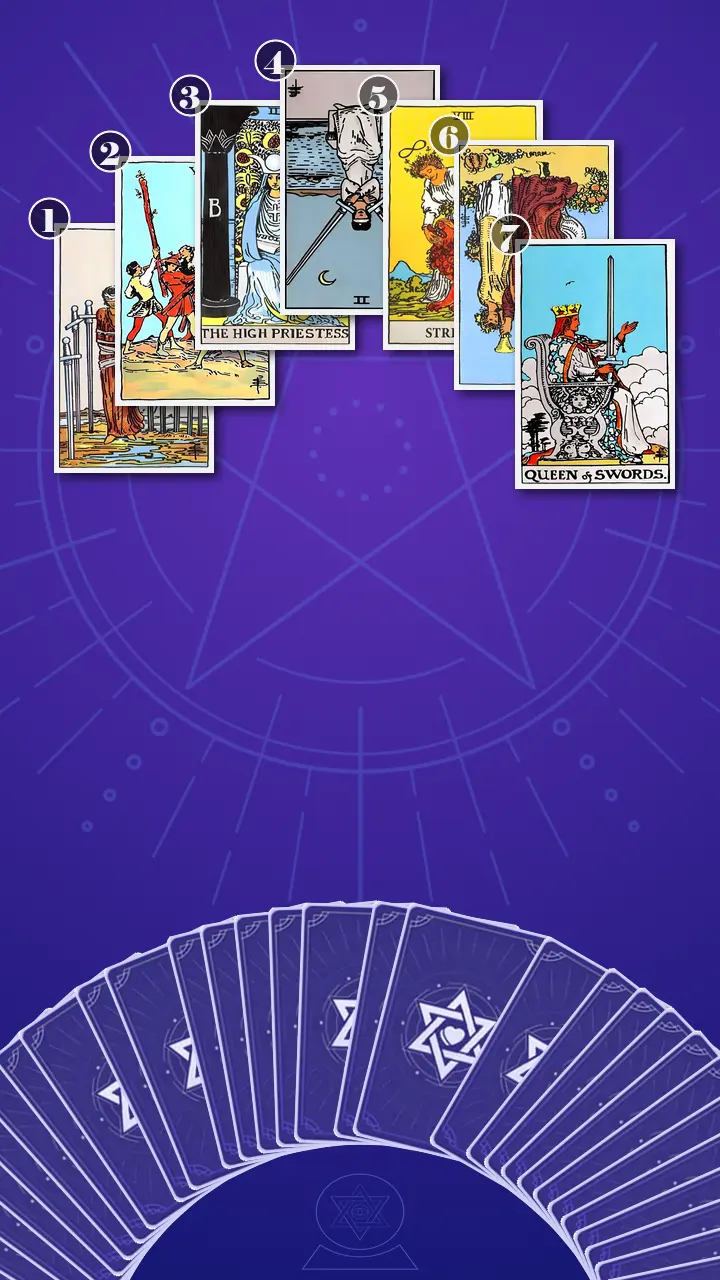
“Today, we’ll use a classic Horseshoe Spread,” I told her, laying the cards in a gentle arc. “It’s one of my favorite spreads for fast, repeating social moments—especially when you’re feeling stuck in the same scene over and over.”
For you reading along: the Horseshoe Spread works because it tracks a pattern across time and pressure. It goes past conditioning → present group dynamic → the hidden truth you’re already sensing → the split-second internal obstacle, then pivots into the best boundary posture, the external social context, and the likely direction if you practice a new move. It’s basically a relationship-and-communication GPS for those moments where there’s no formal turn-taking rules, just vibe and momentum.
“A couple positions matter most for your question,” I added, tapping the arc lightly. “This first card will show what trained you to yield the floor. The center card is the pinch point—what happens in the exact half-second you freeze. And this one—here—will show the posture that helps you hold your ground without escalating the vibe.”
Reading the Arc: The Pattern Behind the Polite Smile
Position 1: What earlier experiences taught you to go quiet — Eight of Swords (upright)
“Now flipped over,” I said, “is the card that represents what earlier experiences taught you to go quiet or yield the floor when someone talks over you.”
Eight of Swords, upright.
I pointed to the blindfold and the loose bindings. “This card is the feeling of being trapped—except the trap isn’t actually locked. In modern life terms, it’s like you’re at brunch and the second someone talks over you, your body reacts like there’s a rule you can’t break: you freeze, keep your face pleasant, and internally decide you’ve ‘lost your turn.’ Later, you replay it on the subway like it was a test you failed.”
Energetically, this is blockage disguised as “being nice.” Your voice isn’t missing—you’re just on a learned version of Low Power Mode. Everything technically works, but you keep dimming yourself to conserve social battery.
Taylor let out a short laugh that didn’t reach her eyes. “That’s… horrifyingly accurate,” she said, like she was impressed and annoyed at the same time. “It’s true. My brain is like, ‘Welp, you lost your chance.’ Like it’s a law of physics.”
“Exactly,” I said. “And the Eight of Swords always asks: what’s the smallest action that proves you’re not actually powerless?”
Position 2: The current brunch dynamic — Five of Wands (upright)
“Now flipped over,” I said, “is the card representing the current, observable brunch dynamic: how the interruption pattern is actually playing out in real time.”
Five of Wands, upright.
“Okay,” I said, and I kept my voice deliberately matter-of-fact. “This is chaos energy. Overlapping side conversations, fast banter, one or two people taking airtime by momentum. It’s not necessarily targeted. It’s like The Bear—everyone talking at once, and the chaos isn’t personal. It’s the room.”
Energetically, this is excess: too much fire, too many voices, no structure. And here’s the line I want you to pocket: A loud table is a system problem, not a personality verdict.
Taylor’s shoulders dropped by about half an inch. “That’s… relieving,” she said. “Because I keep making it mean I’m bad at this.”
“You’re not bad,” I said. “You’re navigating an environment where ‘turn-taking’ doesn’t exist unless you create it.”
Position 3: The hidden need you’re sensing — The High Priestess (upright)
“Now flipped over,” I said, “is the card representing the hidden need or unspoken truth you’re already sensing but not naming when you get interrupted.”
The High Priestess, upright.
“This is your inner knowing,” I said, tapping the scroll in her lap. “In the exact second you’re interrupted, you already know two things: one, that was an interruption. Two, what you need—something as simple as finishing your sentence. But you start doubting whether your perception is ‘valid enough’ to name out loud, so you default to silence.”
Energetically, the High Priestess is balance—quiet, accurate signal under the noise. She’s the part of you that doesn’t need a long explanation. She needs one plain sentence.
Taylor stared at the card a beat longer than the others. “I always know,” she admitted. “It’s immediate. And then I talk myself out of it.”
“That’s the difference between intuition and editing,” I said. “Your intuition is fast. Your people-pleasing is faster.”
Position 4: The split-second block — Two of Swords (reversed)
“Now flipped over,” I said, “is the card representing the main internal block in the moment—the split-second pattern that stops you from taking your next boundary step.”
Two of Swords, reversed.
“This is the micro-freeze,” I said, and I slowed down. “Someone cuts in and you hit an internal fork in the road so fast you can’t even call it a choice: interrupt back—risk sounding rude—or stay pleasant—risk disappearing. Your face stays friendly. Your breath goes shallow. And you tell yourself you’ll jump in after the next sentence… then the topic pivots and your point never comes back.”
Energetically, this is blockage—a buffering wheel right when you need Face ID to work. It’s not that you don’t know what to say. It’s that you’re trying to protect belonging by sacrificing your floor.
Taylor’s reaction came in a chain, fast and honest: first, her breathing stopped for a half-second; then her eyes unfocused like she was replaying a specific brunch in her head; then she nodded tightly, once. “Oh wow,” she said, quieter. “That’s literally my body. The smile arrives before the words.”
I leaned in slightly. “That’s your data,” I said. “And because it’s data, we can work with it. You don’t need to win a volume war—you need a clean re-entry. One practiced line so you don’t have to decide under pressure.”
When Strength Held the Floor: Regulated Clarity Beats Volume
Position 5 (Key Card): The boundary posture that works — Strength (upright)
I took a breath before turning the next card. “We’re flipping the center support card now—the one that shows the most effective boundary posture for you right now—how to hold your ground without escalating the vibe.”
Strength, upright.
And the room did that thing it sometimes does in readings—like the city noise outside gets politely quieter for a second. Even the radiator tick sounded farther away.
“Strength is not about being the loudest person at the table,” I said. “It’s about keeping your signal steady when the room is loud. Noise-canceling headphones for your nervous system.”
I connected it directly to her real life. “Your next boundary step looks like this: you sit up, keep your voice steady, and calmly name what happened—then finish one sentence. No apology. No lecture. No vibe-policing.”
Then I gave her the setup in the most real terms possible—because this is where it always gets stuck. 11:38 a.m., the table is loud, you’re mid-thought, someone cuts in—your throat tightens, your face heats up, and you do the thing where you smile while your point evaporates. In that half-second, you’re trying to solve two goals at once: be liked, and be heard.
Stop trying to win volume wars; choose steady strength, and let gentle firmness hold the floor like a hand on the lion’s mane.
I let the sentence sit between us for a beat, the way I leave space after a heavy lyric on air.
Here’s where my work with sound always becomes more than a fun add-on. In my head, I saw my old mixing board—how a vocal track can be quiet and still cut through if it’s clean, centered, and not drowned in reverb. Boundaries are like that. Not louder. Cleaner.
“Taylor,” I said softly, “this is the breakthrough: Your next boundary step isn’t being louder—it’s staying regulated and naming the interruption clearly.”
Her body answered before her mouth did—another chain, even more vivid this time. First, her eyebrows lifted like she’d been caught off-guard by kindness. Then her eyes went a little glossy, not full tears, just that edge-of-tears sheen. Then her shoulders—tight all session—dropped, and her hands unclenched on her lap like she’d been gripping an invisible napkin for hours.
“But… that feels edgy,” she whispered, and there was a flicker of fear inside the relief. “Like, what if they react weird?”
“They might,” I said, direct but gentle. “And we’re not measuring success by whether the room reacts perfectly. We’re measuring success by whether you abandon yourself mid-sentence.”
I watched her inhale—high and tight—and I intervened in the smallest, most practical way I know: I gave her a Breath Soundtrack. “Try this,” I said. “One slow exhale that lasts the length of a calm sentence—about four beats. Exhale, then speak on the last two beats. It keeps your voice steady.”
She tried it once in the chair: exhale… and then, quietly but clearly, “Hold on—I wasn’t finished.”
Her eyes widened. “That sounded… normal,” she said, surprised. “Not dramatic.”
“Now,” I asked, “with this new lens—can you think of a moment last week when this would’ve changed how you felt, even if nobody else changed?”
She nodded immediately. “Nolita, communal table. My friend Jenna was there—the one who’s kind. I got cut off, and I could’ve just—looked at her and finished one sentence.”
“That’s Strength,” I said. “Calm, regulated confidence—firmness without aggression.”
The Rest of the Arc: Social Systems, Ally Anchors, and Clean Scripts
Position 6: The external social context — Three of Cups (reversed)
“Now flipped over,” I said, “is the card representing the external social context: group norms, alliances, or subtle pressures that shape who gets airtime.”
Three of Cups, reversed.
“This is the ‘airtime economy,’” I said. “Inside jokes land. Quick punchlines get rewarded. Some people are default narrators. It can feel a bit like Succession—even in casual rooms, airtime equals power.”
Energetically, it’s deficiency in reciprocity. The space is called ‘shared,’ but it’s not being shared evenly.
And I offered the ally lens, because it’s a low-drama hack that actually respects how groups work. “Instead of performing for the whole table,” I said, “finish your point to one real person first. Make brief eye contact with your ally anchor and land your sentence there—then open it back up.”
Taylor’s face did that “wait… it’s not just me” shift. “I always thought if I couldn’t win the whole table, I shouldn’t try,” she said.
“You don’t need the whole table,” I said. “You need one clean connection and a clean re-entry.”
Position 7: The likely direction if you practice — Queen of Swords (upright)
“Now flipped over,” I said, “is the card representing if you practice your next boundary step, the most likely immediate impact on your self-respect and the tone of the interaction.”
Queen of Swords, upright.
“This is the after-feeling,” I said. “Not euphoric. Clean. Less foggy. Less resentful.”
I grounded it in the exact modern scenario: “You practice a script so you don’t overexplain. ‘Hold on—I wasn’t finished.’ Then you complete one thought and stop.”
Energetically, this is balance—mature clarity. And here’s your reminder: Clarity lands better than apologies.
Taylor gave me a small, almost disbelieving smile. “I can do one sentence,” she said, like she was testing the weight of it. “I don’t have to give a TED Talk on why interruptions are bad.”
“Exactly,” I said. “One interruption. One boundary line. One sentence. Then release the floor.”
From Insight to Action: The One-Line Boundary Drill (Plus a Sound-Based Safety Net)
I pulled the whole arc into one story, because that’s where tarot becomes practical.
“Here’s what I’m seeing,” I said. “In the past (Eight of Swords), you learned that yielding the floor is safer than holding it—so your body treats interruption like a rule you can’t break. In the present (Five of Wands), the table is genuinely chaotic, so the loudest thread wins by momentum. Underneath (High Priestess), you already know you were interrupted and you already know what you need—finish your thought. But the pinch point (Two of Swords reversed) is the half-second where ‘Don’t be rude’ battles ‘Don’t disappear’—and the smile wins. Strength shows the solution: stay regulated, name it, finish one sentence. And Queen of Swords shows the direction: concise, self-respecting language that trains people how to treat your voice.”
Your cognitive blind spot, I told her, is thinking the only two options are: stay polite and disappear or speak up and create drama. The transformation direction is cleaner: from waiting for permission to speak to using one clear interruption + one boundary line that protects the floor (without escalating).
Then I made it painfully concrete—because boundary advice that isn’t concrete turns into another Notes-app draft you never use.
- Choose your clean re-entry linePick one line that sounds like you and save it in your phone: “Hold on—I wasn’t finished.” / “Wait, let me finish that thought.” / “One sec—I want to land this.”If it feels “cringe,” treat that as newness—not wrongness. You’re building familiarity, not hype.
- Practice it for 60 seconds before brunchIn your kitchen while making coffee, say the line out loud 5 times at normal volume. Then add exactly one sample sentence you might want to finish at brunch. Stop there.Use my Breath Soundtrack: one slow exhale (about four beats), then speak on the last two beats to keep your tone steady.
- Use it once at the table, then release the floorWhen you’re interrupted, say the line, make brief eye contact (ideally with your ally anchor), deliver exactly one sentence to complete your point, then stop talking.One sentence is the magic: it protects your dignity without turning the moment into a lecture.
Because I’m me—and because Taylor’s whole body had been reacting to noise—I added a sound-based safety net that didn’t require her to “be zen,” just regulated.
“If your nervous system spikes before you walk into a loud brunch spot,” I said, “try White Noise First Aid for two minutes on the way—rain sounds or brown noise at low volume. It’s not a personality fix. It’s just turning down the internal static so you can access your words.”
And I offered a small BGM Prescription, the way I would for a caller on my show: “One track for grounding (lower, warm tones), one for confidence (steady tempo), one for decompression afterward—so the night doesn’t end with a 2 a.m. Instagram Stories spiral.”

A Week Later: The Quiet Proof of Self-Respect
Six days later, Taylor sent me a voice note while walking to the L train. I could hear city traffic and her footsteps, but her voice was steadier than it had been in my studio.
“I did it once,” she said. “Williamsburg patio. Someone cut in and my throat did the whole ‘lock’ thing. I exhaled like you said and I went, ‘Wait—let me finish that thought.’ My hands were shaking under the table, but I finished one sentence. Then I stopped. Nobody died. And I didn’t spend the ride home rewriting myself.”
Later, she added, “It was weirdly… quiet after. Like, I didn’t feel euphoric. I just felt clean.”
That’s the kind of clarity tarot is good for—finding the lever inside the loop. Not turning you into a different person. Just helping you stop disappearing from your own sentence.
When you’re halfway through a thought and someone talks over you, it can feel like your throat locks and you have to choose between belonging and being heard—and the fact that you’re even doing that math in real time is exhausting.
If you didn’t need permission to take up one sentence, what would your calm, simple re-entry sound like in your own voice?