When a Day Off Turns Into Chores and Collapse: Relearning Rest First

When a Day Off Feels Like Chores and Recovery
When Jordan (name changed for privacy) sat down with me, I recognized the pattern instantly: if Monday feels like punishment for slowing down, and every day off turns into adulting admin plus recovery time, I am usually not looking at a laziness problem at all. I am looking at rest guilt.
As she described her Saturday, I could see 9:12 a.m. in her small Toronto kitchen as clearly as if I were standing there: her phone unlocked before her feet were fully warm on the floor, the Notes app already open to laundry, groceries, dishes, meal prep, inbox. The fridge hummed, the sink held the faint sour smell of last night’s dishwater, and cold light came through the blinds in pale stripes. She told herself she would do something fun later, but the second the hamper and empty fridge became visible, the whole day got reassigned.
‘I just want one day that does not feel like maintenance,’ she said. Then, almost immediately: ‘But if I slow down too early, Monday will punish me.’ There it was—the real contradiction. She wanted a day off that felt like rest and actual life, yet she was afraid that if chores and recovery were not handled first, everything would slide behind.
I could see the exhaustion in her posture. It was not dramatic. It was the kind that sits in the body like wet denim: heavy through the limbs, tight across the shoulders, flattening even nice ideas before they can become plans. I told her gently that what she was describing sounded like rest guilt inside functional burnout, not failure. ‘Let’s make a map of the fog,’ I said. ‘That’s what today is for—finding clarity, not blaming your nervous system for trying to cope.’

Choosing the Compass: The Situation-Obstacle-Advice-Outcome Spread
I asked Jordan to take one slow breath and hold the real question in mind, not the polished one. Then I shuffled slowly, the way I always do when I want a room to settle before the cards speak. In my practice, how tarot works is simple: the spread gives the psyche structure. It helps me read patterns, not perform mystery.
For a question like why do my days off never feel restful, I chose the Situation-Obstacle-Advice-Outcome spread. It is one of the clearest ways I know to read card meanings in context when the issue is a repeating life pattern, not a future prediction. Four positions are enough here: symptom, blockage, medicine, and grounded outcome.
I told her what I would be watching for. The first card would show why her day off currently feels like collapse rather than choice. The second would reveal the hidden rule that keeps free time functioning like an overflow drawer. The third would point to the key shift needed to rebalance work, maintenance, and restoration. The fourth would show what a realistic, embodied version of care could look like in her actual apartment, schedule, and body.
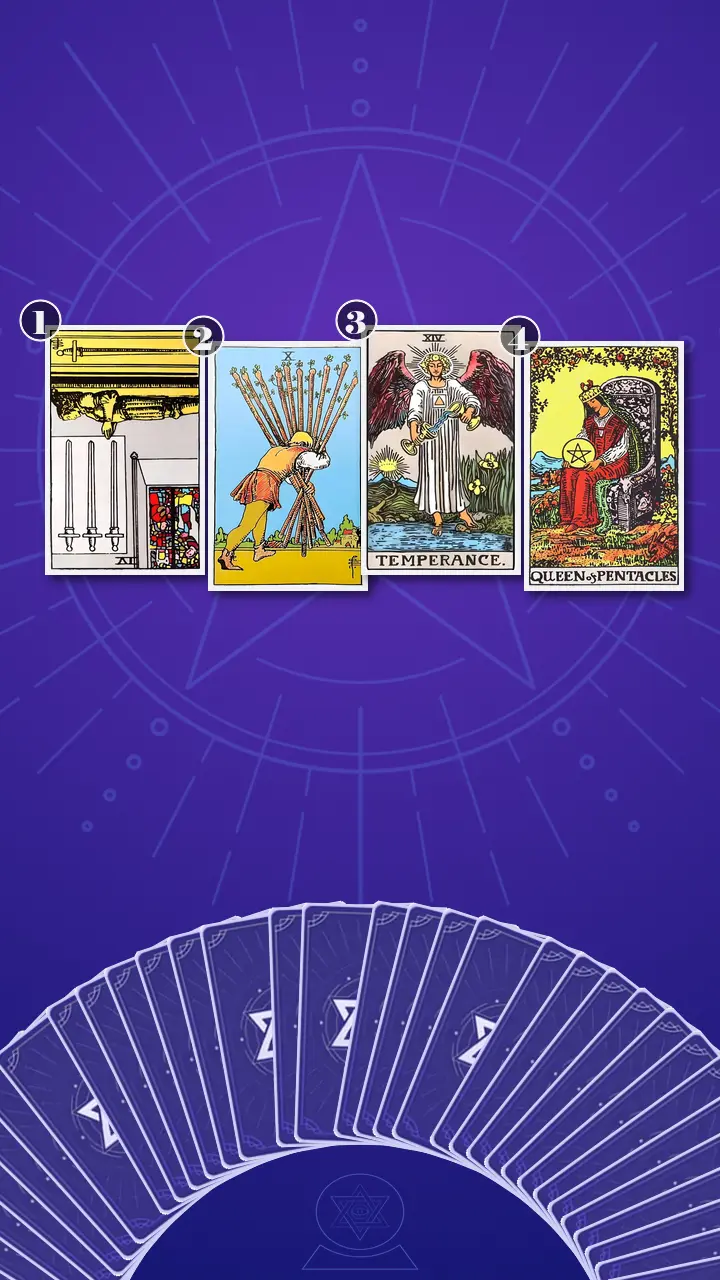
Reading the Overflow Drawer
Position 1: The Couch That Never Becomes Rest
I turned over the first card and named its role aloud. ‘This is the card that shows the visible day-off symptom—why rest currently feels like collapse rather than choice.’
Four of Swords, reversed.
I felt the accuracy immediately. This card looked exactly like the scene Jordan had described to me: off work at last, horizontal on the couch by mid-afternoon, cold coffee on the side table, a museum ticket still sitting in her email, and her mind still sorting laundry, groceries, unread texts, Monday prep, and whether she had earned the right to use any of that free time well. Very Severance outie energy—technically out of the office, not actually released from work mode.
Energetically, this was blockage. The body had stopped, but the mind had not clocked out. The recumbent figure in the card mirrored stillness; the swords overhead mirrored all the browser tabs still hanging above the day. I told her, ‘Collapse is not the same thing as recovery.’ When rest only happens as a crash after overdoing, it lands as accidental shutdown, not real restoration.
I stayed with the rhythm of the card: after this load, after this grocery order, after this text, maybe then the day can begin. Jordan gave a short laugh that had a little sting in it. ‘Okay,’ she said, shaking her head, ‘that’s accurate enough to be rude.’ Her fingers kept tracing the rim of her mug, but the joke had opened a small door. Recognition had arrived.
Position 2: The Weekend Carried in One Trip
I turned to the second card. ‘Now we’re looking at the underlying imbalance and the force that keeps this pattern running.’
Ten of Wands, upright.
‘A day off is not a backup warehouse for the whole week,’ I said before I explained anything else. Jordan went still.
This card showed the actual blockage. Not poor discipline. Not lack of motivation. Saturation. The whole weekend had been packed into one giant bundle: laundry, groceries, inbox cleanup, meal prep, movement, replying to friends, emotional recovery, and Monday prep—one massive package she believed she had to carry alone before the workweek was allowed to restart. It had the frantic ticket-printer energy of The Bear, except the kitchen was her own apartment and the shift never really ended.
Here I brought in one of my core tools: Energy State Diagnosis. Whenever I read a burnout pattern, I track leaks across three levels—environment, relationships, and self. In Jordan’s case, the environment leak was obvious: a compact apartment where clutter becomes visual noise the moment she walks in tired. The relationship leak was subtler: unread messages, low-grade social guilt, and a job that trains the body to stay reachable. The self leak was the deepest one: the hidden belief that if she used free time the wrong way, it would prove she lacked control. That belief kept every task glowing red.
Energetically, this was excess Fire. Too much output pressure, too much burden, too little ranking. The figure in the card cannot see clearly because the load blocks the view. That is exactly what happens in weekend spillover: everything starts to feel equally urgent, even when it is not.
Jordan’s reaction came in a clear chain. First her breath caught, barely there. Then her eyes lost focus for a second, as if a Friday-night Notes app list were replaying behind them. Then her shoulders dropped just enough for the truth to get through. ‘I really do act like all of it matters by Monday,’ she said quietly. ‘Even the stuff that… doesn’t.’
When Temperance Poured Between Two Cups
Position 3: The Antidote to Rest Guilt
I always feel the room change when I turn the key card. In that moment, even over video, something shifted. On Jordan’s side, the dryer that had been thumping faintly in the background finally stopped. The silence made the next card land harder.
‘This position points to the key shift needed to rebalance work, maintenance, and restoration,’ I said, and turned it over.
Temperance, upright.
Whenever Temperance appears, my mind flashes home to Venice. Balance there is never created by draining every canal at once. The water has to be regulated, guided, allowed to move between banks. That is how I read this card too. This is not an all-or-nothing reboot. It is realistic energy budgeting for a nervous system that has been living on overdrive.
I asked her softly, ‘Do you know that Saturday moment when the hamper, dishes, grocery list, and unread texts all become visible at once, and your whole body tightens before the day has even started?’ She nodded before I finished the sentence.
Then I gave her the sentence exactly as the card wanted it spoken.
You do not have to empty every cup of responsibility before you deserve rest; with Temperance, balance comes from pouring carefully instead of draining yourself dry.
I let the silence hold it.
Jordan did not exhale first. Her hand froze halfway to her hair. Her eyes slid off the screen as if something old had been named too clearly. Then came the resistance: ‘But if that’s true, doesn’t that mean I’ve been doing weekends wrong?’ I shook my head. ‘No. It means you built a control rule to survive a demanding week, and now that rule is stealing the recovery it once promised.’ The imbalance was not that she wanted too much from a day off. It was that she kept making rest wait until control felt proven. In Jungian terms, her shadow was not laziness but the exiled need for softness, returning only as collapse or scrolling. I gave her one of my Instant Adjustment Techniques: ten minutes before any chore, phone out of reach, then one question—what would make my body feel five percent more supported right now: water, food, shower, sunlight, silence, movement? Pick one. If guilt rises before relief, let that count as data. Her jaw loosened. Both shoulders dropped. She took a deeper breath and said, almost surprised, ‘Saturday morning. That would have changed Saturday morning.’
I named the transformation clearly for her: this was not just a better weekend strategy. It was a move from depleted resentment and guilt when slowing down toward steady self-respect and sustainable rest. From pushing to pacing. From proving control to allowing care. And yes—if rest only happens after everything is done, rest never actually arrives.
Position 4: Tidy Enough, Fed Enough, Still a Real Day
I turned the final card. ‘This shows the embodied next-step state—how the advice can actually live in your real life.’
Queen of Pentacles, upright.
I loved seeing her here. After all that Air and Fire overdrive, this card grounded the reading in Earth. Warmth. Food. Enoughness. A home that supports rather than audits. The Queen of Pentacles is not performative wellness. She is the version of adulthood where the apartment and the body stop feeling like adversaries.
I translated it directly into Jordan’s world: one manageable reset at home, a simple meal, maybe fresh sheets or open windows, one walk, one thing she genuinely enjoys still making it into the day. Responsibility is still present—the pentacle is right there in her lap—but it is contained now, held close, sized to fit. That is balance in practice. Not spotless. Not optimized. Human.
Jordan looked back at the card and I saw the softness arrive before the words. ‘That actually sounds possible,’ she said. ‘Not fake Instagram possible. Real possible.’ That was exactly the point. The Queen of Pentacles does not ask for a soft-life performance. She asks for stewardship.
From Pressure to Proportion
When I laid the whole story back to her, it became clean. Four of Swords reversed showed the symptom: a body on the couch while the nervous system stayed on shift. Ten of Wands showed the cause: the day off had become the overflow drawer for everything the workweek could not hold. Temperance showed the corrective principle: rest-first pacing that protects restoration before chores and limits maintenance to sustainable, tidy-enough proportions. And the Queen of Pentacles showed the integration: care that feels warm, practical, and lived.
The blind spot was not hard to name once the cards were together. Jordan had been treating control as proof of safety. That made rest feel like a reward to be earned rather than part of how life remains workable. So the more she tried to catch up, the more the day off turned into chores and recovery instead of real rest. That is why the pattern feels so sticky: it gives a brief hit of responsibility, then steals the actual repair.
I told her I wanted to leave her with actionable advice, not a beautiful insight she could only admire. Using my Venetian Wisdom Integration—the same principle I trust in water and in people: regulate the current before the banks overflow—I gave her a small framework:
- Off-Duty First BlockOn her next day off, Jordan would block the first 60 minutes in her calendar for recovery before any Notes app list, grocery route, or quick reset. Tea by the window, a slow shower, or a short walk with no shopping attached would count.Expect guilt to arrive before relief. If an hour feels impossible, start with 15 minutes. This is a boundary experiment, not a morning-routine makeover.
- Overflow Drawer AuditOn Friday night, she would do a full brain dump, then circle only three weekend maintenance tasks: one home task, one food or admin task, and one future-you task. Everything else would go onto a separate ‘not this weekend’ list.When the old panic says all of it matters, ask: what actually breaks by Tuesday if I do not do this? Tidy enough is a care standard, not a moral failure.
- Pleasure Before PerfectBefore the weekend even started, she would pre-book one meaningful but low-friction pleasure—her museum ticket, a coffee walk, a bookstore stop, or a solo matinee—and put it in the calendar before chores, not after them.Keep it short and local. The point is chosen aliveness, not performing leisure. Protect restoration first, and the rest of the day starts behaving differently.
This is where my Situation-Obstacle-Advice-Outcome reading always wants to land: not in abstraction, but in a new rule the body can test. Jordan did not need a better hack for squeezing more out of Saturday. She needed permission to stop using Saturday as a catch-up day and start treating it as part of a sustainable life.

A Week Later: The Quiet Proof
A week later, Jordan sent me a message. She had left her phone charging in the bedroom, sat with her first coffee by the window, and let herself stay off duty for forty minutes before touching laundry. She did two tasks instead of five. Then she used the museum ticket. Afterward she sat alone in a café for an hour—lighter, a little unsure, but not drained.
I smiled when I read it because that is what real change usually looks like. Not a transformed life in one weekend. Just the first clean evidence that the old contract is loosening. The day was not perfect. Something was still undone. But she had stopped disappearing from it.
That, to me, was the true Journey to Clarity. Not certainty. Not a spotless apartment. A steadier relationship with her own energy. From fake rest to real recovery. From guilt-based efficiency to sustainable self-trust.
If you, too, know the ache of arriving at a day off with heavy limbs and tight shoulders and still feeling like you have to prove you used it correctly before you are allowed to exhale, I want to say this as clearly as I can: noticing the rule is already the beginning of changing it.
And if next weekend had one protected hour that did not need to justify itself first, what would you want it to hold?