Hovering Over the Grade-Replace Form—Until It Became a Tool

Finding Clarity in the Hover-Over-Submit Ritual
If you’ve opened the grade-replace/retake form so many times it feels like a nightly ritual—hover, panic, close tab—welcome to the shame loop.
Maya (name changed for privacy) sat at my little café table like she was trying not to take up space. Outside, Toronto was doing that late-fall thing where the light looks clean but the air bites. Inside, my espresso machine hissed softly, and the whole room smelled like toasted hazelnut and warm milk.
She told me it always hits at night: 11-something PM, socks on a cold floor, the portal glow turning her bedroom corner into a tiny interrogation room. One tab is the student portal with the grade replacement form. One tab is a GPA calculator. A draft email to an advisor appears, then disappears—deleted like it never existed.
“I know it’s one grade,” she said, voice flat like she’d rehearsed it. “But it doesn’t feel like one grade.”
I watched her swallow like her throat had turned into a narrow hallway. She pressed her fingers into the paper cup as if she could anchor herself there. Shame does that—makes your body feel like it’s bracing for impact, even when you’re just staring at a button on a screen. For Maya, it was like trying to breathe through a scarf pulled too tight: every inhale technically possible, but effortful and quietly humiliating.
“We’re going to treat this like a real decision,” I told her, gently, the way I’d speak to someone who’d been carrying something heavy in secret. “Not a verdict. Not a character review. A decision. Let’s draw a map through the fog and find a next step you can actually live inside.”
Choosing the Compass: The Decision Cross Spread
I asked Maya to take one slow breath in, one slow breath out—nothing mystical, just a nervous system reset. While I shuffled, I let the rhythm of the cards match the café’s steady background: the grinder, the low murmur, the small clink of a spoon against ceramic.
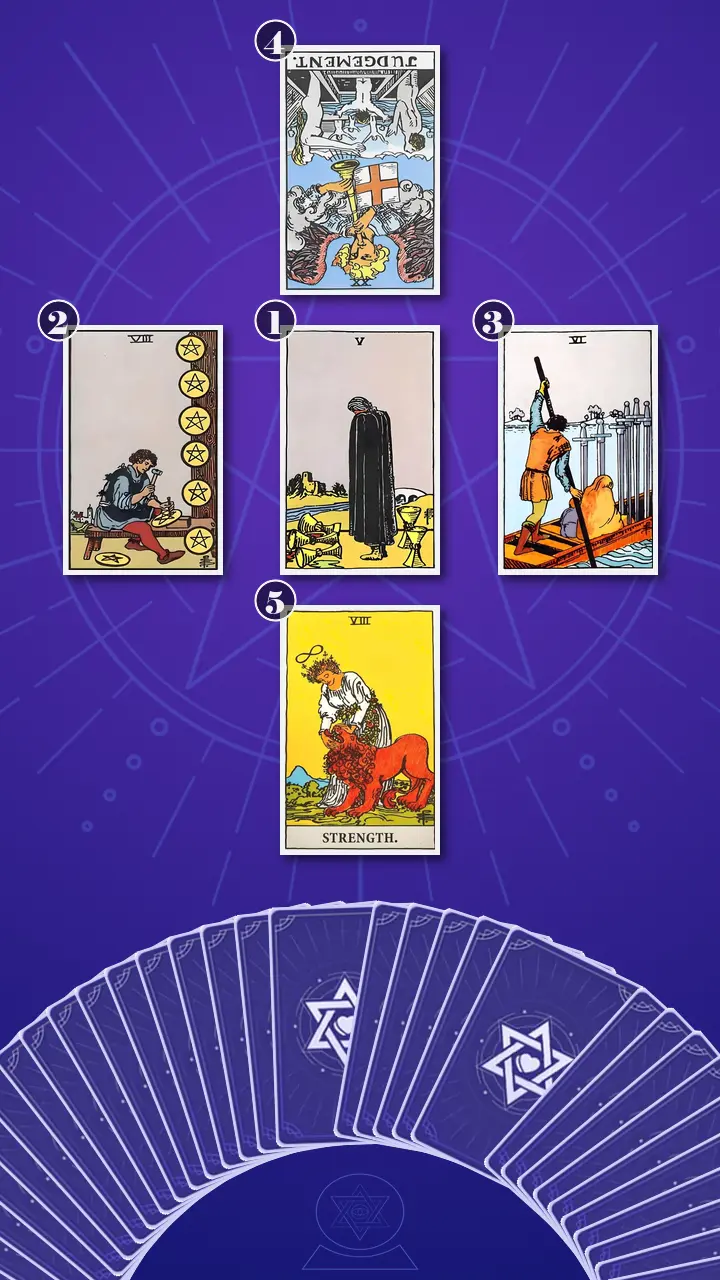
“Today we’ll use a spread called the Decision Cross,” I said.
For you reading this: the reason I like the Decision Cross tarot spread for a retake vs move on choice (a grade replacement decision) is simple. It’s minimal and practical. It shows the emotional center, then compares two paths side-by-side, then names the hidden mechanism that keeps you looping, and finally anchors you in the most supportive stance for action. Five cards. High signal. No fate-narrative.
“The center card will show what shame is doing to your focus when you open the form,” I explained. “Left is the retake path—what it actually asks of you. Right is the move-on path—what closure would require. Above is the hidden driver. Below is the guidance that gets you moving.”
Reading the Map: Five Cards, One Fork in the Road
Position 1: The Current Stuck Point
“Now flipped over,” I said, “is the card representing the current stuck point: what shame/regret is doing to your attention and behavior around the grade-replace form.”
Five of Cups, upright.
I nodded toward the image. “This is 11:30 PM energy. You’re staring at the portal like it’s a moral report card. You can recall the exact grade instantly, but if someone asked you for three things you did well this term, your mind goes blank. You keep reopening the form not to decide—just to re-feel the regret, like it’s proof you care.”
“It’s like…” Maya let out a small laugh that tasted more bitter than funny. “That’s exactly it. And it’s kind of brutal to hear out loud.”
“Brutal,” I agreed, “but not personal. This card is showing selective attention—shame narrows the frame until the grade becomes the whole screen.”
In my head, I pictured the way a coffee filter works: it doesn’t change what you poured in, it decides what gets through. The Five of Cups is a clogged filter—only the grounds of regret make it into the cup. Everything else you’ve built? Blocked.
Maya’s shoulders stayed high, but her eyes softened a fraction—like something in her had been named correctly.
Position 2: Option A (Retake)
“Now flipped over,” I said, “is the card representing Option A (retake): what this path asks of you emotionally and practically, and what it builds in you.”
Eight of Pentacles, upright.
“Retake, but make it boring—in a good way,” I told her. “This card is craftsmanship. It’s ‘craft, not comeback.’ Three calendar blocks. Office hours with specific questions. Tracking progress like skill-building—not self-punishment.”
I described it as a montage: a Notion page that’s actually a plan, not an anxiety dashboard. A 45-minute block on Tuesday where the task is redo last midterm Q3 + note mistakes, not ‘study.’ A Thursday office hour where she brings one page and leaves when the page is filled. Reps, not redemption.
Energetically, this is Earth in balance—steady effort, measurable proof. The risk isn’t failure; it’s turning it into penance. If the retake becomes a punishment, the energy goes excessive and you burn out. If it stays apprenticeship, it builds quiet confidence.
Maya stared at the card like she was trying to imagine the “middle” for the first time. Her fingers loosened around her cup.
Position 3: Option B (Move On)
“Now flipped over,” I said, “is the card representing Option B (move on): what this path requires for closure, boundaries, and forward momentum.”
Six of Swords, upright.
“This isn’t ‘pretend it didn’t happen,’” I said. “This is closing tabs because your RAM is maxed out and you need to run your life again.”
I gave her the side-by-side contrast: if Eight of Pentacles is building a GitHub commit streak—small, boring commits that add up—then Six of Swords is a clean migration. You take your data (lessons). You don’t drag the whole broken folder around at 1 a.m.
Energetically, this is Air in balance—cognitive relief and intentional transition. The risk is using “move on” as silent self-punishment: “Fine, I’ll just live with it forever.” The card says: if you move on, do it with an actual closure step, so it becomes a choice, not a sentence.
Maya’s face did something subtle—like relief tried to arrive, but got stopped at the door by guilt.
Position 4: Hidden Influence (The Real Trap)
“Now flipped over,” I said, “is the card representing the hidden influence: the belief or fear that turns the decision into a self-worth trial and keeps you looping.”
Judgement, reversed.
“Stop treating the form like a verdict. Treat it like a tool,” I said, and I felt the whole reading click into place.
“Here’s the courtroom-vs-coach contrast,” I continued. “Right now, the portal is a courtroom docket. Every refresh is you re-submitting ‘evidence’ against yourself. The GPA calculator is Exhibit A. The policy PDF is Exhibit B. And your brain keeps running the same inner script: ‘If I retake… / If I don’t…’”
I leaned in a little. “Neither option feels safe because you’re not choosing an option—you’re trying to choose a verdict about you.”
Maya went still in a three-step wave: first her breath caught, like her lungs paused to listen; then her eyes unfocused for a second, replaying a hundred late-night tabs; then her mouth opened on a quiet, surprised exhale. “Oh… yeah,” she said. Not dramatic. Just accurate.
Judgement reversed is blocked review—self-surveillance instead of self-renewal. The energy isn’t just stuck; it’s blocked by fear of exposure. And when energy is blocked, people don’t get lazy—they get trapped. That’s why the hovering happens. It’s not a character flaw. It’s an internal trial that never ends.
When Strength Spoke on a TTC Ride Home
Position 5: Guidance (The Antidote)
When I turned the final card, the room felt quieter—not silent, just focused, like the moment before the espresso starts to pour.
“Now flipped over,” I said, “is the card representing guidance: the inner stance that helps you take a next step past shame without needing a perfect outcome.”
Strength, upright.
In plain life terms, this card looks like: you take one gentle, adult action while your shame is still present. You either submit the retake plan with a realistic schedule, or you close the loop with a clear boundary and move forward. The win isn’t ‘the transcript looks perfect.’ The win is: you stop needing self-attack to move.
You’ve had the grade-replace form open—again—mouse hovering, rereading the policy like it might suddenly answer the shame for you. Meanwhile the deadline clock keeps ticking, and every “I’ll decide tomorrow” makes your chest feel a little tighter.
Stop treating the form like a courtroom verdict—choose your next step with the gentle strength that can hold the lion without becoming it.
Maya’s reaction arrived in layers. First, her jaw unclenched like it hadn’t realized it was working overtime. Then her shoulders dropped, not in defeat—more like she’d put a heavy backpack down and was surprised by her own lightness. Then her eyes got wet, and she blinked hard, annoyed at herself for it.
“But if I do that,” she said, a flash of anger under the softness, “doesn’t it mean I’ve been doing it wrong this whole time?”
“No,” I said immediately, steady. “It means you’ve been trying to survive a trial. Strength doesn’t shame you for that. Strength just offers a different job description.”
I slid her a napkin and spoke like the calm project manager version of her: kind, firm, focused on the next ticket. “Set a 10-minute timer. Don’t open the portal yet. Open a blank note and write two versions of the next step: one ‘retake version’ sentence and one ‘move-on version’ sentence. Then pick the one that feels 10% more doable in your body—less throat-tightening.”
To make it real, I used her city: “Picture it on the TTC. You’re on the streetcar, your phone warm in your hand, cold air sneaking in at the doors. If you imagine the retake version and your throat locks up, that’s data. If you imagine the move-on version and your shoulders release, that’s data. We’re not chasing perfect. We’re listening for doable.”
Then I brought in my own way of diagnosing study stress—my Focus Period Diagnosis, the thing I’ve watched for twenty years in students who come into my café with finals in their eyes. “Your brain isn’t just anxious,” I told her. “It’s caffeinated at the wrong time. If you decide to retake, we’ll plan your hardest work for the hours when coffee helps you focus instead of making your thoughts race—because clarity lives in timing as much as intention.”
“Now,” I asked her, “with this new lens—can you think of one moment last week when this insight would’ve changed how it felt?”
She nodded slowly. “Sunday. My roommates were laughing in the kitchen and I kept refreshing the transcript page like it would change. If I’d thought of it as… a tool, not a trial… I could’ve just emailed for info and gone to bed.”
That was the shift right there: from shame-driven freezing and self-sentencing to self-respect-based follow-through and steadier self-trust. Not a personality makeover—just a new posture inside her own mind.
The Tool-Not-Verdict Plan: Next Steps You Can Actually Do This Week
I gathered the whole spread into one clean story for her: the Five of Cups showed how shame hijacks attention until the grade becomes identity. The Eight of Pentacles and Six of Swords offered two adult paths—repair as craft, or closure as boundary. Judgement reversed revealed the trap: she wasn’t choosing between retake vs move on; she was trying to avoid a verdict about her worth. Strength anchored the solution: self-respect is the fuel, not self-attack.
“Your blind spot,” I said gently, “is that you’ve been waiting for a feeling—ready, forgiven, certain—before you act. The direction here is the opposite: choose a good-enough next step that builds self-trust, even if the past stays imperfect.”
Then I gave her actionable advice—small enough to start, concrete enough to finish.
- The Two-Sentence Advisor Email (Request for Info)Tomorrow morning, send an email with only two sentences: (1) confirm eligibility/deadline for grade replacement; (2) ask what the workload/sequence looks like for a retake. No apologies, no backstory.If you feel the shame spike and start writing your life story, stop. Draft it tonight, then schedule-send it for 9:05 a.m. so late-night brain can’t sabotage it.
- The 10-Minute Next-Step Timer (Retake vs Move-On)Set a 10-minute timer. In a blank note, write one sentence for a “retake version” (this week’s step) and one sentence for a “move-on version.” Choose the one that feels 10% more doable in your body.If you start spiraling, close the laptop and stand up for 60 seconds. This is a boundary, not a test.
- If You Retake: Three Craft Blocks + a Study BlendPut three 45-minute blocks on your calendar this week (Tue/Thu/Sun). Each block gets a specific task (e.g., “redo Q3 + note mistakes”). Before each block, make one small “Study Blend Aroma”: a half-caf espresso or light roast that helps focus without tipping you into jittery overthinking.Treat this like training, not penance. Miss a block? Don’t punish yourself with a 5-hour marathon—just return to the next unit.

A Week Later: The Quiet Proof
A week later, Maya sent me a message that was almost anticlimactic, which is my favorite kind of progress: “I sent the two-sentence email. They replied with the deadline and options. I didn’t die. I feel… calmer.”
She added one more line: “I still feel a little sick when I look at the transcript, but I’m not refreshing it anymore.”
That’s what a Journey to Clarity often looks like in real life—not fireworks, but a small, steady return of breath. A tool replacing a verdict. A decision becoming something you can execute, not something you have to morally survive.
When you’re staring at that grade-replace form with a tight throat and a sinking stomach, it’s not the form that’s freezing you—it’s the fear that whichever button you click will prove something permanent about you.
If you didn’t need the past to look perfect, what’s one small next step you’d choose this week that would make you trust yourself a little more?