Too Embarrassed to Go Back to Class? A Minimum-Viable Return Path

Finding Clarity in the Backpack-On, Quercus-Open Moment
You stand at the door with your backpack on, open the LMS “just to check,” and the next thing you know you’ve spent 45 minutes doomscrolling the syllabus instead of leaving—classic shame spiral.
That was the line Jordan (name changed for privacy) tossed out before they even sat down—half joking, half exhausted. They’re 20, in their second year in Toronto, and they had that specific posture I’ve learned to recognize: shoulders pulled slightly inward like they’re trying to become smaller than the room.
They described 8:47 a.m. on a Tuesday like it was a scene burned into film. Backpack already on. Hallway dim. The faint smell of someone’s coffee drifting under a сосед’s door. Phone screen bright against the entryway gloom as they tapped Quercus/Canvas, “just to check.” The page took a beat to load. Their stomach dropped. Their shoulders crept up toward their ears like they were bracing for impact.
“I skipped one class,” they said, staring at their hands as if the answer might be written in the creases. “And then I… ghosted campus. It’s like I’m convinced everyone can tell I don’t belong. So I avoid the lecture hall, I avoid the café, I avoid the TTC stop where I might run into someone from class. I rewrite the ‘sorry I missed class’ message, like, ten times. I don’t hit send.”
The core contradiction was right there, loud and private at the same time: they want to be the reliable, capable student… and the second they slip, they fear being seen as irresponsible, as “not cut out for this.”
Shame isn’t just a feeling in moments like this. It’s a physical lockdown—like your chest turns into wet cement and your body starts running a “do not be perceived” protocol on autopilot.
I leaned forward a little, keeping my voice low and peer-level. “We’re not here to lecture you into discipline,” I said. “We’re here to understand what story shame tells you after one missed class—and find a way back that doesn’t require a perfect comeback. Let’s try to map the fog into something you can actually walk through. That’s the whole Journey to Clarity.”

Choosing the Compass: The Transformation Path Grid (6) for a Shame Spiral
I asked Jordan to take one slow breath in, then out—nothing mystical, just a nervous system handrail. While they held the question in mind—After I skip one class, what shame story makes me avoid campus?—I shuffled, letting the rhythm do what rhythm does: interrupt the replay loop.
“Today I’m using something I call the Transformation Path Grid (6) · Context Edition,” I said, laying six cards into a simple 2x3 grid. “It’s a six-card tarot spread designed for exactly this kind of avoidance loop: when the problem looks like logistics—missed content, missed time—but the real engine is self-judgment after a small slip.”
For you reading this: this spread works because it separates the layers. The top row diagnoses the loop in plain terms—what you feel, what blocks you, and the deeper shame story underneath. The bottom row is the way out—what inner energy pivots the story, what action gets you moving, and what habit keeps you steady. It’s concise, structured, and it doesn’t let us get stuck in “analysis” forever.
I pointed to the grid like stepping stones. “Card one shows the emotional snapshot right after the skip. Card two is the specific thought-loop that freezes you. Card three is the deeper fear that turns one absence into an identity verdict. And down here—card four—is the turning point.”
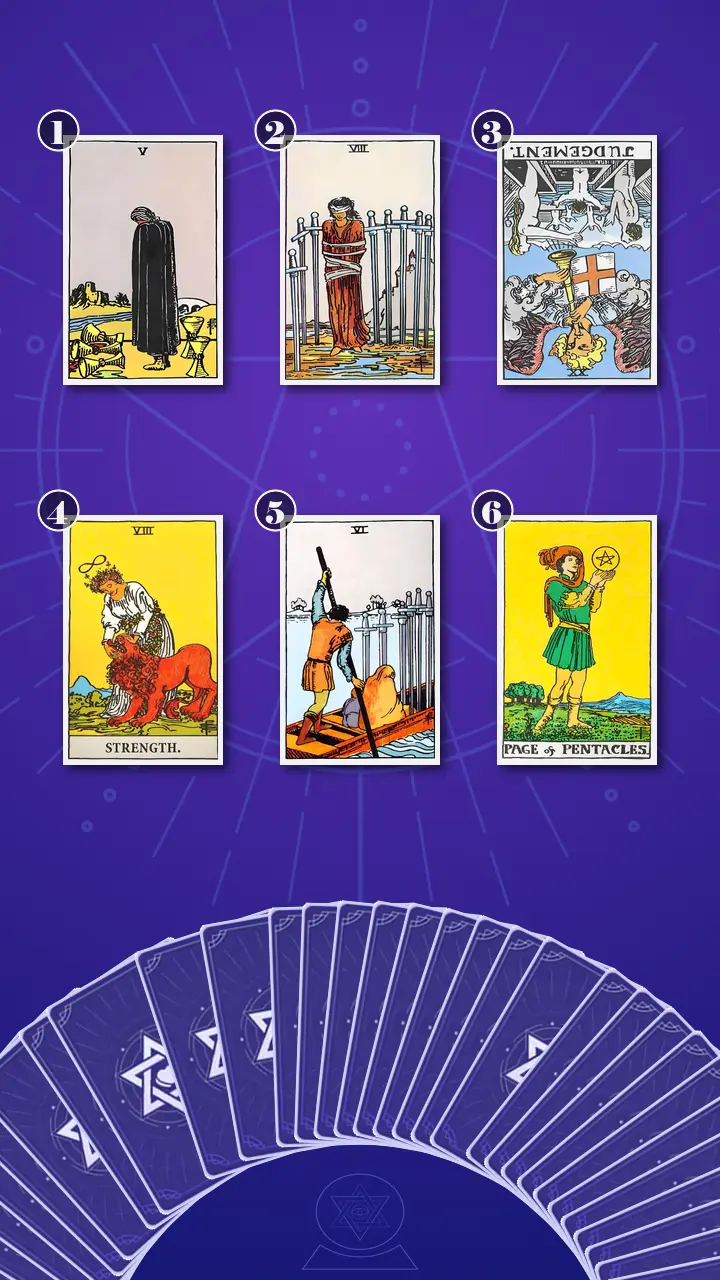
Reading the Map: Card Meanings in Context (and Why They Hit So Hard)
Position 1 — The Emotional Snapshot After You Skip One Class
“Now we’re turning over the card that represents what the shame spiral looks like right after you skip one class—the immediate emotional snapshot and that first avoidance impulse.”
Five of Cups, upright.
This card is regret with tunnel vision. In modern life, it’s the exact scene Jordan already described: you miss one lecture, and that night you replay it like a highlight reel of failure—refreshing the course page, staring at the slide deck you didn’t see, feeling your chest go heavy. You focus so hard on the one absence that you can’t feel the obvious thing: you can still go to the next class like a normal person.
In terms of energy, the Five of Cups is a blockage—not because you don’t care, but because your attention locks onto the “spilled cups.” Your brain treats one bad data point like a one-star review that overrides a hundred normal days.
Jordan gave a small, sharp laugh—more like air escaping a punctured tire than humor. “That’s… mean,” they said, and then, softer: “But yeah. That’s exactly it.” Their fingers tightened around their water bottle, then loosened, then tightened again.
Position 2 — The Thought-Loop That Keeps You Off Campus
“Now we’re turning over the card that represents what specifically blocks you from returning to campus—the loop that freezes action.”
Eight of Swords, upright.
The Eight of Swords is the mind-built trap. It matches this scenario perfectly: you stand at the door and your brain insists there’s no socially acceptable way to return. You picture classmates turning, the professor noticing, someone asking questions. So you choose the ‘safe’ option—stay home—while telling yourself you’ll go back once you’ve solved it privately.
This is deficiency of agency. Not in reality—there’s plenty of open space—but in perception. The blindfold is imagined judgment replacing real information. The ropes are loose, but your nervous system treats them like steel.
I used the visibility scene because shame is cinematic in the worst way. “Picture the TTC doors opening at St. George,” I said. “Fluorescent lights buzzing. Your brain starts rehearsing lines. And the script goes: If I show up, then they’ll notice. And if they notice, it means I’m the flaky one. And if that’s true, it means I don’t belong.”
Jordan exhaled tight through their nose—one of those exhales that’s basically a confession. They nodded once, small and unwilling, like they hated how accurate it was.
Position 3 — The Shame Story Under the Avoidance Loop
“Now we’re turning over the card that represents the underlying shame story and core fear—the thing that turns one absence into an identity verdict.”
Judgement, reversed.
When Judgement is reversed, the “call” doesn’t feel like an invitation back into life. It feels like a summons. In modern terms: every calendar reminder of your next lecture feels like a court date. You draft a long apology email hoping it will erase the mistake, but the real fear is visibility—being seen before you’ve “fixed” yourself.
This is an excess of inner prosecution. Not accountability—prosecution. The inner jury wants a dramatic redemption arc, not a normal human return.
I leaned into the echo technique—an inner disciplinary hearing—because I’ve watched so many smart students do this to themselves. “It’s 1:12 a.m.,” I narrated gently. “Laptop fan humming. You reread the attendance policy like it’s a legal document. You draft a twelve-sentence apology and imagine the professor’s face. And the sentence underneath all of it is: I’m not behind—I’m on trial.”
Jordan went still. Not frozen—still, like a part of them had finally been named. Their eyes flicked to the side as if they were watching that late-night scene replay. Then their shoulders dropped a fraction.
“So what’s the verdict?” they asked, and there was bitterness in it. “That I’m just… not a real student?”
“Here’s what I want you to borrow as a working truth,” I said. “A missed class isn’t an identity verdict—it’s a data point. Judgement reversed is the part of you that forgets you’re allowed to be a learner.”
Position 4 — When Strength Changes the Rules of Coming Back
“Now we’re turning over the card that represents the key turning energy that breaks the loop—the internal shift that makes re-entry possible.”
Before I revealed it, the room quieted in that particular way it does right before someone tells the truth to themselves. This was the heart of the reading.
Strength, upright.
Strength isn’t the kind of courage that kicks down a door. It’s the courage that keeps your hand steady on the leash when your whole body wants to bolt. It’s self-compassionate courage under visibility: you don’t defeat shame by force; you soothe it and still act.
Setup: Jordan knew that doorway moment too well—backpack already on, hand on the doorknob, and then opening the LMS “just to check,” bargaining with time until it’s suddenly 11:38 and the day feels unsalvageable.
Stop treating your missed class like a lion you must defeat, and start meeting it with steady hands—show up anyway, softly and consistently, like Strength.
The sentence landed and I watched the reaction chain move through them in three distinct beats. First: a tiny physiological freeze—breath caught, fingers suspended mid-fidget. Second: their gaze unfocused, like they were suddenly seeing the whole loop from above, not just from inside it. Third: a slow release—an exhale that seemed to come from under the ribs, followed by their shoulders sinking down, as if they’d been holding a weight they never agreed to carry.
Then the unexpected part: their jaw tightened, and their eyes flashed with a quick, defensive heat. “But if I show up anyway,” they said, voice sharper, “doesn’t that mean I messed up? Like… publicly?”
I didn’t rush to soothe it. “It means you’re human,” I said. “Strength doesn’t erase the fact that you missed a class. It changes what that fact means.”
And because my own work lives at the intersection of art and structure, I reached for one of my favorite tools—Einstein’s thought experiments. “Let’s do a tiny experiment,” I told them. “Imagine two timelines like you’re observing them from the outside. In Timeline A, you punish yourself until you feel worthy to return. In Timeline B, you return with one imperfect step while shame is still loud. Which timeline produces more real evidence that you belong?”
Jordan blinked hard, then nodded, slower now. “B,” they said. “Even if it feels awful.”
“Exactly. That’s the shift,” I said. “From shame-driven hiding and visibility dread… to self-respect through an imperfect return. Not a personality transplant. A practice.”
I offered the reinforcement exactly as a boundary, not a demand. “Set a 10-minute timer,” I said. “Do one return step that’s visible-but-small: laptop in bag, shoes on, walk to the nearest campus building entrance—or even just to the TTC stop. When the timer ends, you’re allowed to turn around. If your body feels flooded—nausea, shaking—pause, drink water, and make the step smaller. Standing by the door counts. Opening your calendar counts.”
I let a beat of silence pass. “Now,” I asked, “with this new lens, can you think of a moment last week when answering the ‘call’—even for ten minutes—would’ve changed how the day felt?”
Jordan’s voice went quiet. “Tuesday,” they said. “If I’d just gone to campus and sat somewhere… the whole week wouldn’t have become this.”
Position 5 — The Return That Doesn’t Require Perfect Confidence
“Now we’re turning over the card that represents a realistic re-entry move you can take this week—one that doesn’t demand you feel ready first.”
Six of Swords, upright.
The Six of Swords is transition through steps, not speeches. In real life, it’s treating returning like logistics: tap into the TTC, walk in, pick a seat, open your notebook, write the date. No dramatic explanation. The uncomfortable thoughts ride along in the boat, but they don’t steer.
This is balance after chaos—Air settling enough to move. The card’s message is simple: movement changes the emotional weather.
I kept it concrete, because shame loves grand narratives. “Your rule for the week,” I said, “is: No speeches. Just steps.”
Jordan’s mouth twitched into something almost like a smile. Not happy—relieved to be given a smaller script.
Position 6 — Rebuilding Trust Like a Beginner Builder
“Now we’re turning over the card that represents how to stabilize momentum after you return—the habit and identity stance that helps it stick.”
Page of Pentacles, upright.
The Page of Pentacles is the committed learner. It’s permission to be a student again, not a finished product. In modern terms: one class attended, one reading block done, one checkbox ticked. Confidence doesn’t come from a speech—it comes from evidence.
Energy-wise, this is grounding. Earth energy. Proof-based routines instead of mood-based motivation.
I described a tiny montage—because the Page thinks in repetitions. “A 25-minute library block,” I said. “One lecture attended. One message sent. Evidence over vibes.”
Jordan sat a little more upright, like their spine remembered it had a job.
The One Rule That Breaks the Loop: From Identity Verdict to Minimum Viable Return
When I looked back across the grid, the story was coherent in a way Jordan hadn’t been able to access inside the spiral. The Five of Cups showed the regret-lock—attention glued to what went wrong. The Eight of Swords showed how that regret gets mentalized into a trap: “there’s no safe way back.” Judgement reversed revealed the engine underneath: an inner disciplinary hearing that turns a scheduling event into a character trial. Strength changed the rulebook—carry shame while moving, gently, steadily. And then the Six of Swords and Page of Pentacles did what they always do when you let them: they translated insight into logistics and then into a routine that creates real proof.
The cognitive blind spot here is subtle but common: you’ve been treating “catching up” as something you must do before you’re allowed to return—when in reality, catching up is something that starts because you returned. The transformation direction is the key shift we named: from “I must return perfectly or not at all” to “I return with one imperfect, concrete step today.”
To make it actionable, I offered Jordan a tiny plan—small enough to start, structured enough to hold them when their brain gets loud:
- Minimum Viable Return (20 minutes counts)Today or tomorrow, walk into one campus building that signals “real student” to you (library, department building). Sit down, open your notebook, and write the date at the top of the page. Stay for 20 minutes. Then you’re allowed to leave.Expect your brain to demand a perfect comeback. Don’t negotiate. Use the boundary: leaving after 20 minutes is permitted.
- Two-Sentence Re-Entry Script (send it imperfectly)Send this message to your instructor or TA: “Hi [Name], I missed last class and I’m back this week. What’s the best way to catch up on what I missed?” Read it once, then hit send—no extra paragraphs.If you feel the urge to over-explain, stop at two sentences. If the reply isn’t warm, treat it as “no data yet,” not a verdict.
- Manuscript Mindmap (mirror-writing reset)Before you leave for campus, take 2 minutes with pen and paper. Write one line in mirror writing (backwards) that captures the shame sentence (e.g., “They’ll think I don’t belong”). Then underneath, write the fact-only version normally: “I missed one class; I’m returning today.”Mirror writing slows the spiral down—your brain can’t sprint while decoding. Keep it messy. This is for interrupting the loop, not making it pretty.

A Week Later: The Quiet Proof of Coming Back
A week later, Jordan messaged me a photo—not of their face, not a victory speech. Just a notebook page under a library lamp, the date written at the top in slightly shaky handwriting. The caption was: “I did 20 minutes. My chest didn’t explode. I also sent the two-sentence email. No speeches. Just steps.”
It wasn’t a full-life overhaul. It was something better: a small, repeatable proof that the door wasn’t locked. They still felt embarrassed, they admitted. But it was beside them now—not steering them.
That’s the real Journey to Clarity in moments like this: you don’t rebuild campus confidence by punishing yourself. You rebuild it by practicing one gentle, brave return step at a time—until your nervous system stops treating “being seen” like a trial.
When you miss one class and your chest goes heavy like you’ve just been exposed, it’s not the absence that locks you out—it’s the fear that a single slip proves you don’t belong.
If you didn’t have to “come back perfectly,” what’s one tiny, slightly-brave step you could take today that would still count as returning?