When a Full Sink Feels Like a Verdict: Ranking Stability Before Shame

The Tuesday Kitchen Where Everything Started Shouting
I knew what kind of reading this would be before I drew a single card. When Maya (name changed for privacy) joined my evening call from her west-end Toronto apartment, I told her, gently, that if you are in that post-grad, junior-career stretch where you get home from a hybrid workday, open the sink, your banking app, and your group chat at the same time, and still end up frozen on the couch under pure adulting overload, you are not unusual—you are standing in a pattern I see all the time.
It was 8:37 p.m. Her work tote was still digging into one shoulder. One plate sat under cold water. Her phone lit up with a rent reminder and a buzzing WhatsApp chat at the exact moment the overhead fluorescent gave off that thin electrical hum every renter knows. The dish soap smelled too sharp. Her shoulders locked up near her ears, and I watched the familiar little drop in her stomach register across her face before she said, “I know these are basic adult tasks, so why do they feel impossible all at once?”
The contradiction was immediate: she wanted her life back under control, but the second the mess, late rent, and missed messages became visible together, they stopped feeling like tasks and started feeling like proof. Her evening sounded like fourteen tabs open, a laptop fan screaming, and none of the pages fully loading. “I do not know if I am behind on chores or behind on being a person,” she added, quieter now. I shook my head. “You’re not failing at life; you’re overloaded without a landing sequence,” I told her. “Let’s make one. Tonight’s tarot reading is not about pretending the problem is mystical. It’s about drawing a map through the noise so we can find one clean foothold.”

Choosing the Energy Diagnostic Map for Adulting Overload
I asked her to put both feet on the floor and take one full breath before touching the deck. Then I shuffled slowly, not as theatre, but as a way to help her nervous system stop sprinting long enough for us to see what was actually happening.
For this question, I used my Energy Diagnostic Map · Context Edition, a spread I designed for moments when everything feels urgent at once. How tarot works best, in my practice, is by giving shape to what shame makes blurry. A Past-Present-Future spread would flatten this, and a choice spread would pretend sink, rent, and friends were three equal options. They are not. They are one regulation problem wearing three different coats.
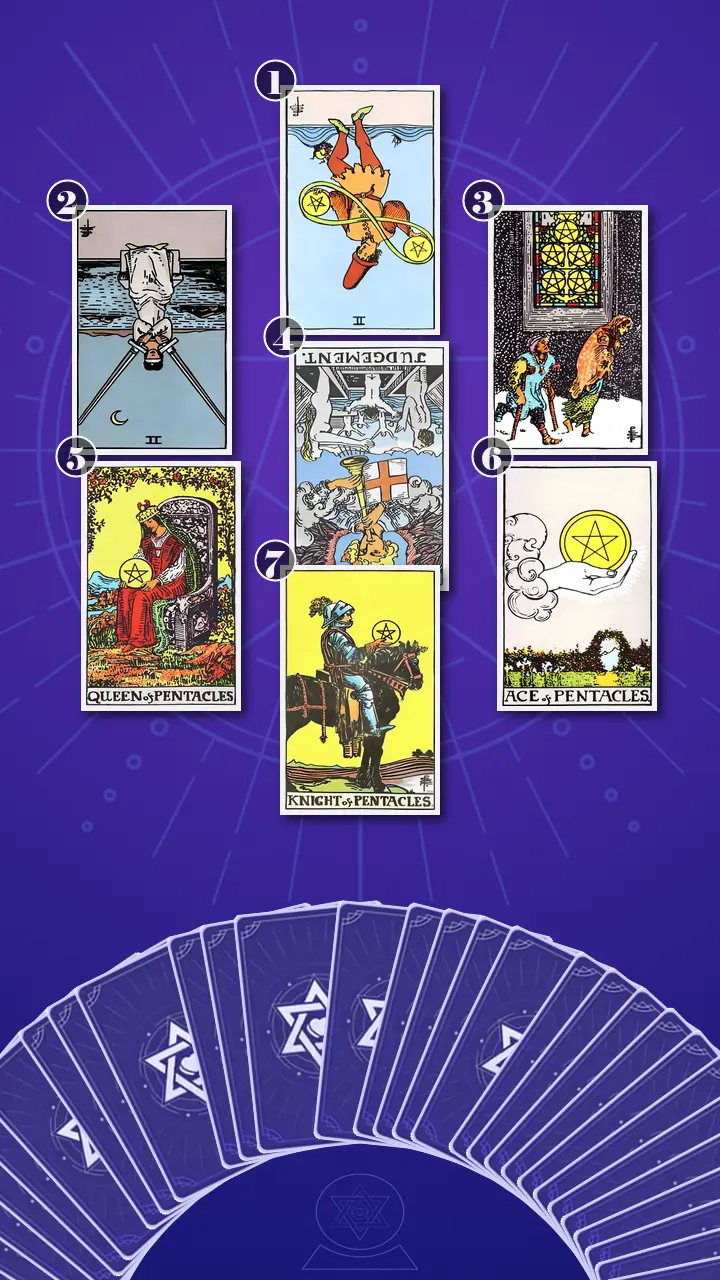
I laid the seven cards in a circle, with the fourth at the center like the buried chamber everything else revolved around. The first card would show the visible symptom pattern. The second would reveal the inner split between wanting order and dreading what facing the backlog might feel like. The sixth—our key transformation point—would tell us what actually comes first when we stop treating life admin as a moral exam and start treating it as triage.
Reading the Pressure Map: How Tarot Works in Real Life
Card meanings in context matter more than generic keywords. So as I turned each card, I kept translating it back into Maya’s actual Tuesday-night kitchen: the sink, the rent alert, the unread texts, the phone growing warm in her hand.
The Loop That Feels Like Effort
The first card I turned was the one representing the concrete backlog behavior that was most visible right now. It was the Two of Pentacles, reversed.
In plain language, this is the card of juggling gone sloppy. I showed her the old image: the infinity loop, the lifted foot, the ships rising on choppy water. Then I translated it into her life. “This is you getting in the door around 8:30, rinsing one plate, checking whether rent can clear, tapping into a friend’s message so you won’t forget, and fifteen minutes later landing on the couch with three open loops and the strange feeling that you were busy without landing anywhere.”
Reversed, the energy is not balanced movement. It is excess motion and failed sequencing. The problem is not laziness; it is frantic switching that looks like effort but prevents completion. It has a bit of The Bear ticket-printer energy to it—too many inputs, no hierarchy, your nervous system acting like every beep is the main character. Maya gave a short, bitter laugh. “Wow,” she said. “That’s accurate enough to be a little rude.” I smiled. “Good. Sometimes recognition is the first unclenching.”
The Choice That Makes Everything Else More Real
The next card represented the inner tug-of-war behind the whole mess. It was the Two of Swords, reversed.
This is what decision fatigue looks like when it has emotional teeth. The blindfold, the crossed swords, the dark water under the moon—card meanings in context could not be clearer here. “You do know you need a first task,” I said. “But choosing one makes the others feel more real. So you hover. You reread the rent reminder, half-compose a reply, maybe open Notes to plan it properly, and stay stuck in the planning layer because the decision itself feels loaded.”
Reversed, the energy is blockage leaking into mental overload. She was not simply unable to choose; she was using not-choosing as emotional self-protection, the way someone hovers between send, close, and mark unread until the message gets heavier than the message itself. Her fingers tightened around her mug, then loosened. “Yes,” she said. “Picking one feels like admitting I dropped the other two.” That was the split exactly.
When the City Itself Is Part of the Problem
The third card showed the real-world pressure making everything harder to hold. It was the Five of Pentacles, upright.
I was glad to see it, oddly enough, because it kept us honest. Some of this was emotional, yes. Some of it was structural. Toronto rent is loud. A thin margin makes everything else louder. “This card says the situation is not just vibes,” I told her. “Once your balance dips or a payment goes late, even dishes and texting back start to feel harsher because your sense of safety has already taken a hit.”
Here the energy was stark but clarifying: material strain reduces bandwidth. The cold street and lit window on the card always remind me that stress can make support feel farther away than it is. I have spent enough years in archaeology to know that collapse is rarely caused by one broken wall; more often it is several systems failing at once under pressure. Maya’s chin lifted a fraction. Being told that the external stakes were real, not imagined, eased some of the private blame from her face.
The Courtroom Hidden Inside the Sink
The fourth card sat at the center of the spread, naming the core mechanism beneath the surface. It was Judgement, reversed.
This was the heart of it. In the card, the trumpet sounds and people rise. In Maya’s life, that trumpet had turned into every rent alert, every unread badge, every dirty dish catching the overhead light at the wrong moment. “A backlog is a pile of tasks, not a biography,” I told her, and I watched the sentence land. “But you’ve been experiencing each reminder like a courtroom summons. Not rent payment pending. Not messages unanswered. Something closer to: if this is still undone, what does that say about me?”
Reversed, Judgement is blocked renewal through self-prosecution. It turns ordinary admin into a verdict on worth. One of her notifications buzzed on the counter right then, a tiny metallic chirp, and the timing almost felt theatrical; the kitchen itself had become an accomplice to the card. Maya went very still. First her breathing paused. Then her eyes unfocused as if replaying ten ordinary evenings at once. Then a long breath left her chest. “That,” she said, “is exactly why opening the app feels so much bigger than the app.”
The Caretaker Already Waiting in the Room
The fifth card showed the underused strength already within reach. It was the Queen of Pentacles, upright.
I loved this as her resource. After the inner judge, here came the grounded caretaker. I pointed to the way the Queen holds the pentacle calmly in her lap. “This is not dramatic self-improvement,” I said. “This is one bowl washed. A glass of water. Food before doomscrolling. Checking the balance without narrating your character. Sending one honest text instead of the perfect explanation. This does not have to be impressive to count. Reply guilt gets heavier in silence, not lighter.”
Upright, the energy is balance through tending rather than performance. In younger clients especially, I often see care mistaken for something you earn after you catch up. The Queen says the opposite. Care is how you catch up. Maya rubbed her eyes and glanced toward a lamp in the next room, away from the fluorescent glare above her. Her shoulders dropped a little. The whole reading warmed there.
When the Ace of Pentacles Offered Ground
The One Open Loop That Actually Matters First
When I turned the sixth card, the air changed. Even through a screen, I could feel it. The fridge clicked off, the room went briefly quiet, and we were looking at the key transformation point in the spread: the Ace of Pentacles, upright.
She was still trapped in the logic so many overwhelmed people fall into: if she could just choose the most virtuous task first, she could earn relief. But that is redemption thinking, not calm prioritization. It keeps the nervous system on panic highway.
Not every open loop deserves equal power. Take the coin being offered, choose the concrete step that makes the ground safer, and let that be enough for today.
I let the sentence sit between us. Then I said it again in plainer language: the first task is not the one that can shame you hardest. It is the one that gives your nervous system and your real life one small piece of solid ground.
My mind went, as it often does, to excavation trenches and old cities at the edge of strain. When a retaining wall starts to give, nobody sensible begins by polishing the prettiest shard. You shore up the section that keeps the site from collapsing. When civilizations hit a crossroads, the ones that endure secure water, grain, and passage before they worry about appearances. That is my Historical Case Matching habit in action, paired with a long-term value assessment: the first task is not the prettiest, nor the most morally satisfying. It is the one with the highest stabilizing value.
Maya’s reaction came in layers. First, a small freeze—her hand stopped halfway to her hair. Then the thought broke across her face before the words arrived. “But doesn’t that mean I’ve been doing this wrong?” There it was: not relief first, but resistance. I answered gently. “No. It means shame has been doing your ranking for you because shame is loud, not because shame is wise.” Her gaze drifted sideways, as if replaying last Thursday in fast-forward. Then her mouth softened, her shoulders finally lowered, and she let out the kind of breath that seems to come from the back ribs. There was relief in it, but also that slight vertigo people feel when the path becomes clear and suddenly they are responsible for taking it. I asked her, “With this lens, was there a moment last week when the night could have gone differently?” She nodded almost at once. “Yes. I kept washing mugs because it felt morally better than opening my banking app.” That was the crossing point: from shame-heavy shutdown and frantic task-switching toward grounded self-trust. Not certainty. Just ground.
The Boring Plan That Builds Trust
The seventh and final card translated the insight into a real next step for the week. It was the Knight of Pentacles, upright.
This is one of my favorite cards for people overwhelmed by chores, bills, and texts, because it has no interest in cinematic makeover energy. The horse is standing still. The field is already plowed. The medicine is repetition. “Small and finished beats ambitious and abandoned,” I told her. “What heals this is not one heroic reset night. It is a boring but trustworthy sequence you can repeat before your brain opens seventeen more tabs.”
Upright, the energy is disciplined follow-through, not speed. This card does not care whether the plan looks impressive on TikTok or fits into a beautiful Notion dashboard. It cares whether it works on a Wednesday when you are tired. Maya actually smiled at that. “So the answer is basically to be unsexy on purpose?” she asked. “Exactly,” I said. “Deeply unsexy. Almost Roman in its practicality.”
From Verdict to Stability-First Triage
By the time I had all seven cards on the table, the story was clear. The reading began with two reversed Twos: too much switching, then too much not-choosing. The Five of Pentacles reminded us that late rent, city costs, and a small apartment are real external pressure, not evidence of weakness. Judgement reversed showed the true freeze: the moment ordinary backlog turned into self-indictment. Then the lower arc rebuilt her footing through the Queen, the Ace, and the Knight—care, one tangible beginning, and steady follow-through.
The cognitive blind spot was simple and brutal: Maya had been assuming the loudest task was the most important one. But loudest often just means most shame-soaked. The transformation direction was equally clear: stop treating the backlog as a verdict on character and start treating it as a solvable sequence ranked by stability first. Or, as I put it to her more bluntly: start with the task that makes the ground safer, not the one that shames you loudest.
I gave her three tools, borrowing from my archaeological habits. First, Artifact Restoration Thinking: when an object comes out of the ground fragile, I stabilize it before I polish it. Second, my Time Stratigraphy Method: scrape away the top layer of panic and ask what will still matter tomorrow morning. Third, a simple Voyage Log Technique: ancient navigators did not command the whole sea; they kept the next bearing. Her next steps looked like this:
- The Stability-First FifteenTonight, before TikTok, Instagram, or a clean-with-me reel, set a 15-minute timer and do the single money task that reduces real-world risk most: send the rent, confirm the exact balance, or message the landlord with timing.Put your phone on Do Not Disturb except for the app you need. If sending the full payment feels too activating, lower the bar to naming the exact number due and the next factual step.
- One Bowl, One Glass of Water, One Honest TextAfter the money step, wash only enough dishes to create one usable mug, bowl, or plate for tomorrow, eat or drink water, and send one low-pressure message to the safest friend: Hey, I’ve been underwater and slow to reply. No pressure to keep chatting tonight—I just didn’t want to disappear.If the text feels too exposed, draft it first and send it tomorrow. One dish, one drink, one text is a complete win, not a starter version of a real win.
- The Three-Night Voyage LogFor three nights this week, make a Notes-app plan with only three lines: 1 money, 2 space, 3 one reply. Finish each line before switching rooms or apps, even if each step is tiny.If energy drops, shorten the line rather than adding a fourth one. The goal is trust, not performance.
When I finished, Maya raised one real obstacle, which I appreciated. “But what if I get home so fried I can’t even spare fifteen minutes?” she asked. I told her the rule still held. “Then make it five. Archaeological field notes are still valid if the weather turns and you have to leave early. A shorter true step beats a grand imaginary one every time.”

A Week Later, the Sink Wasn’t the Main Character
A few days later, Maya sent me a message. It wasn’t dramatic. That was the point. She had checked the exact amount, messaged her landlord before the story in her head got louder than the facts, washed one bowl, and reopened one friendship thread with a simple honest line. “Once the rent had a plan,” she wrote, “the sink stopped feeling like a jury.”
A week after that, she told me she had slept through the night. Her first thought in the morning was still, what if I slip again?—but this time she smiled, made coffee in the one clean mug she had left out for herself, and opened the banking app before opening Instagram. Clear but a little tender. That is usually what real change looks like.
I did not help her solve her whole life in one spread. Tarot seldom works that way, and I would not trust it if it did. What this journey to clarity gave her was better: a landing sequence. She moved from panic pace and shame spiral into calmer prioritization, one stabilizing action at a time.
There is a very specific kind of loneliness in standing in a messy kitchen with your phone buzzing, knowing these are solvable tasks and still feeling like touching any of them might confirm something harsh about who you are. When I use the Energy Diagnostic Map tarot spread for overwhelm, prioritization, and everyday life backlog, that is the loneliness I most want to meet with accuracy and gentleness.
If tonight stopped being a verdict and became triage instead, what would be the smallest coin-in-hand foothold you could give yourself?