Move-In Day Dysregulation—A 7-Day Reset for Work, Money, Sleep

Finding Clarity in the 40-Tab Move-In Night
You got the keys today, but between Slack pings, elevator bookings, and Wi‑Fi setup, your brain feels like it has 40 tabs open—and none of them are loading.
That’s the exact sentence I read out loud before I even asked Jordan (name changed for privacy) to tell me what was happening. We were on Zoom—me in Tokyo, the soft glow of my desk lamp bouncing off a tiny model of Saturn from the planetarium gift shop; them in a NYC walk-up where the hallway light kept flickering through the gap under their door like a glitchy notification.
“It’s not just one thing,” Jordan said, voice low like they didn’t want the apartment to hear them. “Work feels off. Money feels… loud. And sleep feels impossible. I moved in, but I don’t feel moved in.”
Behind them, box towers made their bedroom look like a shipping warehouse trying to cosplay as a home. I could practically smell the cardboard through the screen—tape adhesive, fresh paint, the faint metallic breath of a radiator warming up. Their laptop was open on the bed, Slack unread badge glowing. Their phone kept lighting up on the comforter like it had a pulse. Every time it buzzed, their jaw tightened; their shoulders lifted a fraction, like they were bracing for impact.
“I feel like my brain has 40 tabs open and none of them are loading,” they added, and then they laughed—one quick sound that wasn’t funny. “You’re going to read me to filth, aren’t you?”
I didn’t flinch. I’ve guided thousands of strangers under a dome of stars; I know what it looks like when someone is trying to pretend they’re fine while their nervous system is running a full logistics operation. “We’ll keep it kind,” I said. “And practical. Let’s use tarot the way I use a night sky map—so we can find where you are, what’s hijacking the controls, and what one small rhythm could bring you back to yourself.”
Because beneath the boxes, the calendar invites, and the bank notifications, I could feel the real tug-of-war: wanting to feel settled and financially secure… versus fearing you’ll lose control and fall behind the moment you stop pushing.
Overwhelm doesn’t always feel like panic. Sometimes it feels like chewing through your own molars—jaw clenched, shoulders bricked-up, a buzzy current in your legs that won’t let you fully exhale.
“We’re going to look for clarity,” I told them, “but not the kind that demands a perfect apartment or a perfect budget. The kind that gives you a next step you can actually do tonight.”

Choosing the Compass: The Transformation Path Grid (6)
I asked Jordan to place one hand on their chest—right where the buzzing lived—and take a single slow breath, not as a spiritual ritual, but as a way to stop feeding the “everything is urgent” setting for ten seconds. While they did that, I shuffled.
“Today we’ll use a spread I designed for situations exactly like this,” I said. “It’s called the Transformation Path Grid (6) · Context Edition.”
If you’ve ever wondered how tarot works in a real-life moment—like move-in week stress and insomnia—this is the kind of spread I reach for. It doesn’t try to predict the future. It maps a system. When work, money, sleep, and home setup all feel off at once, you need a minimal-but-complete diagnostic: symptom → blockage → root → catalyst → action → integration.
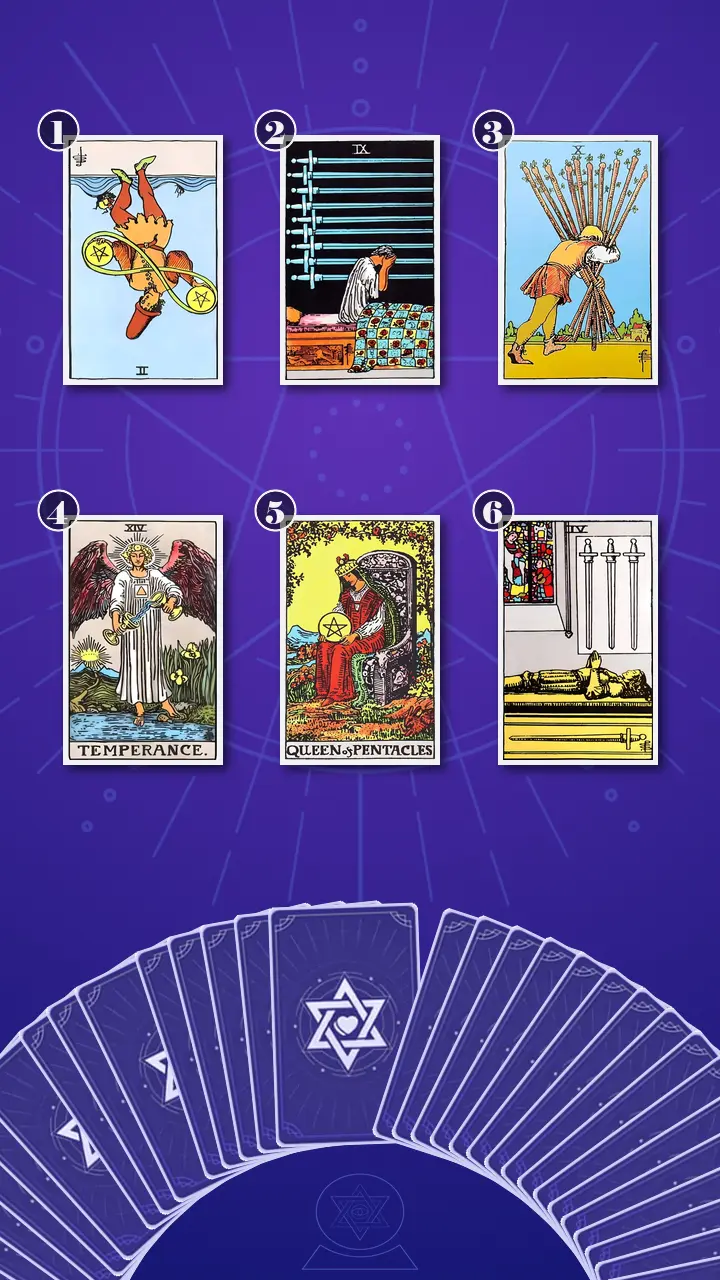
“The top row names what’s happening,” I explained, laying the grid out like a reset panel. “Card 1 will mirror the visible ‘off’ feeling right now. Card 2 is the main blockage—especially what keeps sleep from restoring you. Card 3 is the deeper driver, the belief or load underneath.”
I tapped the bottom row. “Then we drop down. Card 4 is the turning point energy—what shifts the system without requiring a dramatic overhaul. Card 5 gives a concrete next step for the week. Card 6 shows what ‘better’ looks like when you’re not forcing it.”
Jordan nodded, but their leg was still bouncing. “Okay,” they said. “Please just tell me I’m not… failing at adulthood.”
“We’ll let the cards answer that,” I said, and turned over the first one.
Reading the Reset Panel: Work, Money, Sleep—All Fighting for the Same Hour
Position 1: The visible ‘off’ feeling right now
“Now turning over is the card that represents the visible ‘off’ feeling right now—the concrete way work, money, and sleep are showing imbalance on move-in day,” I said.
Two of Pentacles, reversed.
“This is the card of juggling,” I told them, “but reversed, it’s when the juggling stops being adaptable and starts being punishing.”
I used the image the way I’d translate a constellation for a school group: one symbol, made modern. “Move-in day ends and you’re still ‘juggling’ in the same hour: you’re unpacking kitchen boxes, answering Slack pings about a timeline, and reopening your bank app after every charge (Uber, hardware store, tip). You keep switching because each thing feels equally urgent—then you wonder why none of it creates the settled feeling you’re chasing.”
Jordan’s mouth twisted. Their eyes flicked down and back up, like they’d been caught mid-scroll. Their shoulders rose defensively, then dropped a millimeter. “That’s… yeah,” they said, and that bitter laugh came back. “It’s accurate in a way that’s almost rude.”
“Useful rude,” I said gently. “Look at the infinity loop around the coins. This is your bank app refresh loop, your Slack loop, your Notes loop—numbers, notifications, tasks circling without landing. The energy here is blocked and overextended. Not because you’re lazy. Because you’re trying to run three systems at once without a defined ‘done.’”
I watched their jaw. Still tight. “Right now your body thinks: if I stop, I drop something.”
Position 2: What is actively blocking regulation and recovery
“Now turning over is the card that represents what is actively blocking regulation and recovery—especially what keeps sleep from restoring you,” I said.
Nine of Swords, upright.
I didn’t rush. “This is insomnia, rumination, and the kind of self-critique that shows up when the lights go off. The picture is literally a person sitting upright in bed, hands over their face.”
And then I gave them the scene—close-up, no abstraction: “You finally get into bed in your new place, but your brain starts auditing the day like it’s a performance review: what you forgot to set up, what you didn’t reply to at work, what you spent. You’re tired, but your body is still buzzy, so you scroll and rehearse worst-case scenarios instead of letting sleep happen.”
I let the imagery do the work. “The swords on the wall? That’s your wall of tabs. Phone glow on the ceiling. Unread Slack badge. Your mind goes: If I fall asleep now, then tomorrow… / If I don’t answer, they’ll think… / If I don’t check, I’ll get surprised.”
Jordan winced so subtly most people would miss it—a quick tightening around the eyes—then a long exhale, like they’d been holding air hostage. “Yep,” they said. “That’s exactly 1:00 a.m. me.”
“This is the choke point,” I told them. “The energy here is excess Air—too much mind, not enough downshift. And it’s brutal because it steals recovery, and then the next day you’re foggy, and then the fog becomes ‘proof’ you can’t afford to slow down.”
I leaned forward slightly. “If you had to name the one sentence that returns at night—what is it?”
They swallowed. “If I don’t stay on top of everything right now, it will spiral.”
“There it is,” I said. “That belief is doing overtime.”
Position 3: The underlying load or belief that created the pile-up
“Now turning over is the card that represents the underlying load—the belief that created the pile-up across domains,” I said.
Ten of Wands, upright.
“This is what it looks like when you carry too much alone,” I said, “and you treat every responsibility as equally non-negotiable.”
I translated it into the exact kind of NYC moment you don’t forget: “It’s like carrying three tote bags, a lamp, and a rolled rug up a walk-up because your friend had to leave early. Keys in your mouth. One bag ripping. You tell yourself, If I just push for one more hour, it’ll be fine.”
Jordan’s face tightened—not shame, more like irritation mixed with tenderness, as if they were seeing themself from the outside for the first time. Their hand went to their shoulder unconsciously and kneaded once.
“You’re not failing at adulthood—you’re overloading one system with three jobs,” I said, using the phrase like a handrail. “Employee. Mover. Accountant. And because help is arriving in fragments, you’re filling the gaps by over-functioning instead of adjusting the plan to match reality.”
The energy here is excess Fire: effort, effort, effort—no slack. And when there’s no slack, everything feels like life or death, even deciding whether to sleep.”
Jordan stared at the card and said, quietly, “I hate that I do this.”
“I’m not here to make you hate yourself into change,” I replied. “I’m here to help you build a rhythm your body will believe.”
When Temperance Poured Between Two Cups
Position 4: The turning point energy that can start shifting the system
I let the room—Tokyo night on my side, NYC night on theirs—go still for a beat. Even through the screen, the air changed the way it does in a planetarium right before the stars come up: a quiet that isn’t empty, just focused.
“Now turning over,” I said, “is the card that represents the turning point energy—the shift that can start recalibrating the system without requiring a dramatic overhaul.”
Temperance, upright.
Jordan’s shoulders dropped a fraction just seeing it, like their body recognized the word moderation before their mind did.
“Temperance is regulation,” I told them. “Moderation. The art of mixing what you need in the right proportions. This is not the card of ‘do it all better.’ It’s the card of ‘choose a livable ratio.’”
I grounded it in their week: “Instead of trying to stabilize work, money, and the apartment all in one night, you build a simple formula for the week: one focused work block, one home base task, one body anchor (food/walk), and a protected shutdown time. The win isn’t doing more—it’s doing the same small sequence often enough that your body stops bracing for impact.”
Setup. It’s move-in night and you’re sitting on the floor between half-open boxes, laptop balanced on a moving tote. Slack pings, your bank app is open, and you’re telling yourself you’ll sleep once the place looks “done.”
Delivery.
Stop trying to juggle your way into stability; start mixing your days on purpose, the way Temperance pours between the cups.
I didn’t add anything for a moment. I just let the sentence hang there—like a bell tone after you close a meditation app you never opened again.
Reinforcement. Jordan’s breath caught first—tiny, almost inaudible. Then their eyes unfocused, like they were replaying the last three nights in fast-forward: the “ten more minutes” bargaining, the bank-app doom refresh, the laptop heat on their thighs, the kitchen drawer reorganized perfectly at 1:40 a.m. Their lips parted, then pressed together, like they were trying not to cry and not to laugh at the same time.
They blinked hard. Their jaw unclenched with a soft click. Their shoulders, which had been hovering near their ears, slid down as if gravity finally got permission. Then came the new vulnerability—the dizzy part that can follow relief—because if you stop spinning faster, you have to admit you were spinning at all.
“But if I stop…” Jordan started, and there was a flash of anger in it—not at me, but at the implication. “Doesn’t that mean I’ve been doing it wrong? Like, this whole time?”
I nodded. “That reaction makes sense. But Temperance isn’t calling you wrong. It’s calling your current settings outdated. You’re not failing—your nervous system is still in logistics mode.”
This is where my work in astronomy always sneaks in. “When I guide tours, I talk about pulsars—stars that send out pulses with insane regularity. If your timing is off by a little, the signal turns to noise. Your week has been noise because your rhythm keeps changing every hour.”
“Tonight,” I continued, “I want you to borrow my Pulsar Breathing practice—not mystical, just rhythmic. Set a 10-minute timer. Do this once tonight: (1) Write your “tomorrow list” on one note (max 5 bullets). (2) Pick ONE anchor for tomorrow morning (coffee + 5-min tidy, or a 10-min walk, or a 10-min money check at lunch). (3) Put your bank app in a folder and enable a simple screen-time limit after 8 p.m. If you feel your chest tighten or you start bargaining (“just one more”), pause and stop at the timer—no fixing required.”
Jordan looked down at their phone like it was a little less powerful than it had been five minutes ago.
“Now,” I asked them softly, “with this new lens—can you think of a moment last week when you were trying to juggle your way into stability… and mixing a ratio on purpose would’ve changed how your body felt?”
They swallowed. “Last night. I kept checking ConEd emails and my balance. I could’ve… just chosen lunch to check. And stopped.”
“Exactly,” I said. “This is the shift from frantic overstimulation to a rhythm your body can repeat—and trust.”
Make a Minimum-Viable Nest (and Let Perfect Wait)
Position 5: A concrete next step that stabilizes within a week
“Now turning over is the card that represents a concrete next step—something that stabilizes your home/work/money ecosystem within a week,” I said.
Queen of Pentacles, upright.
“This Queen builds stability through tangible care,” I told Jordan. “Not through panic. Not through punishment.”
I made it modern and specific: “You make stability physical: you set up the bed properly, stock a few simple groceries, and decide on one money rule that reduces spiraling (like no checking at night). You let the apartment be imperfect while you create one cozy, functional corner that signals ‘this is a home base now.’”
Jordan nodded, then hesitated. “But… spending more money on groceries or a lamp or whatever makes me feel worse. Like I’m being irresponsible.”
There was our practical obstacle—real life, not a movie. “That’s the Two of Pentacles reversed overcorrecting,” I said. “When anxiety spikes, the brain tries to lock down spending so hard you skip essentials—then you rebound with a late-night ‘treat myself’ DoorDash because you’re depleted. And the guilt reactivates the checking.”
I held their gaze through the screen. “This Queen is giving you permission to spend on what supports function. A towel. Eggs. A real meal. A light source that makes the room feel less like a staging area.”
“Make a minimum-viable nest,” I said, “and let perfect wait.”
Position 6: How to integrate and stabilize—especially around rest
“Now turning over is the card that represents integration—what ‘better’ looks like when you’re not forcing it, especially around rest and mental clarity,” I said.
Four of Swords, upright.
“This is a protected recovery window,” I told them. “Not collapse. Not procrastination. Structured rest.”
I gave them the scenario in plain language: “You treat rest like a scheduled part of moving: a hard evening cutoff where unpacking and work replies stop, even if boxes are still out. You build a small sanctuary routine (phone away, lights down) so your mind can stop interrogating you and your sleep can actually restore you.”
Jordan’s eyes went to their laptop, still open on the bed. They made a face like it was a coworker they didn’t like. “I don’t know if I can,” they said. “Like, I get it, but I’m expected to be responsive.”
“Then we make it a boundary experiment,” I said. “Not a personality makeover.”
I offered one of my oddest-but-most-effective tools—born from too many nights writing research notes with Tokyo apartment noises in the background. “If silence makes your brain turn itself into a courtroom, borrow my Washing Machine Sounds as Cosmic Meditation Background strategy. Put on a steady, boring sound—laundry, AC hum, white noise—and let it be your signal: ‘Nothing new gets decided after this.’ In the planetarium, we dim the lights so people stop scanning for exits. Same principle.”
Then I added my CMB Resonance practice—five minutes, not an hour, because the point is repeatability: “Right before sleep, sit or lie down and do six slow cycles of breathing. On the inhale: ‘I have a home base.’ On the exhale: ‘I don’t have to earn rest.’ Five minutes. That’s it.”
Jordan’s face softened in a way that made them look younger. “Rest is part of the plan, not the prize at the end,” they repeated, almost testing the sentence like a key in a lock.
“Exactly,” I said. “And once sleep becomes protected, work focus and money decisions stop being made from depletion.”
The 7-Day Rhythm Experiment: Actionable Advice for the First Week
I pulled the full grid back into a single story—the way you’d trace a constellation line so it finally looks like something: “Two of Pentacles reversed says you’re trying to manage work, money tracking, and unpacking in the same hour, which makes your attention scatter. Nine of Swords shows the cost: bedtime turns into an audit, so your nervous system never powers down. Ten of Wands reveals the deeper driver: you’re carrying the move like a one-person team because you’re afraid one mistake will prove you can’t handle this transition.”
“Temperance changes the question,” I continued. “Instead of ‘How do I fix everything tonight?’ it becomes: ‘What repeatable rhythm can I keep for seven days?’ Queen of Pentacles turns that rhythm into tangible support—food, bedding, one cozy corner, one money boundary that isn’t punitive. Four of Swords seals it with a protected recovery window so your mind can reset.”
The cognitive blind spot I saw clearly now was this: Jordan kept treating intensity as the only proof of responsibility. As if calm had to be earned by suffering first.
“Your transformation direction,” I said, “isn’t from messy to perfect. It’s from urgency to steadiness. From control-seeking to self-trust.”
Then I gave them the smallest possible plan that could still change the week.
- The 7-day mixing ratio noteOpen Notes and write: 1 work priority, 1 home priority, 1 body priority—no more than one each. Check it in the morning, not at midnight.If your brain tries to add a fourth item, label it “nice-to-have,” not “urgent.” You’re training restraint, not missing responsibilities.
- Boundary-first money checkFor 7 days: No bank-app checking after 8 p.m.; one 10-minute check at lunch. Put the bank app in a folder and set a simple screen-time limit.If anxiety spikes, remind yourself: this is a boundary experiment, not a morality test. If you truly need info, get it in the planned window—no bargaining at midnight.
- The minimum-viable nest + hard stopTonight, pick one nurturing setup task that supports function (make the bed properly, set up one lamp, find towels, stock two easy breakfasts). Then choose a hard stop time when unpacking and work replies end.Expect it to feel “wrong” at first. Hold the boundary anyway. If your mind spirals, write one line: “Tomorrow I will handle ___ at ___.” Then stop.
Jordan stared at the list like it was suspiciously simple. “It’s so small,” they said. “I keep thinking, ‘That can’t be enough.’”
“That thought is the old system trying to stay in charge,” I replied. “Small is the point. We’re testing what’s repeatable, not what’s impressive.”
“Okay,” they said, and for the first time their voice sounded less like a clenched fist. “I can do seven days.”

A Week Later: The Quiet Proof
Six days later, I got a message from Jordan while I was walking into the planetarium for an evening show. It was short—no paragraphs, no spiral.
“Did the lunch money check. Didn’t check at night. Also… I made the bed like you said. It sounds ridiculous but I slept.”
They added, “The apartment’s still messy. But it feels like mine now.”
I pictured them celebrating in the most move-in-week way possible: the boxes still half-open, but a single lamp on, a clear spot on the counter, and a cup of tea held with both hands—light, a little lonely, and still real.
That’s the Journey to Clarity I trust: not the dramatic overhaul, but the moment your nervous system stops acting like it’s on-call 24/7. The moment you realize stability isn’t something you hustle into—it’s something you design, in a rhythm your body can actually keep.
When you finally get the keys, it can feel like you’re supposed to be instantly ‘settled’—but your jaw is clenched, your brain is auditing every dollar, and you’re scared that resting for one night will prove you can’t actually keep your life together.
If you didn’t have to earn calm tonight, what’s one tiny rhythm you’d be willing to repeat for seven days—just to see what your body trusts?