From Zillow-Text Pressure to Cautious Agency: Owning Your Next Move

The Zillow Buzz at 11:34 p.m.
You’re 28, renting in Toronto, and the second your phone lights up with a Zillow link, your chest tightens like you just got assigned a surprise exam.
Jordan (name changed for privacy) said it like a joke, but her mouth didn’t match it—her smile was thin, like she was trying to keep something from spilling. We were on a video call; behind her, a condo living room glowed in laptop-blue. The fridge hummed. Somewhere through the wall, a neighbour’s TV pulsed like muffled bass.
“It’s always late,” she told me, pulling her hoodie sleeves down over her hands. “11:30-ish. I’ve got Zillow open with… too many tabs. And then my mom sends another link. And I’m like—okay. Tonight. I’ll solve it tonight.”
I watched her jaw work as if she were chewing on a thought she couldn’t swallow. The pressure wasn’t abstract. It was bodily: a tight chest like a seatbelt locked in place, a clenched stomach like she’d stepped off a curb and realized a car was closer than it looked.
“It’s not the Zillow link,” I said gently. “It’s what your body thinks that link means.”
She looked down at her phone, then back at me. “It means… I’m behind. And if I pick wrong, I’ll prove it.”
There it was—the engine of it. Craving independence and a home that feels like yours vs fearing financial risk and family disapproval. A tug-of-war that doesn’t just happen in your head; it happens in your nervous system, in the millimeter-tightness around your ribs when the buzz hits.
“Okay,” I said, slowing my own voice the way I do when I’m guiding a planetarium audience through a darkened dome. “Let’s make this a Journey to Clarity. Not a dramatic ‘solve your whole life tonight’ thing. Just a map for why the loop keeps restarting—and one or two next steps you can actually own.”

Choosing the Compass: The Celtic Cross · Context Edition
I asked Jordan to take one breath with me—nothing mystical, just a clean transition from spiraling into looking. I shuffled slowly, letting the sound be a metronome. In the planetarium, I teach that our brains calm down when we have rhythm and orientation; this was the same idea, just in miniature.
“Today, we’ll use a spread called the Celtic Cross · Context Edition,” I said.
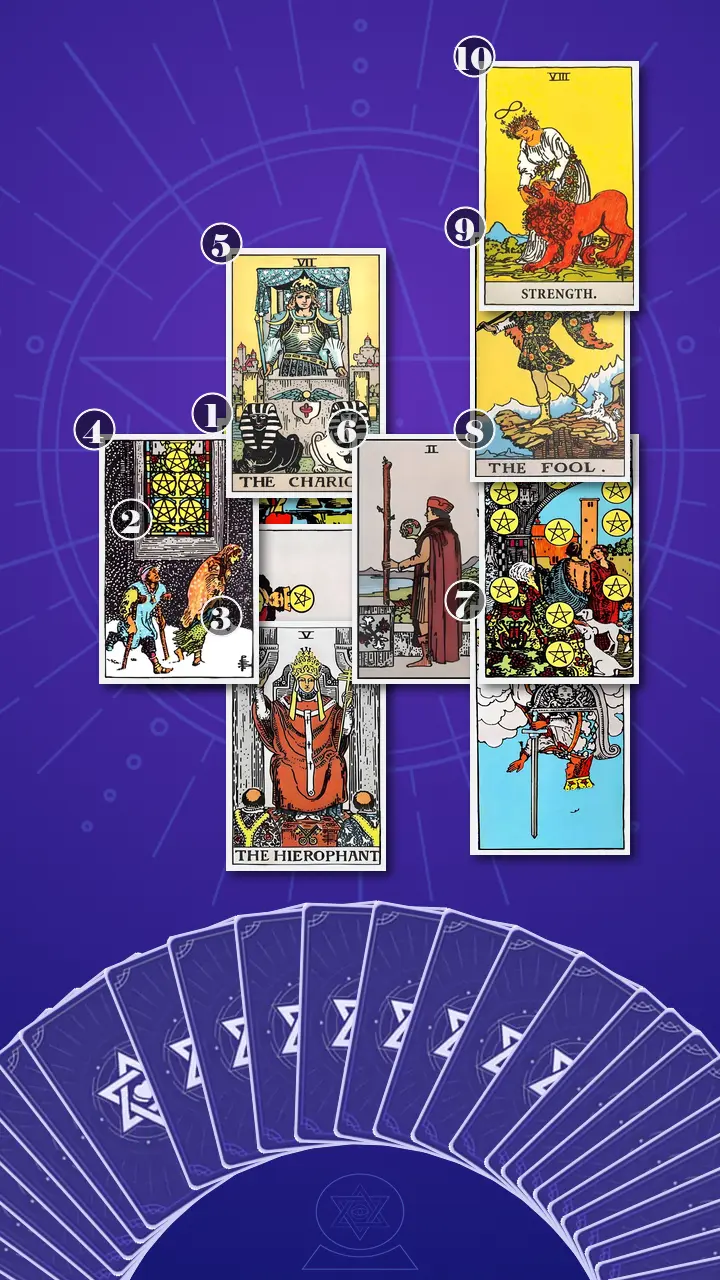
For you reading along: I chose it because it’s excellent for a repeating loop—a pattern that feels like it’s about logistics (housing) but is really powered by an internal script (family expectations + money-control + the fear of being judged). This version keeps the classic structure, but it tunes Position 8 (environment) specifically toward the “mom + housing market pressure” dynamic, and Position 10 toward “the most supportive direction you can own.” It separates inner drivers (positions like 3, 7, 9) from outside pressure (8), while still showing a clear path from stuckness (1–2) to agency (10).
“Here’s how we’ll walk it,” I told her. “Card 1 is what the move-back loop looks like in your real daily behavior. Card 2 is what’s blocking you. Card 3 goes underneath—what’s running the show even when you don’t name it. And at the top of the ladder, Card 10 will show the most supportive direction—what breaks the loop in a way you can repeat.”
Reading the Map: From Tabs to Tension
Position 1 — The loop in daily life
“Now we turn over the card representing the move-back loop as it shows up right now in daily behavior,” I said.
Eight of Cups, reversed.
I didn’t have to reach for a poetic metaphor; the card handed us one. “This is 11:30 p.m. energy,” I said. “It’s like you’re telling yourself you’re ‘just staying flexible,’ but your actions keep circling back to the most familiar safety net—keeping options open, keeping your life half-packed, and re-starting the move-out plan every few months without actually crossing the threshold.”
Jordan gave a short laugh that sounded like it scraped on the way out. “That’s… so accurate it’s kind of rude.”
“I know,” I said, letting it land without defensiveness. “Reversed, Eight of Cups isn’t ‘you don’t want independence.’ It’s hesitation. A half-exit. Like packing a suitcase and leaving it by the door for months.”
Her eyes flicked to the side—toward her laptop, toward the invisible stack of tabs. She was already seeing herself in it.
Position 2 — The core obstacle
“Now we turn over the card representing the core obstacle: what keeps you defaulting to safer options instead of choosing and committing,” I said.
Four of Pentacles, upright.
“This is the grip,” I said. “You treat the housing decision like a one-shot test you can’t fail financially, so you grip tighter: more spreadsheets, more ‘smart’ calculations, more delay—until the only choice left is the default (moving back) that feels safest in your body.”
She nodded, but it was small—like admitting it cost her something. Her shoulders stayed high, almost touching her ears.
“Spreadsheets can feel like control,” I added. “They’re also a really polite way to avoid committing.”
Jordan exhaled through her nose, and for a second her gaze went unfocused—like she was replaying every midnight tweak of a Google Sheets template, every visit to r/personalfinancecanada that ended with more certainty-chasing, not more decision-making.
“Yeah,” she said quietly. “I call it being responsible.”
“Four of Pentacles is responsible,” I said. “But as a blockage, it’s excess. Too much holding, not enough living. Money-security becomes emotional armor.”
Position 3 — The deeper driver underneath
“Now we turn over the card representing the deeper driver you may not be naming: the internalized rules about adulthood, stability, and being ‘responsible’,” I said.
The Hierophant, upright.
“Underneath the Zillow links is an internal rulebook,” I said. “A real adult has a plan, a timeline, and ideally a property path. Even when nobody is in the room, you feel graded—so your choices become about earning approval instead of building a life that fits.”
Jordan’s fingers tightened around her mug, then loosened. “That’s exactly it. It stops being ‘where do I want to live’ and turns into… ‘am I allowed to be the kind of adult who rents?’”
The Hierophant is borrowed authority. It’s the feeling that there’s one correct way, and someone else has the keys.
“If you finished the sentence, ‘A responsible adult should—’ whose voice is that?” I asked.
She didn’t answer right away. Her eyes went up, left—searching her own memory like a file directory. “My mom’s,” she finally said. “And also… the whole vibe. Like CBC pieces about housing affordability, and The Globe, and everyone online saying rent is wasting money.”
Position 4 — What set the pattern up
“Now we turn over the card representing what set this up: the recent experiences with scarcity or instability that made safety feel urgent,” I said.
Five of Pentacles, upright.
“A past season of instability still lives in your nervous system,” I said. “Maybe a rent jump, a shaky lease, or a tight-money stretch—so when you face uncertainty now, your body reaches for the ‘warm place’ (moving home) even if your present resources are stronger than they used to be.”
Jordan swallowed. Her throat moved like the memory had weight. “Two years ago my rent went up like… absurdly. I had to move in a month. I remember standing in a hallway with boxes thinking, I can’t do this again.”
Five of Pentacles is deficiency energy—your body remembers what it was like to be close to not-enough. And then Four of Pentacles shows up and says: never again. Grip harder.
Position 5 — What you think you should aim for
“Now we turn over the card representing your conscious goal image: independence, momentum, having your own place,” I said.
The Chariot, upright.
I felt the room change—subtly—but it did. Like someone opened a window in a warm subway car. “This is the part of you that wants to steer,” I said. “It’s like when you imagine a version of yourself who can say, ‘This is my plan,’ and then follows it with calm consistency rather than rushing to justify it.”
“Yes,” Jordan said fast, as if relief was finally allowed. “I want to be that person.”
“The Chariot is balanced control,” I said. “Not the Four of Pentacles grip. The Chariot says you can hold competing needs—freedom and safety—without having to eliminate one.”
Position 6 — The next feasible opening
“Now we turn over the card representing the next feasible opening: what becomes available once you make one concrete choice instead of seeking certainty,” I said.
Two of Wands, upright.
“This is the shift from research to direction,” I said. “It’s like when you stop trying to forecast every risk and instead choose a ‘good enough’ path to test—one neighborhood, one timeline, one set of boundaries.”
I leaned in a little. “Not more information—more direction.”
Jordan’s shoulders dropped a fraction, like she’d been carrying a backpack she forgot she could set down. “I could do a two-week plan,” she said. “If it’s contained. Like—no adding more options.”
“Exactly,” I said, and I pictured it clearly: one calendar invite titled Viewing — Tuesday 6:15 PM, phone face down for thirty minutes, one sticky note that doesn’t multiply into ten.
Position 7 — How you’re showing up
“Now we turn over the card representing how you’re showing up: your boundary style, self-talk, and decision posture,” I said.
Queen of Swords, reversed.
Jordan’s face did something specific: her mouth pressed flat, and her eyes flashed with recognition. Before I even spoke, she said, “Oh no.”
“This is the edited boundary,” I said. “It’s like when you know exactly what you want to say—‘Please stop sending listings’—but your fear of conflict turns it into polite ambiguity that keeps the door open.”
And then, per the card’s instruction, I wrote it out like a tiny script between us:
Unsent: “Hey—can you pause sending listings? It’s stressing me out.”
Sent: “Thanks! I’m looking :)”
I watched Jordan’s hands as if they were another deck: she mimed typing in the air, then deleting. Hovering over Send. Rewriting. “You’re not confused,” I said. “You’re editing clarity to avoid fallout.”
She gave a small, pained smile. “I do the smiley-face thing too.”
Queen of Swords reversed is a blocked Air energy. The words are there, but they don’t come out clean. Or they come out sharp when the pressure finally boils over. Either way, the Zillow dynamic stays in charge.
Position 8 — External pressure and messaging
“Now we turn over the card representing external pressure and messaging: family expectations, the market narrative, and the Zillow-link dynamic,” I said.
Ten of Pentacles, upright.
“This is legacy,” I said. “It’s like when you hear ‘buying is smarter’ as ‘this is what our family does,’ and your living situation becomes a referendum on belonging and status.”
In my mind, I saw the Ten of Pentacles archway like a doorway Jordan felt she had to pass through in the approved way. I’d seen the same feeling in tourists at the planetarium—people who look up at Saturn and suddenly remember they’re a small part of a long line, and that smallness can feel like comfort or a trap, depending on the story you’re carrying.
“This isn’t just advice,” I said. “It’s a script.”
Jordan’s eyes went wet but she didn’t cry. She blinked hard once. “That’s what it feels like at Sunday dinner,” she whispered. “Like I’m being graded.”
Position 9 — Hopes and fears
“Now we turn over the card representing what you both want and fear: the leap into a self-chosen path and the vulnerability it requires,” I said.
The Fool, upright.
“This is the part of you that wants a fresh start,” I said. “It’s like when you dream about a place that feels like yours—even if it’s not the ‘smartest’ on paper—and worry you’ll be seen as naïve for choosing it.”
The Fool is potential—but in this position, it’s a mix of desire and dread. “You want freedom,” I said, “and you fear the judgment that comes with not following the standard script.”
Jordan stared at the card like it could text her mom back for her. “I want to choose,” she said. “I just don’t want to be… watched while I choose.”
I nodded. “That’s the exact hinge.”
When Strength Spoke: Gentle Control in a Family Orbit
Position 10 — The most supportive direction you can own
The room went quiet in that specific way it does right before a planetarium show begins—when the chatter drops and everyone subconsciously leans toward the dark, ready to see what’s actually there.
“Now we turn over the card representing the most supportive direction if you choose agency,” I said. “The inner strength and gentle boundaries that stabilize follow-through.”
Strength, upright.
Jordan let out a breath that sounded like it had been held for a week.
Before the “aha,” I anchored us in the setup—because her pattern had a rhythm, like a repeated lunar cycle.
It’s 11:30 p.m., the Zillow tabs are multiplying, your spreadsheet looks like a life raft, and your thumb is hovering over a text you keep rewriting.
You don’t have to wrestle your life into place—practice gentle control and steady boundaries, like Strength’s calm hands closing the lion’s mouth without a fight.
I let the sentence hang for a beat, the way I let a constellation hang on the dome so people can actually see it, not just hear the label.
Jordan’s reaction came in layers—like a three-stage eclipse.
First: a physiological freeze. Her shoulders locked. Her breath stopped halfway in. Her eyes widened just a little, pupils catching the screen light.
Second: cognitive seep-in. Her gaze drifted off the camera, as if she were watching a replay of herself on the TTC at Bloor-Yonge, gripping her phone too hard, refreshing a bank app, trying to force certainty out of numbers.
Third: emotional release. Her jaw unclenched visibly, like she’d set down something heavy without realizing she’d been carrying it. She exhaled—slow, shaky at the end—and said, “But… if I don’t fight for the perfect answer, doesn’t that mean I’m being irresponsible?”
There was the unexpected flare of resistance—anger at the implication, grief for all the nights she’d spent trying to be “good.”
“No,” I said, steady. “It means you’re switching from gripping to guiding. Strength isn’t passive. It’s regulated.”
This was where my own framework clicked in—the one I’ve used for years, watching celestial bodies pull at each other without ever touching.
“Can I offer you a metaphor from orbital mechanics?” I asked. “I call it Galactic Gravity Analysis.”
She gave a small nod.
“Your mom is a big mass in your system,” I said. “Not because she’s evil—because she matters. Ten of Pentacles is a powerful gravity field: family legacy, ‘smart’ narratives, the idea that adulthood has one correct trajectory. When the pressure spikes, your path becomes elliptical. You swing back toward the big, familiar gravity well—moving home, reopening the loop—because it feels stable.”
“Yeah,” she breathed, like she’d been waiting for someone to say it without blaming her.
“Strength is you learning a different kind of control,” I continued. “Not by escaping gravity, but by choosing your orbit. Tiny, consistent course corrections. A boundary you can repeat. One action you can commit to.”
I softened my tone. “Now, with this new lens—think about last week. Was there a moment when a Zillow link hit, and this insight could’ve changed how it felt in your body?”
Jordan’s eyes flicked down to her phone again. She put her hand on her chest unconsciously, as if testing the difference. “Monday morning,” she said. “At my desk. I opened the spreadsheet immediately. If I’d done… this… I think I could’ve just… not.”
“That’s the shift,” I said. “This isn’t about a perfect housing answer. It’s about moving from tight pressure and self-doubt to steadier self-trust—one repeatable boundary at a time.”
And I said it plainly, because Strength likes plainness: “The way out isn’t a perfect address—it’s a repeatable boundary.”
The One-Page Plan: Actionable Advice for Breaking the Move-Back Loop
I pulled the whole spread together like a story you can actually live inside.
“Here’s what I see,” I said. “Eight of Cups reversed is the half-leave loop—your life half-packed, your decisions kept hypothetical. Four of Pentacles crosses it with the money-grip: you try to buy safety with certainty. Underneath, The Hierophant says you’re not just choosing housing—you’re trying to obey an inherited rulebook of ‘Real Adult™.’ Five of Pentacles explains why your body panics: you remember scarcity, so you over-control. Your conscious mind wants The Chariot—direction and independence. Two of Wands offers the opening: choose a path to test. But Queen of Swords reversed is the hinge—if you keep editing your boundary, Ten of Pentacles pressure keeps entering. The Fool says you want to begin; Strength says begin with gentle authority and repetition.”
“Your cognitive blind spot,” I said carefully, “is thinking you need perfect certainty plus parental approval before you’re allowed to take a step. That’s the trap. The transformation direction is the opposite: set one clean boundary and take one concrete housing step—then repeat. You can be close to your family without outsourcing your adulthood.”
Jordan nodded, but then she winced. “I want to do the boundary thing,” she said, “but I literally can’t deal with the guilt. Like, I don’t have five minutes for the emotional fallout because work is insane and then Sunday dinner happens and—”
“That’s real,” I said immediately. “So we don’t aim for a performance of calm. We aim for a structure you can lean on.”
I offered her my Solar Eclipse Mediation approach—my three-step conflict resolution model based on how an eclipse works: alignment, brief darkness, then re-emergence. In practice, it’s: state the alignment (what you’re doing), name the shadow (what you’re not doing), then return to the shared light (relationship intact, topic closed).
Then I gave her a small, practical plan—no heroics.
- Send the Two-Sentence Boundary (Solar Eclipse Script)In Messages, send two sentences unchanged: (1) what you will do (your process), (2) what you won’t engage with for now. Example: “I’m doing my housing search in a structured way over the next two weeks. Please don’t send me listings or follow up on timelines until I bring it up.”Expect the first wave to be “This is mean / I’m ungrateful.” That’s a normal guilt spike when you stop outsourcing your adulthood. If there’s pushback, copy/paste the same script once—no debate.
- Build a Two-Week Test Plan (Three Lines Only)In Notes/Notion, write only three lines: budget ceiling, commute ceiling, and 1–2 neighborhoods max. For two weeks, no adding more neighborhoods—just test within the container.When your brain tries to open a 15th tab, label it “grip mode.” Then tell yourself: “Not now ≠ never.”
- Book One Real-World Step Within 24 HoursRequest one viewing, call one leasing office, or start one application—something that creates a calendar event (even if it’s “Fill two fields, then stop”).After you hit send / book the thing, do a 90-second Strength reset: feet on the floor, one hand on chest, exhale longer than inhale, and name the feeling (“pressure,” “guilt,” “resentment”) without solving it.
I looked at her and made it even simpler. “Pick a path to test, not a life to prove.”
Jordan’s face softened into something like disbelief—like the idea that adulthood could be practiced in small units was new information.

A Week Later: The Quiet Proof
Eight days later, I got a message from Jordan. Just two screenshots and one line: “I sent it. Unchanged.”
The first screenshot was her two-sentence boundary. No smiley face. No apology paragraph. The second was a calendar invite: Viewing — Tuesday 6:15 PM.
She added: “I felt shaky after. I did the hand-on-chest thing. And then I slept. Like, a full night.”
It wasn’t a fairytale ending. She didn’t suddenly stop caring what her mom thought. She didn’t magically become immune to Toronto’s rental market TikTok doom and the group chat “we just bought” announcements. But she’d moved from living half-packed to living on purpose.
That’s what this Journey to Clarity is, most of the time: not certainty, but ownership. Not a perfect address, but a repeatable boundary. Not wrestling, but steady hands.
When your phone buzzes and your chest locks up, it’s not just about housing—it’s the feeling that one ‘wrong’ choice could prove you’re not capable, so you keep your life half-packed to avoid being seen choosing.
If you didn’t need perfect certainty or perfect approval, what’s one tiny housing step—or one clean boundary—you’d be willing to try this week, just as an experiment you own?