Backseat Uber Friendships—The One-Sentence Boundary That Gets Data
Finding Clarity in the 9:41 p.m. Story-Scroll
If you’ve ever been in a group chat where it goes dead… and then suddenly there are photos from a plan you weren’t included in, and you pretend you didn’t notice (Sunday Scaries, but social), you already know the feeling I’m about to describe.
Jordan (name changed for privacy) sat down across from me and immediately did that tiny “I’m fine” smile people do when they’re trying to keep a bruise from showing. She’d just moved apartments again—still NYC, still the same borough, but a different set of roommates and a different version of “maybe this will finally click.”
She told me the moment that keeps replaying: Friday, 9:41 p.m. in her cramped Brooklyn bedroom. The radiator clicked like it was counting her heartbeats. Her mascara was half-done, one eye finished and the other still bare, and she was sitting on the bed in jeans she couldn’t commit to. Her phone screen was bright against the dark room as she refreshed the group chat—nothing. Then: three Instagram Stories from a loud bar she wasn’t told about. Clinking glasses. Neon. Someone tagging “the whole crew.”
Her throat tightened the way it does right before you cry or argue—like your body can’t decide which exit it wants. Her stomach dropped, heavy and quick, like a subway lurch.
“I’m not mad,” she said, and then corrected herself, quieter. “I just feel stupid for assuming I was included.”
I watched her thumb hover over an imaginary “Send” button in midair. I’ve seen that gesture a thousand times—people who can speak beautifully at work but go mute in friendship, because the stakes feel messier.
“So your question is,” I said gently, “when you’re in that backseat Uber feeling—watching the route, watching the ETA, watching everyone else laugh from the window—what boundary do you need when you feel left out?”
She nodded, almost embarrassed by how much it mattered.
“Okay,” I told her. “Let’s draw you a map to clarity—something you can actually use the next time your phone starts feeling like an evidence folder.”
Choosing the Compass: The Transformation Path Grid (6)
I always start the same way, not as a mystical performance but as a nervous-system reset. I asked Jordan to put both feet on the floor and take one slow breath in through her nose, out through her mouth—like we were lowering the volume before we tried to hear the song underneath.
Then I shuffled. The sound of cards moving is one of my favorite kinds of white noise—like a soft brush on a snare drum. As a radio host, I’ve spent years watching what happens when people finally hear their own patterns clearly. Tarot works similarly for me: it gives the pattern a shape you can talk to, instead of a fog you have to suffer through.
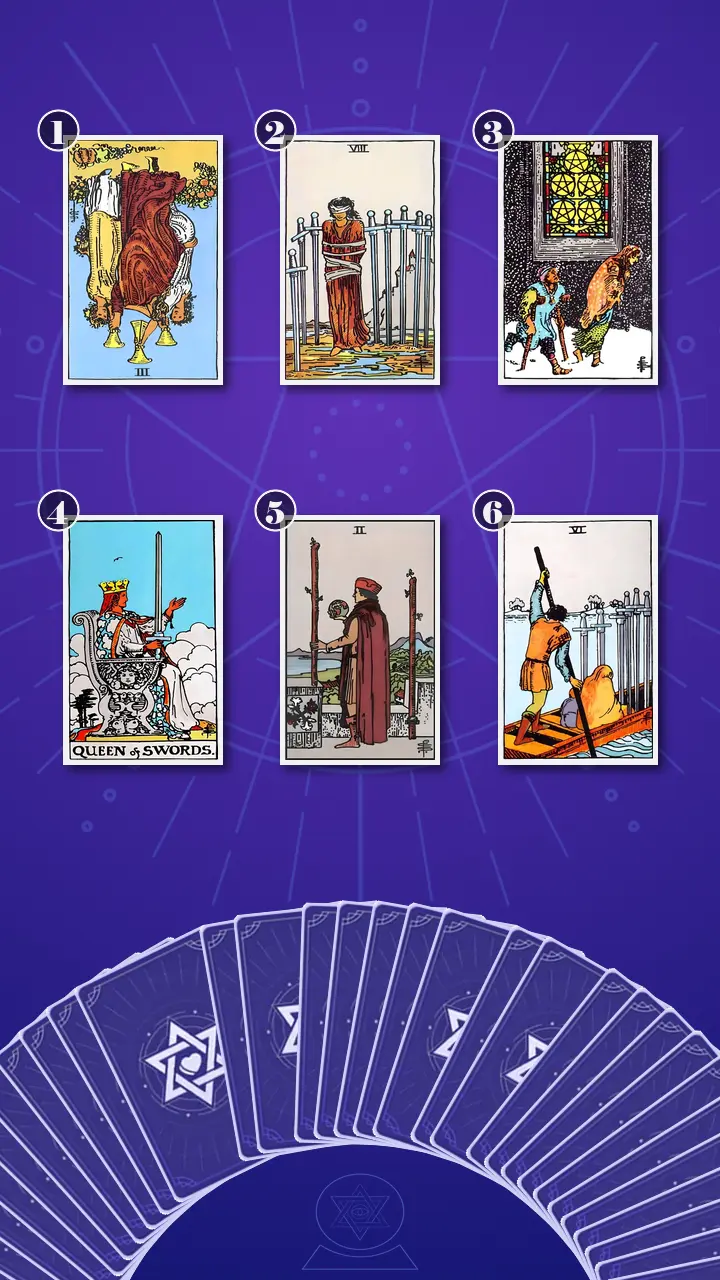
“For this,” I said, “I’m using a spread I call the Transformation Path Grid (6) · Context Edition.”
To you, reading this: this spread fits because Jordan isn’t asking for a prediction about whether these friends will ‘work out.’ She’s asking for a boundary—something that changes her internal reaction and her next move. Six cards is the smallest structure that still shows the whole chain: the left-out moment → the mental block → the deeper wound → the boundary that shifts everything → a concrete experiment → how it looks when the lesson sticks.
It’s laid out as a 2x3 grid. Top row is what happened and why it hooks you. Bottom row is what you do now—like switching lanes instead of staring at the traffic.
“We’ll look at the exact moment you get left out,” I told Jordan, “then the thought loop that traps you, then what it’s really poking at underneath. After that, we’ll find your boundary sentence, your next-step behavior, and what integration looks like—your calmer route.”
Reading the Top Row: The Moment, the Cage, the Cold
Position 1: The left-out moment you can see, but can’t access
I turned over the first card. “Now we’re looking at the card that shows the specific moment you feel left out—and what you do on autopilot right after.”
Three of Cups, reversed.
“This is so literal it’s almost rude,” I said, and Jordan let out a quick laugh that had a bitter edge to it. Like: yes, exactly, and don’t look at me that closely.
In modern life, Three of Cups reversed is you watching your friends’ Instagram Stories from a loud bar—clinking glasses, neon signs, someone tagging the whole group—while your own Friday night is you in half-done makeup refreshing the group chat and trying to act like you don’t care. You’re ‘in the loop’ digitally, but not in the circle emotionally.
Energetically, this is Water reversed: social joy and warmth, but blocked—like the music is loud enough to hear through the wall, but the door doesn’t open. And instead of knocking, your system starts scanning. “Okay,” I told her, “this card isn’t saying you’re unlikeable. It’s saying your brain treats connection like a silent test: if they include me without me asking, I’m wanted; if they don’t, I’m not.”
Jordan’s shoulders crept up toward her ears. She rubbed her thumb along the edge of her phone case, like the texture could keep her steady.
Position 2: The thought loop that keeps you in the backseat
I flipped the second card. “Now we’re looking at the card that reveals the thought pattern that keeps you in the backseat—especially how you silence yourself instead of asking a direct question.”
Eight of Swords, upright.
This card always makes me think of a sound booth with the door shut: you can still see the world through the glass, but your voice doesn’t go out unless you press the button.
In Jordan’s world, this is typing the text that would give you clarity (“Hey, I saw you all went out—was that planned? I’d love to join next time if there’s room.”), then deleting it. Instead, you reread the thread, analyze emoji tone, and wait for someone else to offer information—like you’ve been put in social time-out, even though the lock is mostly in your own head.
I leaned in a little. “Here’s the core mechanic,” I said. “Your phone becomes an evidence folder. You zoom into iMessage reactions like they’re emotional data. ❤️ vs 👍 becomes a whole courtroom.”
Then I used the line I’ve learned people need to hear right there, when the loop is at its loudest: You don’t need more clues. You need one clean sentence.
Energetically, Eight of Swords is Air in blockage. Thoughts are present, sharp, active—but trapped in circles. And the cost is that you never get what you actually need: data. Clarity. A simple yes or no.
Jordan winced—tight nod, eyes flicking down and back up. “I literally do the timestamp + emoji math,” she admitted. “And I hate myself while I’m doing it.”
“No hate,” I said. “It’s your nervous system trying to protect you. It just picked a strategy that keeps you stuck.”
Position 3: The deeper wound underneath the missed invite
I turned over the third card. “Now we’re looking at the card that names the deeper belonging wound—the fear that makes a missed invite feel like evidence about your worth.”
Five of Pentacles, upright.
There’s always a temperature shift with this card. Even in a warm room, it carries cold.
In modern life, it’s one missed invite not feeling like a scheduling glitch—it feeling like NYC itself is telling you you don’t have a place. You scroll through photos like you’re standing outside a warm window in the cold, convinced the door is locked and you’re not allowed to knock, even though someone inside might actually open it.
Energetically, this is Earth in deficiency: not enough safety, not enough “I’m held.” It makes your body interpret uncertainty as scarcity. No invite becomes: no place. No place becomes: no safety net.
Jordan swallowed. Her hand went to the base of her throat, almost unconsciously. “It’s worse after rent comes out,” she said. “Like… it shouldn’t be connected, but it is.”
“It makes perfect sense,” I told her. “When your resources feel tight, your brain treats belonging like another limited commodity.”
Then I asked the question that matters here: “When you feel shut out, where do you feel it first—throat, stomach, chest?”
“Throat,” she said immediately. “Like… I can’t talk.”
When the Queen of Swords Changed the Air
Position 4 (Key Card): The boundary that cuts through guessing games
I paused before turning the next card. The radiator ticked again, and the city noise outside her window felt suddenly farther away—like the room was holding its breath with us.
“We’re flipping the card that defines the boundary you need when you feel left out,” I said. “The one that changes the energy without turning you into a performance.”
Queen of Swords, upright.
Immediately, the vibe shifted. In my head, I heard what I call the “clean mic” sound—when you stop hearing static and you start hearing the actual voice.
In modern life, this is picking one person and sending one clean message—no jokes, no disclaimers: “When plans happen last minute, I sometimes miss them and feel a bit left out. If there’s room next time, I’d love to be included.” Then you stop investigating and let the reply be information, not a referendum on your worth.
Energetically, the Queen is Air in balance. Not cold. Not harsh. Just precise. She doesn’t beg. She doesn’t test. She doesn’t disappear. She names what’s true and asks for what she wants.
Here’s what I needed Jordan to see first—the setup, the reality of her loop: on Friday night, she’s refreshing the chat, watching a bar she wasn’t told about through someone else’s Stories, trying to look chill while her stomach drops. Her brain is screaming, Don’t make it awkward. Don’t be needy. Just wait and see. And the waiting turns into a silent trial where she’s both judge and defendant.
Stop performing “cool and unbothered” and start telling the truth, because the Queen of Swords boundary is the clean blade that cuts through guessing games.
The sentence landed, and I watched the reaction chain move through her like a slow wave.
First: a freeze. Her breath stopped mid-inhale, eyes widening a fraction, like the part of her that survived middle school social hierarchies just got paged.
Second: the cognitive seep-in. Her gaze went slightly unfocused, staring past the card—replaying every time she’d typed “lol where are you guys?” and then deleted it, every time she’d walked into a West Village brunch and laughed at an inside joke she wasn’t in on.
Third: the release—complicated, not cinematic. She exhaled, shoulders dropping, but then her jaw tightened again like she was about to argue with the insight.
“But if I do that,” she said, a flicker of anger showing up like a spark, “doesn’t it mean I’ve been doing it wrong? Like I’ve been… pathetic?”
I shook my head. “It means you’ve been paying for safety with silence. That’s not pathetic—it’s a strategy. We’re updating it.”
This is where I brought in my own lens—my signature tool, the Melodic Mirror. “Tell me what you listen to when you spiral,” I asked.
Jordan blinked. “Honestly? Sad playlists. Stuff where the chorus is basically, ‘If they wanted you, they would.’”
“That’s the lyric your brain keeps looping,” I said. “And it’s catchy. But it’s not always accurate.” I tapped the Queen of Swords. “Let’s write a new chorus—one line you can sing when the old one starts playing.”
I opened Notes and slid my phone toward her, like a co-host passing the mic. “No jokes. No disclaimers. Truth + request. Then breathe.”
Her fingers trembled slightly, then steadied. The room felt warmer—not because anything got fixed instantly, but because she had a tool.
“Now,” I said, “with this lens—truth plus request—think of last week. Was there a moment where one clean sentence would’ve changed how your body felt?”
Jordan nodded, slowly. “Tuesday. I was on the L train. I saw the photo drop. I could’ve just… asked.” She swallowed. “Instead I did the two-minute reopen thing for like an hour.”
“That’s the shift,” I said softly. “From shame-tinged hurt and hypervigilant clue-hunting to self-respectful clarity and self-led belonging. Not overnight. But directionally.”
Position 5: The next move that puts you in the driver’s seat
I turned over the fifth card. “Now we’re looking at the card that turns the boundary into a concrete behavior you can practice this week.”
Two of Wands, upright.
This is Fire re-entering the story—not chaos, not overextending, but initiative.
In modern life, it’s stopping waiting to be ‘picked’ by the thread and initiating one plan: choosing one person you actually like, proposing a specific time/place, and treating the outcome as data. You’re not auditioning; you’re steering.
“Stop riding shotgun in your own social life,” I said, and Jordan’s mouth twitched like she hated how accurate it was.
Two of Wands is Fire in balance: one wand planted (stability), one wand held (movement). It’s not “make a million friends.” It’s one micro-plan that proves to your nervous system you’re not powerless.
I watched her hands shift—less death-grip on the phone, more like she was imagining her calendar app.
Position 6: The calmer lane—what integration actually looks like
I flipped the last card. “Now we’re looking at integration—how your inner state and social choices change when you stop mind-reading and start steering.”
Six of Swords, upright.
In modern life, it’s your mind getting quieter after you practice clarity. You check less, reread less, and when a space repeatedly leaves you behind, you choose a different ‘boat’: fewer chaotic group dynamics, more reciprocal one-on-ones, more calm. You’re still social—but you’re not living in the backseat anymore.
Energetically, this is Air again—but now it’s clean passage instead of a cage. A deliberate transition. The lesson travels with you, but the drama doesn’t have to.
Jordan stared at the boat on the card. “That’s what I want,” she said, quiet. “Not to be numb. Just… to not be wrecked by this.”
“Exactly,” I told her. “Your boundary isn’t ‘stop caring.’ Your boundary is: no mind-reading—one clear question, then you let the answer be data, not a verdict.”
The One-Page Boundary: Turning Hurt Into Actionable Advice
Here’s the story the whole grid told me, stitched together: Three of Cups reversed showed the visible pain—watching closeness from the edge. Eight of Swords showed the mechanism—silence and surveillance dressed up as “being chill.” Five of Pentacles named why it hits so hard—your body reads uncertainty as scarcity and exile. Then the Queen of Swords arrives as an antidote: clear boundary language that replaces guessing with real information. Two of Wands turns that clarity into agency—initiate one plan. Six of Swords is the outcome—less emotional whiplash, more self-led belonging.
The cognitive blind spot here is sneaky: you’ve been treating not having clarity as if it’s safer than hearing a real answer. But the cost is that you keep living in suspense, and suspense is brutal on the nervous system.
The transformation direction is simple and brave: move from mind-reading and performing “chill” to stating one clear truth plus one concrete request—then acting on what you learn.
These are the next steps I gave Jordan—small enough to do, specific enough to change the pattern.
- Write your “Queen of Swords sentence” (under 25 words)Open Notes and write one line that is truth + request. Example: “I felt left out when plans happened without me. If there’s room next time, I’d love to join.” Keep it clean—no extra backstory.If your body spikes (tight throat, shaky hands), take one slow exhale before you decide anything. If today is too much, stop at “write it.” That still counts as taking the wheel.
- Send it to ONE person in daylight hoursChoose the safest person in the group (the one most likely to respond with warmth) and message them privately between Wed 12:30–6:00 p.m.—not during late-night scrolling hours.Expect the resistance script (“This is cringe,” “I’m making it a thing”). That’s your Eight of Swords. Lower the difficulty by using the template and keeping it 1:1.
- Do a 60-minute “no-check window” + an Emotional BPM resetAfter you hit send, put your phone face down and set a timer for 60 minutes. While you wait, play one grounding track around 60–80 BPM (lo-fi, ambient, anything steady) to keep your nervous system from sprinting back to the chat for clues.Name the Focus mode something blunt like “No Forensics.” You’re not punishing yourself—you’re protecting your attention.
Then I added one last piece, because it fits my work as much as my tarot: “When you feel the urge to reread for tone,” I said, “listen for the recurring lyric in your head. That’s your Memory Melody. Replace it with the Queen’s chorus: Belonging isn’t a vibe you earn—it’s information you’re allowed to ask for.”

A Week Later: The Quiet Proof
Six days later, Jordan DM’d me a screenshot. Not a dramatic paragraph—just proof-of-life.
She’d sent the one clean message to one person at 2:14 p.m. on a Thursday. No jokes. No disclaimers. And then—this part mattered most—she’d actually put her phone face down and walked to the corner deli for seltzer like it was a sacred ritual of normal life.
The reply wasn’t perfect, but it was real: “Omg I’m sorry—we thought you were busy. Next time I’ll loop you in.”
Jordan wrote, “My brain still tried to be like, ‘They’re lying.’ But my throat didn’t do the full clamp thing. I feel… calmer. Like I’m not a passenger.”
That’s the Journey to Clarity I trust: not instant belonging, but a shift from guessing to asking, from performing chill to keeping your self-respect intact. Wanting to be included is not a character flaw; disappearing to look chill is.
And if tonight you’re watching the group from the edge with a tight throat and a sinking stomach, it’s not that you’re “too much”—it’s that staying chill has become the price you pay to avoid finding out whether you’re truly wanted.
If you let yourself trade one night of guessing for one sentence of clean clarity, what would you ask—and what would you quietly be willing to learn from the answer?
Every reading at AceTarot is a Journey to connect with inner wisdom and empower next step.
Learn more about our Journey to Clarity.