Payday, Empty Fridge, Unread Emails—And the Triage Rhythm That Followed

Finding Clarity in the 6:18 p.m. Deposit Notification
If you live in a Toronto rental where payday feels like oxygen for five minutes and then instantly turns into triage—fridge empty, inbox full, and your brain screaming that the first choice is a pass/fail test.
Jordan (name changed for privacy) sat across from me with their tote bag still looped around one wrist, like they’d walked in mid-spin. “It’s payday,” they said, and even the word sounded like it came with a timer.
They described the scene so vividly I could practically hear it: 6:18 p.m., narrow kitchen, harsh overhead light that makes everything look a little unkind. The fridge door squeaks, cold air hits their face, and their laptop pings with another email. Phone warm in their palm from being refreshed too many times. Hands buzzing. Chest tight—like a drawstring pulled just under the collarbone.
“I bounce between my bank app, my inbox, and my grocery cart,” they said. “I start three ‘quick fixes’ and finish none. And then I order Uber Eats just to stop thinking. If I pick the wrong thing first, I’m going to waste the whole day.”
I nodded slowly, not because I was impressed by the accuracy—because I recognized the pattern. Overwhelm like this isn’t a vibe. It’s a body state. It’s your nervous system treating routine life admin like an emergency drill.
“We’re not going to solve your whole life tonight,” I told them. “But we can find clarity about what counts as ‘first’—in a way that doesn’t punish you for being human. Let’s draw a map through the fog.”

Choosing the Compass: The Celtic Cross · Context Edition
I invited Jordan to take one breath that was just for them—no optimizing, no multitasking. While they exhaled, I shuffled slowly, the way I learned on transoceanic voyages: not as theater, but as a clean transition from “everything is screaming” into “one thing at a time.”
“Today,” I said, “we’ll use the Celtic Cross · Context Edition.”
For anyone reading along: I choose this spread when the problem isn’t a single decision, but a whole-life bottleneck—money, food, and communication pressure colliding. It’s a classic structure, but we frame it ethically and practically: Card 6 is the next 7 days (supportive direction, not fate), and Card 10 is integration (what becomes possible when you follow the guidance), not a fixed outcome.
I told Jordan what we’d be looking for: the present “triage moment” at the center, the main blocker crossing it, the deeper fear under the urgency, and then—most importantly—the near-term direction and integration that creates a repeatable rhythm. In other words: how tarot works here is not prediction. It’s context. Pattern recognition. A way to turn decision fatigue into actionable advice and next steps.
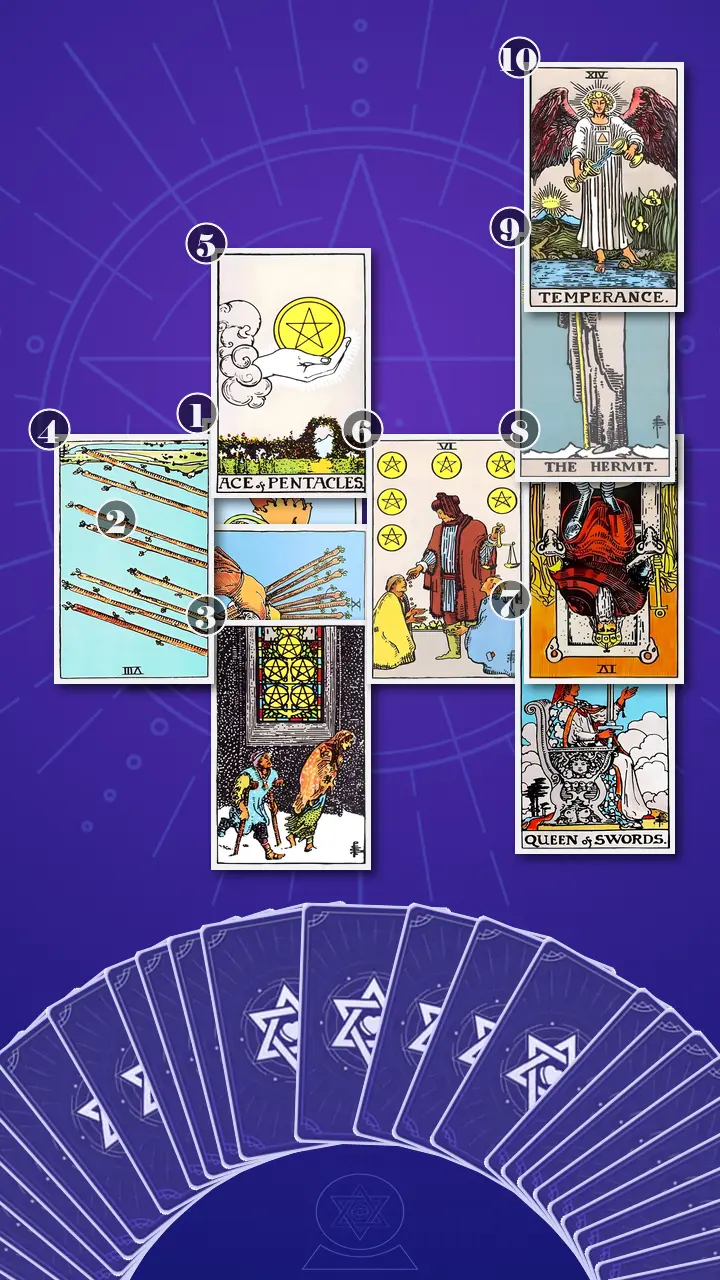
Reading the Map: When Motion Pretends to Be Progress
Position 1 — The current triage moment: what your day is actually asking you to handle right now
“Now we’re turning over the card that represents the current triage moment—what your day is actually asking you to handle right now as one lived experience.”
Two of Pentacles, reversed.
“This is payday afternoon,” I said, using the life scene exactly as it shows up: bank app open, inbox badge count climbing, grocery cart half-built. Toggling—balance → email → cart → balance—like staying in motion will prevent a mistake. But the switching becomes the trap: nothing gets finished, and you end up paying a convenience premium just to quiet your nervous system.
Reversed, the Two of Pentacles is an energy of blockage: the juggling isn’t skillful anymore. It’s compulsive. Like keeping 12 browser tabs open and wondering why your laptop fan sounds like it’s about to take off.
I watched Jordan’s face tighten, then soften into a small, bitter laugh. “That’s… brutal,” they said. “Like, accurate. But brutal.”
“I know,” I said gently. “And here’s the reframe I want you to take with you: Motion isn’t the same as completion. Your brain is trying to create safety by staying busy, but it’s not actually delivering safety.”
Position 2 — The main blocker: what makes it hard to choose a first step and stick with it
“Now we’re turning over the card that represents the main blocker—what makes it hard to pick one thing and stay with it.”
Ten of Wands, upright.
This is the card of over-carrying. The modern translation is painfully simple: your day feels like you’re holding groceries, bills, transit, Slack pings, follow-ups, ‘quick questions,’ and the fear of being seen as slow—all in your arms with no filter. The bundle blocks the figure’s face in the traditional image, and that’s exactly what happens to you: the “pile” blocks clarity until everything becomes one heavy blur.
Upright, the Ten of Wands is excess—too much responsibility, too much alone, too much at once. When that energy is running the show, even choosing groceries first can feel like “neglecting work,” and replying to email can feel like “neglecting your body.”
I let my voice turn a little more direct. “This card is the adulting version of trying to run a one-person startup with no ops team. It’s not that you can’t handle life. It’s that you’re trying to handle all of it simultaneously.”
Position 3 — The underlying need or fear driving the urgency
“Now we’re turning over the card that represents the underlying need or fear—what’s really under the empty fridge and full inbox.”
Five of Pentacles, upright.
This one always makes the room feel colder. Even when the heating is on. In the modern scene: even with money in the account, you still feel one wrong move away from being ‘back in the cold.’ The empty fridge doesn’t read as “I need groceries.” It reads as “I’m failing at stability.”
That’s the Five of Pentacles energy in deficiency: safety feels scarce, so your mind tries to buy safety with perfect decisions. And perfection is expensive—financially and emotionally.
I pointed to the image’s lit window. “See this? Resources exist. Warmth exists. But panic makes it feel inaccessible.”
Jordan’s hands had been fluttering on their knees; now they stilled for a beat, like their body recognized itself in the card before their mind could argue.
Position 4 — The recent pattern that led to this pile-up
“Now we’re turning over the card that represents the recent pattern—how the backlog formed.”
Eight of Wands, reversed.
In real life, this is “speed without landing.” Messages keep arriving but never resolve. You skim, draft in your head, postpone, then panic-reply. Your inbox becomes a background noise you can’t switch off, so even when you try to do groceries or budgeting, your attention keeps snapping back to: what if I missed something?
Reversed, it’s blockage again—momentum without trajectory. And it’s where I bring in one of my Jungian tools and one of my tarot tools at the same time: procrastination rarely looks like “doing nothing.” It often looks like constant monitoring.
“Can I name something gently?” I asked. “Marking emails unread can become a way to keep anxiety ‘active,’ like vigilance equals control. That’s not laziness. That’s your nervous system trying to prevent shame.”
Jordan swallowed and stared at the table edge for a second, then nodded once—small, like it cost them to agree.
Position 5 — What you’re trying to achieve consciously
“Now we’re turning over the card that represents your conscious goal—the ideal fix you’re reaching for.”
Ace of Pentacles, upright.
This is the part of you that’s not dramatic. The part that just wants a baseline. The modern scenario is exactly it: enough groceries to stop feeling feral, one or two bills handled, and a simple inbox plan. Not a new life system. Not a Notion dashboard you download during a panic and never open again. A tangible reset you can touch.
Upright, the Ace is balance in its simplest form: a clean seed. One concrete “first fix” that makes tomorrow easier in a measurable way.
I leaned in. “This is important, Jordan: you’re not asking for perfection. You’re asking for a starting point that doesn’t collapse.”
Position 6 — Next 7 days: the most supportive near-term direction
“Now we’re turning over the card that represents the next seven days—the most supportive direction when you prioritize one stabilizing move first.”
Six of Pentacles, upright.
This card always reads like relief, not because it’s magical—because it’s boring in the right way. Notes app open. Three numbers. Done.
Modern translation: pre-decide your splits so you stop negotiating with yourself at every screen: $X groceries, $Y bills/transit, $Z buffer/small comfort. Same with attention: one timed email block, not all-day drip checking. The stress drops because you’re distributing load, not carrying it all at once.
Upright, it’s balance through fairness—measured giving and receiving. And yes, that includes giving to your own needs without guilt.
Jordan exhaled, and I saw it in their jaw first—the tiniest unclench. That’s how you know a system might actually be adoptable: the body stops bracing.
Position 7 — Your stance and agency: the skill you can use to decide without guilt
“Now we’re turning over the card that represents your stance and agency—the skill you can use to make a clean first decision without guilt.”
Queen of Swords, upright.
I smiled a little, because this is the antidote to the “scoreboard inbox.” The Queen of Swords in modern life is one clean, bounded sentence. Instead of apologizing, overexplaining, or trying to fix everything instantly, you choose clarity: what you can do, by when, and what’s not happening today.
Upright, her energy is balance between truth and kindness: sword up, hand open. Boundaries that don’t require cruelty.
“Your inbox is loud,” I said, letting the sentence land. “That doesn’t automatically make it first.”
Jordan’s eyebrows lifted like something in them wanted permission, not motivation.
Position 8 — The system around you: external expectations shaping inbox pressure
“Now we’re turning over the card that represents the system around you—external expectations, structures, and boundaries shaping the pressure.”
The Emperor, reversed.
This is the environment card that explains why you feel like you’re constantly “on.” Responsiveness is expected, but priorities are fuzzy. So you end up responding to whoever is loudest, and your schedule becomes notification-led. And when you try to regain control, you swing into rigid rules or harsh self-talk—then burn out and rebel against your own plan.
Reversed, the Emperor is deficiency of supportive structure—authority without clarity. That’s why the Queen of Swords is in your “you” position: you’re learning to become the authority of your time, instead of outsourcing it to Slack pings.
In my mind, I flashed back to the cruise days—standing on a bridge while a captain chose a port schedule based on weather, tide, and the ship’s limits. Docking is never “answer every wave.” Docking is “choose a window, commit, and don’t let the sea negotiate with you.”
Position 9 — The emotional double-bind: hopes and fears
“Now we’re turning over the card that represents your hopes and fears—the double-bind that keeps the urgency alive.”
The Hermit, upright.
You hope for one guiding light—one priority that makes the day make sense. You fear that stepping back (closing tabs, taking a breath, not replying instantly) will make you miss something and get judged. So you keep yourself in constant partial attention, which feels safer but costs you peace.
Upright, the Hermit is balance through selective attention: one lantern, not ten alarms.
Jordan stared at the Hermit’s lantern, and their breathing changed—slower, then a little shaky, like the idea of quiet felt both delicious and dangerous.
When Temperance Spoke: Balance as the Method
As I reached for the final card, the room got very still—like we’d walked from a crowded hallway into a clear staircase.
“Now we’re turning over the card that represents integration—what becomes possible when you follow the spread’s guidance and build a repeatable triage rhythm.”
Temperance, upright.
Setup: It’s that payday moment where the deposit hits, the fridge is basically empty, and your inbox lights up—so you start bouncing between apps like if you just find the right order, you’ll finally feel like a functional adult.
Stop treating today like a pass/fail emergency; start mixing one need and one responsibility at a time, like Temperance steadily pouring between the cups.
I let silence do what it does best. Hold the truth without rushing to decorate it.
Then I added, because Temperance isn’t just a pretty card—it’s a practice: in my work I call this a Choice X-Ray. Not because your choices are dramatic, but because your brain is currently hiding the costs and benefits behind panic fog. So we X-ray it:
Option A: Groceries first. Cost: you imagine you’re “ignoring work.” Benefit: your body stabilizes, your brain gets fuel, and you stop making $18 decisions to soothe a $0 feeling.
Option B: Inbox first. Cost: you stay dysregulated, decisions get sloppy, and you treat each email like a tiny urgent lawsuit you have to defend perfectly. Benefit: you reduce visibility anxiety—briefly.
Temperance doesn’t choose one forever. It chooses a sequence: one need, one responsibility—poured in measured amounts.
And then I delivered the line that’s been true for almost every traveler who ever asked me for guidance somewhere between two oceans:
Balance isn’t something you earn after you catch up; it’s the method that helps you catch up.
Jordan’s reaction came in a chain—three small moves that told me it landed.
First: a brief freeze, like their breath forgot to keep going. Their fingers hovered mid-air over their phone, suddenly unsure which app to reach for.
Second: their eyes unfocused, the way people look when their brain replays last week’s spiral at 11:56 p.m.—the blue laptop glow, the reread-and-unread loop, the cold fridge air they kept pretending didn’t matter.
Third: a long exhale from somewhere lower than their lungs, shoulders dropping by a fraction. Relief, and also a weird vulnerability—like if the solution is small, then the responsibility is real.
“But if I do it this way,” they said, and there was a flash of irritation in their voice, “doesn’t that mean… I’ve been making it worse?”
“It means you’ve been trying to survive,” I answered. “Your pattern makes sense for the fear underneath it. This isn’t a moral verdict. It’s a navigation update.”
I pointed back to Temperance’s pouring. “Try a 10-minute experiment: choose one ‘need’ action—checkout a tiny fridge baseline—or one ‘responsibility’ action—send one clean boundary email with a timeline. Set a timer, do only that, then stop and notice what changed in your body. If anxiety spikes, you’re allowed to pause or end it. This is about building self-trust, not forcing yourself through distress.”
Then I asked the question I always ask at the turning point: “Now, with this new lens—can you think of a moment last week when this would’ve changed how you felt? Even five percent?”
Jordan’s mouth twitched like they didn’t want to admit it. “Tuesday,” they said finally. “I ordered takeout because I didn’t want to look at my cart again. If I’d just… checked out staples first, I think I would’ve been calmer.”
That was the shift: from “everything is urgent” to “one essential action at a time, in a planned order.” From overwhelm as a verdict to overwhelm as data. From self-doubt to a first thread of grounded confidence.
The Docking Plan: Actionable Advice for the Next 48 Hours
I looked at the whole spread like a story, because that’s what it is: you start in the infinity-loop juggle (Two of Pentacles reversed), get crushed by over-responsibility (Ten of Wands), and underneath it all is scarcity fear pretending to be urgency (Five of Pentacles). The backlog formed through messages that never land (Eight of Wands reversed). Consciously, you want a tangible reset (Ace of Pentacles). The next week’s antidote is fair distribution (Six of Pentacles), powered by clear boundaries (Queen of Swords), because the environment won’t hand you a supportive system (Emperor reversed). You hope for one lantern-light priority (Hermit). Integration is Temperance: a repeatable rhythm—needs and responsibilities mixed on purpose.
Your cognitive blind spot is this: you keep treating the first choice like it needs to prove you can “handle adulthood.” That turns maintenance into a performance. The transformation direction is simpler and kinder: build a small structure you trust, then follow it—even when the inbox is loud.
This is where I use one of my cruise-based strategies, adapted for real life: the Port Decision Model. On a ship, you don’t dock everywhere at once. You choose a port, choose a window, and commit to what gets on and off the vessel in that window.
- 10-Minute Fridge Baseline (Need Port)Tonight, open your grocery app and buy only staples you can name in one breath (eggs, bread or tortillas, one protein, frozen veg, rice/pasta, coffee/tea). No scrolling for deals. Checkout in 10 minutes—then close the app.A ‘good enough’ checkout beats a perfect plan you never execute. If 10 feels impossible, do the 3-item version and still hit checkout.
- Three-Email Landing Zone (Responsibility Port)Set a 20-minute timer and send exactly three emails that remove the biggest uncertainty (a decision, a timeline, a yes/no). Hit send even if the wording isn’t poetic. When the timer ends, stop.If you feel pulled to reread again, ask: “Am I gathering information, or am I trying to soothe panic?” Then send.
- One Queen of Swords Sentence (Boundary Template)Use this once today in Slack or email: “I can take this on and I’ll have an update by [day/time].” No apology paragraph unless you truly want to add context.Your inbox is loud. That doesn’t automatically make it first. Clear is kind—especially to you.
Jordan hesitated, then voiced the real obstacle: “But I honestly feel like I can’t take even ten minutes. The second I try, I’m like—what if something blows up at work?”
I nodded. “That’s the Emperor reversed talking—external structure that feels pressuring but not supportive. So we reality-test it. Do this as a 48-hour trial: you’re not committing to a new personality. You’re running an experiment. Two short docks. Then we see what actually happens.”
A Week Later: Ownership, Not Certainty
Five days later, Jordan messaged me a screenshot: a Notes app with three numbers—Groceries / Bills & transit / Buffer—and beneath it, a grocery receipt that looked aggressively basic. “I did the tiny checkout,” they wrote. “Then I sent three emails. And then I stopped. I didn’t… spiral.”
They added one more line that felt like the quiet proof I love most: “I still had the ‘what if I’m wrong’ thought in the morning. But I made coffee, opened one tab, and did one thing. It didn’t feel like a verdict.”
That’s the Journey to Clarity I trust: not a dramatic transformation, but a steady change in choreography. The day stops being a pass/fail emergency, and starts becoming something you can steer—one pour at a time.
When payday hits and everything screams at once, it can feel like your chest tightens around one fear: that choosing the ‘wrong’ first fix will expose you as someone who can’t keep up.
If you let balance be the method (not the prize), what’s one tiny ‘pour’ you’d be willing to make today—one need met, or one message bounded—just to prove to yourself you can complete a step?