Turning 'Anything Is Fine' Into Honest Participation at Group Dinner

Finding Clarity in the 6:18 p.m. Scroll
When Sophie (name changed for privacy) came to me, she did not ask about a breakup, a career crossroads, or some dramatic turning point. She asked, very quietly, ‘At group dinner, why do I say anything is fine when it’s not?’ I knew the pattern immediately. I see it often in late-20s city women who can run a client call, manage a chaotic Slack thread, and still freeze when an iMessage chat asks where everyone wants to eat. Being easygoing is not the same thing as being honest.
She described a Tuesday at 6:18 p.m., packed into a TTC Line 1 carriage heading south, half-holding the pole and half-staring at a group chat full of restaurant pins. The carriage light was dim and cold; her phone screen looked almost blue against it. Her coat still smelled faintly of winter air and coffee. She had typed Thai, deleted it, watched three dots appear and disappear, and sent the safer line instead: ‘happy with anything :).’
By the time she told me that, I could already feel the whole contraction of it: the wanting to be honest about a simple preference, and the fearing that having needs would make her seem difficult, high-maintenance, or less welcome. In her body, it landed as a tight throat, a clenched jaw, and that small stomach-drop right before answering. The feeling was not abstract anxiety. It was more like trying to slide a note under a locked door while a tiny fire alarm chirped in her throat.
I told her, as gently as I could, ‘That makes sense to me. This isn’t really about being bad at choosing dinner. It’s about how fast your nervous system learned to edit you in real time. Let’s make a map for that. Let’s see how tarot can help us understand why low-stakes people-pleasing turns into quiet resentment, and what your next clean step toward clarity actually looks like.’

Choosing the Compass: a Four-Card Tarot Spread for Self-Silencing
I asked Sophie to take one slow breath, not as a mystical performance, but as a way to arrive in the real question. Then I shuffled slowly and had her hold the dinner-table moment in mind: the pause, the faces, the pressure to sound chill.
For this reading, I used the Situation-Obstacle-Advice-Outcome · Context Edition spread. For anyone who has ever wondered how tarot works in a practical way, this is exactly the kind of spread I trust: compact, clean, and specific. Her issue was not a sprawling life crisis. It was one repeating social loop. Four cards were enough to trace the chain from symptom, to block, to inner shift, to usable next steps.
I laid the cards in a straight horizontal line from left to right. I told her I was reading them like a narrow bridge across a familiar social gap: from swallowed preference to spoken clarity. The first card would show the live behavior itself: the pause, the scanning, the ‘anything is fine.’ The second would reveal the hidden block underneath, especially the belonging fear. The third would show the transformation lever, the inner shift needed to stop appeasing and start speaking from steadiness. The fourth would translate that shift into a real social skill she could use at an actual table.
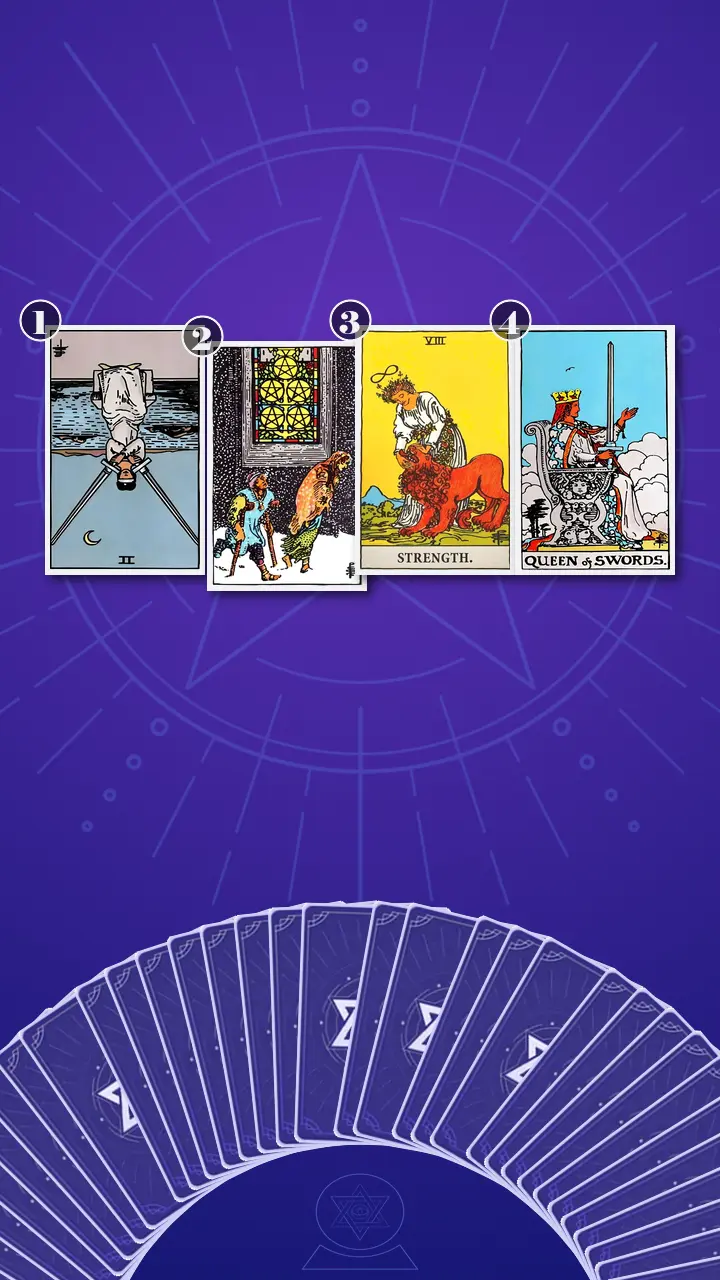
Reading the Map Across the Dinner Table
The Blindfold That Sounded Like ‘I’m Easy’
I turned over the first card and said, ‘This position presents the observable self-silencing behavior from the diagnosis: the pause, the social scanning, and the anything-is-fine response at the table.’ The card was Two of Swords, reversed.
I pointed first to the blindfold and the crossed swords over the chest. In modern life, this is the group chat going quiet after someone asks for dinner ideas, the blinking cursor waiting, the quick glance at who has seen the message, the hope that someone else will offer a safer option first. Then out comes the line that sounds easy: ‘I’m good with anything.’ The tension does not disappear. It just turns inward and starts replaying all through the meal.
Reversed, the energy here is not balanced thought. It is blocked Air starting to fray. Too much internal editing, too little clean expression. It is like auto-correct replacing your actual sentence with the safest possible phrasing. You protect the heart by stopping the decision, but the pressure leaks later as rumination, jaw tension, and irritation. Small resentments are often the receipt for small self-abandonments.
I gave the pattern back to her in the exact shape I saw it: ‘Say something. No, not that. Make it easier. Just be chill.’
Sophie let out one short laugh that had almost no humor in it. ‘Okay,’ she said, rubbing the side of her thumb against her water glass, ‘that’s so accurate it’s honestly a little rude.’ Her shoulders lifted, then dropped half an inch. Recognition had landed.
The Cold Street Beneath the Casual Vibe
I turned to the next card. ‘This position reveals the psychological block underneath the behavior, especially the belonging fear and the scarcity story your body predicts if you name a need.’ The card was Five of Pentacles, upright.
The image says so much with so little: cold street, bent bodies, lit window. In her daily life, it becomes the dinner table moment where a completely normal preference suddenly feels emotionally expensive. Saying ‘I’d rather do tacos than burgers’ starts to feel, internally, like risking warmth itself. Everyone else sounds effortless; she braces for a tiny social winter before anyone has actually pushed her out.
That is why this card matters. The blockage is not indecision. The blockage is scarcity. She is treating belonging as if there are only three seats left and her preference might lose her one. It wasn’t about dinner. It was about whether being visible felt survivable.
When I said that, the room went still in the particular way it does when a sentence reaches the real layer. Outside my window, a grey Toronto light pressed against the glass. It made me think of mornings in Venice when mist sat low over the canal and everything looked farther away than it really was. Fear does that too; it lengthens the distance between a person and their own voice.
Sophie looked down at the card. First her breath paused. Then her eyes unfocused, as if a dozen old restaurant tables had started replaying at once. Then came the release: one deeper exhale from the chest, not dramatic, just tired. ‘But it’s literally just food,’ she said. ‘Why does saying one food preference feel like risking my seat at the table?’
I answered carefully. ‘Because somewhere in you, preference and belonging got linked. So your body is not reacting to noodles versus tacos. It’s reacting to the possibility of being the difficult one. And if no one ever taught that alarm it could survive one honest sentence, of course it keeps reaching for invisibility.’
When Strength Sat Beside the Lion
The Card That Warmed the Air
When I turned over the third card, I felt the reading change temperature. ‘This position defines the key inner shift needed for transformation,’ I said, ‘moving from appeasing to calm, embodied self-expression.’ The card was Strength, upright.
Before I even spoke the core message, I named the setup she knew too well: the TTC ride home, the buzzing chat, the menu of the place she actually wanted still open on her phone, and that strange flat aftertaste of having vanished from a decision that looked small on paper. That tiny moment says a lot about how expensive visibility has started to feel.
You do not need to disappear to keep the peace; let the woman beside the lion remind you that calm honesty is stronger than self-erasure.
I let the sentence sit there for a beat.
Then I told her what I saw in the card. Strength is not force. It is regulated courage. The woman’s hands are calm at the lion’s mouth because she is not trying to overpower instinct or fear; she is staying soft enough to remain present with it. In modern life, that is the moment when the throat tightens, but you take one slower breath, let the shoulders drop, and say, ‘I’d love Thai, but I’m flexible after that.’ The win is not getting your way. The win is staying in your body while being visible. Your preference is a contribution, not a disruption.
This was the moment I brought in the body pattern I know so well from my own work. During years of reading people on transoceanic voyages, and later through a Jungian lens, I learned to notice when the voice leaves the body before the words even begin. Sophie had that exact pattern: jaw set, shoulders subtly braced, neck holding the unsaid sentence like a lock gate. I wasn’t reading it as a medical issue; I was reading the energy flow. In Venice, water does not move by argument. It moves when the channel is clear enough to let it pass. That is what I call my Energy Flow Diagnosis: the body tells me where the truth is getting stuck.
I slid her water glass a little closer. ‘Hold this,’ I said. ‘Feel the cold in your fingers. Unclench your jaw once. Let your shoulders drop once. You do not have to feel completely calm. You only need about five percent more steadiness than you had a moment ago.’ It was one of the quick recovery techniques I often give clients who live in screen-induced exhaustion and social-overload headaches: a three-minute reset, stripped down to one breath and one anchor.
Her reaction came in three clear waves. First: a small freeze, eyes widening, fingers tightening around the glass. Second: the thought sinking in, her gaze going slightly distant as if she were testing the sentence against last week, last month, maybe last year. Third: the feeling itself, a fuller exhale, her shoulders softening, the corners of her mouth pulling into something unsteady between relief and grief.
Then came the resistance, exactly where real change usually begins. ‘But if that’s true,’ she said, voice thinner now, ‘doesn’t that mean I’ve been getting this wrong for years?’
I shook my head. ‘No. It means you found a strategy that once felt safer than honesty. That isn’t failure. It’s adaptation. We’re just noticing that the strategy now costs you more than it protects you.’
And then I gave her the sharper mirror as kindly as I could: ‘Your preference is not what makes the moment awkward. Leaving yourself out of it is what makes the whole night feel off.’
I asked, ‘Now, use this new perspective to think back to last week. Was there a moment when this could have changed how the night felt?’
She nodded without speaking. Her eyes had gone bright. ‘The burger place,’ she said after a second. ‘I wanted ramen. I literally knew I wanted ramen.’
That was the crossing. Not perfection. Not sudden fearlessness. Just one real step from anxious self-erasure in low-stakes group choices toward calm, honest participation.
The Queen Who Stops on Time
I turned over the final card. ‘This position translates the shift into a concrete relational practice,’ I said, ‘what honest, low-drama communication looks like in the moment.’ The card was Queen of Swords, upright.
I love this card for people who have spent too long making themselves easy to digest. The raised sword, open hand, and direct gaze say everything: speak plainly, stay open, stop there. In real life, it is one sentence like, ‘I’d prefer tacos, but I’m open,’ and then silence. No apology spiral. No smiley-face cushioning. No trying to manage every face in the room before anyone has even reacted.
I told Sophie, ‘Think concise Slack message, not whole draft folder. State it. Leave space. Do not manage every face in the room.’
She smiled properly for the first time. I could almost see her mentally rehearsing the line. This card brought the whole spread into focus for me: freeze, cold, warm, clear. The reading had moved from jammed defensive Air in the Two of Swords, through the cold scarcity of the Five of Pentacles, into the warmth of Strength, and finally into clear Air again, but this time as usable speech instead of self-cancelling thought.
‘You can leave room for the group without leaving yourself out of it,’ I said.
From the Low-Maintenance Mask to Kind Clarity
When I stitched the four cards together for her, the story was clean. First came the visible habit: scanning the table, deleting the honest answer, saying the smooth thing instead. Underneath it sat the real driver: the fear that one ordinary preference could cost her warmth or make her seem high-maintenance. Then came the turning point: not becoming louder, but becoming steadier. And finally, the outcome: clear language that is warm, brief, and complete.
I told her the blind spot was this: she had been treating every preference as a social risk instead of a normal contribution. Her mind kept asking, ‘How do I avoid being difficult?’ when the more useful question was, ‘Can I stay connected to myself while staying connected to these people?’ That is the transformation direction of this whole reading. Not winning the restaurant choice. Not becoming the loudest voice at the table. Just naming one real preference without disappearing first.
Because I am from a city built on water, I gave her the action plan in my own language. In Venice, you do not force a canal to flow by pushing harder at the surface. You clear the blockage, then let movement happen. I call this Venetian Aqua Wisdom: soften the gate, then steer the boat.
- One-Preference Practice Before your next dinner chat with friends or coworkers, choose one first-choice cuisine and one backup before anyone asks. Use one sentence such as: ‘I’d love Thai, but tacos also work for me.’ If your brain blanks under pressure, name a cuisine or neighborhood instead of the perfect venue. Stop after the honest sentence.
- Belonging Reality Check After you name one preference in a low-stakes plan this week, open your Notes app and write two lines: what you predicted would happen, and what actually happened. Try this first with a relatively safe group. If people punish normal preferences, that is useful data, not proof that your needs are too much.
- Soft Voice, Clear Ask In person, press both feet into the floor or wrap your fingers around your water glass, unclench your jaw, and take one slower exhale before answering. At home, say your practice line out loud twice so your body knows its shape. Aim for five percent more steadiness, not perfect calm. If breathwork annoys you, use the cold glass or the feeling of your feet instead.
I added one more thing, because it mattered: ‘If your social life moves faster than your nervous system, that doesn’t mean you’re broken. It means you need a cleaner bridge between feeling and speech.’ That is what this compact tarot reading for people-pleasing in dinner plans had shown her: a path from self-silencing, to the belonging fear underneath, to gentle courage, to clear communication in friendships.

A Week Later, the Quiet Proof
A week later, Sophie sent me a message before brunch. It was short enough to make me smile: ‘I said, “I’d vote ramen, but I’m open.” Nobody died. We went for ramen.’ Then she added, ‘I still had a tiny what-if spiral after, but way less. Cleaner.’
That word mattered to me: cleaner. Not triumphant. Not magically healed. Just cleaner. The next morning, she told me, the old thought still flickered through her mind — what if I sounded weird? — but this time she caught it, smiled at it, and kept moving.
That is often what a real Journey to Clarity looks like in my work. Not a personality transplant. Not a perfect script. Just the moment when honesty stops feeling like a threat and starts feeling like a homecoming.
A lot of us know that tiny hush when the table goes quiet, the throat tightens, and we make ourselves smaller before anyone has even asked us to — because somewhere underneath dinner is the fear that one real preference could cost us warmth.
If one honest preference did not have to become a whole personality statement, what might you want to say a little more cleanly the next time the chat goes quiet?