

Judgement Tarot Card Meaning
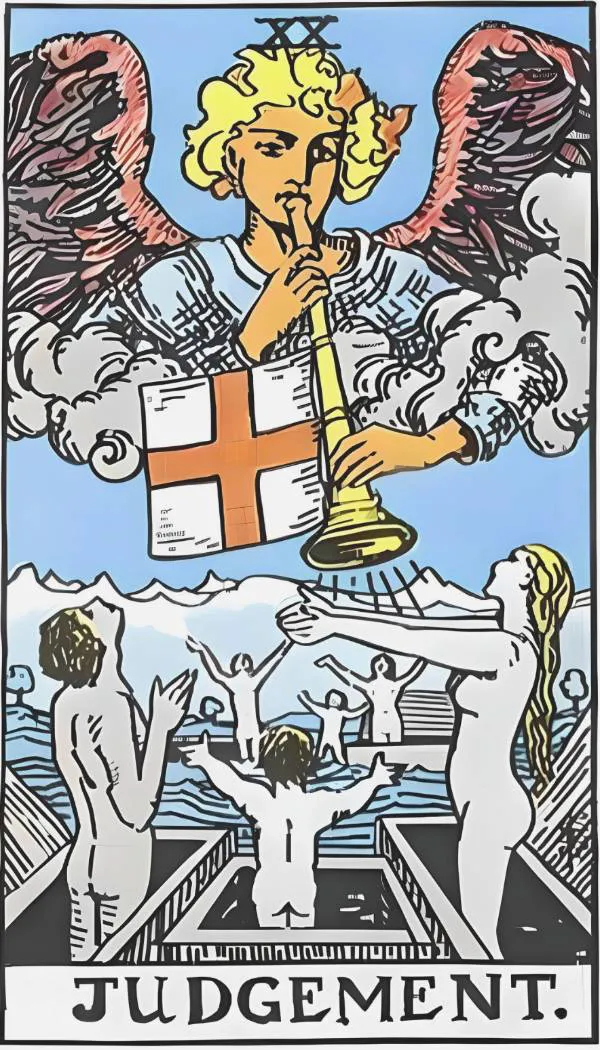
This card is inspired by the biblical story of the Last Judgment, a deeply rooted religious concept in the Western tradition, and almost all Tarot cards have a consistent theme and imagery. Western religious beliefs hold that there will be a judgment after death, but it is an inevitable time, not a unique situation for individuals. Judgment is something that every soul encounters together, often depicted in grand scenes. The angel blowing the trumpet is a biblical scene, announcing the arrival of the end times and the descent of divine judgment. People are resurrected from their graves, a picture from the Book of Revelation.
The angel blowing the trumpet in the image is likely Gabriel, who is considered the leader among angels and possesses great power akin to that of God. He was originally responsible for guarding the Garden of Eden, with a focus on guiding souls through life and death, and both conception and death souls are subject to his influence. In the Last Judgment, Gabriel's role is even more significant, responsible for sounding the trumpet to awaken the resurrection of the dead. Gabriel is an important angel associated with the sound of awakening and music, as well as the transmission of the gospel, and is also seen as the angel of fulfillment and the angel of good news. However, the angel responsible for blowing the trumpet in the Last Judgment sometimes also merges with the image of Michael, as both are related to guiding souls and have responsibilities related to the duty of just judgment.
This angel has fiery red wings and a flame-like hairstyle, similar to the angel in the Lovers card, but the two images are slightly different. Although the hair is in the shape of flames, it is golden, lacking emotional color. However, the angel's wings are still fiery red, indicating strong activity and echoing the red cross on the flag, representing the action and spirit of redemption. The entire image and background colors are monotonous and cold, with the only colorful parts being the red cross and the red wings. The angel appears in the clouds, shrouded by them, creating a distance from the ground, signifying loftiness and remoteness, with only the sound of the trumpet able to reach the soul. The white clouds in the sky symbolize mystery and spiritual vision. The angel in the clouds is playing the trumpet, with the right hand closer to the handle of the trumpet and the left hand on the outer side near the mouth of the trumpet, with a flag hanging between the two hands.
Beneath the trumpet hangs a white flag with a red cross symbol. The cross itself has many symbolic meanings, especially in the West, where it is an important religious symbol, representing the union of spirit and body, mind and matter. The cross flag itself represents the meaning of redemption, and different colored flags and crosses have different connotations of redemption, as the situations of suffering and hope are different, requiring different paths of redemption. The red cross is a symbol of immediate physical salvation for people, and the white background with a red cross represents the suffering of redemption or assistance, echoing the theme of judgment. Of course, the appearance of both red and white colors is also related to the theme of the Golden Dawn. Additionally, the cross in the West has multiple meanings, such as the intersection of mind and matter, and it also represents the meaning of intersection, overlap, and choice, symbolizing a turning point in life.
The trumpet, as an instrument, originally has a warning function, and playing the trumpet is one of the scenes of the Last Judgment in the Book of Revelation, also representing a voice of admonition, and various religions use the sound of musical instruments to symbolize spiritual or spiritual awakening. The trumpet also symbolizes the proclamation of the 'gospel', which is an essential element in religion.
There is an implied symbol that cannot be directly and clearly expressed, which is that this card carries sound. In front of the trumpet edge, there are several radiating lines, implying the emission of sound, and further, it represents the performance of music. In addition to looking at the graphic with our eyes, we must understand and imagine, experience and create this sound. And we can freely assign this music, or judge the scene as a religious piece of music - 'Requiem'. Such a form of music is from religious music, including drama, chorus, etc., created based on the plot of the Last Judgment, and there will often be a trumpet sound to simulate the scene of the Last Judgment in the Book of Revelation. And the music here is the most primitive, the 'Requiem' from heaven, and its connotation is the gospel that enters the heart.
The many people standing up from the coffins on the ground, with pale bodies without blood color, are the dead who were originally lying in the coffins. At this time, they rise from their tombs, called to salvation and resurrection. Each person's coffin is open, and although they stand up, they still stay inside, not leaving their original habitat, as if they are eager to receive the call.
The people waking up from the tombs are divided into two groups, each consisting of a man, a woman, and a child, and they should be a family. Therefore, there are a total of two families here, living opposite each other, each with parents and children. The closer family, the woman is on the right side of the picture, the man stands on the left side, and the child in the middle is facing away from the picture, and the family opposite in the distance, the standing position is the same, like a mirror. And these three groups each form a triangle, and the two groups interweave into a hexagram pattern, representing the interweaving of spirit and matter and all phenomena. It is also a subtle depiction of the two directions of the soul, up and down.
Each of these people has different gestures, but they are all welcoming the arrival of the angel: the woman's straight hands directly receive the 'gospel', the man's bent elbow is moved, and the child is facing away from us, with both hands up in a V-shape, which is originally a gesture of soul call. And the people opposite all face the picture, and their postures are roughly the same as the child facing away. They may respond to the gospel or participate in the chorus calling them the 'Requiem', at this time the Requiem is no longer a judgment, nor is it just comfort and rest, but a hope of redemption and joy.
The place where these people are located is actually a cemetery, surrounded by a continuous undulating mountain range, surrounding the entire area. The color of the foothills and the ground is gray-blue, and the white peaks seem to be covered with snow, and the sky is also a low-key deep blue, only the white light around the angel's trumpet. It seems to be a world of ice and snow, and the cold air is a symbol of death. The ground is uneven and seems to be muddy, but it is like the ripples of the water surface, making these coffins seem to float on the water surface, and the confusion of land and water, the coexistence of solidification and floating, is like the stream of consciousness mixed with thought and emotion, spirit and desire.
The Angel
The angel depicted in the Judgement card is the archangel Gabriel, known as the messenger of God. Gabriel’s trumpet symbolizes the call to resurrection, awakening, and new beginnings. The flag adorning the trumpet bears the cross, linking the imagery to divine intervention and spiritual rebirth.
Rising Figures
The people rising from the graves represent humanity, and their ascending stance signifies awakening, rebirth, and renewal. These souls are answering the divine call, signifying a moment of self-realization, personal growth, and transformation.
Mountains
The distant mountains, often a symbol in the Tarot, represent challenges, obstacles, and milestones in our journey. In the Judgement card, they emphasize the long journey of the soul and the ascent towards spiritual enlightenment after overcoming trials.
Open Coffins
The coffins from which the people arise symbolize the end of something and the beginning of a new phase. It’s a reminder that we must let go of the past to embrace new opportunities and growth. These coffins signify release, renewal, and the cycle of death and rebirth.
The Ocean
The expansive body of water below suggests the collective unconscious, the deep reservoir of our experiences, memories, and inner wisdom. The water’s presence indicates the emotional depth and intuition required during times of significant transformation and introspection.

A Partner's Family Dinner as an Audition—Choosing Self-Respect

Golden-Child Burnout at 11:40 p.m.: One Quiet Curiosity Gets Tested

When an Old Post Feels Like a Verdict: Choose What Counts Now

PTO Procrastination Under Deadline Pressure: Plan a Small Pause

DNA Match Contact Limbo: From Drafting and Deleting to Self-Trust
