When Slack Felt Like a Courtroom: Learning the One-Sentence Reply

The Slack Courtroom at 11:07 a.m.
Before I touched the deck, I said the thing I have learned to say plainly: if you’re an early-career woman on a hybrid team in Toronto who can handle feedback in theory but spirals the second your name gets tagged in Slack in front of everyone, this is probably your exact workplace shame spiral.
Jordan (name changed for privacy) gave me the kind of laugh people give when they’ve just been seen a little too accurately. Then she told me about 11:07 a.m. on a Wednesday, at a hot desk near Union Station: the fluorescent lights humming overhead, coffee gone lukewarm beside her laptop, Slack flashing her name in the #launch channel before she had even finished reading the thread. A coworker had corrected one small detail. Her jaw locked. Her face went hot. Her fingers hovered over the keyboard and then started moving faster than the rest of her could think.
“I know it was a small correction,” she said, looking at the table rather than at me, “but then I need everyone to understand what I actually meant.”
There it was in one sentence: she wanted to look competent and composed in front of coworkers, yet the public correction had landed like proof that she might look careless, less credible, quietly downgraded. It was a small correction. Her body did not experience it as small. Shame had hit her like a fire alarm trapped behind the face — too much heat, nowhere graceful to put it.
I told her, gently, “That makes sense to me. You’re not failing some basic professionalism test. You’re reacting to visibility. Let’s see if we can draw a map through it — not to make you colder, but to help you find clarity the next time the channel starts to feel like a courtroom.”

Choosing the Compass: A Five-Card Tarot Spread for Public Correction Anxiety
I asked Jordan to take one slow breath and keep her question simple: not ‘How do I become perfect at work?’ but ‘How do I stop overexplaining when I’m corrected in public?’ Then I shuffled. In my practice, that moment is less about mystique than focus. It gives the nervous system a handrail.
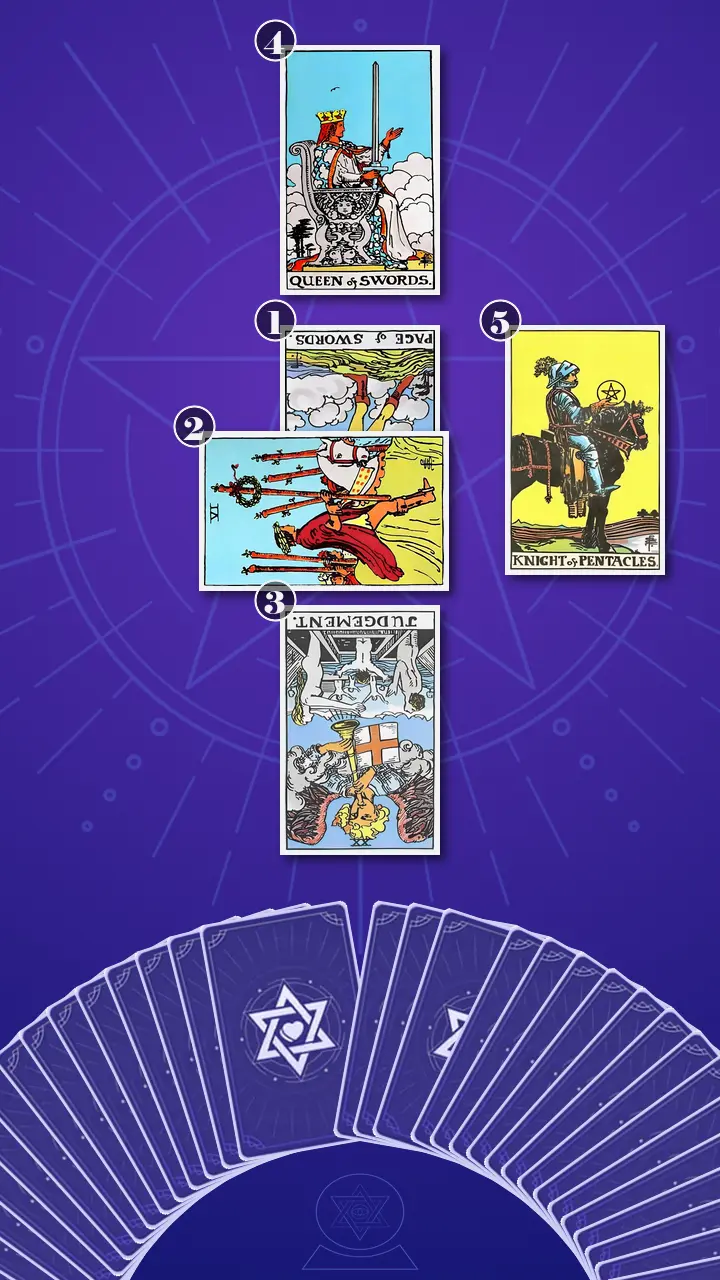
I chose the Five-Card Cross · Context Edition, a five-card tarot spread I use when someone wants to understand a specific modern loop rather than receive a vague life forecast. For workplace overexplaining after public correction, it is nearly ideal: small enough to stay clean, but complete enough to track the whole sequence from symptom to trigger to root pattern to guidance to practical integration.
I explained the structure as I laid the cards into the cross. The center would show the behavior itself — what happens in the first live minutes after the correction. The crossing card would reveal the pressure that makes the moment feel bigger than it is. The card below would point to the hidden root: the private story that keeps the Slack shame spiral alive long after the thread has moved on. Above it, I wanted the clarifying perspective — the shift that could interrupt the cycle. And the final card, to the right, would not predict her future so much as show the next steps: how this becomes a steadier communication habit in real life.
That is how tarot works best, at least as I have always understood it: card meanings in context, arranged so that a person can finally see the architecture of a pattern instead of just suffering inside it.
Reading the Pressure Chamber
Position 1: The Cursor That Moves Faster Than Thought
I turned the first card and named its job before its title. “This card shows the observable overexplaining behavior that appears right after a coworker corrects you in group chat.” Then I looked down. “Page of Swords, reversed.”
I told her exactly what I saw. This was the moment her name lit up red in Slack and she started typing before she was emotionally settled — first a quick acknowledgment, then context, then extra clarification she did not originally need, like sending the paragraph she drafted in Apple Notes instead of the one line that would have done the job. The Page’s sideways stance and raised sword are all keyed-up nerves: a mind already braced for more threat than the thread actually contains.
In energy terms, this is Air in excess and judgment in blockage. Too much mental motion. Not enough inner stillness. The reply grows not because the facts require it, but because discomfort is trying to manage every possible interpretation at once. In modern work language: maybe I should explain that. No, clarify that. Actually add context. Maybe one more sentence so nobody thinks I missed something obvious.
Jordan let out a short, almost unwilling laugh. “Wow,” she said. “That’s accurate enough to be rude.”
I smiled. “Good. Then we’re not wasting time on flattery. The important thing is this: the Page reversed is not telling me you’re a poor communicator. It is showing me a fast, intelligent mind that loses its center the moment it feels exposed.”
She pressed her thumb against the rim of her mug and nodded once. The nod had a wince inside it.
Position 2: When the Channel Becomes an Audience
I turned the crossing card. “This one reveals what the public setting specifically activates — the fear of looking less competent in front of peers.” It was Six of Wands, reversed.
“One person said it,” I told her, “but it felt like everyone saw it.”
That card could hardly have been clearer. The elevated rider and watching crowd translated almost perfectly into how a shared work channel turns one routine note into a tiny stage. In a DM, the same correction might have been mildly annoying. In a public thread, it became status-loaded. The real trigger was visibility, not feedback alone. Her brain had turned the channel into an audience and the audience into a verdict machine.
This is Fire distorted by outside eyes: not healthy confidence, but confidence made contingent on public approval. That is why the correction felt career-sized. Not because the issue itself was enormous, but because early-career credibility matters, and a hybrid team can make competence feel weirdly trackable until one public note suddenly makes it all feel personal. Slack, in moments like this, becomes as identity-heavy as a season of Severance.
I asked, “If the exact same message had arrived in a direct message, would it have hit you like this?”
Her answer came instantly. “No. I would’ve just fixed it.” Then her shoulders rose, then paused, then dropped a fraction, as if her body had finally heard the right question. “So it’s not even the correction. It’s that everybody can see it.”
“Exactly,” I said. “Visibility is the accelerant.”
Position 3: The Verdict You Wrote Against Yourself
I turned the third card. “Now we’re looking at the deeper blind spot beneath the reaction loop — the harsh self-judgment underneath it, the part that fuses your identity with being right.” The card was Judgement, reversed.
I felt the atmosphere change as soon as it landed. Judgement reversed is not merely embarrassment. It is the inner tribunal. It is the Line 1 ride home after Union, the subway brakes screeching, phone warm in your palm, reopening the thread even though the conversation moved on hours ago. Externally, a coworker corrected a detail. Internally, an entire case begins: maybe I only seem competent when nothing public tests me. Maybe this proves I miss obvious things unless I overexplain.
When I see this card, my mind still flashes to archaeological catalog rooms. A mislabeled shard never meant the whole site was fraudulent. It meant the record needed amendment — nothing more. Only the anxious apprentice mistakes one corrected label for the collapse of the civilization. So I said to Jordan what this card required me to say: “A correction is not a character reference.”
In energy terms, this is honest review blocked by self-sentencing. The card below the spread told me her deepest pain was not ‘I was corrected.’ It was ‘I was corrected, therefore I may be less solid than people think.’ That is why the long Slack reply never truly soothed her. It was trying to defend an identity, not answer a fact.
Jordan went very still. First her breath caught high in her chest. Then her gaze unfocused, as if she were watching the commute-home replay unspool behind my shoulder. When she finally spoke, her voice was quieter. “That’s the gross part,” she said. “I know nobody else is making it that deep. I’m the one doing that.”
“Yes,” I said. “And seeing that is important, because it means the loop is understandable. Not inevitable.”
When the Queen of Swords Drew the Line
Position 4: The Antidote
I touched the fourth card before turning it, and even then I knew the spread had reached its hinge. Outside my window, the pale afternoon light broke through cloud just enough to sharpen the edges of the room. “This,” I told her, “is the card that offers the key cognitive shift — the one that interrupts the defense cycle and restores concise self-trust.” I turned it over. Queen of Swords, upright.
There are cards that soothe, and there are cards that clarify. This one clarifies. The upright sword. The open hand. The clear sky. Not coldness, not detachment, but truth with clean boundaries. In modern life, it is the difference between posting your whole internal draft history and sending the final line your most grounded coworker would send.
At this point I used something I often call Skill Archaeology. When a person brings me a reactive pattern, I do not assume the pattern reveals their nature. I excavate. I brush away the panic, the overediting, the self-protective verbal backfill, and I look for the intact tool buried underneath. With Jordan, the overlooked talent was not explaining. It was discernment. She already knew how to separate signal from noise in campaigns, timing, and messaging. Shame had simply buried that talent under too many words.
Reply to the Fact, Not the Fear
I named the setup carefully. “Right now, the moment your name gets tagged, you move straight into impression management. You’re trying to make sure no one forms the wrong conclusion about you before you’ve even decided what actually needs answering.”
Not every correction deserves a courtroom defense; state what is true, cut the excess, and let the Queen’s upright sword draw the line.
I let the sentence sit there.
Jordan’s reaction arrived in layers, exactly as real insight usually does. First, a brief freeze — fingers suspended in midair over her cup, breath halted. Then the cognitive drop: her eyes shifted away from me, not evasively but inward, replaying a recent thread with a new caption under it. Then the release came, unevenly. Her shoulders loosened. Her mouth opened as if to object. Her eyes brightened with the first sting of recognition rather than tears. “But if I do that,” she said, and there was a flash of resistance in it, “doesn’t that mean I’m just leaving people with the bad impression?”
“No,” I said. “It means you are leaving them with the fact. And the fact is much smaller than the fear. One clear sentence can be more confident than five careful ones.”
I slid a blank card toward her and said, “Now, use this new perspective to look back at last week — was there a moment when this insight could have let you feel different?”
She answered almost immediately. “Thursday. Someone corrected a date in the rollout thread, and I wrote this huge ‘for context’ reply. I could’ve just said, ‘Good catch — updated.’ That would’ve been enough.”
“Exactly,” I said. “That is the move. From impression-management panic to concise self-trust and steadier professional presence. Not silence. Not passivity. Matured speech.”
Position 5: The Steady Builder
I turned the last card. “This one translates the shift into a practical communication stance you can embody the next time it happens.” It was Knight of Pentacles, upright.
I was glad to see him. After so much Air and so much internal noise, Earth is a relief. The still horse. The carefully held pentacle. The cultivated field. This is not the energy of winning the thread. It is the energy of building trust through repeatable work. Update the doc. Fix the asset. Send the clean file. Answer carefully, briefly, then return to the task.
In energy terms, this is balance after reactivity. The reading had begun with scattered Air and public Fire. It ended in grounded Earth. That mattered. Insight alone would not solve this. Routine would. Her credibility was not going to be built by a heroic clarification in one group chat. It was going to be built the slow way — through steadiness, accurate follow-through, and fewer defensive add-ons.
Jordan looked down at the Knight and smiled for the first time without flinching. “So the answer is basically: ship the work well every week, not write a manifesto every time somebody corrects me.”
“That,” I said, “is an excellent translation.”
The Slack Courtroom Exit
When I pulled the whole spread together for her, the logic became beautifully blunt. Page of Swords reversed showed the visible symptom: reactive overtyping, the cursor moving faster than judgment. Six of Wands reversed named the trigger: public visibility turning one teammate’s note into an imagined audience response. Judgement reversed exposed the root: a tiny correction becoming a referendum on worth. Then the architecture changed. Queen of Swords replaced self-defense with discernment. Knight of Pentacles grounded that discernment into habit.
The blind spot, I told her, was this: she believed she had to repair everyone’s impression in real time. But that belief kept her trapped in the very loop she was trying to escape. The transformation direction was cleaner and far more adult: one clear acknowledgment or factual clarification, then stop. Reply to the fact, not the fear. Let steadiness speak louder than self-defense.
Jordan frowned, practical again. “But launch threads move fast. I can’t always carve out five serene minutes to become the Queen of Swords.”
I laughed. “Nor should you have to. We’re not trying to build a spa inside Slack. We’re building a faster internal filter.”
I gave her three concrete practices — not lofty advice, but actionable next steps she could use the same week.
- Relic Authentication CheckBefore replying in any public channel, open a private note called ‘Reply Drafts’ and ask one question: ‘What is actually being corrected here — a detail, or my identity?’ If the answer is a detail, write one factual sentence only: acknowledge or clarify, nothing more.The first discomfort is usually exposure, not incapacity. If one sentence feels impossible, write two — then delete the one that only exists to manage impressions.
- The One-Clean-Sentence PracticeKeep two or three low-drama templates saved in your notes for shared channels: ‘Good catch — updated.’ ‘You’re right, the date is Thursday, not Friday.’ ‘Fixed now, thanks.’ Use them at work the next time a coworker corrects you in Slack or Teams.Brevity is not rudeness. One clear sentence can be more confident than five careful ones, especially when your nervous system wants to write a closing argument.
- Megalith Transport Exit RitualAfter you post the short reply, do not reopen the thread for 15 minutes unless someone directly pings you. Put both feet on the floor, drop your shoulders once, and return to one concrete task that builds real credibility — update the doc, fix the link, send the file, finish the checklist item.If 15 minutes is too much, start with 3. Ancient stones were never moved in one heroic gesture; they were moved in manageable shifts. Professional calm works the same way.
I also told her to keep a note titled ‘Steady Builder.’ At the end of the day, three lines only: what happened, what I made it mean, what evidence actually exists. That practice matters because you do not have to keep attending the trial after the case is already closed.

A Week Later, the Thread Stayed Closed
A week later, Jordan sent me a message. A teammate had corrected a date in the launch channel. She drafted a paragraph in Notes, cut it down to ‘Good catch — updated to Thursday,’ posted it, fixed the asset, and went back to work. She told me the urge to reopen the thread still followed her onto Line 1 home — but this time she let the urge ride without obeying it.
The change was small, which is exactly why I trusted it. She had not solved her whole nervous system in five business days. She had produced the first real proof. Clear but still a little tender: she slept properly that night, and the next morning her first thought was still, What if that sounded curt? This time, she smiled at the thought and did not promote it.
That is what a true Journey to Clarity looks like to me. Not a personality transplant. Not the death of sensitivity. Just the quiet movement from defending your image to trusting your judgment, from thread-monitoring to steadier self-trust.
When one tiny public correction makes your face go hot and your chest lock up, it is easy to start typing as if you are defending your whole worth, not just one detail. If the Slack courtroom opens again in your world, what is the smallest, cleanest sentence you might let stand the next time this happens?