When Care Feels Like Debt: Learning to Stay in the Warmth

The Soup at 6:18 and the Burden Story
If you’re living alone in Toronto, usually the reliable one, and the second a friend offers practical help your body goes tight instead of relieved, you’re not being dramatic. You’re probably doing quiet reciprocity math. That was the question Leah (name changed for privacy) brought me, though she said it more bluntly: “Why do I feel guilty when people help me?”
She told me about 6:18 p.m. on a freezing Tuesday in the hallway outside her condo: yesterday’s hoodie, the elevator ding behind her friend, the faint bleachy smell of building cleaner mixed with winter air, and a paper bag damp at the bottom where the soup container had started sweating through. She had wanted that soup so badly. But the second it touched her hands, her throat cinched, her stomach knotted, and one hand stayed on the door like she needed to make the whole interaction smaller and faster.
“I know it’s just soup,” she said, with that half-laugh people use when they’re already bracing for their own tenderness, “but I instantly feel like I’ve created work for someone.”
What sat between us was the real contradiction: she wanted care and closeness, but the moment care arrived, shame rushed in and told her that needing anything made her a burden. The feeling sat on her like a winter coat pulled tight in a heated room—too hot to keep on, too unsafe to take off. I told her gently, “That makes sense to me. We don’t need to shame the part of you that tightens. We just need to map it. Let’s see if we can find some clarity in the exact moment your body starts translating care into cost.”

Choosing the Shadow Spread: A Map for Finding Clarity
I asked Leah to take one slow breath and keep the question precise. Not “Why am I like this?” but “What happens in me when kindness arrives and I can’t just receive it?” Then I shuffled slowly, the soft brush of card stock doing what ritual is meant to do in my sessions: not create mystery for its own sake, but give the nervous system a beat to settle into.
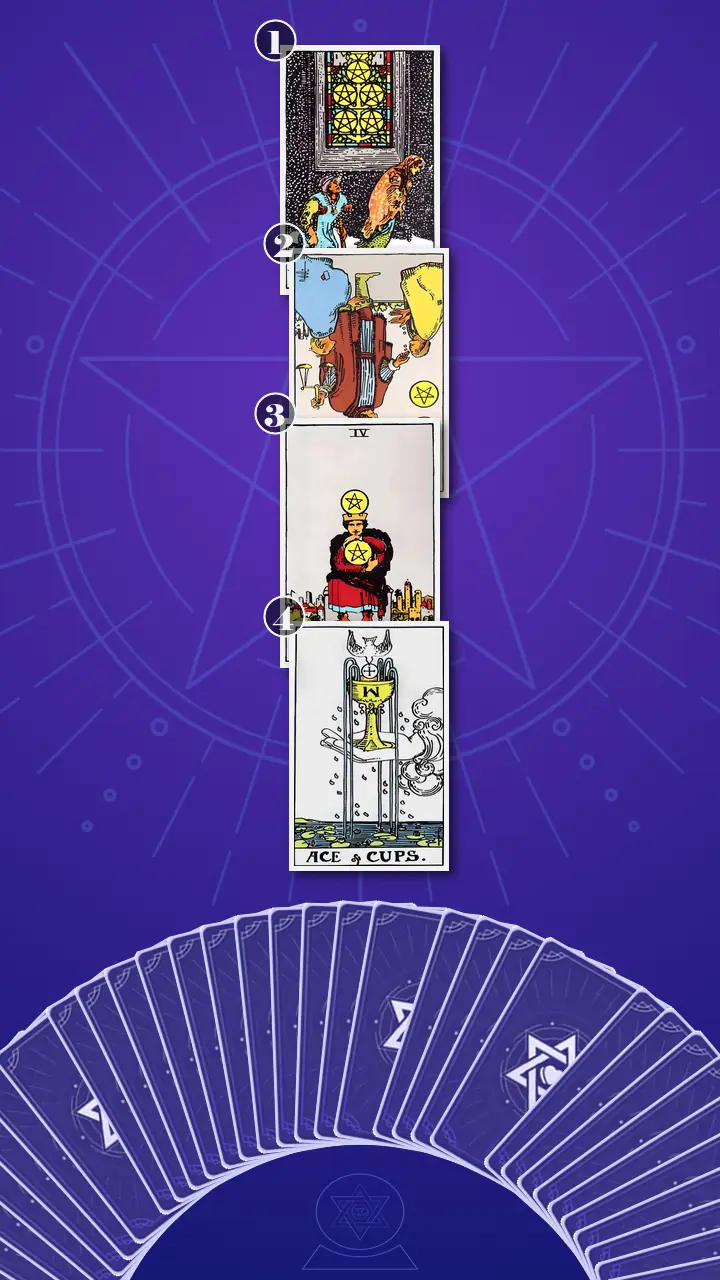
For a case like this, I reached for the Shadow Spread, a four-card tarot spread for feeling like a burden when receiving care. When people ask me how tarot works in real life, this is one of the clearest answers I can give: the cards help me move from the visible symptom into the hidden belief underneath it, then into the protective pattern keeping the issue alive, and finally toward the integrating truth that can actually change the next choice you make.
This spread was the right fit because the outer trigger looked simple—soup at the door, a coworker covering a doc, someone folding your laundry when you’re slammed—but the real knot lived deeper down in worthiness, blocked receiving, and the fear that having needs lowers your value. Card one would show the everyday symptom. Card two would reveal the wound that makes help feel like debt. Card three would name the defense Leah uses to stay “low-maintenance.” Card four, the one I already suspected would matter most, would point to the shift from ledger to intimacy.
Reading the Cards That Kept Her Coat On
Position 1: The Doorway Apology
The first card I turned over was the one representing the concrete behavior in the diagnosis: apologizing, shrinking, and feeling ashamed the moment care arrives. It was the Five of Pentacles, upright.
In context, this was the exact doorway moment. Leah is clearly unwell, care is literally present, and yet her attention locks not onto warmth but onto the inconvenience she imagines she has caused. The energy here is scarcity and exposure. Not because nobody cares, but because her nervous system still reads the scene like she’s out in the cold. The glowing window in the card says shelter is nearby; the bowed posture says her body doesn’t believe it belongs to her.
I looked at her and said, “You are not bad at closeness. You are just used to translating care into cost.” She let out a short laugh that had a little sting in it and glanced down at the table. “That is… kind of brutally accurate,” she said. Her fingers caught on the cuff of her sleeve, then kept worrying at it. I nodded. “Five of Pentacles often shows me the moment support exists, but shame makes it feel unusable. Someone is being kind, and your body is reacting like you’ve created a problem.”
Position 2: The Ledger Underneath
The next card sat in the position that reveals the hidden belief and core fear that turn a kind gesture into discomfort, debt, or self-doubt. It was the Six of Pentacles, reversed.
This is the card I see when receiving care feels like debt. In modern life, it looks exactly like opening Apple Wallet from bed, buying the coffee gift card, drafting the extra-grateful text, and planning next week’s check-in before your own fever has even broken. The scales on the card become reciprocity math. The height difference between giver and receiver becomes the private fear that if you accept help, you are suddenly underneath someone—less equal, less worthy, more trouble than you’re allowed to be.
The problem isn’t that care is absent. It’s that shame keeps labeling it as debt. Reversed, the energy is blocked balance: generosity cannot land as generosity because the mind turns every act of love into an invoice. Like Venmo culture moving into the heart, nothing gets to be a gift for more than three seconds before a tab opens. Leah inhaled sharply at that. Her eyes lifted to mine, then flicked back to the card. “The invoice thing is too real,” she said. “I always think, how do I make this even again?”
“Exactly,” I told her. “And that question is not coming from ingratitude. It’s coming from fear—fear that needing comfort will make someone resent you or quietly pull away.”
Position 3: The Polished Clamp
The third card was the position that maps the defense strategy and self-protective behavior keeping support from fully landing. It was the Four of Pentacles, upright.
Here was the Slack-status card. Resting, but reachable. Jaw tight. Shoulders up. Phone still in hand under the duvet while typing “all good!” too fast. In real life, this is Leah making every ask as tiny as possible, smoothing every hard moment with upbeat language, and performing easygoing competence so nobody ever has to feel the full weight of her need. The energy is not absent; it is over-controlled. The heart is not empty. It’s clamped.
Low-maintenance can become a cage when it is built out of fear. Four of Pentacles always reminds me of someone keeping every browser tab open at once so they never have to rest fully inside one truth. In Leah’s case, the truth was simple and hard: she did want to be cared for. She just did not trust what it would cost. She pressed her lips together, then exhaled hard enough that I saw her shoulders drop a fraction. “I genuinely thought I was just being considerate,” she said.
“You were being considerate,” I told her, “and protective. But the protection has a price. It keeps support from reaching you, so intimacy stays shallow even when people are trying to come closer.”
When the Ace of Cups Changed the Tempo
Position 4: The Card That Let the Warmth In
By the time I reached the final card in the Shadow Spread, the whole reading had built a very clear chain: hardship, debt, control. Three Pentacles cards in a row had made the atmosphere feel cold, dense, almost metallic. A streetcar rattled past outside my studio window, then the room went strangely still. I turned over the last card, and it felt like the first breath after holding one too long: Ace of Cups, upright.
This was the position pointing to the key shift and healthier way to receive care. In real life, Ace of Cups is not grand romance or dramatic catharsis here. It is much more ordinary and much more radical. It is Leah feeling the heat of the soup in her hands before her mind converts it into an obligation. It is the first sip of comfort being allowed to mean comfort. The energy is receptive, flowing, unmeasured.
Because so much of my work lives at the intersection of tarot and sound, I reached for one of my favorite diagnostic tools: the Melodic Mirror. I asked Leah to notice the emotional playlist that starts the second kindness arrives. “For you,” I said, “the first note is relief. Then, by the second bar, the track jumps tempo—apology, calculation, payback. Ace of Cups changes the song. It doesn’t ask for a huge performance. It asks whether you can hear the warm note before shame remixes it into admin.” In the radio studio, I learned long ago that if you cut the reverb too soon, you never hear how much warmth the room was already holding. This card felt exactly like that.
So I asked her to picture the hallway again: the soup hot in her hands, the relief already there, and her first instinct still being to apologize for being cared for.
You do not have to turn every kindness into a debt; let the overflowing cup remind you that care can be received before it is measured.
Leah didn’t soften right away. First came the freeze: her breath stalled mid-inhale, and her thumb stopped against the seam of her mug as if someone had pressed pause. Then came the cognitive hit—her gaze went slightly unfocused, like she was replaying not one doorway but ten of them, from soup to rides to folded laundry to all the times she’d said “you really didn’t have to” when part of her had wanted to cry from relief. Then the feeling broke through, but not as instant peace. Her mouth tightened. “But if that’s true,” she said, and there was a flash of anger under the tremble in her voice, “then I’ve been making it harder for people to love me. Doesn’t that mean I’ve been doing this wrong?”
I shook my head. “No. It means you learned a rhythm that helped you survive vulnerability. We don’t punish the rhythm. We update it.” I let that sit for a second, then added, “Receiving is not the opposite of loving. It is part of how love becomes real.”
Her eyes went bright. One shoulder dropped, then the other, as though her body needed two separate instructions to stand down. She laughed once through her nose, but this time it sounded softer, a little disoriented, like setting down a heavy grocery bag and having to remember what your hands feel like empty. I asked, “Now, using this new lens, can you think of a moment from last week when letting the help land would have changed the feeling?”
“Yeah,” she said quietly. “My friend brought meds on Sunday. I thanked her like a customer service bot and sent money for the TTC before she even got home.” She pressed a hand to her chest. “I actually felt better when she handed them over. I just… didn’t let that count.”
That was the real threshold. Not perfect ease. Not a personality transplant. Just one clean step in the transformation from shame-tightening and quiet reciprocity math toward receptive trust in being cared for. Before she could make it even, she had felt the warmth.
The No-Invoice Experiment
Once all four cards were on the table, the story was clean. Five of Pentacles showed the surface reaction: help arrives, and Leah feels outside the warmth of it. Six of Pentacles reversed named the wound underneath: receiving seems to lower her, so care becomes a bill. Four of Pentacles showed the defense: she grips, minimizes, over-manages, stays reachable, stays easy, stays small. Ace of Cups offered the correction: support is not proof that she is too much; it is one ordinary way closeness becomes real.
The blind spot was subtle but important. Leah had been reading instant reciprocity as kindness and maturity, when much of the time it was actually a polished exit from vulnerability. Her transformation direction was not to become passive, dependent, or dramatically “open.” It was simpler than that: let the help land before she organized her way out of it.
Because her body speeds up before her logic can intervene, I gave her three very concrete experiments, including one from my music-therapy toolkit. I call it an Emotional BPM check: if your internal tempo spikes the second someone helps, that is the moment to slow the next beat, not add more performance.
- Warm Bowl Pause The next time someone hands you food, medicine, or any small practical help, hold it with both hands for one full breath. Notice your Emotional BPM: did your body rush into obligation, or soften even slightly into relief? Let your first sentence be only, “Thank you, this helps.” Tip: save that exact line in Notes if your brain blanks when you’re vulnerable. One breath is enough. We are practicing receiving, not performing it perfectly.
- The 24-Hour No-Invoice Experiment Choose one safe person this week and let their act of care stand as-is for 24 hours. No Apple Wallet, no Starbucks gift card, no immediate score-evening text, no “you didn’t have to” follow-up designed to make the whole thing smaller. Tip: if 24 hours feels too activating, make it 2 hours. Write yourself one note instead: “I can reciprocate later from warmth, not from shame.”
- One Honest Line Instead of Minimizing The next time you’re texting from bed or replying to someone who offers help, swap the polished “totally okay” script for one clean sentence: “I actually do feel rough today, and I appreciate you,” or “Thank you. I’m going to let that help me.” Tip: keep it specific and short. Gentle un-clenching works better than a dramatic emotional reveal.
These were small on purpose. When someone has spent years building a low-maintenance identity, the goal is not to blow open every gate in a week. It is to create one or two moments where the body learns a new outcome: help arrives, nothing terrible happens, and the relationship does not collapse because you had a need.

A Week Later, the Quiet Proof
A week later, Leah sent me a screenshot: “Yes please. I actually feel rough today.” No disclaimers. No gift card. The old thought—was that too much?—still showed up the next morning, but this time she smiled at it and ate while the soup was still hot.
That is what this Shadow Spread tarot reading for feeling like a burden when receiving care gave her: not certainty, but ownership. Not the end of the pattern, but the first clear move from braced gratitude toward felt relief. Sometimes the whole journey to clarity is just this—taking your coat off in a room that was already warm.
Sometimes the deepest ache is not only that you need something. It’s that the second warmth arrives, your body tightens like love has already become too much to ask for. If that happens to you, I hope you remember that the tightening is not proof that you are difficult or ungrateful. Often, it’s just an old survival rhythm arriving a beat before trust.
If kindness didn’t have to be repaid before it could count, what is one tiny way you might let the bowl stay warm in your hands for one breath longer the next time someone reaches for you?