From Gift Guilt to Calm Receiving: Reciprocity Without Scorekeeping

The Gift That Felt Like a Bill
If you’re the kind of London friend who says “thank you” and then immediately opens Monzo to see if you can ‘make it even,’ you’re not alone—this is gift guilt with a side of comparison fatigue.
Maya (name changed for privacy) sat down across from me with her coat still half-zipped, like she’d come straight from the day without finding the off-switch. She was 29, a product designer, the kind of person whose “I’ll sort it” energy probably kept entire projects alive. But tonight, it was turning her relationships into a ledger.
She described Tuesday at 9:18 PM on the Northern line, headed home. The carriage squealed around a bend. Fluorescent light buzzed overhead. Her phone was warm from scrolling, and a gift message thread kept glowing like a tiny emergency on her lock screen. “My chest did that… drop,” she said, pressing a knuckle lightly under her ribs. “And then my thumbs just—move. I reread the thread, draft the perfect thank you, open Monzo… and sometimes ASOS. Like I can’t breathe until I’ve made it even.”
She looked at me, almost annoyed with herself. “I want gifts to feel like love. But my body treats them like leverage. I hate feeling like I owe anyone anything.”
The guilt she described wasn’t abstract. It sounded like a receipt being printed inside her—thin, relentless paper—every time someone was kind. A stomach-drop, then restless energy to do something, to cancel the feeling before it could turn into a future request she might not be able to refuse.
I nodded slowly. “We’re not here to force you to ‘just relax and receive.’ We’re here to understand the script that flips love into debt—so you can get your choice back. Let’s make a map for this fog, and find clarity without losing your autonomy.”

Choosing the Compass: The Four-Layer Insight Ladder Spread
I asked Maya to take one steady breath in, one breath out—nothing ceremonial, just a clean transition from the Tube-brain to the present moment. While I shuffled, I told her to hold the question exactly as she’d asked it: “When they give me gifts, what past script turns love into debt?”
For this, I chose a spread I trust for inner-pattern work: the Four-Layer Insight Ladder · Context Edition. It’s not a prediction tool and it’s not a “pick A or B” spread. It’s designed for the kind of problem that lives in your nervous system and your assumptions—where you’re not stuck because you’re indecisive, but because an old rule auto-launches the second something tender happens.
Read top to bottom, the ladder walks us through six rungs: your surface reaction, the past script beneath it, the trigger mechanism that snaps on, the key transformation that breaks the loop, a practice that makes it real in relationships, and finally the integration—what healthy receiving actually feels like.
It’s a way of answering, in plain English: What’s happening? Where did I learn it? What keeps it running? What changes the system? What do I do next?
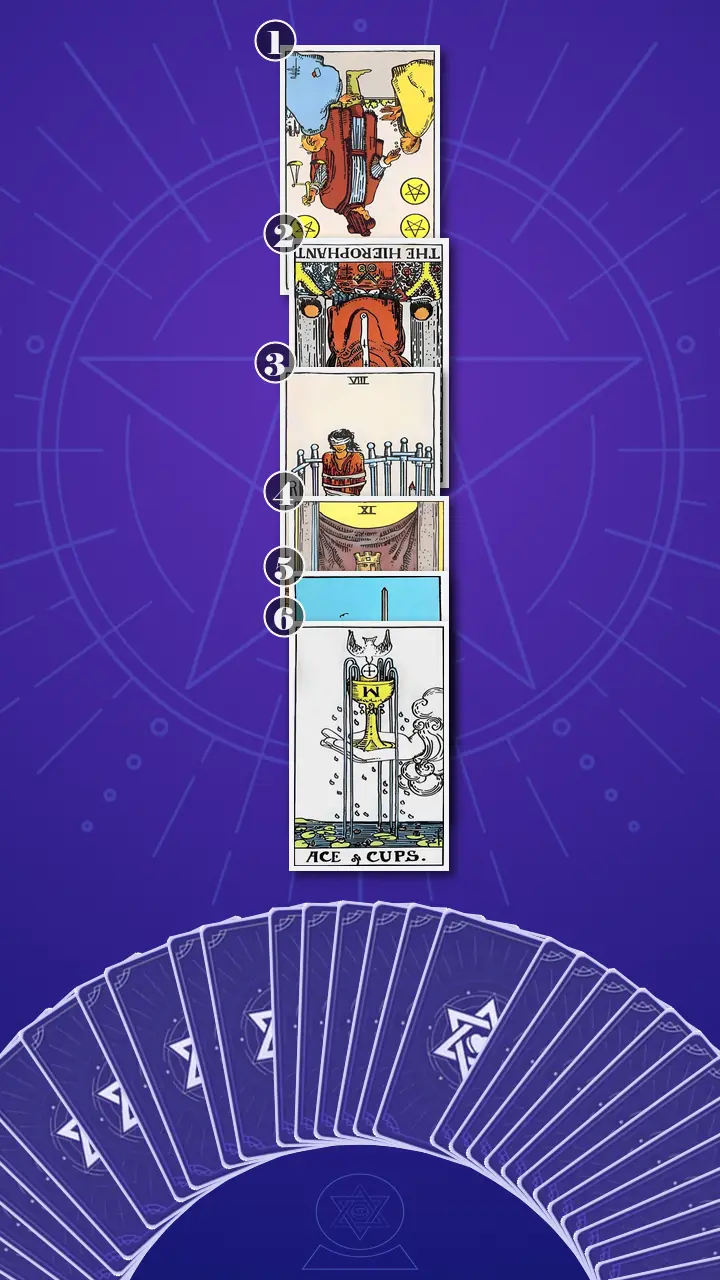
Reading the Ladder: How Tarot Works When Gifts Trigger Anxiety
Position 1 — Surface reaction: what ‘gifts’ register as in your body
“Now we open the card that represents Surface reaction: how ‘gifts’ currently register in your body and behavior—the immediate love-to-debt reflex.”
Six of Pentacles, reversed.
I tapped the image lightly, respectful of it the way I’m respectful of weather maps. “This is the ‘scales’ card. Upright, it can be generosity and flow. Reversed, it’s when receiving doesn’t feel free—when it feels loaded.”
I brought it straight into her world using the most modern translation of it: Someone gives you a generous gift and your first move isn’t enjoyment—it’s damage control. You over-thank, you soften your voice, you offer to bank transfer them back, and you start planning an ‘equal’ return gesture so the dynamic doesn’t tilt.
“This is blocked Earth energy,” I said. “The practical realm—money, favors, tangible gestures—gets distorted into a power audit. Your brain treats kindness like a tilted scale you have to correct immediately.”
Maya let out a tense little laugh, sharp at the edges. “Oh wow. That’s… horrible. And accurate.” Her fingers rubbed her thumb against her nail like she was trying to erase a number.
I softened my voice. “You’re not ungrateful—you’re trying to buy back autonomy. That’s a protective reflex, not a character flaw.”
Position 2 — Past script: the inherited rule that equates love with obligation
“Now we open the card that represents Past script: the inherited rule or conditioning that equates love with obligation.”
The Hierophant, reversed.
“This one can feel personal,” I warned gently, “but it’s often impersonal—a script you inherited.”
In modern terms, it looks like this: The gift activates an old ‘proper behaviour’ script: be grateful but not too happy, humble but not weird, appreciative but never needy. You don’t feel free to just receive; you feel like you must perform the correct response so you remain respectable.
“I call this the inner etiquette handbook,” I said. “It pops up mid-intimacy like an HR policy document: ‘Be easy. Be low-maintenance. Don’t be a burden.’ Reversed, it’s not guiding you—it’s policing you.”
And because my family taught healing by watching seasons—how things bloom when they’re allowed, how they close when they’re forced—I added, “In the Highlands, you can’t bully spring into arriving sooner. But you can create conditions where it’s safe for buds to open. This script does the opposite: it makes tenderness feel like an exam you must pass.”
Maya went still in a way that wasn’t numb—more like recognition landing. Her eyes flicked down, then back up. “It sounds like my old school head of year,” she said quietly. “Like… ‘Don’t get too big for your boots.’”
“Exactly,” I replied. “That voice might have kept you safe once. But in adult relationships, it can turn closeness into compliance.”
Position 3 — Trigger mechanism: the bind that activates right after receiving
“Now we open the card that represents Trigger mechanism: the internal bind that activates right after receiving—the thing that makes you feel like you have no choice.”
Eight of Swords, upright.
I described it the way it actually plays out: Right after receiving, your mind collapses into a two-option tunnel: repay immediately or be indebted forever. You smile on the outside, but inside you’re rehearsing future scenarios where they ask for something and you ‘can’t’ refuse.
“This is Air energy in excess,” I said. “Too many thoughts, too little oxygen. It’s the ‘terms & conditions’ feeling—like fine print auto-attached to the gift, even though you never saw the screen.”
I pointed to the loose ropes in the image. “Your body experiences this as real restriction—jaw tight, shoulders up, stomach drop. But the card quietly shows an exit: the ropes are loose. The blindfold can come off. Options exist besides ‘repay now’ or ‘be trapped.’ You can ask. You can pace. You can say no later.”
Maya nodded once, hard. “That’s the exact tunnel. It’s like—if I don’t fix it immediately, I’m signing up for future requests.”
“And here’s the psychological mechanics in plain English,” I added, because clarity loves structure: “Trigger: gift. Belief: ‘this means expectations.’ Coping: over-thank, over-explain, repay fast. Short-term relief: the pressure drops. Long-term cost: receiving stops feeling safe, and love starts feeling like negotiations. Then the belief gets reinforced.”
“Yeah,” she whispered. “That’s… exactly it.”
When Justice Held the Scales
Position 4 — Key transformation: the reframe that restores choice
When I turned the next card, the room felt quieter—not dramatic, just focused, like a kettle clicking off.
“Now we open the card that represents Key transformation: the reframe that breaks the debt narrative and restores choice.”
Justice, upright.
“This is the scales again,” I said, “but look closely: they’re not in someone else’s hand. They’re held by you.”
In the language of her life: Instead of assuming hidden expectations, you do a reality check: What did they actually ask for? Is this freely given? What do I genuinely want to reciprocate over time?
Justice is balanced Air: clear, adult, consent-based. Not cold. Clean.
Setup. I watched Maya’s face as she held the familiar panic in her body—the Tube moment, the lock-screen glow, the reflex to open Monzo like it was a fire alarm. She was still living inside the old logic: If I repay fast, I’m safe. If I don’t, I’m trapped. Her mind wanted certainty right now, tonight, before sleep.
Delivery.
Stop sentencing yourself to repayment; start choosing fairness with your own scales, and let the sword of clarity cut the imaginary strings.
I let the silence do what it does when a true sentence lands.
Reinforcement. Maya’s reaction came in a chain, not a single moment: first, a tiny freeze—her inhale caught, her fingers hovering mid-fidget like her body wasn’t sure whether to run or listen. Then her eyes unfocused, as if her brain replayed a dozen scenes at once: birthday dinners in Soho, the office kitchen fluorescent hum, the “no worries” coffee that still felt like a hook. Finally, her shoulders dropped, not all at once but in layers, like a coat sliding off a chair; she exhaled through her nose and her voice went smaller. “But if I stop doing that…” she said, a flash of anger underneath the fear, “doesn’t it mean I’ve been—making it all up?”
I nodded, steady. “It means you’ve been trying to stay safe with the tools you had. Justice doesn’t shame you for that. It just asks for evidence.”
This is where I used my own Relationship Pattern Recognition—my way of spotting emotional scripts the way you spot a chorus returning in a song. “Your pattern isn’t ‘I’m bad at receiving,’” I told her. “It’s: kindness arrives → your body drops → your mind writes a silent contract → you pay anxiety to stop talking. Justice says: pause, read the actual terms, and only sign what you consent to.”
I leaned in a fraction. “Now, with this new lens: can you think of one moment last week when you sentenced yourself without evidence? A moment when one question—‘What was actually asked of me, literally, in words?’—could have changed how you felt?”
Maya swallowed. Her eyes went glassy, not tearful yet—more like honest. “My friend bought me coffee,” she said. “She literally said, ‘Don’t worry about it.’ And I spent the whole morning… worrying about it.”
“That,” I said softly, “is you moving from guilt-driven tallying toward self-trust. From a tight mind to a clear voice—so your heart can open again.”
The Clean Text and the Open Cup
Position 5 — Practice: the boundary language that protects connection
“Now we open the card that represents Practice: the boundary or communication skill that makes the reframe real.”
Queen of Swords, upright.
I smiled, because this card doesn’t ask for a personality overhaul. It asks for a sentence.
Here’s the modern-life translation: You send a short message instead of a gratitude paragraph. You ask one clear question if you need to. You state a limit without over-apologizing. You don’t try to be perfect—you try to be clear.
“The Queen is where we stop writing silent contracts in our head,” I said. “And we replace them with one clean line. Remember: Clarity is not cruelty. It’s consent.”
Maya’s mouth twitched into something like relief. “So… no more Figma-iterating my thank-you message for forty minutes,” she said.
“Exactly,” I replied. “Two sentences. Max.”
Position 6 — Integration: what healthy receiving feels like
“Now we open the card that represents Integration: what healthy receiving feels like when the old script loosens.”
Ace of Cups, upright.
“This is Water,” I said, “and it’s the part of you that actually wanted to be moved by the gift.”
The modern scenario is simple and radical: You receive, say thank you, and you don’t immediately ‘do something’ to erase the discomfort. You let the warmth arrive in your body—maybe just a softened chest, a calmer breath.
“Let ‘thank you’ be a full stop, not a payment plan,” I told her. And I watched her try it on—her shoulders lowering as if her body remembered how to be held without bracing for the bill.
Next Steps for Gift Guilt: Consent-Based Reciprocity Over Time
I brought the whole ladder together for her in one story, because patterns change faster when they make sense. “Here’s what the cards showed,” I said. “The Six of Pentacles reversed is the love-as-ledger reflex—your nervous system reads gifts as power imbalance. The Hierophant reversed explains why it feels moral: an inner ‘proper’ rulebook says you must earn receiving. The Eight of Swords is the two-option tunnel: repay now or lose freedom. And then Justice arrives as the bridge—self-led fairness, evidence, consent. The Queen of Swords gives you language. The Ace of Cups is what becomes possible when you stop paying anxiety: actual warmth, over time.”
“Your blind spot,” I continued, “is that you’ve been treating assumptions as if they’re agreements. You’ve been acting like a gift is a contract you already signed.”
I paused, then said it plainly—the line I’ve watched change people’s shoulders in real time: “A gift isn’t a contract unless you sign it.”
Then I gave her a few small, practical next steps—things a tired London brain can actually do on a Tuesday night.
- The Justice Question (10 seconds)Before you repay, ask in your head: “What was actually asked of me—literally, in words?” If the answer is “nothing,” take one full breath before you do anything else.If your brain argues, don’t debate it—just write the question in Notes. You’re creating a pause, not winning a fight.
- The Two-Sentence Thanks ProtocolSend a Queen of Swords thank-you: (1) “Thank you—this is really kind.” (2) “It means a lot.” No disclaimers, no apology, no repayment plan.If you feel the urge to write an essay, set a 2-minute timer. When it ends, hit send or stop. Clarity beats perfect tone.
- The 24-Hour No-Repayment RuleFor one week, after any gift (even coffee), do a 24-hour pause: no bank transfer, no “return gesture” planning, no shopping for an equal gift.Expect discomfort. Treat it like data, not failure. If you break the rule, you didn’t fail—you learned where the trigger is strongest.
Because this was about relationships—not just self-management—I offered one more tool from my own practice, something I’ve used with couples and close friends who want to stay connected while they get honest.
“If you do need to clarify expectations with someone close,” I said, “use my couple breathing sync exercise first: sit facing them (or even side by side at the kitchen table), and take three slow breaths together. On the exhale, relax your jaw. It sounds small, but it moves you out of fight-or-flight and into conversation.”
“And choose the setting,” I added, using another of my strategies. “Important talks go better during a shared meal—not as an ambush, just as a warm container. Humans soften when they’re eating. You don’t have to make it a big ‘relationship meeting.’ You can say, ‘Hey, can I ask a quick clarity question about gifts?’”
She blinked, thinking. “I can do ‘quick clarity question,’” she said. “I can’t do… a dramatic scene.”
“Good,” I said. “We’re not doing dramatic. We’re doing clean.”

Ownership, Not Certainty
A week later, Maya messaged me. Not a paragraph—two lines, like a small miracle.
“Got a ‘just because’ gift from a friend. Did the 24-hour pause. Sent the two-sentence thank-you. Didn’t Venmo. Felt weird for like… 12 minutes. Then I went back to my evening.”
She added, almost as an afterthought: “Woke up the next morning and my first thought was still ‘what if I’m being rude?’ But I laughed a little. Like—oh, there’s the old script. Not driving today.”
That’s what a real Journey to Clarity looks like in relationships: not certainty, but ownership. Not never feeling the stomach drop, but not letting it hand you a receipt you have to pay immediately.
And if someone is kind to you and your first body reaction is a stomach drop—like you’re already holding a receipt and waiting for the bill—you’re not “dramatic,” you’re stuck between wanting love to feel simple and fearing it will cost you your autonomy.
If you didn’t have to ‘settle the ledger’ today, what’s one tiny way you’d let a kindness land—just for a moment—before you decide what reciprocity looks like over time?