From Texting Nervousness to Self-Trust: Sending the Human Version

The Typing Bubble Disappears on Line 1
If you’ve ever watched the typing bubble disappear and then reread your last text like it’s evidence in a trial, you already understand the specific kind of texting anxiety that doesn’t look dramatic—until it takes over your whole body.
When Alex booked a session with me, they were 27, Toronto-based, and tired in a way that didn’t come from sleep. They told me it hit hardest on the TTC—especially Line 1 heading north from Union—because there’s nowhere to put the feeling. You’re just standing there under buzzing fluorescent lights, tote bag strap digging into your shoulder, phone warm in your palm like a tiny radiator.
Alex showed me what they meant, right there in the intake notes: a friend texted, “you free this weekend?” Alex typed, “omg yes!! I’d love to—what were you thinking?” Then deleted the second exclamation point. Then swapped an emoji for a period. Then reread the whole thing three times. Their shoulders crept upward like they were bracing for impact, and their breath went quiet and shallow—like their lungs didn’t want to disturb anything.
“It’s just a text,” Alex said, and the way they said just sounded like someone trying to minimize a cut they could still feel. “But it feels like a personality test. I want to sound natural and connected… and then I’m terrified one imperfect line is going to get misread and change the whole vibe.”
I nodded, because I’ve heard this from so many people—on land and, oddly enough, at sea. “We can work with this,” I said. “Not by forcing you to stop caring, and not by diagnosing you as ‘too much.’ Today, let’s aim for something more useful: finding clarity about what the loop is protecting—and what your next small, real step is.”

Choosing the Compass: The Celtic Cross Spread for Texting Anxiety
I keep my sessions simple. No theatrical incense, no dramatic declarations. I asked Alex to take one slow inhale, a longer exhale, and hold the question in their mind: Why do I over-edit every text to friends—perfectionism or fear?
As they shuffled, I explained what I was doing in plain terms: “This isn’t about predicting what your friends will do. It’s about mapping the chain—behavior, blockage, root driver, and the most workable pivot. Tarot is good at pattern recognition, and patterns are where you get your agency back.”
For this, I chose the Celtic Cross. It’s my go-to when the surface problem is obvious but the engine underneath is tangled. Over-editing a text is the symptom. The fuel is usually something like uncertainty, attachment to approval, and an inner voice that mistakes control for safety. The Celtic Cross gives us that full internal-to-external route: present pattern → what blocks you → what’s really driving it → how it formed → what you’re trying to guarantee → what pivot is approaching → how you talk to yourself → what your environment actually offers → the hope/fear dynamic → the likely direction of growth.
“Think of it like this,” I added, slipping into the practical tone I used to teach on cruise ships when emotions ran high and social cues crossed languages. “If you only look at the final message you sent, you miss the weather system that formed it. This spread lets us read the weather.”
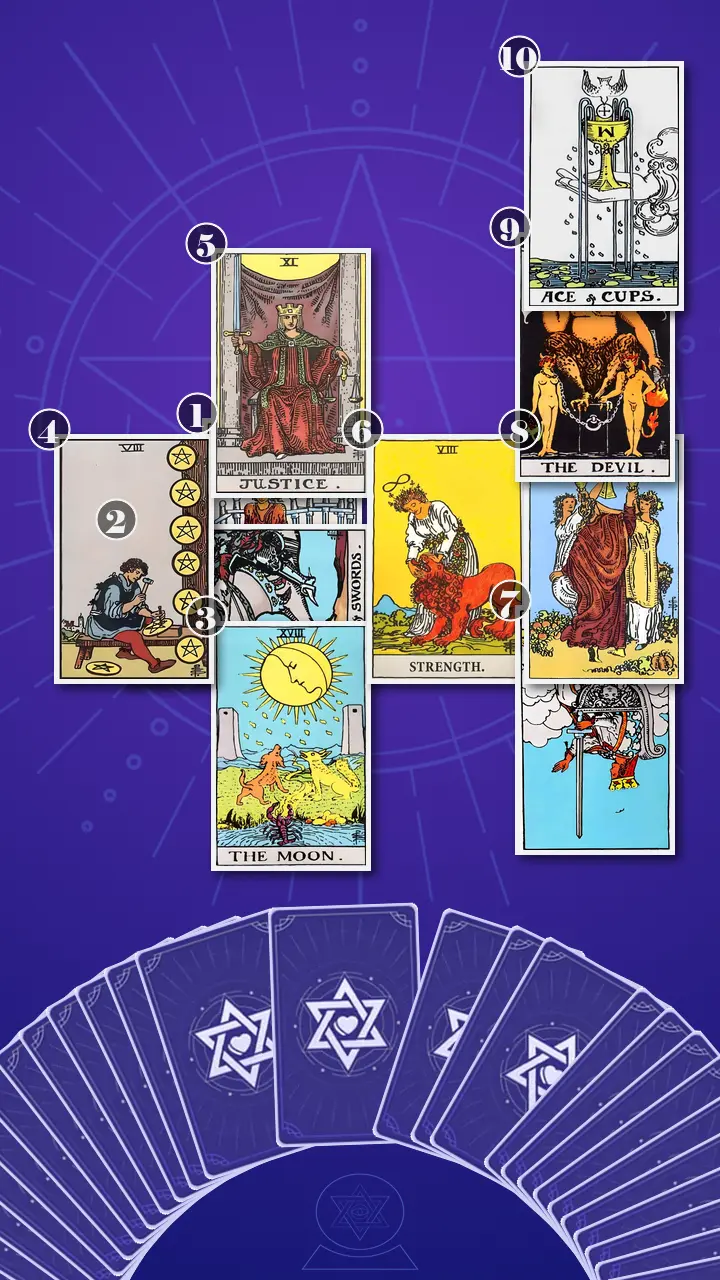
Reading the Map: The Inner Courtroom, the Fog, and the Air-Overload
Position 1: What the over-editing looks like right now — Eight of Swords (upright)
“Now we turn over the card that represents what the over-editing pattern looks like right now in real texting behavior and body-level tension,” I said.
The Eight of Swords, upright.
In the classic image, a figure is blindfolded and loosely bound, surrounded by swords like a narrow fence. The detail I always point out is the looseness: the ropes aren’t welded. The trap is persuasive, not permanent.
“This is exactly the feeling of staring at a draft and feeling boxed in by imagined reactions,” I told Alex, “even though a simpler, honest reply would be enough. It’s the ‘I can technically send this… but I don’t feel safe unless it’s scripted’ energy.”
I watched Alex’s jaw flex—tight, then tighter—like they were bracing for a tiny impact. “It’s Air energy at its most contracted,” I said. “Not ‘you’re bad at texting.’ More like: your nervous system treats a casual message like it could trap you in a bad impression.”
Alex let out a short laugh that had a bitter edge. “That’s… too accurate. Like, rude,” they said, and then they pressed their tongue against the inside of their cheek, like they were trying not to show how relieved they felt to be seen.
“I’ll take ‘rude’ if it’s also true,” I said gently. “No shame. The question is: what rule are you following when you edit? And who are you trying to protect yourself from disappointing?”
Position 2: What blocks a simple send — Knight of Swords (reversed)
“Now we turn over the card that represents what directly blocks a simple send: the immediate inner friction that keeps the draft looping,” I said.
Knight of Swords, reversed.
This is the mind’s speed—turned sideways. When it’s upright, it’s decisive. Reversed, it’s stop-start: urgency that doesn’t trust itself, so it slams the brakes.
I leaned in slightly, letting my voice match the quick, clipped rhythm of the card. “This is the loop,” I said, and I gave it to Alex the way it actually sounds in the body:
“Send. No—rewrite. Too eager. Too dry. That joke could sound passive-aggressive. What if they think I’m intense? What if they think I don’t care? Send. No—delete.”
“It’s like treating a DM the way you treat a Slack message that might get screenshotted and forwarded,” I added, “except this is a friend. And your thumb freezes like it’s waiting for a verdict.”
Alex gave a sharp nod—one of those tiny, involuntary acknowledgments you can’t fake. “Yeah,” they said quietly. “It’s fast. Like my brain generates five interpretations in ten seconds. And then I’m trying to edit until none of them can happen.”
“Exactly,” I said. “That’s not perfectionism as a personality trait. It’s mental speed plus low self-trust. The editing becomes a brake—not for clarity, but for containment.”
Position 3: The deeper driver beneath perfectionism — The Moon (upright)
“Now we turn over the card that represents the deeper driver beneath perfectionism: the uncertainty or fear the mind is trying to manage through editing,” I said.
The Moon, upright.
I’ve lived most of my life around water—Venice canals at home, then open ocean for years on transoceanic routes. The Moon always makes me think of night navigation: you can’t see the whole path, so the mind starts inventing monsters to explain the darkness.
“Your brain is trying to make tone into a solvable problem,” I told Alex. “But text is inherently foggy. Read receipts off. Delayed replies. The typing bubble appears, disappears. And the mind hates blanks.”
I used the contrast I’ve learned works best—fact versus story. “Here’s what you actually see: a friend replies ‘k’ with no emoji. Here’s what the Moon writes in your head: ‘They’re mad. I’m annoying. I said it wrong.’ And then you edit your next message to fix a problem you cannot confirm exists.”
I asked, softly but clearly: “What do you know for sure from the thread—and what are you imagining from past experiences?”
Alex’s shoulders dropped a fraction. Not relaxed—just less armored. They exhaled like they’d been holding their breath for a long time without noticing. “I… don’t know,” they admitted. “I’m guessing. But it feels so real when it’s happening.”
“That’s The Moon,” I said. “Fog feels like fact when you’re inside it.”
Position 4: How a useful skill became a default habit — Eight of Pentacles (upright)
“Now we turn over the card that represents how a useful skill—being careful with words—became a default habit in friendships,” I said.
Eight of Pentacles, upright.
The craftsman on this card is focused, diligent, improving one pentacle at a time. “This is the part of you that learned, honestly, that wording matters,” I said. “School. Work. A hybrid office culture where written tone is visible, searchable, and sometimes permanently screenshot-able.”
Alex made a face like, don’t call me out like that. “Slack has trained me,” they said. “Like adding exclamation points so I don’t sound cold, then panicking that I sound too much.”
“Exactly,” I said. “Your conscientiousness is real. But the Eight of Pentacles has a shadow when it leaks into the wrong room. Friendships aren’t deliverables. Connection matters more than polish.”
In my head, I flashed to a moment on a cruise ship years ago—two guests arguing because a short text in a group chat sounded ‘rude’ across languages. I’d taught staff one rule: when tone is ambiguous, lead with warmth and assume goodwill until proven otherwise. The work is in the relationship, not the sentence.
“This started as a strength,” I told Alex. “Then it became a reflex.”
Position 5: The conscious intention behind the edits — Justice (upright)
“Now we turn over the card that represents the conscious intention behind the edits: what you’re trying to guarantee with ‘perfect’ wording,” I said.
Justice, upright.
Justice is scales and sword—measurement and finality. “This is your inner courtroom,” I said, and I watched Alex’s eyes lock onto the image like they recognized it immediately. “Every phrase gets weighed. Every emoji gets cross-examined.”
“There’s something genuinely admirable here,” I added. “You want to be fair. You want your words to match your intentions. You don’t want to hurt people or be careless.”
Then I named the cost. “But Justice can turn texting into self-trial. The standard becomes not ‘clear and kind,’ but ‘unimpeachable.’ And friendships cannot run on unimpeachable.”
I tapped the table lightly—one small sound in the room, like a gavel. “Clarity edits build connection. Personality edits erase it.”
Alex swallowed, and I saw that tiny stomach-jolt they’d described rise into their chest—because that line touched the exact spot they’d been trying to avoid. “I think I’ve been doing… personality edits,” they said.
When Strength Spoke: A Gentle Hand on the Lion
Position 6 (Key Card): The next best pivot — Strength (upright)
“We’re turning over the card that represents the next best pivot: what quality to practice that loosens the loop without forcing outcomes,” I said, and I let the room get a little quieter on purpose. “This is the bridge card in your reading.”
Strength, upright.
On the card, a woman calmly rests her hand on a lion—not fighting it, not denying it, not trying to out-logic it. Just steady presence.
Setup—I reflected back Alex’s exact moment. “You’re on Line 1 heading home, thumb hovering over ‘send,’ jaw tight—because the message isn’t just a message, it’s suddenly proof you belong.”
Delivery—I said the sentence I wanted to land in their body, not just their mind:
Stop treating every text like a courtroom verdict and start treating it like a gentle hand on the lion: calm the impulse to control, then send the human version.
I stopped talking for a beat. The hum of my little space heater sounded suddenly louder, like the room had decided to listen too.
Reinforcement—Alex’s reaction came in layers. First, their breathing froze for half a second, as if their body didn’t know whether to accept the idea. Then their eyes unfocused—not glazed, just turned inward—like a memory rewound: the drafts, the deletions, the sudden shame after sending something “safe.” Then their mouth pressed into a line, and their chin trembled in a way that wasn’t tears exactly, but it was close to the place tears come from. Finally, their shoulders lowered, slowly, like two heavy bags being set down with care.
“But if I don’t control it,” Alex said, and their voice had that thin edge of protest, “what if I mess it up?”
“That’s the lion,” I said, warm and firm. “The heat in your face. The tight jaw. The held breath. Strength isn’t telling you to be fearless. It’s telling you to be steady while you send something that’s clear enough and human enough.”
This is where I brought in one of my core tools—what I call Social Role Switching. I learned it in the strangest classroom: international cruise ships, where you could watch someone change their whole communication style depending on whether they were talking to a guest, a supervisor, or a friend at crew dinner. “Alex,” I said, “your phone is pulling you into ‘Work Mode’—the mode where everything is permanent and judged. But your friend deserves ‘Friend Mode.’”
“So here’s the micro-courage script,” I continued, keeping it doable: “Set a 2-minute timer. Draft the text once. Do one clarity pass—typos, remove one extra sentence. Then add one tiny warmth cue: one emoji, or one ‘lol,’ or one human sentence like ‘That made me laugh’ or ‘I miss you.’ When the timer ends, you hit send. Then for ten minutes, phone face-down or switch apps so you’re not rereading. If your body spikes, three slow breaths—longer exhale.”
I leaned in and asked the question that turns insight into a lived experiment: “Now, with this new lens—when was the last time this could have helped? Last week, was there a moment where you were hovering over send and treating it like a verdict?”
Alex’s eyes flicked to the side, and I saw it: the scene replaying. “Saturday,” they said. “I wrote ‘Actually I’d love to see you’… and deleted it. Sent ‘Sounds good’ instead.”
“That,” I said softly, “is the exact hinge in your journey—from ‘I must control how I’m perceived’ to ‘I can communicate clearly and let relationships hold a little ambiguity.’ This is how you move from tense vigilance to warmer ease. Not all at once. In tiny brave sends.”
Position 7: Your inner stance while texting — Queen of Swords (reversed)
“Now we turn over the card that represents your inner stance while texting: the self-talk voice that edits, judges, and protects,” I said.
Queen of Swords, reversed.
“This is the red pen,” I told Alex. “Not your intelligence. Your sharpness turned inward.”
I described the moment exactly as it happens for them: “You write something sincere—‘Actually I’d love to see you.’ Then the inner voice appears like a pop-up: ‘Cringe.’ ‘Too much.’ ‘Don’t give them ammo.’ And your hand obeys. You delete the line that had your actual heartbeat in it.”
Alex winced, then gave a little laugh. “I literally call my own texts cringe,” they admitted. “Like I’m… policing myself.”
“That Queen is a protector,” I said. “She thinks she’s keeping you safe from embarrassment. But reversed, she can become self-erasure. And again: clarity edits build connection. Personality edits erase it.”
Position 8: What your friendships offer that you underuse — Three of Cups (upright)
“Now we turn over the card that represents what your friendships likely offer that you underuse: evidence of safety, warmth, and resilience,” I said.
Three of Cups, upright.
Three people raise cups together. It’s mutual goodwill. “This is important,” I said. “Because your nervous system is behaving as if you’re texting an audience. But this card says: these are friends. Not a panel of judges.”
I watched Alex’s expression soften—like their face was remembering something. “They’re not… mean,” they said. “They’re actually pretty supportive. I just… don’t feel it when I’m texting.”
“Because you’re alone with the draft,” I said. “The mind gets loud in isolation. This card is permission to lean on the fact that real friendships can hold a little awkwardness.”
Position 9: What you secretly hope will happen if you edit enough — The Devil (upright)
“Now we turn over the card that represents what you secretly hope will happen if you edit enough, and what you fear will happen if you don’t,” I said.
The Devil, upright.
I didn’t moralize it. I never do. The Devil isn’t “bad.” It’s attachment—especially the kind that promises relief.
“Here’s the montage,” I said, letting it play quickly because that’s how it feels: “Draft → sanitize → send → reread → interpret silence → draft again. Refresh the thread like package tracking: ‘Delivered… but what does that mean?’ Check read receipts like they’re an emotional stock price.”
Alex stared at the card for a long moment. “I hate how much I need it,” they said—meaning approval, certainty, the sense they’d done it right.
“Wanting to be liked is human,” I said. “Needing to be liked to feel safe is the chain. And the chain is loose—like the card shows. Your freedom starts the moment you notice the attachment while it’s happening.”
Position 10: Integration — Ace of Cups (upright)
“Now we turn over the card that represents what integration looks like if you practice the pivot: the healthier communication style you’re moving toward,” I said.
Ace of Cups, upright.
The cup overflows. Warmth returns. “This is the direction,” I told Alex. “Not oversharing. Not confessing everything. Just letting your messages carry a real human tone again.”
“Ace of Cups is what happens when you stop trying to make every message bulletproof,” I said, “and start letting it be alive. One feeling word. One sincere sentence. A text that sounds like you talk.”
Alex blinked slowly, and for the first time in the session their shoulders didn’t creep upward. “That sounds… nice,” they said, like they didn’t trust “nice” to be allowed.
From Overthinking Every Text to Actionable Next Steps
I gathered the whole spread into one story, the way I would for a traveler staring at a confusing port map: “Your present pattern is the Eight of Swords—self-censorship and body-level tension around sending. The Knight of Swords reversed is the immediate friction—mental speed that doesn’t trust itself, so it freezes you. Underneath, The Moon is the engine: ambiguity intolerance and projection. The habit formed honestly through the Eight of Pentacles—being careful with words became identity. Justice shows the conscious intention: you’re trying to guarantee fairness and avoid harm, but it turns into an inner courtroom. Strength is the pivot: embodied self-trust—calm the impulse to control and send the human version. And the outcome is the Ace of Cups: warmth and emotional honesty returning to your everyday communication.”
“Here’s the blind spot,” I said plainly: “You’ve been using workplace-level proof standards in friendship-level situations. You’re treating a casual text like it needs legal-grade precision, because you’re trying to earn belonging with perfect phrasing in a space where no message can control how it lands.”
Alex nodded, then hesitated. “But I don’t have time,” they said. “Like, I’m on the subway, my brain is fried, I’m exhausted. I can’t add another ‘practice’ to my life.”
I didn’t argue. I adjusted. “Good,” I said. “Then we make it smaller. Two minutes. One thread. Low stakes. This isn’t self-improvement homework. It’s nervous system training for decision fatigue—so you stop losing an hour to one text.”
Then I offered a few actionable, low-drama experiments—because tarot is only useful if it changes what happens after you close the session.
- The One-Pass Send (2-minute timer)Pick one low-stakes friend thread. Draft your reply once. Do exactly one clarity pass (fix typos + remove one unnecessary sentence). Hit send within 2 minutes—no extra polishing.If your brain screams “this will sound stupid,” treat that as The Moon fog. Make it smaller: start with a meme reply or a simple “haha true.”
- Warm Clarity Cue (add back one human signal)Right before you send, add one tiny warmth cue: one emoji OR one “lol” OR one short human sentence like “That made me laugh” / “I’m really glad you texted.” Send that version.Ask yourself: “Am I making this clearer—or just less like me?” If it’s a personality edit, undo it.
- The 10-Minute No-Reread RuleAfter you send, set a 10-minute timer. Put your phone face-down, or open a different app. Do not reopen the thread until the timer ends.If your jaw tightens, do three slow breaths (longer exhale). You’re teaching your body that “delivered” is not an emergency.
I framed it using my Maritime Social Protocol—a tactic I used to teach crew when misunderstandings happened fast and emotions traveled faster than language: “On a ship, you learn quickly that you cannot control how every sentence lands across cultures. What you can do is choose a clean message and a warm signal—and then let the relationship do its job. Friendship is the relationship doing its job.”
And because Alex’s inner critic was loud, I gave them a ready-to-use line they could steal verbatim: “Hey—yes, I’m free. I’d love to. What were you thinking?” Clear. Warm. Human. No courtroom.

A Week Later: The Quiet Proof of Finding Clarity
A week after our session, Alex sent me a message that made me smile—because it wasn’t polished, it was real.
“Did the 2-minute thing,” they wrote. “Texted: ‘Want to grab coffee this weekend? I miss you lol.’ Sent it. Put my phone face-down. I felt insane for like… two minutes. Then it passed.”
They added one more line: “They replied ‘omg yes’ and nothing exploded. I still woke up the next morning with a split-second ‘what if I sounded weird?’—but I didn’t spiral. I just… got up.”
That’s what I mean when I talk about a Journey to Clarity. It’s rarely cinematic. It’s usually a jaw unclenching. A thumb moving. A message sent before the inner courtroom convenes.
When a simple text makes your jaw clench and your thumb hover, it’s not because you’re “too much”—it’s because you’re trying to earn belonging with perfect phrasing in a space where no message can control how it lands.
If you didn’t have to manage how you’re perceived for one tiny moment, what would the “clear + human” version of your next text sound like?